The police inspected the coastal storage unit early on Monday morning. Helen Morris accompanied the investigating officer, along with a representative from the facility who confirmed that the account had been maintained under the name Clara Wynn. The unit was small and orderly, with cardboard boxes stacked against the walls and a metal cabinet secured by a separate lock.
Inside the cabinet, investigators found a leather case containing correspondence, photographs, and a notebook wrapped in a faded blue cloth. The notebook was marked with the same three initials that appeared in the original bank records. The police photographed everything before moving the items to a secure location for examination.
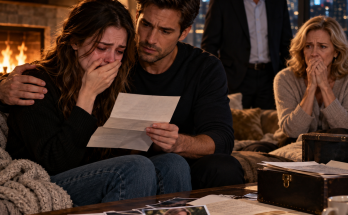
The most important discovery was an envelope addressed to Walter. It had been placed inside a sealed plastic sleeve, protected from moisture and dust. The handwriting belonged to Evelyn, according to the preliminary assessment, and the date was several years after her last known communication with the family.
The letter had never been mailed.
Helen read the first page before contacting us. She explained that the contents were personal and that the police needed to determine whether the letter was relevant to the missing-person investigation before sharing it more widely. She could, however, confirm that Evelyn had written about the trust, the property records, and a promise that she believed had been misunderstood.
Daniel asked whether the letter indicated that Evelyn was alive at the time it was written.
“Yes,” Helen said. “If the date and authorship are confirmed, it would establish that she was alive years after the period in which the family believed she had disappeared. But we need to authenticate the document and verify the date.”
That possibility left Daniel shaken. For years, he had imagined his aunt as a distant figure who had left the family and never returned. The letters had already shown that she had been trying to protect her son, but this new evidence suggested that she might have continued trying to communicate with Walter long after he had stopped speaking about her.
“Why would she write a letter and never send it?” he asked.
“Perhaps she changed her mind,” I said. “Perhaps she was afraid. Or perhaps she left it with someone who was supposed to deliver it later.”
We had no way to know which explanation was correct.
The notebook was examined next. Its entries recorded dates, payments, and references to meetings that had taken place between the late 1970s and the early 2000s. Some entries matched the financial transactions in the sealed deposit, while others referred to people who had never appeared in the official records.
One name appeared repeatedly: Thomas Reed.
The police had previously found that name in a visitor log connected to the archive. He had examined a sealed box several months before Walter disappeared, but investigators had not established why he had requested access or whether he had removed anything.
Helen asked the archive to preserve the visitor records and identify any documents Reed had requested. The institution confirmed that he had reviewed a collection related to the old property trust, but the request had been submitted under a professional research exemption. The archive was now reviewing the authorization to determine whether it had been valid.
Daniel wondered whether Thomas Reed could be the man who had met Walter at the bus station. The police had a photograph of the man in the dark coat, but the image was not clear enough to establish his identity. They were comparing it with the available records and would interview Reed if the evidence supported doing so.
Later that afternoon, Helen contacted us again. She had reviewed the opening pages of Evelyn’s letter and believed that it contained information relevant to Jonathan’s legal position. With Jonathan’s consent, she arranged for his solicitor to receive a certified copy.
Jonathan read the letter privately before calling us. When he spoke, his voice was controlled, but I could hear the strain beneath it.
“She says she wanted me to know her name,” he told us. “She says she never agreed that I should grow up believing she had abandoned me.”
Daniel closed his eyes.
“What else does she say?” he asked.
“She says the trust was meant to protect me until I could decide for myself. She says Walter promised to tell me the truth when the danger passed, but he never did.”
Jonathan paused.
“And she says she doesn't blame him for being afraid. She blames him for deciding that fear gave him the right to choose for everyone.”
The words echoed what Jonathan had already told us. He understood the danger Evelyn had faced, but he could not accept that protection should require the permanent loss of choice.
Daniel asked whether the letter contained an address or any indication of where Evelyn had gone. Jonathan said the final page referred to a place near the coast, but the name had been partly obscured by a fold in the paper. He did not want to speculate until the document had been examined properly.
He also asked whether Walter had ever received the letter.
Helen said there was no evidence that it had been delivered. The envelope was addressed to Walter, but it had been found among Clara Wynn’s belongings. It might have been intended for him and never sent, or it might have been retained by someone who planned to deliver it later.
Jonathan said he wanted to read the complete letter once the police had finished examining it. He did not ask Daniel to interpret his mother’s words, and Daniel did not try to explain them away.
That evening, the police contacted Thomas Reed through his solicitor. Reed agreed to attend an interview but denied knowing where Walter was. He said he had reviewed the archive materials because he had been hired to determine whether the trust could be challenged. He claimed that his client was interested in the property, not in the beneficiary’s identity.
The officer asked whether he had met Walter at the bus station.
Reed denied it.
He also denied having any connection to the anonymous messages or the visit to Miriam’s cottage. Investigators had not yet established whether his statements were truthful, but they were examining the records associated with his research contract.
The next morning, the police received a message from the coastal storage facility. The account associated with Clara Wynn had been accessed remotely several days before the inspection. The system recorded an attempted payment and a request to change the account’s contact details, but the transaction had failed.
The attempt had been made using an internet connection associated with a public building in Bellweather.
The officer asked us whether Walter had used that building recently. Daniel said his father occasionally visited the public library, which shared a network with several municipal offices, but there was no evidence that he had accessed the storage account.
Helen cautioned that the connection could have been coincidental. The building’s network served many users, and the record did not identify a specific device or individual.
Still, the attempted account change suggested that someone knew the storage unit existed and wanted to alter the information attached to it. The police requested the relevant access logs and began reviewing the facility’s security footage.
Meanwhile, the document specialist completed a preliminary examination of Evelyn’s letter. The handwriting was consistent with her known correspondence, and the paper appeared to match the period indicated by the date. The specialist could not yet establish exactly when the letter had been written, but there was no immediate indication that it was a recent forgery.
Helen shared the findings with Jonathan and his solicitor. Jonathan asked that the letter be preserved as part of the historical record, whether or not he eventually accepted the trust. He also requested that any public account of the case distinguish between what Evelyn had written and what other people believed she meant.
His request was reasonable. For decades, the family had relied on assumptions because the person at the center of the story had been absent. Now that her words had survived, we had a responsibility not to replace them with another convenient explanation.
Daniel began to see the importance of that distinction. He had spent much of the investigation searching for a single answer that would explain Walter’s silence. But Evelyn’s letter did not offer a simple verdict on her brother. It acknowledged his fear while refusing to excuse the decisions he had made.
“Maybe Dad was trying to keep his promise,” Daniel said that night. “Maybe he thought the danger never really passed.”
“And maybe he forgot that keeping someone safe isn't the same as giving them a life,” I replied.
He nodded slowly.
The following afternoon, Jonathan asked to meet with us once more. He had decided to authorize the legal review of the trust but would not yet accept the property. He wanted the records authenticated, the financial discrepancies investigated, and the identity of the person who had threatened Evelyn established as far as possible.
He also wanted to know whether the house could be used to preserve the family documents rather than sold or treated solely as an asset. His solicitor explained that this would depend on the trust’s terms and the outcome of the legal review, but the possibility could be considered.
Daniel agreed that the house should not be sold before the questions surrounding it were resolved. He no longer spoke of the property as something his father had stubbornly clung to. It had become a place where a promise had been preserved, though not always in a way that respected the people involved.
Before leaving, Jonathan asked whether he could visit the house one day. He wanted to see where Evelyn had grown up and understand why Walter had refused to sell it for so many years.
Daniel said yes, but he made clear that Jonathan could choose when and whether to come.
“I don't want the house to become another obligation,” Jonathan said.
“It won't,” Daniel replied. “Not if we can help it.”
That evening, the police called with the first result from the storage unit’s access logs. The attempted account change had been made from a device registered to a company that had previously contracted with Andrew Vale’s consulting business. The connection did not prove that Vale himself had accessed the account, but it established a link between the storage unit and the network of people who had been investigating the trust.
The officer said investigators would pursue the connection and determine whether the attempted change had been authorized by the account holder.
Daniel asked whether the police had located Walter.
“Not yet,” she replied. “But we have reason to believe that he knew about the storage unit and may have intended to retrieve the records.”
After the call, I went into Walter’s room. His brown hat was still on the dresser, and his shoes remained beside the bed. I had stopped moving his belongings because every time I tried, I felt as though I was erasing evidence of a life that had not yet been explained.
I picked up the hat and held it for a moment.
Walter had left our house without it, without his wallet, and without the coat he usually wore when the weather turned cold. Whatever he had planned, he had not prepared for an ordinary journey. Perhaps he had expected to return quickly. Perhaps someone had told him that he could not safely return at all.
When I placed the hat back on the dresser, I noticed a small folded paper tucked into the lining.
It contained three words in Walter’s handwriting.
“Ask Clara first.”
I called Daniel upstairs.
He read the note and looked at me with a mixture of hope and apprehension.
The letter, the storage unit, and the hidden record had brought us closer to Evelyn’s final days. But Walter’s note suggested that he had believed Clara Wynn could answer a question the documents could not.
Before we could act on it, the officer called again.
Investigators had located a current address associated with the name Clara Wynn.
The address was in the same coastal town where Walter had traveled.
And the person living there had recently requested information about the Hayes family.
Click here to continue reading: PART 24: The Search for Clara Wynn Led to a Meeting That Revealed Why Walter Had Disappeared and What He Still Needed to Put Right Before Coming Home
The Old Man Who Never Paid for Dinner Had One Secret That Could Change Everything My Family Believed About Him
Part 23 of 35