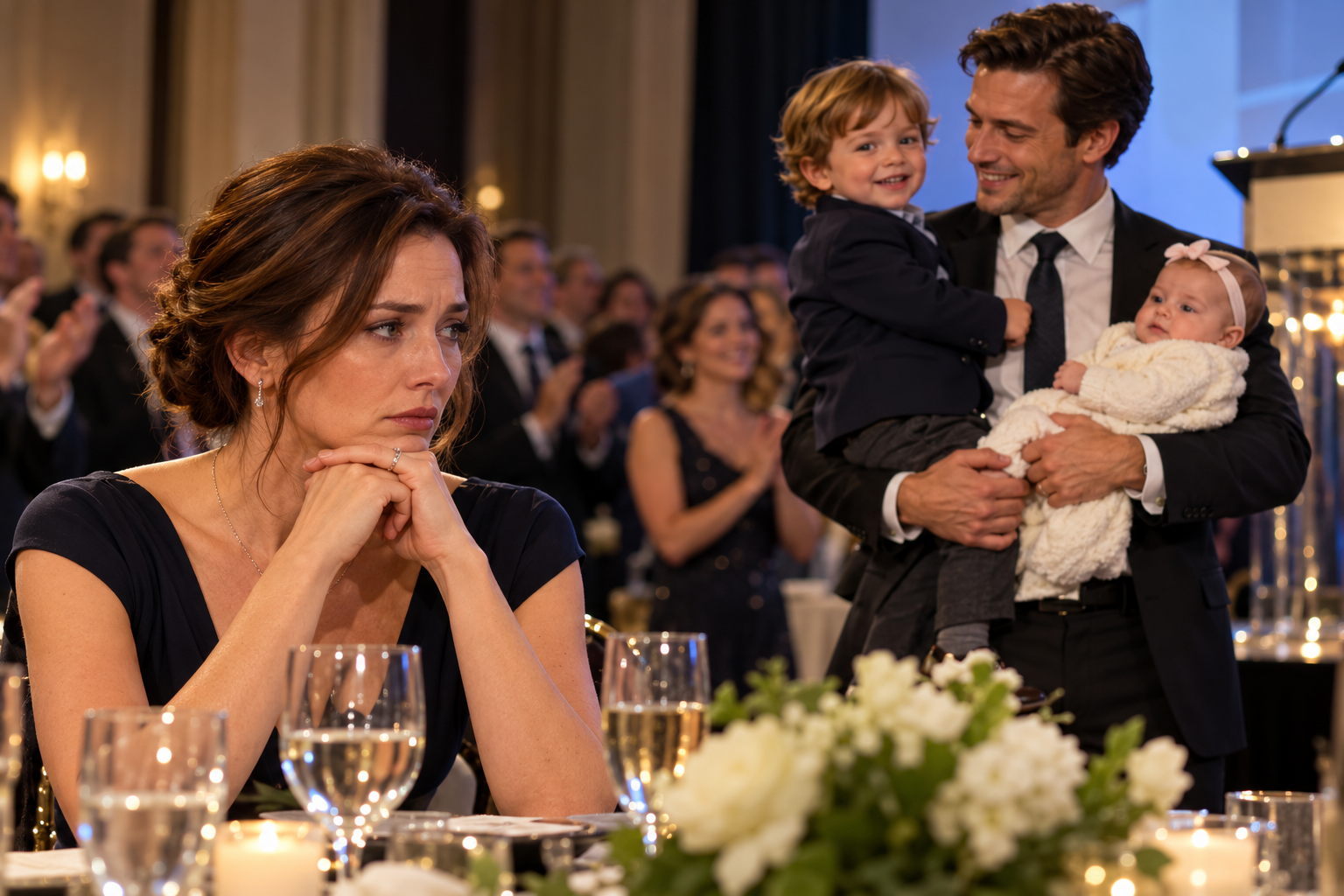
Martin kept his eyes on his hands.
The doctor waited a little longer.
I could hear the clock above the cabinet, each click separate from the next.
Martin finally cleared his throat.
"I understood there was a problem."
The doctor nodded.
"And what did you understand that problem to mean?"
Martin shifted in his chair.
"I thought there might be other explanations."
"There may be additional factors to consider," the doctor said. "But that doesn't make the findings disappear."
I watched Martin's fingers close around one another.
He had always been good at conversations in which he could control the subject.
He knew when to smile, when to pause, and when to make another person feel unreasonable for asking a difficult question.
This was different.
The doctor wasn't trying to win an argument.
He was asking Martin to acknowledge what the medical evidence showed.
And Martin had no easy way to make that question about me.
I wanted to feel sorry for him.
Part of me did.
I knew what it was like to sit in that room and hear that the future you had imagined might not be possible.
But I also remembered the first appointment.
I remembered the empty chair beside me.
I remembered driving home with the information written on an appointment card while Martin disappeared into the rest of his day.
My sympathy had limits now.
The doctor turned toward me.
He asked whether I understood the information that had been discussed.
I said I did.
He asked whether Martin and I had talked about it together after the first appointment.
I looked at my husband.
"No," I said. "Not properly."
Martin turned toward me.
I didn't look away.
The doctor explained that fertility was a sensitive subject for many couples, but avoiding it could make an already painful situation harder to manage.
He encouraged us to ask questions rather than make assumptions about one another.
I thought about the years I had spent doing exactly that.
I had assumed Martin was ashamed.
I had assumed he needed time.
I had assumed that if I stayed patient, he would eventually let me stand beside him.
Those assumptions had helped him keep me outside the truth.
The appointment continued.
The doctor explained what further evaluation might establish and what uncertainties remained.
He didn't promise a particular outcome.
He didn't suggest that one conversation could settle everything.
He simply made it clear that the medical problem was real and that we needed to face it honestly.
Martin listened.
He asked two questions, both brief.
Then he thanked the doctor.
The words sounded stiff.
When we left the room, I walked ahead of him down the corridor.
At reception, I stopped to collect the paperwork.
The receptionist handed me a few sheets and an appointment card.
I folded them together.
For a moment, I thought of the first card I had kept in my bedside drawer.
That small piece of paper had held the only evidence I trusted when Martin refused to speak.
Now there was another one.
I slipped it into my bag.
Martin was waiting by the entrance.
Outside, the sky was gray, and the parking lot was wet from an earlier shower.
He unlocked the car.
Neither of us spoke until we were on the road.
Then he said he hadn't expected the doctor to be so direct.
I looked at him.
"He asked you what you understood."
"I know what he asked."
"Then why were you surprised?"
Martin let out a breath.
"Because I didn't need to hear it like that."
I turned toward the window.
I understood the feeling.
I had spent five years avoiding the same truth because hearing it had made me feel as though something had been taken from me.
But I hadn't been the one who walked out of the room.
I hadn't been the one who decided the subject was closed.
"I didn't need to hear it that way either," I said.
He didn't answer.
When we arrived home, Martin went straight to his study.
I remained in the kitchen, taking the paperwork from my bag.
I laid the sheets on the counter and read them carefully.
There was nothing dramatic about them.
Medical terms.
Instructions.
Information about the next steps.
Still, I felt strangely relieved.
The truth had been written down by someone other than me.
I no longer had to rely on my memory of that first appointment.
I no longer had to wonder whether I had misunderstood the doctor.
I put the papers back into the envelope.
Then I sat at the kitchen table and waited for Martin to come out of his study.
I told myself I wasn't waiting for an apology.
I was waiting to see whether he would choose to speak without being forced.
An hour passed.
Then another.
I made dinner.
I set two plates on the table.
When Martin finally came downstairs, he had changed into a sweater and looked tired.
He sat across from me.
We ate quietly.
Halfway through the meal, he put down his fork.
"I didn't know how to deal with it."
I looked up.
He stared at his plate.
"When the doctor told us, I couldn't think about anything else."
I waited.
He said he had imagined being a father for as long as he could remember.
He had assumed it would happen when the time was right.
He had never considered that his body might prevent it.
I listened without interrupting.
For the first time, he was speaking about the appointment as something that had happened to him rather than something I had failed to understand.
He admitted that he had been embarrassed.
He said he hadn't wanted to answer questions from friends or family.
He didn't want people to look at him differently.
I believed him.
But believing him didn't mean I could excuse everything he had done.
"Why did you tell people the problem was me?" I asked.
He looked at me.
"I never meant to make you feel that way."
"That isn't what I asked."
He rubbed his thumb along the edge of his plate.
He said people expected a husband to be able to have children.
He said he couldn't bear the thought of explaining his medical situation to everyone.
He had found it easier to let people assume I was the reason.
Then he had kept repeating the explanation until it became the version everyone accepted.
I stared at him.
There it was.
Not a complicated misunderstanding.
Not a failure to communicate.
A choice.
He had protected his pride by allowing me to carry his shame.
I felt something inside me settle.
Not forgiveness.
Not yet.
Just clarity.
"Did you ever think about what that did to me?" I asked.
Martin looked down again.
"I thought you understood."
"I understood that you didn't want to talk about it."
I paused.
"I didn't understand that you wanted me to live as though it was my fault."
He didn't respond.
We finished dinner without speaking again.
Later, I returned the appointment papers to the drawer beside my bed.
I placed them beside the old card.
Two appointments.
Two versions of the same truth.
I closed the drawer.
For years, I had treated those papers as evidence that something had gone wrong in our marriage.
Now I understood that the medical problem wasn't the only thing that had changed our lives.
The other problem was what Martin had done with the truth.
And what I had allowed myself to accept.
Click here to continue reading: PART 6: I Thought Martin’s Honesty Might Bring Us Closer, Until I Understood That Admitting the Truth Was Not the Same as Making Things Right
The Night My Husband Presented Another Woman’s Children as His Own, I Finally Understood What My Silence Had Cost Me
Part 5 of 20