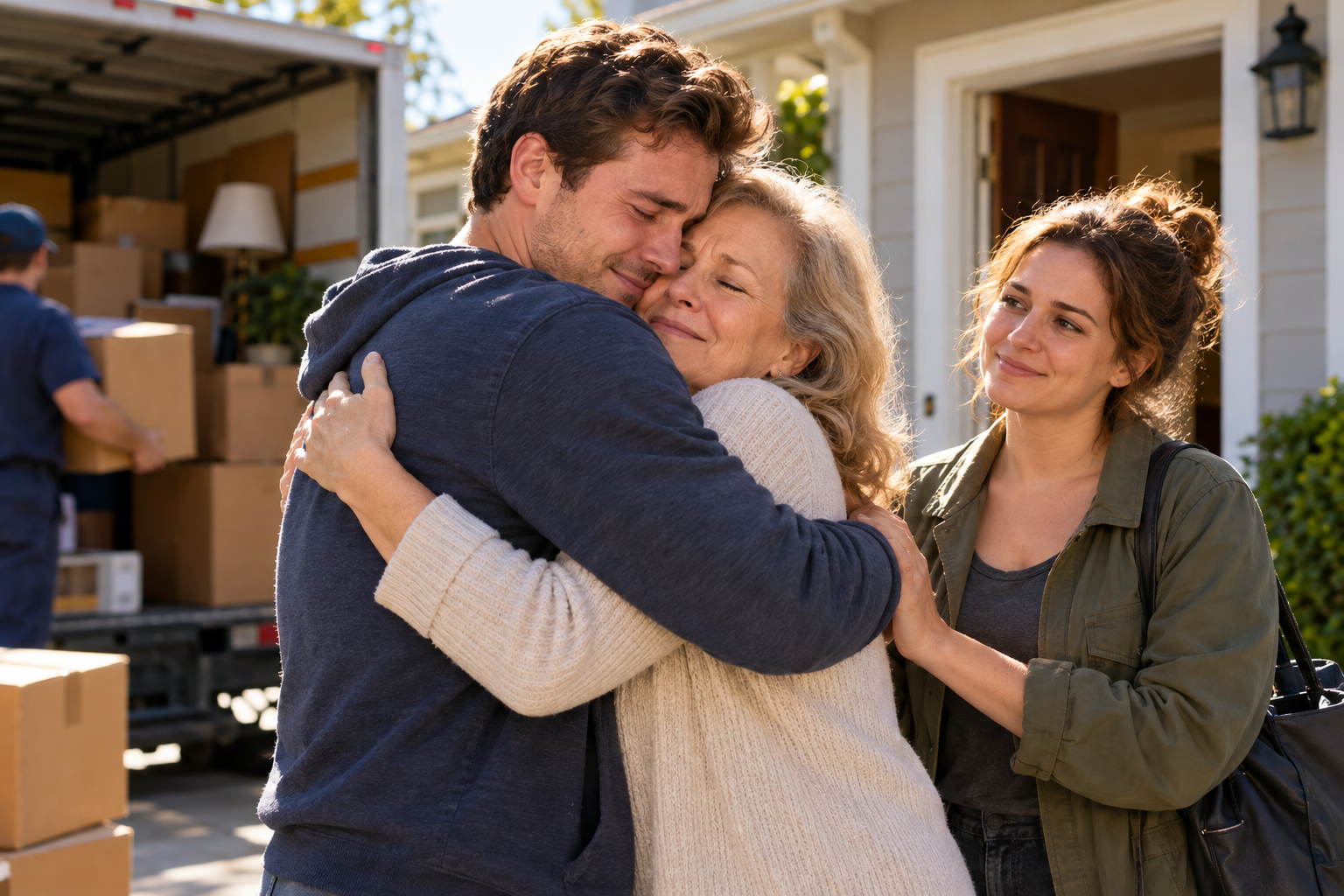
David called just after six.
I was sitting in the living room with a book open on my lap.
“Mom, we're here.”
I sat up.
“How did it go?”
“Mostly fine. The couch barely fit through the doorway.”
I laughed.
“Did you measure it?”
“We measured the living room. We forgot to measure the hallway.”
I could hear Sarah laughing in the background.
“What did you do?”
“We turned it sideways and took the legs off.”
“Then you figured it out.”
“Eventually.”
He sounded tired.
But beneath the tiredness, there was excitement.
“We're still unpacking the kitchen,” he said. “We don't know where anything should go.”
“That is part of having a new place.”
“I think we've opened every box except the one with the plates.”
“Did you label it?”
A pause followed.
Then he laughed.
“No.”
I laughed too.
“Then you have a mystery to solve.”
Sarah called something from the other room.
David answered her before returning to the phone.
“Anyway, I wanted you to know we got here safely.”
“I'm glad.”
“And I wanted to say thank you again.”
“You already thanked me.”
“I know. I just wanted to say it when we were actually here.”
I looked around my living room.
The lamp cast a warm circle across the table beside my chair.
A book rested on the arm of the sofa.
Everything was where I expected it to be.
“You're welcome, David.”
He was quiet for a moment.
“It's strange being here.”
“Strange how?”
“It's small. We have to figure everything out ourselves. And there's no extra room if we buy something we don't need.”
“Those are good things to learn.”
“I know.”
His voice softened.
“I think I understand now why you wanted us to have our own place.”
I did not rush to answer.
“What do you understand?”
“That you could love us and still need your own life.”
I closed my book.
“Yes,” I said. “That is exactly what I wanted you to understand.”
He let out a long breath.
“I wish I had understood it before we hurt you.”
“So do I.”
There was no point pretending the argument had not happened.
It had happened.
It had changed the way I understood our relationship, and I hoped it had changed the way he understood it too.
But it did not have to be the only thing we remembered.
“Have you eaten?” I asked.
“Not yet.”
“Then stop talking to your mother and find something to eat.”
He laughed.
“Yes, ma'am.”
“Don't call me ma'am.”
“Sorry, Mom.”
I could hear Sarah laughing again.
After we hung up, I sat quietly for a while.
I had worried that their departure would feel like an ending.
Instead, the phone call had reminded me that distance did not erase affection.
It gave us room to choose how we wanted to be together.
The next morning, I woke up without hearing footsteps in the guest room.
No cupboard doors opened downstairs.
No one asked whether I had seen a missing shoe.
I made coffee and sat at the kitchen table.
The old wooden table leaned slightly to one side.
I pushed it with my palm and listened to the familiar wobble.
Then I took a small piece of cardboard from the drawer and folded it beneath the leg again.
It was not a permanent repair.
It worked for now.
I thought about David and Sarah trying to arrange their own kitchen.
I wondered whether they had found the plates.
I did not call to check.
They could tell me when they were ready.
That was another small change I wanted to practice.
I did not need to monitor every detail of their lives to prove that I cared.
I could wait for them to ask.
I could let them learn.
And I could spend the morning doing things I had postponed while the house felt crowded.
I cleaned the kitchen windows.
I watered the flowers by the front steps.
I sorted a drawer full of old receipts and discarded the ones I no longer needed.
In the afternoon, I went to the grocery store and bought what I wanted for the week.
I bought fresh fruit, a loaf of bread, and a small bunch of flowers for the kitchen.
I did not have to plan meals around two other people's schedules.
I did not have to wonder whether I had enough food for unexpected guests.
I could still invite people to dinner.
I simply did not have to provide for everyone by default.
When I returned home, I put the flowers in a glass jar.
The kitchen looked brighter.
I stood back and smiled.
It was a small pleasure, but it belonged entirely to me.
On Monday, Sarah sent me a message.
She included a photograph of their kitchen.
The plates were finally in the cupboard.
The couch was against the wall.
A cardboard box sat in the middle of the floor, still unopened.
Her message read, “We found the plates. We are calling that a successful first day.”
I smiled and typed back, “That counts as progress.”
A few minutes later, she sent another message.
“Thank you for giving us the chance to figure things out.”
I read it twice.
Then I answered honestly.
“You are welcome. I am proud of you both for taking this step.”
I did not add that they could always come back if things went wrong.
I did not promise to pay their bills.
I did not offer to fill every gap in their new home.
Those offers might once have felt like love.
Now I understood that they could also make it harder for David and Sarah to build a life of their own.
I could be kind without taking over.
I could be generous without surrendering every boundary.
And I could say no without turning it into a punishment.
That evening, I changed the sheets in the guest room.
I opened the closet and removed the last empty hanger.
Then I put the spare key in the kitchen drawer beside the other household keys.
I did not need to keep checking whether the room was empty.
It was empty.
The fact was simple.
I closed the closet door and stood in the doorway for a moment.
I remembered Sarah standing in that same room, talking about taking my bedroom.
I remembered David refusing to meet my eyes.
For a while, I had wondered whether the argument had revealed something terrible about my son.
I no longer believed that was the whole truth.
It had revealed a pattern.
I had made myself available for so long that David had grown used to thinking my help would always be there.
He had made a selfish choice.
I had also made choices that allowed the pattern to continue.
That did not mean I deserved to be treated without consideration.
It meant I had a responsibility to stop agreeing to things that hurt me simply because refusing felt uncomfortable.
I had finally done that.
And David had begun to respond.
Neither of us had become perfect.
We had simply started doing something differently.
On Wednesday, he called to ask whether I wanted to come over for dinner the following weekend.
“Only if you have time,” he added. “We are still getting settled.”
“I would like that.”
“We're thinking of making pasta.”
“Can you cook pasta?”
“I can read the instructions.”
I laughed.
“Then you have a chance.”
He laughed too.
After we settled on a time, he asked whether I could bring the large serving bowl from the cupboard.
I considered it.
“Which bowl?”
“The white one you used when we had Sunday dinners.”
“I know the one.”
“Would you mind bringing it?”
“I can bring it for dinner,” I said. “But I want it back when I leave.”
There was a short pause.
Then he answered, “Of course.”
I smiled.
The bowl was not valuable.
It had no special history beyond years of ordinary meals.
But I liked the way it felt in my hands, and I wanted to keep it.
I no longer needed to give something away just because someone I loved wanted to use it.
That weekend, I carried the bowl to their apartment.
The place was modest, but it was clean and bright.
Their couch fit against the wall.
The kitchen table was smaller than mine.
Two chairs did not match, and one of the cupboard doors hung slightly crooked.
Sarah had placed a plant beside the window.
David was stirring sauce on the stove.
“We're glad you're here,” Sarah said.
I handed her the bowl.
“Where would you like this?”
She cleared a space on the counter.
We ate together at their small table.
The pasta was slightly overcooked, and the sauce needed more seasoning.
David apologized.
I told him it tasted fine.
We talked about work, the apartment, and the neighbor who had helped them carry a heavy shelf upstairs.
They had already learned that living independently did not mean doing everything alone.
It meant asking for help without assuming that someone else owed it to them.
After dinner, David washed the dishes while Sarah dried them.
I sat near the window and watched them move around their little kitchen.
They looked tired.
They also looked proud.
When I was ready to leave, I picked up the serving bowl.
Sarah wrapped the leftovers in a container for me.
David walked me to the door.
“Thank you for coming,” he said.
“Thank you for inviting me.”
He hesitated.
“I hope we can do this more often.”
“We can.”
He smiled.
“And I promise we won't ask for your bedroom.”
I laughed, and he laughed with me.
The joke did not erase what had happened.
It showed that we could remember it without being trapped inside it.
When I arrived home, I put the serving bowl away.
Then I went upstairs, changed into comfortable clothes, and sat beside the lamp.
My husband's photograph stood on the bedside table.
I looked at it for a long time.
“I think I finally understand,” I whispered.
I had spent years believing that being a good mother meant making sure my son never struggled.
But struggle was part of growing up.
And love was not measured by how much of myself I could give away.
It was measured by whether we could care for one another while still respecting the lives we each had to live.
I turned off the lamp and settled beneath the covers.
The house was quiet.
For the first time in months, I did not feel that I had to listen for someone else's needs before I could rest.
I was still a mother.
David was still my son.
Sarah was still part of our family.
But my home was mine, and my life belonged to me.
I had not lost them by keeping my bedroom.
I had given us a chance to find a healthier way to stay close.
And that was enough.
The End
Read more original stories on Feel Every Story.
My Son Had Three Days to Turn My Home Upside Down, and I Had Until Eleven to Decide What I Would Do
Part 20 of 20