
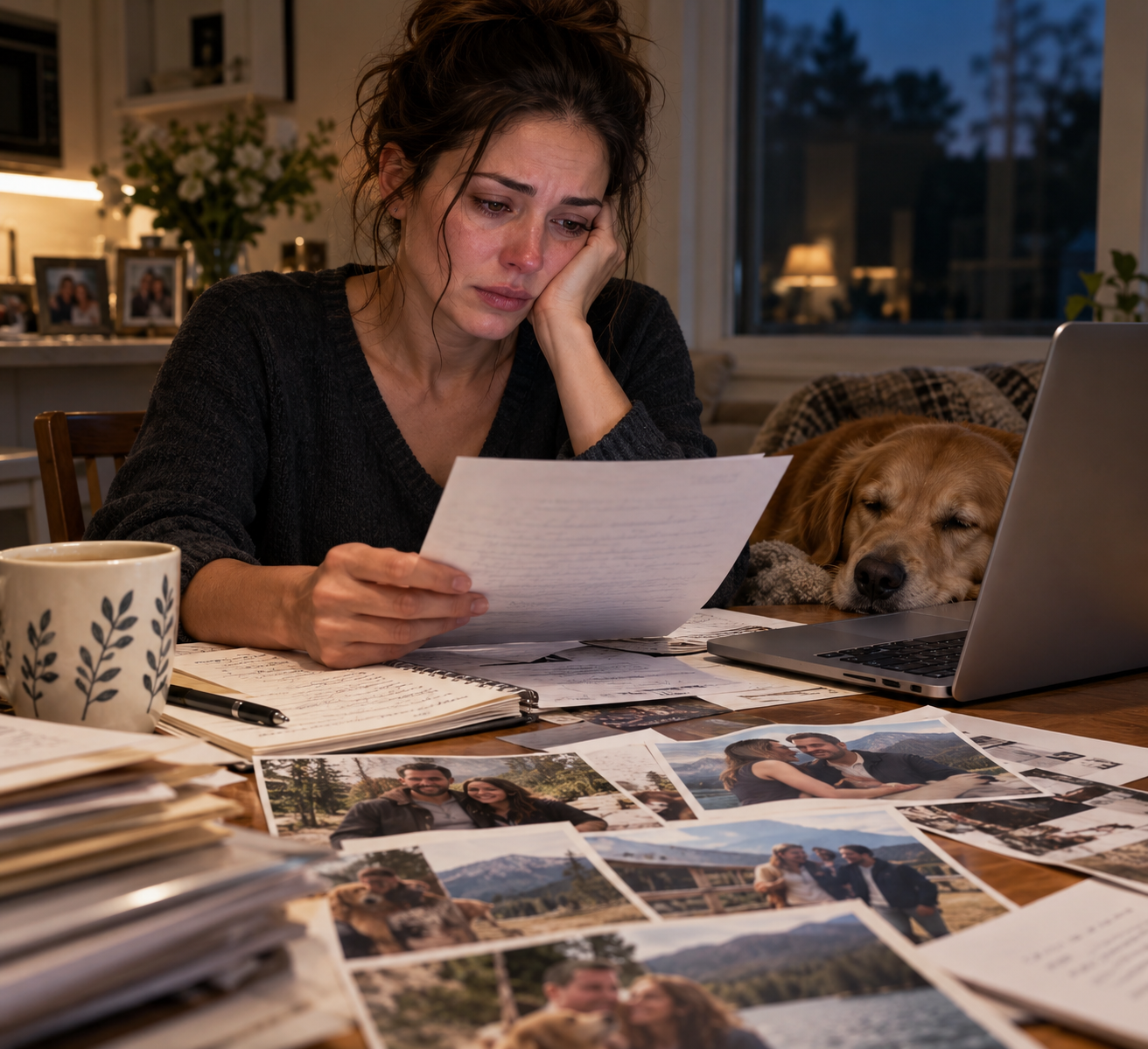
By the time the weather began to change, the photograph had become part of the kitchen.
It stood beside the sugar jar, near the place where the morning light reached the table.
The notebook stayed beside it.
Sometimes I opened the notebook and read a page.
Sometimes I closed it without reading anything.
I had stopped expecting the words to reveal a final truth about Jack.
They were notes, plans, jokes, and reminders.
They were the ordinary things a person wrote when he believed there would be more time to finish what he had started.
I no longer needed them to explain him.
They were enough as they were.
Daniel had begun inviting Theo over every few weeks.
Sometimes we ate dinner together.
Sometimes Theo came for tea and stayed only half an hour.
There was no schedule we had to follow.
We were learning that a relationship did not have to be made into a ceremony before it could matter.
One evening, Theo arrived with a small envelope.
"I had a copy made," he said.
Inside was a photograph of Jack and Theo standing outside a building I did not recognize.
Jack was laughing.
Theo had one hand raised to shield his eyes from the sun.
On the back, Theo had written the date and a few words about where they had been.
I looked at it for a long time.
"Would you like me to put this with the others?" I asked.
"If that's all right."
"Of course."
I placed it beside the frame on the table.
Daniel came into the kitchen and saw it.
"Another one?"
Theo nodded.
"Jack took it when we were leaving."
Daniel leaned closer.
"What were you doing there?"
Theo told him.
The story involved a long wait, a broken machine, and Jack insisting he could fix something that neither of them understood.
Daniel laughed.
"That sounds familiar."
We listened while Theo described the day.
I did not interrupt to ask what the photograph meant.
I did not need to know whether it was one of Jack's most important memories.
It had mattered enough for Theo to keep it.
Now it had a place in our house, too.
After Theo left, I carried the photograph to the living room.
I considered putting it in a drawer with the other pictures.
Instead, I brought it back to the kitchen.
The table had room for it.
That small decision surprised me.
For weeks, I had been thinking about what it meant to make room for Theo.
I had imagined it as a question of whether he belonged in our family.
But belonging was not always a fixed place someone either received or lost.
Sometimes it was a chair pulled closer.
Sometimes it was a photograph set beside another photograph.
Sometimes it was the willingness to hear a story without demanding that it answer a question.
The next morning, I found Daniel reading the notebook.
He was sitting at the kitchen table with his glasses low on his nose.
I made coffee and sat opposite him.
"Anything interesting?"
He turned the notebook toward me.
There was a short list on the page, written in Jack's handwriting.
Some items had been crossed out.
Others had small marks beside them.
Daniel tapped one of the lines.
"He wrote this twice."
I leaned forward.
The words were simple.
They were about making time for the people who mattered.
I read them again.
"They sound like him," I said.
Daniel closed the notebook gently.
"I wish I'd listened more."
I reached across the table.
"So do I."
He looked at me.
"But I don't think wishing is the same as changing."
"No," I said. "It isn't."
We sat together for a while.
Then Daniel got up to make breakfast.
I remained at the table, looking at the notebook.
The line about making time was not a message from beyond the grave.
It was not an instruction we had to obey perfectly.
It was something Jack had written while he was alive.
It belonged to the life he had been trying to live.
I could respect it without turning it into a rule that made every day feel like a test.
We were allowed to forget things.
We were allowed to become distracted.
We were allowed to make mistakes and try again.
The important part was not that we never failed to listen.
It was that we kept returning to the people in front of us.
A few days later, I went through the hall cupboard looking for a spare tablecloth.
At the back, beneath a stack of old towels, I found a box of photographs I had not opened in years.
Some were curled at the corners.
Others had faded so much that faces had become pale shapes.
I carried the box to the kitchen.
Daniel joined me, and we began sorting through them.
There were pictures of birthdays, holidays, school events, and family dinners.
Jack appeared in nearly every handful.
He was sometimes smiling.
Sometimes he was looking away.
In one picture, he was holding a cake that had tilted to one side.
In another, he was standing beside Daniel with his arms crossed, pretending to be annoyed.
I laughed at that one.
"He thought he looked very serious."
"He thought he was the only serious person in the family," Daniel said.
We found a picture of Jack as a child sitting on the kitchen floor.
His toys were scattered around him.
He was holding a wooden spoon like a microphone.
I remembered the day clearly.
He had been singing so loudly that I had asked him to stop.
Then I had gone into the next room and listened because I could not help smiling.
"I wish I'd kept more of these out," I said.
Daniel looked at the box.
"We can put some up."
"Not all of them."
"No. Just the ones we like."
We chose three.
One showed Jack with a crooked smile.
One showed him laughing at something outside the frame.
The third showed him sitting at the table with a plate of food in front of him, looking as if he had just been told to wait before eating.
We placed them on the shelf in the living room.
The photograph of Jack and Theo stayed on the kitchen table.
I did not feel the need to put them all in the same place.
Jack had belonged to our family.
He had also belonged to the friendships and moments that existed beyond our home.
Those truths did not compete.
That weekend, Theo came by to return a book Daniel had lent him.
He noticed the new photographs immediately.
"You found the old box."
"We did."
He picked up the picture of Jack holding the cake.
"What happened to that cake?"
"It fell over before we could cut it."
Theo smiled.
"Jack told me he was very good at baking."
"He was good at eating."
"That sounds more accurate."
We laughed.
Theo put the picture back on the shelf.
Then he stood quietly for a moment.
"I like seeing him here," he said.
"So do I."
He looked at the photograph on the kitchen table.
"And there."
I followed his gaze.
"There's room for both."
Theo nodded.
I meant it.
I was not saying it because I wanted him to feel welcome.
I was saying it because I had finally begun to believe it myself.
We sat in the kitchen and drank tea.
Theo told us about a place he had visited the previous week.
Daniel asked questions about the journey.
I listened while they talked.
At one point, Theo paused and looked at me.
"Do you ever feel like you're forgetting him?"
I considered the question.
"Yes."
The answer hurt, but it was true.
"Sometimes I can't remember exactly how his voice sounded when he was younger. Sometimes I know a story happened, but I can't remember all the details."
Theo looked down at his mug.
"I worry about that, too."
"I think that's part of why I keep the photographs out."
He nodded.
"But I don't want the photographs to become the only way we remember him."
I looked at him.
"What do you mean?"
"I don't want to feel as if I have to look at a picture every time I miss him. Sometimes I just want to remember something and let it be enough."
I understood.
For a while, I had treated the photographs as if they were fragile doors I had to keep open.
I had feared that if I put one away, I might lose the memory behind it.
But Jack had not lived inside the photographs.
He had lived in the world.
He had spoken, laughed, eaten, argued, listened, and walked through ordinary days.
I could remember him without proving the memory was still there.
"You're right," I said.
Theo smiled faintly.
"Jack would have told us not to make everything so complicated."
Daniel laughed.
"He would have said that after making it complicated himself."
We all laughed at that.
The sound faded naturally.
Nobody rushed to fill the quiet that followed.
I had once believed silence meant there was something left unsaid that needed to be discovered.
Now I knew silence could simply mean people were sitting together.
When Theo left, he put his mug in the sink.
Daniel walked him to the door.
I heard them exchange a few ordinary words about the weather and the road.
Then the door closed.
Daniel returned to the kitchen.
"Would you like more tea?"
"No, thank you."
He sat beside me.
We looked at the photographs.
"I think we should keep inviting him," Daniel said.
"We will."
"And if he wants to bring someone else who knew Jack?"
"Then we'll make more tea."
Daniel smiled.
"That sounds simple."
"It doesn't have to be difficult."
He looked at the photograph of Jack and Theo.
"I wish I'd understood that earlier."
"So do I."
I did not tell him that it was all right.
Some things were not all right.
Some words could not be unsaid, and some moments could not be given another chance.
But we were not trapped inside the worst moment of our lives.
We could choose what kind of people we wanted to be afterward.
We could make different choices next time.
We could stop asking other people to carry the weight of our fears.
And we could let love become something we practiced, not merely something we claimed to feel.
That evening, I stood at the kitchen sink and watched the light fade through the window.
The chipped mug sat on the shelf.
The notebook rested on the table.
The photographs stood where we had placed them.
I thought about the funeral and the bright red dress Theo had worn.
I remembered the way I had stared at him before I had even considered what the day meant to him.
I could not go back and meet his eyes differently.
I could not take away the embarrassment or the loneliness he might have felt when he walked into that room.
I could only admit what I had done.
I could listen when he spoke.
I could welcome him without requiring him to explain why he deserved to be there.
And I could remember that Jack had loved people in ways that were not mine to define.
The red dress had been part of Theo's goodbye.
It had not been a challenge for me to solve.
It had not been an accusation.
It had been what Theo chose to wear while mourning someone he loved.
I understood that now, though understanding did not erase the fact that I had been slow to see it.
When Daniel came to stand beside me, he followed my gaze toward the table.
"Do you think things will ever feel normal again?" he asked.
I thought about the question.
The house was still our house.
The table was still the table.
We still drank tea, argued about small things, and forgot to buy what we needed at the store.
But Jack was gone.
There was no version of normal that could return us to the life we had before.
"I don't know," I said. "Maybe we'll have to find a different kind of normal."
Daniel nodded.
He did not ask me to make the answer more comforting.
He put his arm around my shoulders.
We stood there until the room grew dim.
Then I turned on the light.
The photograph of Jack and Theo caught the glow from the ceiling.
Jack was smiling.
I could not know everything that smile had meant in that moment.
I did not need to.
I knew he had been alive when the picture was taken.
I knew he had shared that day with someone who remembered him.
I knew that person could come into our house and tell us about it.
And I knew that when Theo returned, there would be a chair for him.
Not because we had solved every question.
Not because we had finally learned everything about Jack.
Because grief had taught us that love did not become smaller when we made room for another person's memory.
I picked up the photograph and straightened it beside the sugar jar.
Then I left it there.
The next morning, the light would fall across the table again.
The kettle would boil.
Daniel would ask where I had put the coffee.
And somewhere in the middle of those ordinary things, we would remember Jack.
Sometimes we would speak his name.
Sometimes we would laugh.
Sometimes we would miss him so much that neither of us could find the right words.
We would not always get it right.
But we would keep listening.
We would keep the door open.
And we would let the people who had loved Jack sit with us, carrying their memories alongside our own.
The End
Read more original stories on Feel Every Story.
The Funeral Had Barely Begun When the Person I Trusted Least to Surprise Me Walked Through the Chapel Doors
Part 20 of 20

One Comment on “PART 20 – I Could Not Bring Jack Back, but I Could Leave the Door Open for the People Who Still Carried His Memory”