I woke up before the alarm I no longer needed.
For a few seconds, I forgot what had happened.
Then I looked toward the bedroom door and remembered the turkey in the refrigerator.
I remembered the red gift bag beside the kitchen table.
And I remembered Daniel's face.
Christmas morning.
I had always loved waking up on Christmas.
Even after Richard died, I tried to make the morning feel special.
I would put the kettle on, make myself a cup of tea, and turn on the little lights around the living room.
Sometimes I played Christmas music while I prepared breakfast.
Richard used to complain that I started the music too early.
He would say he needed coffee before he could appreciate anything festive.
Then he would hum along anyway.
That morning, I couldn't bring myself to turn on the radio.
I went downstairs in my slippers and stood in the kitchen.
The turkey was still in the refrigerator.
The red gift bag was exactly where I had left it.
Nothing had changed overnight.
Except me.
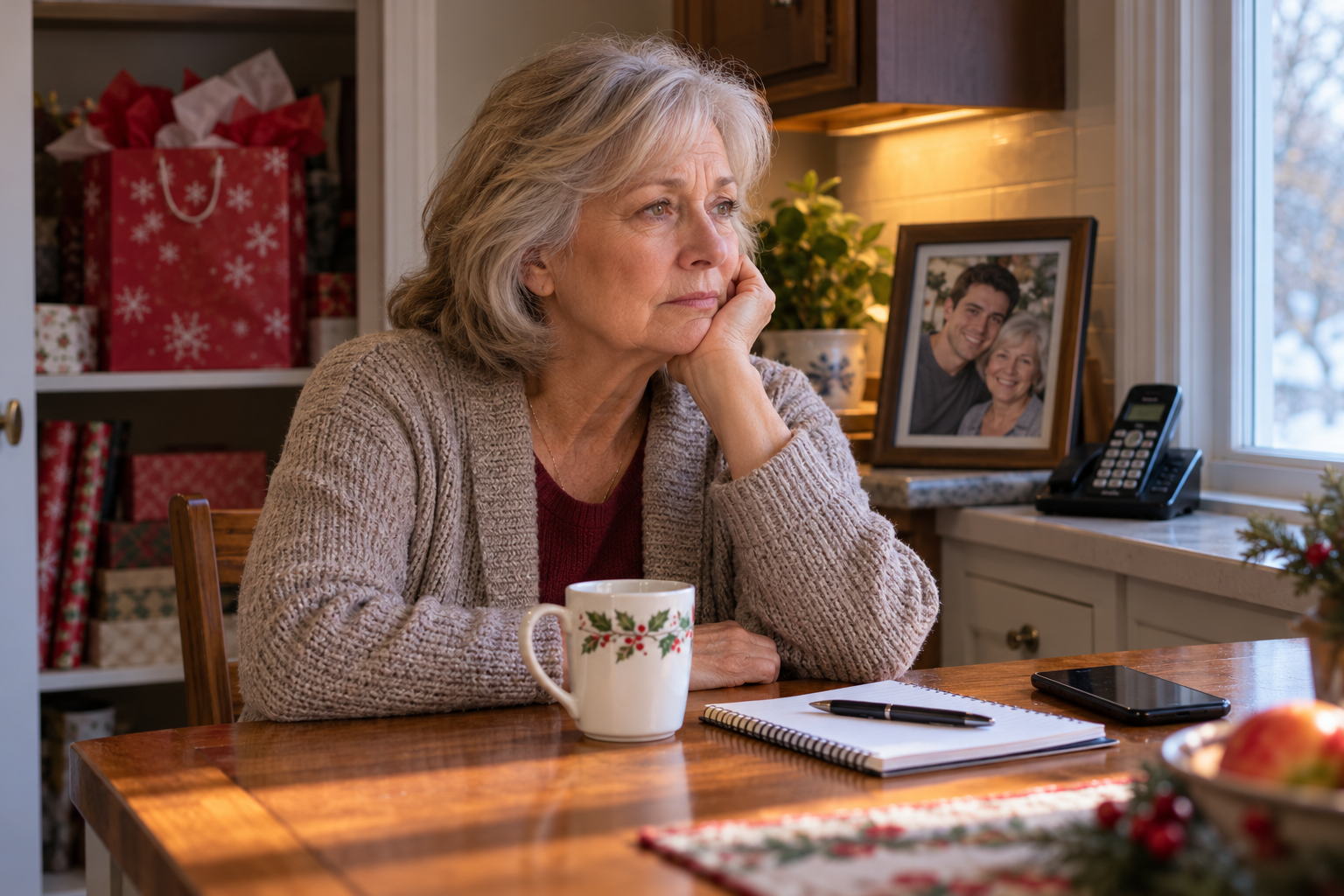
I made tea and sat at the kitchen table.
I kept thinking about the people inside Daniel's house.
I wondered whether they had noticed my absence.
Perhaps nobody had.
That was a possibility I didn't want to consider, but I couldn't avoid it.
I had spent so many years making sure Daniel's family had what they needed that I had assumed my presence would matter to them.
I had confused being useful with being wanted.
I didn't recognize the difference until I was sitting alone on Christmas morning.
I picked up my cup.
The tea had gone cold.
I poured it out and made another.
Then I took the red gift bag from the chair and placed it on the table in front of me.
I hadn't opened the bag the night before.
I didn't want to look at the presents because they reminded me of the children.
I loved those children.
I wanted them to have a happy Christmas.
I didn't want my hurt to become something they had to carry.
They hadn't closed the door on me.
Daniel had.
I repeated that to myself because it mattered.
I couldn't blame children for a decision their father had made.
Still, I wondered what they had been told.
Had Daniel said I was too busy to come?
Had he told them I wasn't feeling well?
Or had he explained that I had arrived and he had sent me away?
I didn't know.
I had no way to find out without contacting him, and I wasn't ready to hear his voice.
For the first time in a long time, I didn't feel responsible for making the next move.
That feeling frightened me.
I had always been the one to smooth things over.
If Daniel and I disagreed, I usually found a reason to call him a day or two later.
If he sounded upset, I tried to lighten the conversation.
If he needed something, I made myself available.
I had convinced myself that this was what kept a family close.
But perhaps I had been doing something else.
Perhaps I had been teaching him that no matter how he treated me, I would always return.
I looked at the telephone on the counter.
It was quiet.
I told myself that was a good thing.
I didn't want to hear excuses.
I didn't want to explain why his behavior had hurt me.
I didn't want to be told that I had misunderstood something I had seen with my own eyes.
I wanted a simple acknowledgment that what had happened was wrong.
And I wanted it without having to beg for it.
That seemed reasonable.
It also seemed unfamiliar.
I had spent so many years accepting less than I needed that asking for something different felt almost selfish.
I finished my tea and washed the cup.
Then I began putting away the Christmas things I had left out.
I straightened the small decorations on the mantel.
I folded a piece of wrapping paper that had been lying near the cupboard.
I moved slowly, stopping whenever my thoughts returned to the previous evening.
At one point, I opened the refrigerator and stared at the turkey.
I had prepared it for Daniel's family.
Now I had enough food for several days.
I considered taking some to a neighbor, but I didn't feel like getting dressed and going outside.
So I left it where it was.
I wasn't hungry.
By late morning, I had managed to make myself some toast.
I ate half of it and put the rest aside.
I kept thinking about Richard.
He would have hated seeing me sit there blaming myself.
He had never been a man who needed long explanations.
If someone behaved badly, he preferred to deal with the behavior rather than invent reasons to excuse it.
I could almost hear him asking why I was taking responsibility for something Daniel had chosen to do.
I didn't have an answer.
I only knew that blaming myself felt easier than admitting how little control I had over my son's feelings.
If I had done something wrong, I could apologize.
If I had arrived at the wrong time, I could try again another day.
If I had embarrassed him, I could make myself less noticeable.
But what if none of those things were the problem?
What if Daniel simply didn't want me there?
That possibility sat with me for the rest of the morning.
I tried to push it away.
I told myself that Christmas was stressful.
People sometimes behaved badly when they were overwhelmed.
Maybe he would call later.
Maybe he would apologize.
Maybe the whole thing would seem different after we had both slept.
I had spent a lifetime believing in second chances.
I wasn't ready to abandon that belief because of one terrible evening.
But I was beginning to understand that forgiveness and pretending were not the same thing.
I could forgive Daniel someday.
I could still love him.
I could still love his children.
None of that meant I had to pretend the previous night hadn't happened.
I sat at the kitchen table and looked at the red gift bag again.
Then I moved it away from the chair and placed it in the cupboard beneath the counter.
I wasn't throwing the presents away.
I wasn't making a decision about what would happen to them.
I simply couldn't look at them anymore.
After lunch, I tried to read.
I opened a book I had been enjoying before Christmas and read the same paragraph three times.
The words wouldn't stay in my mind.
Eventually, I closed it.
I walked into the living room and sat beside Richard's photograph.
I touched the edge of the frame.
"Your son hurt me," I whispered.
The words sounded strange in the empty room.
I had never spoken about Daniel that way before.
Even when he disappointed me, I found softer language.
He was busy.
He was tired.
He had a lot on his mind.
I had always tried to protect his image, even when he wasn't there to defend himself.
But I was tired of protecting him from the truth.
He had hurt me.
I didn't need to make that sound smaller.
I didn't need to pretend it hadn't mattered.
And I didn't need to decide that I was somehow less worthy of love because my own son had treated me badly.
I sat quietly for another few minutes.
Then I stood and went back to the kitchen.
The day was moving forward whether I was ready or not.
I made myself a sandwich.
I put the remaining food away.
I washed the dishes.
I did the ordinary things that had to be done.
But something had shifted.
For the first time, I began asking myself a question I should have asked years earlier.
If I stopped paying for things, stopped fixing problems, and stopped making myself available whenever Daniel needed help, what would remain between us?
I didn't like the question.
I didn't like what it suggested.
I also couldn't ignore it.
Fourteen years was a long time to support another person's household.
I had never kept a perfect record of every dollar I had contributed, and I wasn't interested in turning our relationship into a list of debts.
But I knew the help had been substantial.
I knew that my payments had made a difference.
And I knew I had continued making them because I wanted my son to be secure.
I had believed that helping him was one of the ways I could continue being a mother after he became an adult.
Now I wondered whether I had allowed that responsibility to become an excuse for him to take me for granted.
I didn't have enough answers to make any decisions that day.
But I knew I could no longer keep telling myself that everything between us was fine.
That evening, I ate a small portion of the turkey I had prepared.
I warmed it in a pan and sat at the table alone.
The food was good.
That almost made me sadder.
I had worked hard to make something nice for the people I loved, and it had ended up being a meal I ate by myself.
Afterward, I washed the plate and placed it in the cupboard.
Then I turned off the kitchen light.
Christmas was nearly over.
I had spent most of it alone.
And for the first time, I wasn't certain that being alone was the worst part.
Click here to continue reading: PART 6: I Had Always Been the One to Call First, but That Christmas I Left the Telephone Alone and Began Looking at Our Relationship Differently
I Thought Bringing Christmas Dinner to My Son Would Make Him Happy, Until I Saw the Look on His Face at the Door
Part 5 of 20