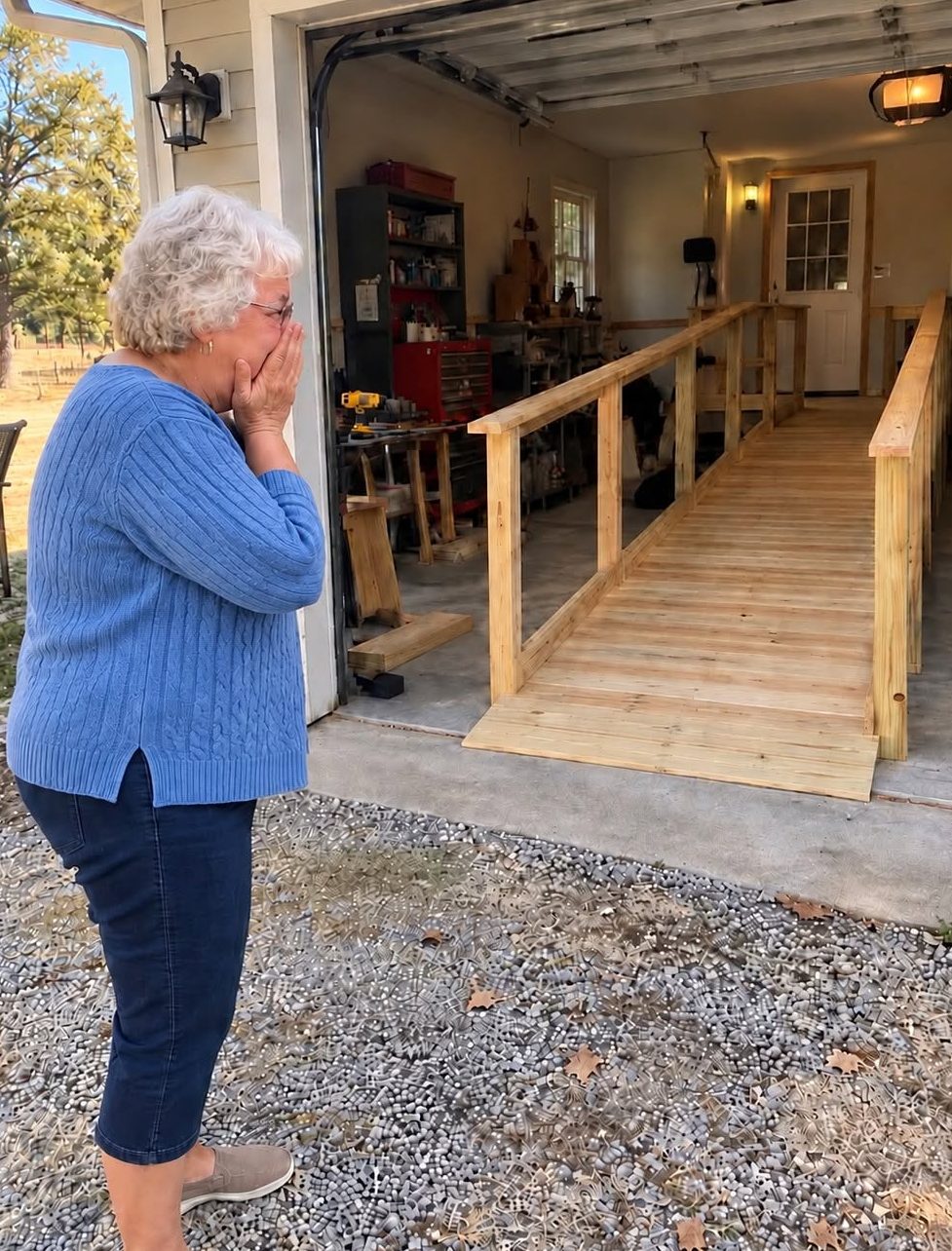
Part 2 – I Thought He Was Hiding Another Woman—Then I Saw the Ramp
I had taken three steps into the garage before Wendell realized I was there.
He was kneeling beside the unfinished ramp with a carpenter’s pencil tucked behind one ear and a cordless drill balanced against his thigh. The radio on the workbench was playing an old George Strait song beneath the shriek of a circular saw winding down somewhere behind him, and for a moment he stayed bent over the lumber as though the whole world consisted of pine boards, screws, and whatever measurement he had marked in blue pencil. Then he looked up.
The expression on his face made me stop.
Not guilt exactly. Not the startled panic of a man caught with another woman, either. I had seen guilt in emergency rooms plenty of times—husbands arriving with bruised wives, teenagers swearing they had only taken one pill, men who insisted the blood on their shirts belonged to somebody else. Wendell’s face held something different. His mouth opened, then closed, and his eyes moved from my good shoes to my blouse and finally to my face.
“Winnie,” he said quietly. “You weren’t supposed to see this yet.”
I folded my arms, partly because I was angry and partly because I suddenly did not know what to do with my hands. “That is not the first thing a woman wants to hear when she shows up unexpectedly at a man’s house.”
His eyes closed for half a second. “Lord. That came out wrong.”
“It certainly did.”
Wendell pushed himself upright, slower than he usually moved at my house. His right knee gave a small crack that I heard even over the radio. Sawdust clung to the front of his work shirt, and there was a smear of pale yellow paint along the side of his wrist, the same shade I had noticed more than once over Sunday supper.
He took one step toward me, stopped, and glanced at the ramp between us. “I can explain.”
“You have been saying that house wasn’t ready for visitors since June.”
“It wasn’t.”
“It has walls, Wendell.”
“That isn’t what I meant.”
“I know that now.” I pointed at the ramp. “What is this?”
He looked at it as though he might find a less dangerous answer written somewhere among the boards. The ramp rose gradually from the garage slab toward the interior door, broad enough for a wheelchair to turn comfortably at the landing. One handrail was finished on the left side. The other existed only in pieces: two upright posts had been secured, but the smooth top rail lay across sawhorses, freshly sanded.
Wendell wiped his palms on his jeans. “It’s a ramp.”
“I spent thirty-four years in an emergency room. I can identify a ramp.”
“That was a foolish answer.”
“It was.”
He gave a small nod, accepting the correction without trying to smile his way out of it. That was one of the things I had liked about him from the beginning. Dwight, God rest him, could argue with a stop sign if he believed he had technically rolled rather than run it. Wendell had a habit of becoming quieter when a situation became serious.
He bent, picked up the carpenter’s pencil from where it had fallen, and set it on the workbench. “Come inside.”
I did not move. “You have avoided bringing me inside for four months.”
“I know.”
“And now you want me to walk in because I caught you?”
His shoulders lowered. “No. I want you to walk in because standing in a garage while you imagine the worst is going to make this worse than it already is.”
“I have not told you what I’m imagining.”
“No.” He rubbed his thumb across a spot of dried glue on his palm. “But I know what a frightened person looks like.”
That irritated me because it was too close to the truth. “I am not frightened.”
Wendell met my eyes. “All right.”
That was all he said.
I looked away first.
The garage itself told a story I had not expected. There was no shiny new truck bought with some widow’s money, no boxes from expensive stores, no evidence of a secret life more glamorous than the one he showed me. Instead, one wall was lined with old hand tools whose wooden handles had been darkened by years of use. Sheets of plywood leaned against a freezer. A coffee mug sat beside an open package of galvanized screws, and next to it was a yellow legal pad covered in measurements.
I stepped closer despite myself.
At the top of the page he had written WINNIE in block letters.
Below it were numbers.
Doorway: 36 inches.
Rail: 34 inches.
Turn clearance.
Kitchen threshold.
Bedroom entry.
Shower support.
My stomach gave a peculiar tightening sensation.
“Wendell.”
He did not answer immediately.
I touched the paper with one finger. “Why is my name on this?”
His jaw worked once. “Because those measurements are for you.”
The country song ended. An advertisement for cattle feed came on, absurdly cheerful in the silence between us.
I stared at the list again. “For me to do what?”
“To get around.”
“I get around perfectly well.”
“I know you do.”
“Then why are you building a wheelchair ramp?”
He looked toward the open garage door, beyond me to the gravel driveway and my Buick parked beneath the pecan tree. Sunlight came through the branches in moving pieces, brightening the gray in his hair and the dust on his shoulders. When he turned back, there was no embarrassment left in his face. Only sadness.
“You remember that night you said you’d end up in a wheelchair like your mother?”
I gave a short laugh, but it sounded wrong even to me. “I was joking.”
“I know.”
“Apparently you didn’t.”
“No.” Wendell’s voice had gone low. “I didn’t.”
Something changed then. Not in the garage, but in him. His hands rested against the edge of the workbench, broad fingers spread as though he needed something solid beneath them.
“My wife started falling about a year before we knew how bad things were,” he said. “At first she blamed the rugs. Then her shoes. Then me for leaving things where she could trip over them, whether I had or not.”
I said nothing.
“She hated that I noticed.” His gaze stayed on the workbench. “Hated it. Every time I offered an arm, she thought I was telling her she was old. Every time I suggested we put a rail somewhere, she heard me saying she couldn’t manage her own house anymore.”
The sharpness in my chest softened, though I did not yet understand why.
Wendell continued, “By the time she agreed we ought to change anything, everything was hard. Bathroom. Front steps. Getting through that door there.” He pointed toward the entrance from the garage. “That opening used to be twenty-eight inches. A chair wouldn’t clear it. I took the frame apart after she died, but I couldn’t make myself finish the work.”
I looked at the doorway. Fresh lumber bordered one side, lighter than the older wall.
“You never told me that.”
“No.”
“Why?”
He finally looked at me. “Because you weren’t dating my grief, Winnie.”
That shut my mouth.
He drew a breath and let it out through his nose. “Then you sat at your kitchen table one evening rubbing your knee and made that joke. Everybody else laughed. You laughed. I went home and stared at that doorway for an hour.”
“Wendell.”
“I know what you’re going to say.”
“No, you don’t.”
“You’re going to say I’m getting ahead of myself.”
“I was going to say you should have talked to me.”
His face tightened. “You’re right.”
The quickness of his answer irritated me nearly as much as an argument would have. “Don’t agree with me just because you’re in trouble.”
“I’m agreeing because you’re right.”
“You still should have told me.”
“Yes.”
“Stop that.”
For the first time, a little humor touched his eyes. “Would you prefer I lie?”
I pointed a warning finger at him. “Do not get clever now. You are on very thin ice.”
“Yes, ma’am.”
“That was clever too.”
“I’ll hush.”
He did, which left me standing there with nothing to push against.
I turned toward the ramp again. Up close, I could see the pencil marks along the unfinished rail. One line crossed the wood near my hip level. Beside it, in Wendell’s square handwriting, were the words WINNIE HAND.
My throat tightened.
I ran my fingers along the sanded pine. It was smooth except for one rough patch near the end. “You measured me?”
His ears went slightly red.
“When?”
He cleared his throat. “Your porch.”
“My porch?”
“You hold the rail every time you step down when your right knee is acting up.”
“And you stood there measuring me?”
“Not with a tape measure.”
“That would have been difficult to explain.”
“Yes, ma’am.”
I turned to him. “How?”
He lifted one hand to demonstrate. “My hip is about here. Yours is about—”
“Never mind.”
“All right.”
I should have been furious. Part of me was. Another part wanted to sit down very suddenly.
I had spent two years after Dwight’s death learning how to exist in rooms that had been shaped around two people and now held one. The coffee maker sat where Dwight liked it. His old fishing hat still hung on a hook in the laundry room. I had not moved his recliner because moving it felt too much like admitting he would never return to ask why I had changed things.
Yet here was a man measuring a handrail because he had noticed which knee hurt when I stepped off my own porch.
“I want to see the house,” I said.
Wendell hesitated.
That hesitation brought my anger back immediately. “Do not tell me no.”
“I wasn’t going to.”
“You hesitated.”
“I was trying to decide whether to clean the worst room first.”
Despite myself, I smiled. “Too late.”
He picked up a rag from the workbench, wiped his hands, and switched off the radio. The sudden quiet made the garage feel larger. “Watch that threshold. I haven’t finished leveling it.”
“I thought this whole project was so I could manage your thresholds.”
“That one’s temporary.”
I stepped past him before he could offer his arm.
The first thing I noticed inside was the smell. Fresh lumber, joint compound, primer, and beneath all of it the faint scent of an older house—wood warmed by decades of Texas summers. Drop cloths covered part of the floor. A stack of trim boards rested against the wall, and two unopened cardboard boxes near the hallway were labeled with the picture of a stainless-steel grab bar.
I pointed.
Wendell sighed. “Bathroom.”
“I gathered that.”
“They aren’t installed.”
“I can see that too.”
“The wall needs blocking first.”
I glanced at him. “You are explaining construction to a woman who once watched a man remove a fishhook from his own ear with bolt cutters before checking into the emergency room.”
His mouth twitched. “Did it work?”
“No.”
“Good to know.”
We moved through the hallway. One doorway had been stripped down to studs on one side, widening the passage into what appeared to be a bedroom. A tape measure hung from a nail there. On the floor nearby sat a new lever-style door handle still in its package.
I stopped again.
“You changed the knobs.”
“Not yet.”
“You bought handles.”
“They’re easier on hands.”
“My hands work.”
“I know.”
“Wendell.”
He leaned against the wall. “Arthritis doesn’t usually send an engraved invitation.”
I stared at him.
He lifted both hands. “That sounded better in my head.”
“I hope so.”
The bedroom itself was mostly empty except for a bedframe against one wall and a chest of drawers that looked older than either of us. Nothing about it resembled a seduction chamber. There were no satin sheets, no rose petals, no ridiculous evidence of a man plotting to lure me into surrendering my virtue or Dwight’s insurance money. There was, however, an open electrical outlet box and enough construction dust to trigger every infection-control instinct I had ever possessed.
I sneezed.
Wendell immediately pulled a clean handkerchief from his pocket.
I took it. “You carry these?”
“My father carried one every day of his life.”
“That is the most sixty-six-year-old thing you have ever said.”
“I’m sixty-six.”
“Exactly.”
He waited while I wiped my nose, then gestured toward the end of the hall. “There’s one more thing.”
The kitchen doorway stood open.
Before I even stepped through it, I saw the yellow.
Not beige. Not cream. Not some modern shade a paint company had given a foolish name like Tuscan Morning or Harvest Whisper. It was bright, warm buttercup yellow, almost exactly the color of my mother’s kitchen when I was a child.
I stopped so abruptly that Wendell nearly walked into me.
Half the room had been painted. The finished wall glowed in the afternoon light pouring through the windows above the sink. The other half remained covered in primer, with painter’s tape lining the cabinets and baseboards. A paint roller rested in a tray on the floor.
I could see Mama standing at the old stove in our childhood house, flour on her forearms and sweat at her temples, telling us children not to slam the screen door. I could see myself at nine years old eating peaches over the sink because she said the juice would ruin my dress. The memory came so quickly and completely that for a moment I could smell cinnamon instead of paint.
“You remembered,” I whispered.
Wendell stayed behind me. “You talked about it more than once.”
“No, I didn’t.”
“You did.”
“When?”
“The first time was when Carla brought that lemon cake to group and said yellow kitchens made food look strange.”
I turned my head. “Carla says a great many things that should not be preserved.”
“That one stuck.”
“And the other time?”
“You were telling me about your mother making biscuits on Saturday mornings. You said the kitchen was buttercup yellow and she wouldn’t let your father repaint it because gray walls made her feel poor.”
The exact words hit me harder than the color.
I walked slowly to the painted wall and laid my palm against it. The surface was dry and slightly cool.
“Most people don’t remember things like that,” I said.
He was quiet for several seconds. “I remember things you say.”
There were dangerous sentences, and then there were simple sentences that became dangerous because a person meant them.
I faced him. “What were you planning to do, Wendell? Finish all this, bring me over here, and announce that you had redesigned your house for a woman you had been dating a few months?”
“When you put it like that, I sound touched in the head.”
“You sound presumptuous.”
“I was afraid of that.”
“You should have been.”
“Yes.”
I narrowed my eyes. “We have discussed your agreeing problem.”
He came farther into the kitchen and rested one hand on the back of a wooden chair. “I wasn’t planning to ask you to move in.”
My chest tightened again, though this time from embarrassment at realizing the possibility had crossed my mind.
He continued before I could speak. “I wasn’t planning to ask you to marry me either. Not now. Maybe not ever, if that wasn’t what you wanted.”
“Then what were you doing?”
“Making room.”
“For what?”
“For possibility.”
I stared at him.
He looked uncomfortable now, truly uncomfortable, as though wiring a live transformer would have been easier than explaining himself. “You have your house. Dwight is in that house everywhere you look, and I know that matters. My wife is here too, in ways I don’t always notice until I move something and feel guilty about it. I don’t want you giving up what belongs to you. I thought…” He rubbed the back of his neck. “I thought if we kept going the way we were going, maybe there’d come a day when you wanted to stay here two nights instead of driving back after supper. Maybe Christmas. Maybe if your knees were hurting. Maybe never. I wanted the house to be ready before I asked whether you wanted any part of it.”
The room seemed very still.
I looked around again. The widened doorway. Lever handles. Grab bars. The yellow walls.
“You built a wheelchair ramp for possibility?”
“I build things when I’m nervous.”
“That is an expensive nervous habit.”
“I could have taken up gambling.”
“Do not joke about money.”
The words came out sharper than I intended, because Zach’s voice had entered the room with me. Daddy’s insurance payout. Looking for money. Give him time.
Wendell heard something in my tone. He straightened.
“No,” I said, before he could ask. “Actually, we are going to talk about money.”
“All right.”
“How much has this cost?”
He considered the question, then gave me a number.
It was not small.
I felt the old suspicion rise immediately. “Where did it come from?”
“My checking account.”
“That answer is too easy.”
“My savings too.”
“What savings?”
His brow furrowed. “Mine.”
“You know exactly what I’m asking.”
He studied my face for a moment, and I watched understanding arrive. Not anger. Not offense. Something heavier.
“Your boy thinks I’m after your money.”
I hated hearing it said aloud.
“He thinks anyone in my position should be careful.”
“Does he?”
There was an edge in those two words that I had rarely heard from Wendell.
I folded my arms again. “He thinks you refusing to let me visit was suspicious.”
“It was suspicious.”
“That does not mean he is right.”
“No. It doesn’t.”
“You could sound a little more offended on your own behalf.”
“I don’t need to be offended to know what I’ve done.”
“And what have you done?”
Wendell turned without answering and walked toward a narrow built-in cabinet near the kitchen desk. He opened the bottom door, crouched, and pulled out a thick accordion folder. Dust marked the knees of his jeans when he stood again.
He placed the folder on the table between us.
“What is that?”
“Receipts.”
I did not touch it.
“For all this?”
“For all of it.” He opened the flap and began removing paper. Hardware store receipts. Lumber invoices. Plumbing supplies. Paint. Door hardware. A contractor’s estimate with several lines crossed out and handwritten notes beside them. “I kept everything because I wanted to know what I was spending.”
I picked up one receipt. His name appeared at the top. The last four digits of the payment card were printed below the total.
“You paid cash for some of this.”
“Yes.”
“Why?”
“Because I’m old and stubborn.”
“Where did the cash come from?”
He gave me a patient look. “My bank.”
“I am serious.”
“So am I.”
I set the receipt down. “Did you borrow against this house?”
“No.”
“Take out a new credit card?”
“No.”
“Ask anyone for money?”
“No.”
“Did you use anything that came from me?”
His eyes held mine. “Not one dollar.”
I believed him before I wanted to.
Maybe it was the steadiness of his answer. Maybe it was the receipts. Maybe it was simply that I had spent three decades watching people lie under fluorescent lights and had learned that truth did not always look noble, but it usually looked less busy than deception.
Still, Zach had planted something poisonous in me, and poison did not disappear just because you recognized the bottle.
Wendell gathered the papers into a neat stack but did not return them to the folder. “Take them.”
“What?”
“Take the receipts home.”
“I don’t need to.”
“You asked.”
“And you answered.”
“That isn’t the same as knowing.”
I looked at him.
His voice remained calm. “Check every number. Call the places I bought things from if you want. Look at the dates. Look at the card numbers. You don’t owe me trust because I painted a kitchen yellow.”
Something in my chest broke open then—not romantically, not neatly. It was embarrassment, relief, affection, and anger at my children, all tangled together.
“I came here expecting another woman,” I admitted.
Wendell blinked.
“I thought perhaps Zach was right. I thought I might knock on your door and find some poor lady in house shoes asking why I was looking for her husband.”
His mouth opened.
“Do not laugh.”
“I wasn’t.”
“You were considering it.”
“A little.”
I pointed toward the hallway. “Instead I find a man tearing his house apart because I made a joke about my knees.”
“That does sound worse.”
“It sounds insane.”
“That too.”
I wanted to laugh, but tears surprised me instead.
I turned away so quickly I nearly stepped into the paint tray.
Wendell did not come closer.
That mattered.
He stayed where he was while I pressed my fingers beneath my eyes, irritated by the heat in them. “I hate crying.”
“I know.”
“No, you don’t.”
“You’ve told me three times.”
I gave him a watery glare. “Of course you remember.”
“Yes, ma’am.”
I picked up his handkerchief again. “I have been lying awake wondering whether I have become stupid.”
The humor vanished from his face.
I continued because once the sentence was loose, the rest came after it. “Zach watches me like I’m about to hand my Social Security number to a stranger in a parking lot. Megan calls and uses that careful voice with me. That voice children use when they think their mother is becoming fragile but nobody wants to say the word fragile.”
Wendell’s fingers tightened around the chair back.
“I spent my whole life being the person everybody else called when they were frightened,” I said. “People handed me their babies. Their husbands. Their mothers. I made decisions while blood was running onto the floor. And now I date one man after my husband dies, and suddenly my own children act like loneliness has dissolved my brain.”
“You’re not stupid.”
“That is easy for you to say.”
“No.” His voice hardened. “It is easy for me to know.”
I looked at him.
He released the chair and leaned both hands against the table. “You came here because something didn’t add up. You didn’t accuse me. You looked. That isn’t stupidity.”
“I snooped.”
“You drove to an address I gave you.”
“Without warning.”
“I wish you had warned me.”
“Because the house wasn’t ready?”
“Because I would have swept.”
A laugh escaped me before I could stop it.
Wendell smiled, but only briefly. “I should have told you. I was trying to make something nice, and I turned it into something secret. Those aren’t always as different as people think.”
That sentence stayed with me.
I touched the folder of receipts again. “Why didn’t you simply ask what I wanted?”
“Because I was afraid you’d hear a question I wasn’t asking.”
“What question?”
He looked around the kitchen.
Move in with me.
Marry me.
Leave Dwight behind.
Choose my house over yours.
He did not have to say any of them.
I lowered myself into one of the kitchen chairs. My knee ached from standing on concrete and uneven flooring, a deep familiar throb under the kneecap. Wendell noticed, of course. His eyes dropped toward it, but he did not offer help.
“Good,” I said.
He frowned. “Good what?”
“You learned.”
“About what?”
“Not grabbing my elbow every time my knee hurts.”
His expression softened. “I’ve been practicing.”
“That must be difficult for you.”
“Excruciating.”
I looked at the yellow wall again. “This color is almost exactly right.”
“Almost?”
“Mama’s was a little warmer.”
His brows rose. “You are telling me that after two coats?”
“You wanted honesty.”
“I’ve made a terrible mistake.”
I smiled, then noticed a small framed photograph sitting facedown on the counter, covered with a clean cloth. “What is that?”
Wendell followed my gaze.
He went still.
I reached for it, then stopped. “May I?”
He nodded.
The photograph showed a woman about our age seated beside that same kitchen window. Her hair was short and silver, and she had one hand curled around a coffee mug. Behind her, the kitchen walls were pale green.
“Your wife?”
“Yes.”
“She was pretty.”
“She was.”
There was no awkwardness in his answer. No scrambling to reassure me that I was prettier, no foolish competition with a dead woman.
I set the photograph upright instead of returning it facedown.
Wendell watched me.
“You don’t have to hide her because I’m here,” I said.
“I wasn’t hiding her.”
“You put a cloth over her.”
“Paint splatter.”
I glanced at the wall, then at the picture.
“All right,” I said. “That is reasonable.”
He smiled.
I looked at the woman again. “What was her name?”
He told me, and grief moved across his face so quietly that I almost missed it.
I thought of Dwight’s recliner.
Maybe love after loss was not a matter of clearing a room. Maybe it was learning where to put another chair.
A vehicle roared somewhere outside.
At first I barely noticed. Trucks passed on the county road often enough, their engines rising and fading beyond the pecan trees. But this sound grew louder instead of disappearing. Gravel crackled sharply beneath tires.
Wendell’s head turned toward the garage.
“That somebody you’re expecting?” I asked.
“No.”
The engine revved once, hard, then cut off.
My skin prickled.
I knew that truck.
“No,” I whispered.
Wendell looked at me. “What?”
I was already pushing myself out of the chair.
“Winnie?”
“That is Zach’s truck.”
The kitchen seemed to tilt.
I moved into the hallway, ignoring the complaint from my knee. Wendell followed several paces behind me. Through the open garage I could see the front end of Zach’s dark pickup angled crookedly across the driveway behind my Buick, as if he had arrived too angry to park properly.
The driver’s door flew open.
Zach climbed out.
Even at a distance I could read my son’s body better than most mothers read handwriting. His shoulders were high. His jaw was set. He slammed the truck door with enough force to send a flock of birds scattering from the pecan tree.
My first feeling was not fear.
It was fury.
“How did he know I was here?”
Wendell did not answer.
He did not have to.
I remembered Zach sitting at my kitchen table with my phone in one hand and his own in the other. I remembered him setting up the banking app after Dwight died. Security alerts. Account recovery. Location services when he worried I might have trouble driving alone. I had let him handle those things because grief had made paperwork feel like a foreign language and because he was my son.
It’s just to protect you, Mama.
My mouth went dry.
Zach strode toward the garage.
“Mama!” he shouted before he reached us. “What in the hell are you doing out here?”
Wendell’s posture changed beside me, not aggressive but solid. He stepped slightly forward.
I put out one arm across him.
“No.”
He stopped.
“This is my son.”
“I know.”
“I will handle my son.”
Wendell looked at me for one second, then stepped back.
Zach entered the garage breathing hard. His eyes went first to me, scanning from my face to my clothes as though checking for injuries. Then he saw Wendell.
His expression sharpened.
“So it is true.”
I felt something cold settle inside me. “What is true?”
“You came out here.”
“That part should be obvious.”
“You weren’t answering your phone.”
“My phone is in my purse.”
“In your car.”
“Yes.”
“I called six times.”
“And I did not hear it.”
“You drive forty miles out into the country without telling anybody, leave your phone in the car, and you think that’s normal?”
“I have been driving without permission since 1978.”
“That isn’t what I said.”
“No, what you said was worse.”
Zach’s gaze shifted past me.
He finally saw the ramp.
I watched the meaning he gave it arrive instantly.
His face changed.
“Oh, you have got to be kidding me.”
“Zach,” I warned.
He walked past me before I could stop him, boots striking the garage floor. He stared up the length of the ramp toward the widened doorway, then at the unfinished second rail.
“What is this?”
Wendell answered evenly. “A ramp.”
Zach laughed once, without humor. “I can see that, old man.”
“Then we’ve established something.”
“Wendell,” I said.
He went quiet.
Zach turned on me. “Mama, do you see this?”
“I have eyes.”
“He’s building a damn wheelchair ramp.”
“Yes.”
“For you.”
I did not answer quickly enough.
Zach seized on the silence. “Jesus Christ.”
“Do not take the Lord’s name in vain in front of me.”
“Mama, are you listening to yourself?”
“I am listening to you shout in somebody else’s garage.”
“Somebody else?” His voice rose. “That is exactly my point. You don’t know this man.”
Wendell’s jaw tightened.
I stepped between them. “You will lower your voice.”
“I have been trying to protect you for months.”
“By following me?”
That stopped him.
Only for an instant.
Then he frowned. “What?”
“You knew exactly where I was.”
“You weren’t answering.”
“So you tracked me.”
“I checked because I was worried.”
“How?”
His gaze flickered.
That tiny movement bothered me more than shouting would have.
“Mama, this isn’t about that.”
“It is now.”
“We can talk about my phone later. Look around you.” He pointed toward the ramp. “This man has been planning something behind your back.”
Wendell spoke from behind me. “She knows what I’ve been doing.”
Zach spun toward him. “I wasn’t talking to you.”
“No,” Wendell replied. “You mostly seem to be talking at her.”
“Both of you stop.”
They did.
For one strange second, I almost laughed. Sixty-four years old, standing in a sawdust-covered garage between two grown men who had instantly obeyed the tone I used on intoxicated patients and junior residents.
Then Zach noticed the folder of receipts in my hand.
“What’s that?”
“None of your business.”
His eyes narrowed. “If it involves your money, it absolutely is my business.”
Something in me tightened.
“My money?”
“Yes.”
I studied his face.
He seemed not to hear what he had just said.
Wendell heard it. I knew because his gaze moved to me.
Zach pointed toward the house. “Has he asked you to sell your place?”
“No.”
“Put his name on anything?”
“No.”
“Change your will?”
“No.”
“Beneficiaries?”
“No.”
“Then what is all this?”
“He was renovating his house.”
“For you.”
“Yes.”
The answer hit him hard.
Zach stared at me. “You’re moving in with him?”
“No.”
“He asked you to?”
“No.”
“Then why build a ramp?”
“I have already had this conversation once today.”
“Apparently you need to have it again.”
My temper flared. “You do not get to speak to me that way.”
He dragged both hands over his face. “Mama, I am trying to get you to see what is happening.”
“I see more than you think.”
“No, you don’t. You see some sweet old widower remembering how you take your coffee, and you think that means he doesn’t have a plan.”
Wendell took a slow breath behind me.
I raised one hand without looking back. He remained silent.
Zach gestured toward the ramp again. “Men do not spend this kind of money without expecting something back.”
I looked down at the folder.
Receipts. Lumber. Paint. Hardware. Wendell’s own accounts.
My son saw the movement and misunderstood it.
“There,” he said. “You know I’m right.”
“No,” I replied. “I know you are frightened.”
His face hardened. “I’m frightened because you’re not being careful.”
“I came here to investigate something that bothered me. That sounds rather careful.”
“You came alone.”
“I am allowed to be alone.”
“You keep saying allowed like I’m controlling you.”
The word hung between us.
None of us moved.
Outside, wind stirred the pecan leaves. Somewhere down the road, a dog barked twice.
I looked at my son—the boy I had once sat beside all night when he had pneumonia, the teenager who had dented Dwight’s truck and confessed before breakfast, the man who had held my hand at his father’s funeral. I loved him so much that sometimes the love itself made it difficult to see where he ended and I began.
“How did you find me?” I asked again.
His mouth flattened.
“Mama.”
“How?”
“I checked the location on your phone account.”
“My phone is in the car.”
“The family locator updates from the last connection. I saw where you’d stopped.”
“You told me that was for emergencies.”
“This looked like one.”
“To you.”
“Yes, to me.”
The answer came without apology.
I felt Wendell shift behind me, but he stayed out of it.
Zach pointed toward the house. “I don’t care if you’re angry at me. Be angry. But then use that anger to think. He has widened doors. He has built a ramp. He is preparing his house for you before you’ve even agreed to live here. That isn’t romantic. That’s strategy.”
“You haven’t seen the rest.”
“I don’t need to.”
“The kitchen is yellow.”
He stared at me as though I had lost my mind.
“What?”
“Buttercup yellow,” I said. “Like Grandma’s.”
His expression flickered. He remembered the stories.
I continued, “He kept receipts for every dollar he spent. He has not asked me for money. He has not asked me to sell my house. He has not asked me to move here.”
“Yet.”
The word sliced through the air.
I drew myself straighter.
Zach looked at Wendell now. “That is the game, isn’t it? Make her feel special. Make her think you built all this because you care so damn much. Then eventually she’s here every night, her place is empty, and you start talking about how wasteful it is for an old woman to maintain two houses.”
“Zach,” I said.
But he was moving now, pacing along the edge of the ramp.
“And then what? She sells? Puts the money somewhere you can reach it? Changes her will because you’ve convinced her this is home?”
Wendell finally spoke. His voice was quiet enough that Zach had to stop moving to hear him.
“You don’t know me.”
“I know men.”
“No. You know what you’re afraid of.”
Zach stepped closer. “You want to talk about what I’m afraid of?”
“Not particularly.”
“I’m afraid my mother is going to wake up one day and realize she handed everything my father worked for to some man she met at a grief group.”
Wendell’s face went still.
That was the first moment I saw anger in him.
Not loud anger. Not Zach’s kind. Wendell’s anger seemed to settle deeper, making him more deliberate.
“Dwight’s work belongs to Winona,” he said. “Not to me. And not to you.”
Zach took another step.
I moved between them again.
“Enough.”
My voice cracked through the garage.
Zach stopped, chest rising and falling.
I looked at him. “You are going to get back in your truck.”
“Mama—”
“You are going to get back in your truck, and later, when I am ready, you and I are going to discuss why you believed you had the right to track me without asking.”
“I’m not leaving you here.”
The certainty in his voice stunned me.
Not I don’t want to leave you.
Not I’m worried.
I’m not leaving you here.
As though the decision were his.
My pulse thudded in my ears.
“Zachary.”
He must have heard something in my voice because his expression shifted. For a moment, my son looked almost young again.
Then his gaze dropped past me.
To the unfinished handrail.
The piece laid across the sawhorses still bore Wendell’s pencil mark.
WINNIE HAND.
Zach stared at it.
His face changed slowly.
The anger did not leave. It hardened into something colder.
He looked from the rail to the ramp, from the ramp to the widened doorway, and then at Wendell.
Finally, he turned to me.
“Mama,” he said, “you need to ask him what he plans to do with your house after you’re gone.”
Part 3 – The Man Who Was Watching My Money
For several seconds, nobody moved. Zach stood in the middle of Wendell’s garage, staring at that unfinished handrail as though the pencil marks on it had confessed to something terrible, while I tried to understand how a conversation about a ramp had become a conversation about my death.
“After I’m gone?” I repeated.
Zach finally looked at me. “That’s what you need to think about, Mama. You’re making decisions now that could affect everything you’ve worked for your entire life. What happens to your house if you move in with him? What happens to Daddy’s insurance money? What happens if you get sick and can’t make decisions for yourself?”
The questions came so quickly that I barely had time to consider one before he threw another at me. Behind him, the radio played a cheerful country song, and a fine layer of sawdust drifted across the concrete floor whenever the breeze slipped through the open garage door. I had spent thirty-four years in emergency rooms listening to frightened people talk themselves into believing the worst possible outcome was the only possible outcome. My son sounded exactly like them.
“Have you considered asking me what I want?” I said.
His mouth tightened. “Of course I have.”
“No, Zachary. Have you actually asked?”
He glanced at Wendell, apparently expecting him to interrupt or defend himself. Wendell remained beside the workbench, his hands resting loosely at his sides, and I noticed that he had positioned himself far enough away from me that I could leave without having to pass him. It was a small courtesy, but at that moment, it mattered more than he could have known.
“Mama, I’m trying to protect you,” Zach said, lowering his voice as though the problem had been his volume rather than his assumptions. “You’ve been alone since Daddy died. You meet a man at a grief group, and suddenly he’s building a ramp into his house and painting his kitchen the color you liked as a child. You don’t think that’s moving a little fast?”
I looked toward the unfinished kitchen doorway visible beyond the garage. From where I stood, I could see the yellow paint on a section of wall, bright and fresh beside the unpainted trim. I had told Wendell about that buttercup kitchen more than once, but I had never imagined he would remember it so precisely. The sight filled me with a tenderness I didn’t entirely trust, and I resented Zach for making me feel I had to defend that tenderness before I was allowed to enjoy it.
“He hasn’t asked me to move in,” I said.
“Not yet.”
“He hasn’t asked me to marry him.”
“Not yet.”
“He hasn’t asked me for a single dollar.”
Zach gave a short, humorless laugh. “Mama, do you think somebody who wants your money is going to come right out and ask for it? He’s preparing the ground. First, he makes himself indispensable. Then he convinces you that your own house is too much trouble, that you need help, that it would be easier to live with him. By the time you realize what’s happening, you’ve signed something you shouldn’t have signed.”
I felt the familiar tightening in my chest that came whenever one of my children used the word Mama as though it meant I had stopped being a person and become a responsibility. I had delivered difficult news to parents in hospital corridors. I had explained procedures to frightened patients who were old enough to be my grandparents. I had helped people understand that accepting assistance did not mean surrendering the right to decide what happened to their own bodies. Yet here I was, standing in a stranger’s garage, struggling to make my thirty-nine-year-old son understand the same principle.
“Have I signed anything?” I asked.
Zach hesitated. “Not that I know of.”
“Then perhaps you should stop accusing me of things I haven’t done.”
His expression hardened. “You really think I’m the enemy here?”
“I think you’re behaving as though I’m not allowed to make a mistake.”
“That’s because you don’t understand what’s at stake.”
Wendell moved then, not toward Zach but toward the workbench. He picked up a thick manila envelope that had been lying beneath a tape measure and placed it on a clean patch of wood between us. Several folded receipts protruded from the top, their edges softened from being handled repeatedly.
“Winona,” he said, “you should look through these.”
Zach turned toward him. “What are those?”
“Receipts.”
“For what?”
“The work I’ve done on the house.”
Wendell opened the envelope and began arranging the papers in small, orderly groups. There were receipts for lumber, hardware, door modifications, paint, and the materials for the ramp. A few were accompanied by handwritten notes in Wendell’s careful block lettering, recording measurements and the portions of each job he had completed himself. I recognized the name of the hardware store in Ferris and the paint supplier he had mentioned once over Sunday supper.
“I kept everything,” Wendell explained, looking at me rather than Zach. “I know this situation looks suspicious. I know what your son thinks. I don’t expect you to take my word for anything, Winnie, not when you can look at the figures yourself.”
Zach leaned over the workbench, his shoulders squared as he examined the papers. “Anybody can collect receipts.”
“Yes,” Wendell said. “That’s why you ought to read them.”
“And where did the money come from?”
“My pension and my savings.”
“You expect us to believe you’ve been paying for all this out of pocket?”
“I expect Winona to decide what she believes after she’s looked at the records.”
There was no challenge in Wendell’s voice, no attempt to win the argument by making Zach look foolish. That seemed to irritate my son more than a direct insult would have. Zach had arrived prepared for a confrontation, and Wendell was refusing to give him one.
I reached for the nearest receipt. The date was from several weeks earlier, and the amount matched the price handwritten beside a list of lumber dimensions. Beneath it lay another receipt for the yellow paint, with the color name and number written in the margin. I turned the paper over, half expecting to find something hidden on the back, then checked the next one.
There was nothing extraordinary about them. No mysterious payment, no suspicious withdrawal, no evidence of money changing hands between Wendell and me. They were ordinary records from ordinary purchases, and their very ordinariness made Zach’s certainty seem increasingly unreasonable.
“Did you pay for the materials yourself?” I asked.
“Every bit of them.”
“Even the ramp?”
“Every board.”
I ran my thumb along the edge of the envelope. “And the work inside the house?”
“Some things I’ve done myself. Some things cost more than I could manage alone, so I’ve had to spread them out. The doorway is taking longer than I expected.” He glanced toward the house, and for the first time that afternoon, I saw embarrassment cross his face. “I thought I could finish before Christmas. I may have been too ambitious.”
“Why didn’t you tell me?”
Wendell looked down at his hands. Fine yellow paint remained in the creases beside his fingernails, despite the scrubbing I knew he had done before coming to dinner the previous Sunday.
“Because I didn’t want you to feel obligated,” he said. “I wanted to ask whether you might like to spend more time at my place someday. Not move in tomorrow. Not give up your home. Just have somewhere we could be comfortable together, especially if your knees get worse. I wanted the house to be ready before I asked, so you could say yes or no without feeling you were being asked to accept a project.”
His words settled into the quiet garage, where the radio had moved on to a song about a man who had driven too far to turn back. I looked at the ramp again, at the broad boards and sturdy rails, and understood why Wendell had measured everything so carefully. He had not been building a way to get me out of my house. He had been building a way for me to enter his.
“I shouldn’t have joked about the wheelchair,” I murmured.
Wendell’s eyes lifted to mine. “You didn’t know.”
“I knew you didn’t find it funny.”
“My wife lost her mobility before she died,” he said. “There were things we could have changed in our house that would have made her life easier, but I kept thinking we had more time. By the time I understood what she needed, we were trying to solve everything at once.” He paused, pressing his palm against the workbench. “When you made that joke, I remembered how helpless she felt. I didn’t want you to have to feel that way if we could prevent it.”
For a moment, I could not find a response. I had spent so many months assuming that Wendell’s quietness meant there were things he refused to tell me. Now I wondered whether some of that silence had come from grief too familiar to explain easily. He had not been avoiding my questions because he was hiding another woman. He had been trying to spare me the uncomfortable feeling of being the reason somebody else had spent his money.
But being touched by his intentions did not mean I was ready to accept them without reservation.
“Wendell,” I said carefully, “you cannot build an entire future around what you imagine I might need without asking me first.”
“I know.”
“Do you?”
He nodded once, and I noticed that he did not immediately offer an excuse. “I thought I was making it easier for you to choose. I see how it could look like I was making the choice for you instead.”
That answer eased something in me. He had made a mistake, but he was willing to name it without insisting that his good intentions made it impossible to be a mistake.
Zach, however, was not finished.
“That’s a touching story,” he said, tapping the edge of the envelope. “But it doesn’t change the fact that he wants you living here. Look at the ramp. Look at the kitchen. He’s making this place into a home for you before you’ve even agreed to visit.”
Wendell gathered the receipts into a neat stack but did not put them away. “I hoped she would like it.”
“And once she likes it, what happens? She sells her house? Changes her will? Puts your name on the insurance policy?”
“Zach,” I warned.
“No, Mama. These are reasonable questions.”
“Then ask reasonable questions without treating him like a criminal.”
My son turned to me, and for a brief instant his face carried the injured disbelief of a little boy who had been told he could not have something he wanted. I remembered him at eight, sitting at the kitchen table with a scraped knee, furious because I had insisted on cleaning the wound before letting him go back outside. Back then, his anger had always been easier to understand because I could see the hurt beneath it. At thirty-nine, he had learned to disguise hurt as authority, and the disguise had become difficult to remove.
“I am the one who has to live with the consequences if this goes wrong,” he said.
“So am I.”
“You don’t understand what you’re risking.”
“My house is still mine. My accounts are still mine. My decisions are still mine.” I held his gaze, surprised by the steadiness of my own voice. “If I choose to spend an afternoon here, that does not mean I’ve handed Wendell my life.”
Zach opened his mouth, then shut it again. I could tell he was searching for a response that would restore the balance he expected between us. He had spent the last several months acting as though my trust in him had made him the appointed guardian of every choice I made, and he could not understand why I was suddenly questioning the arrangement.
Wendell stepped back from the workbench. “Winona, you don’t need to settle anything today. You don’t need to promise me anything. Take the receipts, if you want, and look them over at home. Ask whatever you like. If you decide you never want to come back here, I’ll be disappointed, but I’ll respect that.”
Zach gave him a sharp look. “And you’ll just let her walk away?”
“If she wants to walk away, yes.”
“Just like that?”
“She’s a grown woman.”
The words were plain, almost weary, but they struck me harder than any elaborate declaration of affection could have done. Wendell was offering me the right to refuse him, even after all the work he had done. Zach was insisting that he knew better than I did what my refusal, my acceptance, or even my curiosity ought to mean.
I picked up the envelope. It was heavier than I expected, full of the small, tangible evidence of a man’s time and money. “I’ll look at these,” I told Wendell. “And I will think about what you’ve said.”
He nodded. “That’s all I ask.”
Zach’s gaze followed the envelope into my hands. “You cannot seriously be taking his side.”
“I’m taking my own side,” I replied.
I had never said anything like that to him before. The silence that followed was so complete that I could hear the rattle of the loose garage-door chain outside. Zach stared at me as though I had spoken in a language he understood perfectly well but had never expected to hear from my mouth.
“Fine,” he said at last. “Do whatever you want. But don’t come crying to me when you find out what this is really about.”
He turned toward the driveway. I remained beside the workbench, holding the envelope against my blouse, while Wendell waited without reaching for my arm or asking me to stay. Through the open garage, I watched Zach climb into his truck and slam the door hard enough to make the side mirror tremble.
His engine roared to life, but instead of leaving, he sat there for several seconds with both hands on the steering wheel. Then he backed out sharply, tires scattering gravel against the chain-link fence, and disappeared down the country road.
The sudden quiet left me feeling strangely hollow.
“I’m sorry,” Wendell said.
I turned to him. “For what?”
“For putting you in the middle of that.”
“You didn’t put me in the middle of anything. I was already there.”
He gave me a tired smile, and I could see how much older he looked without the distraction of the argument. The work had worn him down. Sawdust clung to the cuffs of his jeans, and the skin around his knuckles was rough from sanding. I wanted to reach for his hand, but I was not yet certain whether I wanted to comfort him or reassure myself that I had not made a foolish choice.
Instead, I tucked the envelope securely beneath my arm.
“I need to go home,” I said.
“Of course.”
“And Wendell?”
He waited.
“If you want me to understand something about your life, you need to tell me. I cannot make a decision about a future you refuse to discuss.”
His face grew serious. “You’re right, Winnie.”
“I mean it.”
“I know you do.”
I walked toward my car alone. Wendell did not follow me down the driveway, and I appreciated that more than I could explain. At the driver’s door, I glanced back at the ramp. The unfinished rail lay on the sawhorses, its pencil marks dark against the pale wood, and I wondered whether the person who had made such careful measurements understood that love could become another kind of burden if the person receiving it had no say in how it was offered.
Then I got into my car and drove home.
*
By the time I reached Seagoville, the afternoon light had begun to soften over the rooftops. The drive gave me too much time to think, which was usually dangerous when my children were involved. I replayed Zach’s accusations, Wendell’s explanations, and my own sharp answers, examining each one as though it were a patient’s chart that might reveal a missed symptom if I looked closely enough.
When I entered my house, Dwight’s recliner stood exactly where I had left it, its worn brown upholstery catching the light from the window. I set my purse on the kitchen counter and placed Wendell’s envelope beside it. The familiar kitchen smelled faintly of lemon cleaner and the coffee I had made that morning, but the rooms seemed different somehow, as though Zach’s questions had followed me home and settled into every corner.
I took off my good shoes, put on my house slippers, and made myself a cup of tea. The kettle clicked off, and I stood waiting for it to cool, watching the steam rise in thin white threads. My hands had begun to tremble, not from fear of Wendell but from the effort of resisting the familiar urge to call Zach and apologize for upsetting him.
I had done that many times over the years. Even when I believed I was right, I often found myself smoothing over his feelings because I wanted peace more than I wanted to be understood. Since Dwight’s death, that instinct had become stronger. I had lost my husband, and the thought of losing my children’s affection as well sometimes felt like more than I could bear.
My phone buzzed on the counter.
Zach’s name appeared on the screen.
I stared at it until the call stopped, then turned the phone facedown. A moment later, a message arrived.
*I hope you understand I’m only trying to protect you.*
I read it twice. There was no mention of the way he had spoken to me, no acknowledgment that he had tracked me to Wendell’s property, and no apology for ordering me to leave a place where I had chosen to go. Still, I could hear the little boy beneath the words, the boy who had always needed to believe his mother was safe.
I typed, *I know you’re worried.*
Then I deleted it.
I tried again. *We will talk when we’re both calmer.*
That seemed fair, so I sent it. I was still looking at the screen when the doorbell rang.
Jordyn stood on the porch with a covered casserole dish balanced in both hands. She had changed out of the clothes she wore when she worked at Zach’s shop office, and a loose strand of hair had escaped from the clip at the back of her head. Her expression was composed, but I knew her well enough to notice the strain around her eyes.
“I brought dinner,” she said. “I figured you probably hadn’t eaten.”
I stepped aside to let her in. “You didn’t have to do that, sweetheart.”
“I know.” She carried the dish into the kitchen and set it on the counter. “But if I went home and sat down with Zach tonight, we’d end up having the same argument again, and I don’t have the energy for it.”
I looked at her carefully. Jordyn was not a woman who complained for the pleasure of hearing herself talk. She usually tried to make things easier for everybody, smoothing the rough edges of Zach’s temper and finding ways to keep the grandchildren out of disputes they were too young to understand. If she had come to my house alone, carrying dinner and speaking this plainly, something had happened that she could no longer manage by herself.
“Would you like some tea?” I asked.
She nodded, and while I poured two cups, she began removing the lid from the casserole dish. The smell of baked chicken and rosemary spread through the kitchen, comforting in a way that made my throat tighten unexpectedly. Dwight had always said food tasted better when somebody else made it, and for the first time that day, I wished he were sitting at the table to tell us both to stop worrying and eat.
Jordyn watched me place the cups on the table. “Did you really go to Wendell’s house?”
“Yes.”
“And?”
I sat down slowly. “He has been making changes to accommodate my knees. He’s widening the doorways, putting in a ramp, and fixing up the kitchen. He wants me to be comfortable if I visit.”
Jordyn lowered herself into the chair opposite me. “That sounds thoughtful.”
“It does, doesn’t it?”
“But Zach didn’t see it that way.”
“Zach sees a thief.”
She wrapped both hands around her teacup. “He sees a lot of things as threats lately.”
I studied her face. “What does that mean?”
Jordyn looked toward the hallway, although there was nobody else in the house. She seemed to be deciding how much she could tell me without setting off another argument between herself and her husband. I had seen that expression before, during family disagreements, when she was searching for a way to tell the truth without making it sound like an accusation.
“His shop is in trouble,” she said finally.
I frowned. “What kind of trouble?”
“Serious trouble, Winnie.”
The use of my name instead of Mama or Mrs. anything made me sit a little straighter. “Is he losing customers?”
“Some. Business has been slow for months, and the expenses haven’t gone down. There’s equipment that needs repairs, suppliers who want to be paid, and payroll that doesn’t wait just because the work isn’t coming in.” She rubbed her thumb along the handle of her cup. “Zach keeps telling me he’ll get through it. He says one good month will put him back on his feet.”
I thought of my son in his shop in Balch Springs, sleeves rolled to his elbows, walking between vehicles with the brisk confidence of a man who knew how to fix what was broken. Dwight had admired that about him. Zach could look at a damaged car and imagine how it would appear after the work was done, long before anyone else could see past the twisted metal and shattered glass.
“He never told me the shop was struggling,” I said.
“He doesn’t want you to know.”
“Why not?”
“Because he’s embarrassed. Because he thinks he should be able to handle it himself. Because he knows you’ve always worried about him, and he doesn’t want to hear that he needs to change something.” Jordyn paused, then added, “And because he has convinced himself that if he can get through this difficult stretch, everything will be fine again.”
I watched her face, looking for the signs I had learned to recognize in patients and their families. Her breathing was shallow. Her fingers kept moving against the cup, smoothing an imaginary wrinkle that wasn’t there. She was frightened, but not only of the financial trouble itself.
“Jordyn,” I said, “is Zach in danger of losing the business?”
“I don’t know.” She swallowed. “He hasn’t shown me everything. I know what comes through the shop, and I know how much pressure he’s under, but there are things he handles without telling me. Every time I ask for the whole picture, he says he’ll explain it when things settle down.”
“And have they settled down?”
She gave me a small, unhappy smile. “No.”
For a while, neither of us spoke. Outside, a car passed slowly along the street, its headlights sweeping across the kitchen wall. I thought about Zach’s accusations at Wendell’s house, the way he had spoken about protecting the family’s future, and the certainty with which he had insisted that another man’s interest in me could only be financial.
“Do you think he suspects Wendell of wanting my money because of the trouble at the shop?” I asked.
Jordyn’s eyes lifted to mine. She did not answer immediately, and that silence told me more than a quick denial would have.
“I think he’s afraid of anything he can’t control,” she said at last. “And I think he’s afraid of what might happen if you start making changes to your life that he doesn’t know about.”
“What kind of changes?”
“Changes to your will. Changes to your accounts. Changes to who gets to make decisions if you become ill.” She looked down at her hands. “He talks about these things as though they’re all the same problem, as though he has to keep every part of your life exactly where it is to make sure you’re safe.”
I leaned back in my chair. “He already has access to my banking.”
“I know.”
“I gave him that access because I trusted him. I thought it would make things easier when I needed help with the computer or wanted to check something while I was away from home.”
“I know that too.”
“But I never gave him permission to move my money wherever he pleased.”
Jordyn’s fingers went still around the cup. For the first time since she had arrived, she looked directly at me without trying to soften what she was feeling.
“You should look at your accounts, Winnie.”
The words were so quiet that I almost wished I had not heard them.
“Why would you say that?”
“Because you deserve to know what’s happening with your own money.” She drew a slow breath. “And because I don’t want you to find out something later and wonder why nobody said anything.”
I felt the old nursing instinct awaken, the part of me that could hear a change in someone’s breathing and know the conversation had reached its real subject. Jordyn was no longer talking about Wendell or even about Zach’s business. She was trying to give me a warning without making herself responsible for the consequences.
“Do you know something specific?” I asked.
She pressed her lips together. “I know the shop is in trouble. I know Zach has been desperate about payroll. I know he’s been saying that the family needs to be protected from people who might take advantage of you.” Her eyes shone, though she did not cry. “I don’t know everything he’s done, and I don’t want to accuse him of something I can’t prove. But I think you should look.”
I wanted to ask her whether Zach had borrowed money from someone else, whether the business was behind on its bills, whether he had considered selling equipment or cutting costs. Those were the practical questions, the ones I could have asked without exposing how frightened I suddenly felt.
Instead, I asked, “Why didn’t you tell me sooner?”
Jordyn looked away. “Because he’s my husband.”
The answer was not defensive. It was simply the truth, and I understood it more than I wanted to. Marriage meant knowing the parts of another person that nobody else saw. It meant recognizing the difference between a bad day and a bad pattern, between a promise made in good faith and a promise repeated because the first one had failed. It also meant spending a great deal of time hoping the person you loved would become the person you knew they could be.
“I kept thinking he would fix it before it got this bad,” she continued. “He would come home and say he’d found another contract or worked something out with a supplier, and I’d tell myself that meant we could stop worrying. But lately, every time I think we’re getting somewhere, he finds another reason to be angry with you about Wendell.”
“Do you think Wendell is the reason he’s angry?”
“No.” Her answer came more quickly this time. “I think Wendell is the thing he can point at. If he can convince you that this man is dangerous, then you won’t question why Zach is suddenly so interested in your finances. You won’t ask why he’s been pushing you to let him handle more and more of your affairs.”
My tea had gone cold. I looked at the pale surface and watched a tiny reflection of the overhead light tremble as I set the cup down.
“What do you mean, pushing me to let him handle more?”
Jordyn drew a breath that seemed to cost her something. “A few weeks ago, he asked me to talk to you about giving him power of attorney.”
For a moment, the kitchen appeared to tilt beneath me. I put my palm flat against the table, grounding myself in the familiar grain of the wood.
“Power of attorney,” I repeated.
“He said it would be sensible. That if something happened to you, he could pay your bills and deal with the bank without having to wait for you to sign everything. He told me you might resist the idea if it came from him, so he wanted me to bring it up gently.”
I stared at her. “He wanted you to persuade me to give him legal authority over my affairs?”
“He said it would protect you.”
“Did he explain why I needed that protection?”
“He talked about emergencies, about how complicated things could become if you were hospitalized. He said you shouldn’t have to worry about money when you were trying to get better.” Jordyn’s voice faltered. “And he said that if you trusted him enough to let him help with your banking, formalizing it would only make sense.”
I knew exactly what he was doing, or at least I knew what he was asking me to do. Practical access to a bank account was one thing. Legal authority to act on my behalf was another. I had never surrendered ownership of my money, never signed a document giving Zach control over my decisions, and never agreed that his judgment should replace mine simply because he was my son.
“Did you agree with him?” I asked.
“No.” Jordyn’s hands tightened around the cup. “I told him it wasn’t my place to arrange something like that for you. He said I was making things difficult, that I didn’t understand how much he was trying to do for the family.”
“And what did you tell him?”
“I told him you were perfectly capable of deciding whether you wanted to give someone that authority.” She looked at me with an expression so weary that it made her seem older than thirty-seven. “He didn’t speak to me for the rest of the evening.”
I reached across the table and touched her wrist. “You should not have had to carry this alone.”
Her composure finally cracked. She blinked hard, then lowered her gaze to the table, and I watched her struggle to keep the tears from falling.
“I love him, Winnie,” she whispered. “He’s not always like this. He can be generous, and funny, and he works harder than almost anybody I know. I remember how he was when we first got married. But when he’s frightened, he tries to make everyone else do exactly what he thinks they should do. And lately, I’m afraid he can’t tell the difference between protecting his family and controlling it.”
I squeezed her wrist gently. “Those are not the same thing.”
“I know.”
“And you don’t have to decide what to do about his business tonight.”
She nodded, though I could tell she had come to me hoping I might provide an answer that would make everything easier. I wished I had one. I wished I could tell her that Zach’s behavior was only temporary, that once his business recovered he would return to the son I knew, and that the family could move past this without anyone having to confront what had happened.
But the receipts in Wendell’s envelope lay on the counter behind her, and I could not ignore the contrast. Wendell had shown me exactly where his money was going without asking me to trust him. Zach had demanded that I trust him while refusing to explain why he needed so much control.
We ate dinner at the kitchen table. Jordyn had brought enough for both of us, and she told me about the grandchildren’s latest school projects while I listened and tried to let the ordinary conversation soothe us. We did not discuss Zach again until she stood to leave, wrapping the remaining casserole in its foil and tucking it into the refrigerator for me.
At the front door, she turned back. “Please don’t tell him I came here to say all this.”
I studied her face. “I won’t use your confidence against you.”
“Thank you.” She hesitated, then added, “But please look at the accounts. Even if everything turns out to be fine, you’ll at least know for yourself.”
After she left, I locked the door and stood in the quiet hallway, listening to her car pull away. I wanted to call Megan immediately, but I knew that if I did, I would spend half the conversation defending Zach and the other half asking questions I was not yet ready to hear answered. Instead, I carried the dishes to the kitchen and washed them slowly, giving myself time to think.
The bank account could wait until morning, I told myself. I had a right to sleep on the information before doing anything with it. Yet when I turned off the kitchen light and walked past Dwight’s recliner, I found myself looking at my phone again, wondering how long I had been confusing convenience with permission.
*
Megan called the following afternoon while I was folding laundry in the spare bedroom. Her name appeared on my screen, and for a moment I considered letting it ring. After our last conversation, I was not eager to hear another version of the argument about Wendell, particularly from my daughter, who had always been better at making her doubts sound like concern.
But Megan had a way of sensing when I was avoiding her. If I did not answer, she would call again, and then I would spend the rest of the day feeling guilty for not picking up. I set the folded towels on the bed and answered.
“Hello, sweetheart.”
“Hi, Mama.” Her voice carried the thin, bright quality it acquired when she was trying too hard to sound cheerful. “Are you busy?”
“Not especially. I’m folding laundry.”
“Oh, good. I won’t keep you long.”
I sat on the edge of the bed. “What’s on your mind?”
She paused, and I heard a door close somewhere on her end of the line. Megan lived in Longview, far enough away that our conversations usually happened over the phone, and she often chose her words as carefully as if she were sitting across from me at the kitchen table. She had always been the peacemaker between herself and Zach, even when their disagreements had nothing to do with me.
“I wanted to see how you’re doing,” she said. “Zach told me about yesterday.”
“Did he?”
“He said you went to Wendell’s house and that things got pretty heated.”
“Your brother has a generous definition of pretty heated.”
She let out a small, reluctant laugh. “I thought you might say something like that.”
“Megan, I am tired of discussing Wendell as though he isn’t a person. He’s a widower. He’s retired. He’s been kind to me. And he has done nothing to suggest that he wants my money.”
“I understand, Mama.”
“Do you?”
“I think I do.” Her voice softened. “I also think Zach is scared. He’s been talking about your accounts a lot lately, and he keeps saying that if you make a mistake, the consequences could be permanent.”
I folded the corner of a towel, then unfolded it again. “Has he told you that I am considering giving him power of attorney?”
The silence on the line lasted long enough for me to hear the faint hum of whatever appliance was running in Megan’s house.
“Yes,” she admitted.
“And what did you tell him?”
“He asked me to talk to you about it.” She took a breath. “He said you’d probably listen to me because I’m not as emotionally involved as he is. He wanted me to explain that it would make things easier if something happened to you.”
I closed my eyes. There it was again, that assumption that my children could organize my life among themselves and then present me with the decision they had already made on my behalf.
“Did he tell you I had asked for help?”
“No.”
“Did he tell you I was unable to manage my own affairs?”
“No, Mama. He didn’t say that.”
“Then why are we having this conversation?”
“Because he thinks it’s safer.”
“For whom?”
Megan sighed. “I don’t know. I really don’t.”
I could picture her sitting at her kitchen counter in Longview, turning her wedding ring around her finger the way she did when she felt trapped between two people she loved. She had always been more sensitive to conflict than Zach, and I knew she would prefer to let an uncomfortable question remain unanswered rather than risk making somebody angry.
“Megan, I need you to tell me something honestly,” I said. “Do you believe I can make my own decisions?”
“Yes, of course I do.”
“Then stop talking to me as though loneliness has made me incapable of recognizing a decent man.”
She went quiet. When she spoke again, her voice had lost its careful brightness.
“I’m sorry, Mama. I know I’ve made you feel that way. I think I was afraid that if you got hurt again, you’d be even more alone than before, and I didn’t know how to help you without trying to prevent everything that might go wrong.”
“You cannot prevent everything that might go wrong.”
“I know.”
“And you cannot make every decision for me simply because you love me.”
“I know that too.”
I rubbed my forehead. The conversation was not easy, but there was something relieving about hearing Megan acknowledge what Zach refused to see. I did not need her to agree with every choice I made. I needed her to recognize that the choice belonged to me.
“Your brother is struggling with something,” I said. “I don’t know what the full extent of it is yet, but I suspect there’s more going on than he’s telling us.”
Megan hesitated. “You mean the shop?”
I straightened. “You know about the shop?”
“Only that business has been difficult. He mentioned it a while back, but he said he had everything under control.” She paused. “Mama, is there something else?”
“I don’t know yet.”
I could have told her what Jordyn had said, but I remembered the strain in my daughter-in-law’s face and decided not to pass along a confidence before I understood what it meant. Megan did not press me, perhaps because she recognized the same hesitation in my voice that I had heard in hers.
“Just promise me you’ll be careful,” she said.
“I will.”
“And if you need help with anything, you can call me. Not Zach. Me.”
I smiled despite myself. “I can call either of my children if I need help.”
“Yes, Mama. You can.” Her voice grew softer. “I just want you to know you don’t have to prove anything to us. You don’t have to find a new relationship, or stay single, or do anything else to make us feel better. I want you to be happy.”
For a moment, I felt the full weight of how much I had missed hearing those words. Since Dwight’s death, my children had spoken about my safety, my vulnerability, and the dangers of being alone. They had meant well, I believed, but they had spent so much time worrying about what might happen to me that they had forgotten to ask what I wanted my life to look like.
“Thank you, sweetheart,” I said. “That means more than you know.”
When we hung up, I remained on the edge of the bed for several minutes. The folded laundry sat beside me, neat and orderly, while my thoughts refused to settle into anything resembling order. Zach had asked Megan to persuade me to give him legal authority over my affairs. Jordyn knew the business was struggling and suspected he had been using money that was not his to use. Both women had been afraid to challenge him directly, and both had come to me with the same quiet warning.
Look at your accounts.
I rose, carried the laundry to the closet, and returned to the kitchen. The sun had moved across the floor, leaving a bright rectangle beside the table where Zach had once sat and signed into my banking app without asking permission. I remembered the heat in my cheeks, the helpless anger of being embarrassed in front of my grandchildren, and the way he had brushed aside my request to put his phone away.
At the time, I had told myself that he was simply being overprotective. He had always been a capable young man, and after Dwight died, I had been grateful for his help with the practical things that seemed suddenly more complicated than they should have been. He had shown me how to check my balances online, helped me organize the accounts, and offered to keep an eye on things in case I missed a bill.
I had trusted him because he was my son.
That was all the permission I had given him.
I took my laptop from the cabinet beneath the television and carried it to the kitchen table. The machine was older, and the hinge made a soft cracking sound when I opened it, but it still worked well enough for checking my email and paying the occasional bill. I plugged in the charger, waited for the screen to wake, and opened the browser.
My hands were steadier than they had been the night before. I had spent too many years in emergency rooms to mistake fear for evidence, and I was not going to accuse Zach of anything until I knew what I was looking at. If the accounts were in order, I would have proof that Jordyn’s concern had been misplaced. If they were not, I would have to decide what to do with information I had never expected to need.
The bank’s sign-in page appeared. I entered my username and password, then waited while the little circle spun in the middle of the screen. When the account summary loaded, I felt an unexpected pang of familiarity. There were the savings account Dwight and I had built over decades, the checking account from which I paid my utilities, and the separate account holding the proceeds of the life insurance policy that had helped me remain in our home after his death.
The balances were not what I expected.
At first, I thought I had selected the wrong date range. I clicked into the savings account, then back to the summary, checking the numbers again. The amounts were lower than I remembered, though I could not immediately say by how much. There had been property taxes, insurance premiums, and the expense of replacing the air-conditioning unit in August. I had also paid for some repairs to the roof, and I knew those costs had added up.
Still, the figures bothered me.
I opened the transaction history and began working backward through the previous several months. Most of the entries were familiar: utility payments, insurance, groceries, a deposit from a certificate of deposit that had matured, and the occasional transfer between my own accounts. Zach had always explained that moving money between accounts could help keep things organized, and I had never questioned those movements because he had assured me that everything remained in my name.
I checked the dates against the notes I had kept in the drawer beside the refrigerator. The air-conditioning repair had been paid from checking, just as I remembered. The property taxes had come out of savings. There were several withdrawals I could not immediately identify, but they were small enough that I wondered whether I had forgotten an ordinary expense.
Then I noticed a series of transfers.
The first was dated in July. The description read *Online transfer to linked account*, followed by a string of numbers and a reference code. The amount was not enormous by itself, but it was larger than the monthly utility bills I had grown accustomed to paying. A second transfer appeared three weeks later, followed by another in August and two more in September.
I sat forward, my elbows resting on the table.
The descriptions were vague, but the transactions were real. Each had a corresponding debit from one of my accounts, and the amounts varied enough that I could not dismiss them as a recurring bill. I opened the details of the first transfer and found a note identifying it as a movement between accounts under my profile.
That was reassuring, I told myself. Perhaps Zach had moved money into a different savings account to earn a better rate, or shifted funds to cover an upcoming expense. The description suggested that the money had not left my ownership at all.
I clicked on the next transfer.
The same explanation appeared.
I checked another, then another, trying to follow the trail as carefully as I would have followed a patient’s symptoms through an unfamiliar chart. The entries looked legitimate on the surface. They had been processed through the bank’s online system, and the account names were abbreviated in a way that made it difficult to distinguish one from another without opening each record individually.
I went back to the main summary and examined the list of linked accounts. My checking account appeared first, followed by the savings account and the account holding Dwight’s insurance proceeds. There was also a smaller account I used for household expenses, one that I had opened years earlier and rarely touched.
I did not see anything unfamiliar there.
Perhaps the money was still safe, and I was simply looking at a series of ordinary transactions without remembering why they had occurred. I leaned back, rubbed my eyes, and glanced at the clock. I had been at the table nearly an hour, and the house had grown so quiet that I could hear the refrigerator cycling on in the next room.
I almost closed the laptop.
Then I remembered Zach’s certainty in Wendell’s garage, the way he had known exactly which danger to warn me about and how much confidence to place in his own judgment. He had spoken about insurance money, houses, and the possibility of someone taking advantage of me. He had been watching my finances closely enough to know where I might be vulnerable, yet he had also insisted that I did not understand what was at stake.
I turned back to the transaction history.
This time, I stopped looking at the amounts and began examining the destinations.
I wrote down the account numbers associated with the transfers, then compared them against the list of accounts displayed in my profile. Most of the digits matched one of the familiar accounts, but the numbers attached to the largest transfers did not. They belonged to an account I could not identify from the summary screen.
I checked the digits again, carefully comparing them one by one. Perhaps I had missed a zero or transposed two numbers while writing them down. I returned to the transaction details, enlarged the page, and copied the destination number onto a piece of paper beside my laptop.
It still did not match any account I recognized.
My mouth had gone dry. I stood, poured myself a glass of water, and drank half of it before returning to the chair. I was not ready to decide what the unfamiliar account meant. There could be an innocent explanation, and I reminded myself that the bank sometimes displayed linked accounts in ways that were not immediately obvious.
I clicked the account number.
A new page opened, displaying a transfer history and a partial account holder name. The screen showed the final digits of the destination account, along with the dates and amounts of several incoming payments. The first payment matched the July transaction. The next matched August. The rest lined up with the transfers I had just reviewed.
My heart began beating harder.
I looked for an account nickname, something that might explain the connection. There was a field labeled *Account owner*, but the full information was concealed behind a small link. I moved the cursor toward it, then stopped, suddenly afraid of what I might see.
It was ridiculous, I told myself. I had been a nurse for thirty-four years. I had sat beside people waiting for test results that could change their lives, and I had watched families struggle to understand news they had spent weeks dreading. I knew that delaying the answer did not change the answer.
I clicked the link.
The bank requested that I verify my identity before revealing the full account details. I followed the instructions, entering the information it requested and waiting for the confirmation screen to appear. A moment later, the page refreshed, and the account holder’s name appeared in full.
I stared at the screen, reading it once, then again, as though the letters might rearrange themselves if I looked long enough.
Zachary.
My son’s full name sat beside the unfamiliar account number.
For several seconds, I could not move. The refrigerator hummed behind me, the clock ticked above the doorway, and a car passed outside without slowing. I looked down at the handwritten list beside my laptop, where every unfamiliar transfer had been carefully recorded, and then back at the screen.
The money had not been moving between my own accounts.
It had been going into Zach’s.
Part 4 – What My Son Took
The printer began feeding paper into its tray, one sheet after another, while I stood beside it with my arms folded tightly across my chest. I had selected the past six months of transactions, including the destination account details, and the machine was producing a record of every dollar that had left my savings. The sound was ordinary enough, a mechanical whir followed by the dry slap of paper, but each new page seemed to make the kitchen smaller. By the time the final sheet emerged, I had begun to feel the same peculiar numbness I used to experience when an emergency-room patient’s condition took a sudden turn and everyone else in the room started talking at once.
I gathered the pages and carried them to the kitchen table. Dwight had once sat there balancing our checkbook with a pencil tucked behind his ear, muttering at the arithmetic as though the figures were deliberately trying to inconvenience him. He had trusted me to handle our savings because I was the one who remembered which bills came due when, and I had trusted him to tell me when something looked wrong. Neither of us had imagined that, years after his death, I would sit at that same table trying to understand how our son had managed to take money from me without my knowledge.
The transfers were neatly arranged in chronological order. July, August, September, October, and November. The first had been small enough to escape notice among the ordinary movements of money between my checking and savings accounts, but the later ones were larger, and together they amounted to $41,850. I ran my finger down the column once, then again, adding the figures in my head even though the total was already printed at the bottom.
Forty-one thousand, eight hundred and fifty dollars.
I had worked for thirty-four years to build the kind of savings that allowed a person to sleep at night. There had been double shifts, holiday weekends, and stretches when my feet hurt so badly that I could barely stand long enough to take off my shoes. Dwight and I had postponed vacations, repaired appliances instead of replacing them, and driven our old cars long after other people would have traded theirs in. We had not been wealthy, but we had been careful, and carefulness had been our protection against the things nobody could predict.
Now I was looking at the evidence that my own child had treated that protection as a resource he could use whenever he pleased.
I pressed my fingertips against the edge of the table until the first tremor passed. Anger was there, certainly, but beneath it lay something more painful, a sickening awareness that Zach had known exactly where to look for money and how little attention I paid to the small transactions because I believed him when he said he was keeping an eye on my accounts. I had given him access because he was my son, because I was grieving, and because the online banking system had seemed unnecessarily complicated after Dwight died. I had never signed anything giving Zach ownership of my money, and I had never authorized him to borrow a dollar.
The distinction mattered. I needed to hold on to it.
I took a clean sheet of paper from the drawer and wrote three questions at the top: *How much? Why? What now?* Then I placed the bank statements underneath it, squared their edges, and put the entire stack in a manila folder. The neatness was almost absurd, but I had spent too many years in emergency rooms to believe that panic was a useful substitute for preparation.
My phone lay beside the sugar bowl. Zach’s name appeared near the top of my recent calls, and I stared at it for a long moment before pressing the number.
He answered on the fourth ring, with the sound of machinery rattling somewhere behind him.
“Mama? Everything all right?”
His voice carried the familiar impatience of a man whose attention was already divided between three different problems. I could picture him in his auto body shop in Balch Springs, his work shirt marked with grease, his phone wedged between his shoulder and ear while he examined a vehicle that needed to be finished before somebody started complaining about the bill.
“I need you to come over this afternoon,” I said. “There are some financial matters we need to discuss.”
He went quiet for half a second. “What financial matters?”
“Mine.”
Another pause followed, longer this time.
“Did somebody contact you? Is this about Wendell again?”
I looked at the folder on the table. “No, Zach. It is about my money. Can you come over?”
“Sure, but if you’re worried about something, you can just tell me now. I don’t want you sitting there worked up over a misunderstanding.”
“I would rather discuss it in person.”
He exhaled into the phone. “All right. Give me an hour.”
After we hung up, I remained at the table with the phone in my hand. Part of me wanted to call him back and demand an explanation before he had time to prepare one. Another part wanted to put the statements away, make coffee, and pretend I had misunderstood the numbers. I knew both impulses for what they were: the first was anger trying to get ahead of the facts, and the second was fear trying to avoid them.
Neither would help me.
I went to the bathroom, washed my face, and looked at myself in the mirror. My eyes were swollen from another poor night’s sleep, and a faint crease crossed my forehead where I had been pressing my fingers against it. I straightened my blouse and pinned back the loose strands of gray hair around my temples. When I returned to the kitchen, I put the kettle on and laid the folder in the center of the table, directly opposite the chair where Zach usually sat.
I did not set out any food.
When his truck finally came up the driveway, I heard it before I saw it. The engine rattled as he pulled into his usual place, and then the front door opened without the customary knock. Zach had possessed a key for years, originally because I wanted him to be able to check on the house if I ever fell or needed help. Lately, I had begun to notice how often he used it without waiting for an answer.
He walked into the kitchen carrying his phone and glanced at the empty countertop.
“Where’s everybody?” he asked. “I thought you might have invited Megan over.”
“I didn’t.”
He studied my face, then the folder. His expression tightened almost imperceptibly, the way a person’s does when he recognizes a problem before he knows how serious it is.
“Okay,” he said, pulling out a chair. “What’s going on?”
I remained standing for a moment, looking at the boy I had once carried through the house when he had a fever so high he could barely keep his eyes open. At thirty-nine, Zach was a broad-shouldered man with a receding hairline and a permanent crease between his eyebrows. He had Dwight’s habit of rubbing his thumb against the side of his index finger when he was impatient, and he was doing it now as he waited for me to speak.
I sat down and opened the folder.
“These are copies of my bank statements,” I told him. “I want you to explain the transfers to this account.”
He looked at the first page, then at me. “What transfers?”
I turned the statement toward him and tapped the first unfamiliar account number with my finger.
“These.”
His eyes moved over the page quickly. Too quickly, I thought, for someone who had never seen the transactions before. He shifted in his chair, picked up the next sheet, and laid it down again without reading to the bottom.
“Those are just account movements, Mama. The bank makes things confusing sometimes. You know that.”
“Then you can explain them.”
“Explain what? You move money between checking and savings all the time.”
“Not into this account.”
He leaned back, trying to look amused. “Where did you get this account number?”
“From my banking history.”
“Why were you digging around in there?”
The question came so quickly that I nearly laughed. He had walked into my house and found his own transactions printed on my table, yet he seemed more offended by my discovery than concerned about the money.
“Because I wanted to understand my accounts,” I said. “Something I am entitled to do.”
“Of course you are. Nobody said you weren’t.” He rubbed his forehead and glanced toward the window. “But you have to be careful. You click on the wrong thing, you can misread a transaction. That’s why I help you with all this.”
“You help me because I gave you permission to help me. I did not give you permission to transfer money into your account.”
His jaw shifted. For the first time since arriving, he stopped touching his phone.
“Mama, I can explain.”
“Then please do.”
He stared at the statements for several seconds before gathering them into a loose stack. The paper edges bent beneath his fingers, and I found myself wanting to pull them away from him, as though he might somehow damage the evidence by handling it.
“The shop has been going through a rough patch,” he began. “You know how things are right now. Parts are expensive, insurance companies take forever to settle claims, and people want their vehicles fixed yesterday but don’t want to pay what it costs.”
“I know you own a business, Zach.”
“Then you know cash flow can get tight. One slow month turns into two, and before you know it, you’re behind on suppliers. I had payroll coming due, bills stacking up, and a couple of jobs that should have paid out weeks earlier. I needed a bridge until the money came in.”
I listened without interrupting. He had always been good at explaining how a problem began, particularly when the explanation allowed him to postpone discussing what he had done about it.
“And you decided to take forty-one thousand, eight hundred and fifty dollars from me,” I said.
“I didn’t take it like that.”
I glanced down at the total on the page. “How would you describe it?”
“I borrowed it.”
“Did you ask me?”
His mouth opened, then closed again.
“Did you ask me, Zach?”
“No,” he admitted, his voice dropping. “I didn’t ask you first.”
“Did you ask me afterward?”
He shifted his chair, and one leg scraped against the tile. “I was going to tell you when I had a repayment schedule worked out. I didn’t want you worrying over something temporary.”
“Temporary.” I repeated the word slowly, trying to understand how it could be used to describe five months of unauthorized transfers. “You took the first payment in July. Then August, September, October, and November. At what point did you intend to tell me?”
“When I could give you a firm date for paying it back.”
“And when would that have been?”
“I don’t know, Mama. That’s what I’m trying to work out.”
The honesty of that answer frightened me more than another excuse might have. Zach was not sitting across from me with a repayment date hidden in his pocket. He had no clear plan, no firm timetable, and no guarantee that the shop would recover enough to return the money. He had simply kept taking what he needed and trusted that I would not discover it until he was ready to deal with the consequences.
I turned to the last page and slid it toward him.
“Read the amounts aloud.”
He looked at me as though I had asked him to perform some humiliating childhood punishment. “What?”
“Read them, please.”
“Mama, this isn’t necessary.”
“It is necessary to me.”
For a moment, neither of us moved. Then he lowered his eyes and began reading, stumbling slightly over the figures on the first two lines. By the time he reached the last transfer, his voice had become quieter, and the confident rhythm he used at the shop had disappeared. When he finished, he placed the page on the table and stared at his hands.
“That’s a lot of money,” he said.
“Yes.”
“I know how it looks.”
“Do you?”
He looked up sharply. “I’m not some stranger who got hold of your banking information. I’m your son. I wasn’t trying to run off with your savings. I was trying to keep the business alive so I could take care of my family.”
“You could have told me the truth.”
“And what would you have done? Given me a lecture about saving for a rainy day? Told me to go to the bank and take out a loan with an interest rate that would have buried me?” He spread his hands, the frustration returning to his voice. “You would have worried, Mama. You would have asked a hundred questions, and I needed to act quickly.”
“I might have said no.”
His expression hardened.
“There it is,” he said. “You might have said no, so I couldn’t ask.”
I felt the words settle between us. They revealed more than he seemed to realize. He had not borrowed from me because he believed I would agree. He had taken the money because he believed my refusal was an obstacle he could avoid by making the decision himself.
“You understood that I had the right to say no,” I said. “You simply decided not to give me the opportunity.”
He looked away.
For years, I had imagined that if Zach ever needed serious help, he would come to me. I had expected him to arrive at my kitchen table looking worried and perhaps a little ashamed, to explain that the business was in trouble and ask whether I could lend him something. We might have argued about the amount or discussed selling equipment, restructuring payments, or finding another solution. I might even have agreed to help, because I loved him and because I knew how hard he had worked to build the shop.
But I would have made that decision myself.
Instead, he had taken the choice from me and left me with the consequences.
“What happens if the business doesn’t recover?” I asked.
“It will recover.”
“That isn’t an answer.”
“I’ve been doing this for years. I know how to run my shop.”
“Then why did you need my money without telling me?”
His cheeks reddened. He reached for his phone, seemed to remember what he was doing, and put it back down.
“Because I was in a bind. I made a bad decision, all right? I know that. But I didn’t do it for some selfish reason. I’m trying to keep a roof over my kids’ heads and make sure I can keep paying my employees. If the shop closes, it doesn’t just affect me.”
“No,” I said. “It affects you, Jordyn, the children, and the people who work for you. That is why you should have asked for help before you started using money that wasn’t yours.”
He gave a humorless laugh. “You make it sound so simple.”
“I make it sound like a decision that belonged to me.”
He pushed the statements away. “I said I would pay it back.”
“With what?”
“I’ll figure it out.”
“That is not a repayment plan.”
“Well, what do you want me to do? Put the shop up for sale tomorrow? Tell my employees they don’t have jobs because my mother found some transfers and decided I’m a thief?”
The word hung in the kitchen, ugly and deliberate. I watched him, noticing the way he had changed the subject from what he had done to what I might do in response. It was a familiar tactic, one I had seen in hospital rooms when frightened relatives tried to turn a difficult conversation into an argument over the doctor’s tone.
“I’m not deciding what you are,” I said. “I’m deciding what I will allow you to do with my money from now on.”
He looked at me, and something in his expression changed.
“This is Wendell, isn’t it?”
I blinked. “What does Wendell have to do with your bank transfers?”
“Everything, apparently. Ever since you started seeing him, you’ve been acting differently. You went snooping around his house, you started questioning everything, and now you’re going through your accounts as if everybody is out to get you.”
“I went through my accounts because I wanted to know where my money was going.”
“After I warned you about him.”
“You warned me that he wanted my insurance money. He has never asked me for a dollar.”
Zach leaned forward, his elbows pressing into the table. “Mama, you don’t understand how these things happen. A man gets close to a widow, he learns her routines, he figures out what she has, and then he starts making himself indispensable. First he fixes a porch light, then he’s eating Sunday dinner, then he’s talking about how much easier life would be if you were living together.”
I thought of the broad ramp outside Wendell’s garage, the unfinished handrail, and the yellow paint on his fingers. I remembered how he had stood beside the doorway, looking almost embarrassed when he explained why he had widened it. He had not asked me to move in, nor had he suggested that I hand over a single account or deed. He had built something with his own hands and waited for me to discover it.
“You don’t know what Wendell intends,” I said.
“I know what men want when they start courting women with money.”
“Do you?”
The question escaped before I could soften it. Zach’s eyes narrowed, and for the first time I wondered whether he had heard the double meaning in my voice.
He stood abruptly and began pacing beside the refrigerator. “You think I’m the one you need to be suspicious of? I’m your son. I’ve been looking after you since Dad died. I make sure the bills get paid, I check that nobody has gotten into your accounts, and I keep an eye on anything that might put you at risk. Now you’re treating me like I’m the danger.”
“You have been moving my money into your own account.”
“To save the business!”
“And you were telling me that Wendell was trying to steal it.”
“Because he might be!”
“Or perhaps you were afraid I might discover what you had already done.”
Zach stopped pacing. The refrigerator motor hummed behind him, filling the silence that followed. His face had gone still in a way I remembered from his adolescence, when he knew he had been caught doing something he could not explain away and was searching for a new argument before admitting the old one had failed.
Then he gave a short, disbelieving shake of his head.
“You really believe that?”
“I am asking you why you have spent so much time trying to keep me away from Wendell when the person who has taken my money is sitting in my kitchen.”
He looked down at the floor. “You don’t know what you’re talking about.”
“Then tell me.”
“I’ve told you. The shop needed help.”
“No. You’ve told me why you wanted the money. You have not explained why you thought you were entitled to take it, and you have not explained why Wendell became such a threat to you.”
His shoulders rose and fell with a deep breath. When he looked at me again, his voice had lost some of its anger, but not its defensiveness.
“Because if you marry him, everything changes. If you move into his house, or you decide to put his name on something, or you change who gets what when you’re gone, then what happens to this family? Dad worked his whole life for what he left you. That money was supposed to be security for you, and eventually it was supposed to help the family. I thought I was protecting that.”
I felt an ache behind my breastbone, sharp enough that I pressed my palm against it. Dwight’s insurance money had been intended to help me live without the fear of becoming a burden. It had paid the mortgage balance, covered the funeral expenses, and given me a cushion against the ordinary misfortunes of old age. Dwight had never described it as a family inheritance, and I had never promised to distribute it according to Zach’s expectations.
“Your father left that money to me,” I said. “He trusted me to decide what to do with it.”
“And I’m trying to make sure it doesn’t disappear.”
“It has already disappeared, Zach. Forty-one thousand, eight hundred and fifty dollars of it.”
He flinched, then tried to hide the reaction by straightening the papers. I could see the calculation behind his eyes now, the same calculation I had watched him make whenever a repair estimate exceeded what a customer wanted to pay. He was looking for a way to turn an uncomfortable number into a smaller, more manageable problem.
“I’ll pay you back,” he repeated. “I just need time.”
“You will have to give me more than a promise.”
He opened his mouth to answer, but the front door rattled, and Jordyn’s voice came from the hallway.
“Zach? Are you in there?”
He closed his eyes briefly, as if the interruption had arrived at the worst possible moment. Jordyn appeared in the kitchen doorway a few seconds later, still carrying her purse, her expression moving from confusion to concern as she saw the statements spread across the table. She looked at her husband first, then at me, and finally at the account number printed in bold near the top of the page.
“What happened?” she asked.
“Nothing you need to get involved in,” Zach replied.
Jordyn did not take off her coat. “You called me and told me to come over because Mama was upset. You said she was making a mistake about the accounts. I think I need to know what I’m walking into.”
I gestured toward the empty chair beside me. “Please sit down, Jordyn.”
She did, slowly, and I pushed the folder toward her. She opened it with careful fingers, reading the first page and then turning to the next. I watched the color drain from her face as she reached the summary, though she made no sound until she had read the final figure.
“Zach,” she said quietly. “Is this real?”
He rubbed his hands over his face. “It’s a loan. I was going to pay it back.”
Jordyn stared at him. “You told me you had found a way to cover the payroll shortage.”
“I did.”
“You told me the money was coming from a short-term business arrangement.”
“It is a short-term arrangement.”
“With your mother?” Her voice grew unsteady, but she kept her eyes on him. “You used Winona’s savings?”
“I borrowed it. I didn’t steal it.”
“Did you ask her?”
He said nothing.
Jordyn looked down at the pages again. She had the kind of face that revealed very little when she was trying to stay composed, but I noticed the slight tremor in her fingers and the way she pressed her lips together before speaking. I had seen her worry about the shop for months, even when she tried to hide it from the children. She had always known there were bills piling up and that Zach was losing sleep over payroll, but I could tell from her expression that the full extent of what he had done was new to her.
“How much did you take?” she asked.
“Jordyn, please.”
“How much?”
“Forty-one thousand, eight hundred and fifty dollars,” I answered.
She shut her eyes for a moment. “Oh, Zach.”
He turned toward her, anger rising in his face. “Don’t start. You know how bad things have been. You know I have been trying to keep the shop from going under.”
“I know the shop has been struggling. I’ve known that for months. I’ve watched you take calls at the dinner table and stay up until midnight working through bills. I knew you were desperate about payroll, and I knew you were looking for money wherever you could find it.” Her voice caught, but she forced herself to continue. “I did not know you had been taking it from your mother.”
“I was going to put it back.”
“When?”
He looked away.
Jordyn lowered the papers to the table. “You told me you were trying to protect the family.”
“I am.”
“Then why did you put us all in this position without telling any of us the truth?”
He struck the table with his palm, not hard enough to move anything but enough to make the cups rattle in the cabinet. “Because nobody understands what happens if the shop goes down! Everybody thinks you can just close the doors and walk away. There are employees who depend on me, customers waiting for their vehicles, equipment loans, rent, insurance. It’s not a little hobby I can quit because things get difficult.”
“No one is saying it is,” I told him. “But your business is not entitled to my savings simply because you are afraid of losing it.”
He looked from Jordyn to me, searching for someone who might take his side. Neither of us spoke, and he finally sank into his chair, his shoulders slumping in a way that made him look suddenly older than thirty-nine. For a brief, painful moment, I wanted to reach across the table and touch his hand. He was my child, and I could still remember him at six years old, crying because he had broken a toy he could not afford to replace. But the instinct to comfort him could not be allowed to erase what he had done.
“I’ll work something out,” he muttered. “I said I would.”
“You will,” I replied. “But you won’t be making any more decisions about my money.”
He stared at me. “What does that mean?”
“It means I am removing your access to my accounts today.”
His head came up sharply. “Mama, don’t do that. You don’t know how any of this works without me.”
“I managed our household accounts for decades before you ever touched my banking app.”
“Online banking isn’t the same as balancing a checkbook.”
“No, it isn’t. And I will learn what I need to learn.”
“You could lock yourself out. You could miss a payment. You could lose access to your own money.”
“I would rather learn how to use my accounts than discover another forty thousand dollars missing.”
Jordyn looked at me with an expression I couldn’t quite identify. There was worry in it, but also something like relief, as though she had been waiting for somebody to say plainly what had become impossible to ignore.
Zach turned to her. “Are you going to sit there and let her do this?”
Jordyn’s hands rested on the folder, one on either side. “She doesn’t need my permission, Zach.”
“You’re my wife.”
“And she’s your mother. Neither of those things gives us the right to decide what happens to her money.”
He looked as though she had struck him. She lowered her eyes briefly, but she did not take the words back.
I picked up my phone and opened the banking application. Zach leaned forward at once, his attention snapping to the screen.
“Let me do that,” he said. “You’ll change something you shouldn’t.”
“No.”
“Mama, please. I know the system.”
“I know the account belongs to me.”
I entered my password, then changed it. The application asked me to verify my identity, and I followed the instructions without looking at Zach. When the security page opened, I reviewed the devices and access settings attached to my profile. There was his phone, listed as a recognized device, along with my laptop and my own phone. I removed his device, revoked the access I had previously allowed him, and enabled additional verification for transfers.
Zach watched every movement, his breathing becoming more audible as each step carried me farther from the arrangement he had controlled.
“You’re overreacting,” he said. “You don’t have to lock me out completely.”
“I do.”
“What if something happens and you need help?”
“Then I can ask for help.”
“From Wendell?”
I looked up. “From whoever I choose.”
He stood again, but this time he did not pace. His hands hung stiffly at his sides, and his mouth worked as if he had several responses ready but could not decide which one might still persuade me.
I called the bank using the number printed on my statement. After verifying my identity, I explained that I had discovered unauthorized transfers to an account belonging to my son and wanted to secure my accounts immediately. I asked for a restriction on outgoing transfers while the bank reviewed the transactions, and I requested that the access associated with Zach’s device be removed from my profile. The bank confirmed that I was the sole legal owner of the affected accounts and that the practical access I had given my son did not make him a joint owner or give him authority to use my money for his own purposes.
I wrote down the reference number and the next steps for disputing the transfers. My handwriting had steadied by then, and I made sure to ask about every fee, deadline, and requirement before ending the call. The process was less mysterious than Zach had made it sound. It required patience and attention, not a son sitting beside me deciding which questions I was capable of asking.
When I set down the phone, Zach was staring at the window.
“You’ve really done it,” he said.
“I’ve secured my accounts.”
“You’ve made it impossible for me to get money back into them.”
I turned toward him. “You can still repay me. You simply cannot take anything else.”
He looked at the papers, then at Jordyn. “I need the shop to survive long enough to make this right.”
“Then you will need to make a plan that doesn’t depend on using my money without permission,” I replied.
For a moment, he seemed ready to argue again. Then he gathered his jacket from the back of the chair and shoved his phone into his pocket.
“I can’t believe you’re doing this to me, Mama.”
I felt the old reflex rise in my chest, the one that urged me to soften a difficult truth because my child was hurting. I let the feeling pass without acting on it.
“I am not doing this to you, Zach. I am taking back control of what belongs to me.”
He stared at me as though he had never heard those words before. Then he walked out, letting the front door swing shut behind him with enough force to rattle the glass in its frame.
Jordyn remained seated, looking at the empty doorway. For several seconds, the only sound in the kitchen was the refrigerator humming and the distant rush of traffic on the road outside. Then she turned to me, and her eyes filled with tears she seemed determined not to shed.
“I am so sorry,” she whispered. “I knew things were bad at the shop. I knew he was scared, and I knew he had started talking about your money more than he used to. But I didn’t know he’d actually done this.”
“What did he tell you?”
She drew a shaky breath. “He said you were being careless with your savings because you were lonely. He said you were getting attached to Wendell too quickly and that somebody needed to protect you before you made a decision you couldn’t undo. I thought he was being overprotective, but I also thought he was genuinely worried about you.”
“Did you believe Wendell was after my money?”
“I didn’t know what to believe.” She looked down at her hands. “I knew Zach was frightened about the business, and I knew he had started looking for ways to control things he couldn’t fix. I told myself he was just stressed. I didn’t want to think he’d crossed a line this serious.”
I folded the statements and returned them to the folder. “Did he ever ask you to persuade me to give him control of my finances?”
Jordyn hesitated. “He talked about it. He said you should make things official, that he could handle the accounts properly if you gave him legal authority. He wanted you to sign papers giving him power of attorney, but he said it was only a precaution.”
“Did he tell you why he wanted that?”
“He said it would protect you if you became ill or couldn’t manage things yourself.” She swallowed. “I asked him why he couldn’t simply help you without having legal control. He told me I didn’t understand how much responsibility he had taken on since Dwight died.”
I looked toward the empty recliner beside the window. Zach had always been quick to volunteer when somebody needed a ride, a repair, or help with a bill. Those gestures had been real, but somewhere along the way he had begun treating every act of assistance as evidence that he should be allowed to make the decisions, too.
“I never asked him to take responsibility for my whole life,” I said.
“I know.” Jordyn’s voice was gentle. “I think he started believing that if he was the one protecting you, then he should be the one deciding what protection meant.”
She stood and slipped her purse over her shoulder, then paused beside the table. “I won’t defend what he did, Winona. I love him, but I can’t pretend this was all right. He needs to tell you the truth about the business and figure out how he’s going to repay you.”
“Thank you for saying that.”
She nodded, though she looked far from relieved. At the doorway, she turned back once more.
“Please don’t think I’m asking you to forgive him right away. I know you have every reason to be angry. I just hope you won’t let what he did make you believe you’re wrong for wanting a life of your own.”
After she left, I sat quietly for a while, thinking about the strange shape that concern could take when it became tangled with fear. Zach had begun by wanting to protect me from being cheated. Then he had decided that protecting me meant keeping an eye on my accounts, questioning my choices, and warning me away from anyone he could not control. Somewhere inside that progression, he had made himself the exception to every rule he insisted other people should follow.
My phone rang while I was still sitting at the table. Megan’s name appeared on the screen, and I answered before I could talk myself out of it.
“Mama?” she said. Her voice sounded strained, as though she had been rehearsing what to say. “Zach just called me. He’s furious. He says you’ve locked him out of your accounts and that you’re making a terrible mistake.”
“I have removed his access.”
“Why didn’t you tell me something was going on?”
“Because I only learned the full truth today.”
There was a pause. I could hear faint traffic on her end and the muffled clatter of something being set down. Megan lived in Longview, far enough away that most of our conversations took place over the phone, and she had always been the one who tried to smooth over arguments before they grew too large to manage.
“What did you find, Mama?” she asked at last.
I told her about the transfers, the destination account, and the total. I did not soften the numbers or describe Zach’s excuses as anything more than they were. As I spoke, I could hear her breathing change, becoming shallower whenever I mentioned another month or another payment.
“Forty-one thousand dollars?” she repeated when I finished. “He took that much?”
“Forty-one thousand, eight hundred and fifty.”
“Oh, Mama.” Her voice broke on the second word. “I didn’t know. I swear I didn’t know he had taken that much.”
“Did you know he was having trouble at the shop?”
“Yes, I knew he was struggling. He told me some of the customers weren’t paying on time and that he was having difficulty keeping up with payroll. He made it sound like a temporary problem, something he could handle if everybody would stop worrying him.” She fell silent, and when she spoke again, her voice had grown smaller. “He also told me he was worried about you.”
I closed my eyes. “What exactly did he say?”
“He said Wendell might be trying to take advantage of you. He said you were so lonely after Dad died that you might agree to things you wouldn’t normally consider. He asked me to talk to you, to make you see that you needed to be careful.”
“And did he ask you to persuade me to give him power of attorney?”
Megan did not answer immediately. I heard her move away from whatever noise had been in the background, and then a door closed on her end.
“Yes,” she admitted. “He did.”
The words hurt, though I had already begun to suspect the truth. I had known Megan was uncomfortable with my relationship, but I had hoped her hesitation came from the ordinary worry of a daughter who wanted her mother to be safe. Now I wondered how much of her concern had been shaped by Zach’s version of events.
“When did he ask you?”
“About a month ago. He called me after the children had gone to bed. He said you were becoming difficult to reach, that you were spending more time with Wendell and less time talking to the family. He said he wanted to get the financial arrangements settled before things got complicated.” Her breath caught. “He made it sound as if you were on the verge of losing everything.”
“And you believed him.”
“I believed you might be vulnerable. I didn’t know he was using your money.” She began speaking faster, the words tumbling over one another. “Mama, I know you can manage your own life. I do know that. But I remember how hard the first year after Dad died was for you, and I was afraid you were trying to fill that empty space too quickly. Zach kept telling me he was worried about your judgment, and I let his certainty become mine.”
I looked down at the handwritten list beside my laptop. The ink had smudged where my hand had rested against it, but every amount remained legible.
“Loneliness doesn’t mean I have lost my judgment, Megan.”
“I know.”
“And being sixty-four doesn’t mean I need somebody else to own my decisions.”
“I know, Mama.” Her voice cracked again. “I should have remembered that.”
For a moment, neither of us spoke. I could hear her trying to compose herself, and I wished I could reach through the telephone and put a hand on her shoulder. I was angry with her, but I could also recognize the same fear I had felt myself when Zach first warned me about Wendell. He had taken a real concern—my loneliness, my grief, the possibility that I could be hurt—and used it to make his demands sound reasonable.
“I am not asking you to choose between your brother and me,” I said. “But I need you to stop helping him make decisions that belong to me.”
“I will,” she replied quickly. Then, after a pause, she added, “I should have stood up for you sooner.”
I let the silence remain for a few seconds before answering. “Yes, sweetheart. You should have.”
She began to cry quietly, and I waited until she could speak again. We did not settle everything during that call. I did not tell her that all was forgiven, and she did not ask me to. Before we hung up, she promised to speak with Zach only when she could do so honestly, without repeating his accusations about Wendell or pretending that his actions had been justified by his intentions.
When the call ended, the kitchen seemed unusually still. I placed the phone beside the folder and looked at the clock above the doorway. The afternoon had slipped toward evening, and the light falling across the table had turned the color of old honey. I had spent years believing that the people closest to me would naturally understand the boundaries I had never needed to explain. Now I knew that love, left unquestioned, could become an excuse for taking liberties no stranger would have dared to attempt.
I opened my laptop again and reviewed the security settings one last time. Zach’s device was no longer listed as authorized, the password had been changed, and the bank had placed the requested restrictions on outgoing transfers while it reviewed the disputed transactions. I wrote the next steps in a notebook and put it beside the folder, where I could find them easily the following morning. It was not a complete solution, but it was a beginning I had chosen for myself.
Then I looked at Wendell’s name in my phone.
For several minutes, I considered calling him and telling him everything. He had been the target of Zach’s accusations for months, and I could imagine how much easier it would have been for him to dismiss my son’s warnings as the jealousy of a possessive family. Yet Wendell had never tried to convince me that I should trust him instead. He had told me to look at the evidence, to ask questions, and to make up my own mind.
I wanted to tell him what I had found, but I also wanted to see his face when I said it. I needed to know whether the gentleness I had come to rely on would survive the arrival of a problem he could not solve with a screwdriver or a carefully fitted piece of lumber.
I called him.
He answered after two rings, and I heard the familiar low murmur of the country music he liked playing in the garage.
“Winnie?”
“Are you busy?”
“Not too busy to talk to you.” He paused, listening to something on his end before the music quieted. “You sound tired. Everything all right?”
“No,” I said honestly. “But I think I need to see you.”
There was no immediate question, no anxious demand to know what had happened. He simply asked whether I wanted him to come to Seagoville or whether I would rather drive out to Ferris. I told him I would come to him, and he said he would leave the garage light on.
The drive took me along the same country roads I had traveled when I first went looking for his house. The sky was beginning to darken, and the fields beyond the roadside fences had turned a muted gray-green beneath the evening clouds. I kept both hands on the steering wheel and tried not to rehearse the conversation ahead of me. I had learned in the emergency room that a person could spend an hour imagining every possible outcome and still be surprised by the one that arrived.
When I turned into Wendell’s driveway, the garage was open, just as it had been the first afternoon. A radio played softly near the workbench, and the smell of pine drifted through the cool air. Wendell was standing beside the ramp with a length of wood in his hands, examining the unfinished second handrail. He set the board down when he saw my car and came toward me, wiping his palms on a rag tucked into his back pocket.
“You came all the way out here after a day like that,” he said. “Come inside, Winnie. You shouldn’t have to stand in the cold.”
I followed him into the garage, where the overhead light illuminated the pale sawdust scattered across the floor. The ramp looked different in the evening, less like a construction project and more like a promise that had been interrupted before it could be completed. The first handrail was securely fastened, but the second still lay unfinished beside the workbench, its smooth wooden surface marked with pencil measurements.
Wendell led me toward a pair of folding chairs near the wall. He did not reach for my arm or try to guide me into a seat, though he waited until I had settled myself before sitting down opposite me.
“Tell me what’s happened,” he said.
I placed the manila folder on my lap and began with the unfamiliar account number, then the transfers, then the confrontation with Zach. Wendell listened without interrupting, his hands resting loosely between his knees. When I described the total, his expression changed, but he did not curse or launch into a speech about my son’s character. He simply looked down at the concrete floor, where a narrow trail of sawdust had collected beside his boot.
“That’s a terrible thing to discover about your own child,” he said quietly.
“Yes.”
“Did you get your accounts secured?”
“I changed my passwords, removed his access, and asked the bank to restrict further transfers while they review everything. I am going to dispute the transactions and find out what I need to do next.”
He nodded once. “Good. You should have control of that money.”
I studied him, searching for some sign of triumph or vindication. He had been accused of wanting the very money Zach had taken, and now he had every reason to point out that the truth had turned out differently. He could have told me that he had warned me, that my son had been wrong about him, or that I ought to stop listening to people who did not understand what we were building together.
Instead, he asked whether I had eaten anything that day.
I almost laughed, though there was no humor in the sound. “Not much.”
“There’s soup in the kitchen. I can heat some up.”
“Wendell, I didn’t come here to have soup.”
“I know.” His eyes met mine, steady and unhurried. “But you still need to eat.”
The simplicity of the answer loosened something in my chest. I had spent the day being questioned, accused, and told what I should do by people who insisted they were acting in my best interests. Wendell was offering me soup without suggesting that accepting it meant I owed him anything.
“All right,” I said. “A little soup.”
He rose and went inside, leaving me alone with the ramp and the unfinished handrail. I could hear him moving around the kitchen, opening a cupboard and setting a pot on the stove. The house was quiet except for the radio in the garage and the faint clink of a spoon against a saucepan. I looked toward the doorway leading into the kitchen, where the walls were half painted a cheerful buttercup yellow, and felt the old ache of grief rise unexpectedly in my throat.
Dwight had loved yellow. Not every shade, but that particular warm color that made a room feel as though sunlight had settled into it and decided to stay. I had mentioned it once, almost casually, while telling Wendell about the kitchen where I grew up. I had not imagined that he would remember the exact shade, much less buy paint and begin transforming his own home around a memory that belonged to me.
When he returned with two bowls, he set one on the workbench and placed the other beside my chair. We ate without talking much at first, the soup warm and slightly peppery, and I found myself watching his hands whenever he reached for his spoon. Those hands had spent a lifetime working with electrical equipment, repairing things that had failed, and building things that needed to last. They were rough around the knuckles, with small scars that had faded almost white against his skin.
“Zach thinks you are trying to get me to move in with you,” I said eventually.
Wendell set down his spoon. “I know he does.”
“He thinks you are planning to get hold of my insurance money.”
“I know that, too.”
“Doesn’t it make you angry?”
He considered the question carefully. “It makes me sad that he thinks so little of me. But I can understand why you might be afraid when your own son says those things. I don’t want you feeling you have to prove anything to me.”
I looked at the unfinished rail. “You have spent a great deal of time on this house.”
“Some.”
“And money.”
“Some of that, too.”
“Why?”
He leaned back in his chair, rubbing his thumb along the rim of his bowl. For a moment, he seemed to be searching for a way to explain something he had never intended to turn into a speech.
“Because I like having you around, Winnie. Because when you’re here, you notice the things I overlook, and you tell me when I’m being stubborn. Because Sunday supper is the best part of my week, and I started thinking about what it would be like if we had more time together.” He glanced toward the kitchen. “But thinking about a future with you isn’t the same as deciding what that future should be for you.”
I felt my eyes sting. “You could have told me that instead of hiding the house.”
“I could have.” He accepted the criticism without trying to defend himself. “I was afraid you’d think I was rushing you. After what happened with my wife, I know what it feels like to watch somebody you love struggle with things that used to be easy. I wanted to make the house comfortable before I asked you to spend more time here. I thought if I waited until everything was ready, you could see what I meant without feeling pressured.”
“And you never considered that I might worry you were hiding something?”
A small, rueful smile crossed his face. “Not enough, apparently.”
For the first time all day, I felt able to breathe without measuring every breath. I had not come to Wendell expecting him to solve the problem with Zach, and he had not offered to do so. The money was mine to recover, the accounts were mine to protect, and the decisions ahead were mine to make. He seemed to understand that better than anyone else had that day.
After we finished eating, Wendell took our bowls inside and returned with the unfinished handrail. He set it across two work supports and reached for a pencil, checking the measurements he had marked earlier. I watched him adjust the board, measuring the height again before marking where the next piece would attach.
“Is that the height you wanted?” I asked.
He looked at the pencil mark, then at me. “It’s the height you can comfortably hold when you step onto the ramp. I measured it when you were here last time, though I wasn’t sure you’d noticed.”
I had noticed. I remembered standing beside the ramp, wondering why the rail felt so natural beneath my hand. I had assumed he had used a standard measurement, but now I understood that he had paid attention to the way I stood, the reach of my arm, and the slight bend in my wrist when I needed something steady to hold.
“You did all that without asking me,” I said.
“I did.” He set down the pencil. “And maybe I should have asked. I wanted to do something useful for you, but I didn’t want you to feel obligated to accept it. If you never want to live here, the ramp will still be useful to me someday, and the kitchen will still be yellow. It isn’t a contract, Winnie.”
I looked at him for a long moment. “What if I decide I want to spend more time here?”
“Then we’ll talk about what works for both of us.”
“What if I decide I don’t?”
“Then we’ll still have Sunday supper, if you want it.”
There was no disappointment in his voice, at least none he tried to put on my shoulders. He was not asking me to choose him as a reward for his effort, nor was he offering to rescue me from the consequences of Zach’s actions. He was giving me room to make a decision that might please him or might not.
I had not realized how badly I needed that room until he offered it.
We sat in the garage while the evening grew darker beyond the open door. Wendell talked a little about the next stage of the renovation, explaining that the bedroom doorway still needed work and that he had to install the remaining grab bars before he could call the house finished. I listened, asking questions about the materials and the time involved, but I did not promise to move in or suggest that I might marry him. Those decisions could wait until I understood what I wanted without the pressure of fear, grief, or anyone else’s expectations.
Eventually, I stood and gathered my purse. Wendell walked me to the driveway, stopping at the edge of the ramp rather than following me all the way to the car. He did not ask when I would return, and he did not make a joke about how often he hoped to see me. He simply said to drive carefully and reminded me that the road could be difficult to see where it curved beyond the pecan tree.
I sat behind the wheel for a moment before starting the engine. Through the windshield, I could see him standing beside the unfinished rail, his shoulders outlined by the light spilling from the garage. He raised one hand in farewell, then turned back toward the workbench, where the pencil marks and tools lay waiting.
On the drive home, I thought about the money Zach had taken and the trust I had given him. I thought about Megan’s apology, Jordyn’s quiet shame, and the way both of them had allowed fear to make my choices seem like a family problem they had the right to solve. I thought about Wendell’s yellow kitchen, the ramp, and the rail he had measured to fit my hand without ever asking me to surrender my future in exchange for it.
When I reached Seagoville, I parked beside the house and sat for a while with the engine off. Dwight’s old recliner was visible through the living-room window, still standing beside the place where he used to read the newspaper. I loved that chair because it belonged to him, because it held the shape of a life we had shared, and because keeping it did not mean I had to remain frozen in the years before he died.
I had mistaken the question before me for a choice between two men: the son who claimed he was protecting me and the man who wanted to build a future with me. But neither man could decide what I should do with my money, my house, or the years I had left. Zach’s betrayal had not made Wendell the answer to every question, just as Wendell’s kindness could not erase the work I still needed to do for myself.
I got out of the car and went inside, passing Dwight’s recliner without touching it. The bank statements were still on the kitchen table, and the unfinished list of next steps waited beside them. I picked up the folder, carried it to the drawer where I kept important papers, and placed it carefully inside, not to hide it but to keep it where I could find it again in the morning.
Then I stood by the window, looking toward the dark road that led to Ferris. I could still picture the unfinished handrail, the pencil mark set at exactly the height my hand needed, and Wendell’s quiet refusal to turn his affection into a demand. For the first time since Zach had begun warning me about the man I loved, I understood that the final decision was no longer about which man I trusted. It was about whether I trusted myself.
Part 5 – My Own Front Door
The woman across the bank desk stopped with her fingers above the keyboard, and I heard the faint rattle of the air-conditioning vent overhead. I had worked in emergency rooms long enough to recognize the moment when somebody realized a situation was more serious than the first sentence suggested. Her eyes shifted from me to the folder on my lap, then back to the screen where Zach’s name still appeared beside mine in places I had never bothered to study closely.
“Mrs. Winona, I want to make certain I understand what you’re requesting,” she said carefully. “You want his online access disabled, any linked permissions terminated, and new account credentials issued.”
“I want him unable to move one nickel unless I hand it to him myself.”
The words came out steadier than I felt. My palms were damp against the manila folder, though the bank lobby was cool enough to make the skin on my forearms pebble. Beyond the glass wall of the office, people stood in line with deposit slips and children and cups of drive-through coffee, carrying on with ordinary Monday errands while I dismantled a piece of my own family.
The woman nodded once and began typing. “We can do that.”
“And the account numbers need changing.”
“That may be advisable.”
“No may about it.”
She looked at me again, and this time I saw something in her expression that made my jaw tighten. It was not pity exactly, but it was close enough to remind me how Zach had looked at me whenever he explained my own banking to me as though I were a child learning fractions. I straightened in the chair.
“I am sixty-four years old,” I said. “I spent thirty-four years in an emergency room. I can understand a bank account if someone explains it to me plainly. So explain everything plainly, and don’t soften it.”
Her shoulders relaxed a fraction. “All right.”
For the next hour, I made her slow down whenever she used a term I did not recognize, and I wrote notes in the same block letters I used to put on medication boards during long hospital shifts. New checking account. New savings account. New passwords. No shared login. No recovery phone except mine. No transfers to external accounts unless I authorized them myself. We went line by line through every setting Zach had once managed “for convenience,” and with each one I felt less like I was taking something away from him and more like I was taking something back.
When she asked whether I wanted alerts for withdrawals and transfers, I said yes.
“How low should the threshold be?”
“Zero.”
She gave me a questioning look.
“If money leaves my account, I want to know.”
That earned the smallest hint of a smile. “Understood.”
I signed until my hand cramped. My handwriting changed as the stack went on, beginning with careful loops and ending in tired scratches, but each signature was mine. By the time I closed the folder, Zach’s access had been severed so completely that even I could not have restored it without coming back through the bank’s verification process.
The representative slid one final sheet toward me. “You also asked about documenting repayment.”
I glanced down at the notes I had prepared the night before. “My son took money without permission. I am not giving it to him after the fact just because he spent it.”
“If you’re pursuing repayment privately, the bank can provide certified transaction records. For anything involving collateral or a formal security agreement, you’ll need proper documentation.”
“I know.”
The old Winona might have heard that sentence as a reason to delay. The new Winona heard it as the next item on the list.
I gathered my papers and stood. My knees protested immediately, a dull grinding ache behind both kneecaps. For months, I had joked about those knees as if making fun of them first would keep everyone else from worrying. That morning, I did not joke. I simply put one hand on the chair back, waited until the stiffness passed, and walked out under my own power.
Zach was waiting in my driveway when I reached home.
His truck sat crooked beside the curb, one rear tire partly on the grass, as though he had stopped wherever anger told him to stop. He stood by my porch with both hands shoved into the pockets of his work pants. There was gray primer dust on one sleeve and a dark semicircle of sweat at the neck of his T-shirt, though the October air had finally turned mild.
I parked in the garage and stayed behind the wheel until the door finished lowering. The motor whined overhead. In the sudden dimness, I could hear my pulse in my ears, but it no longer sounded like fear.
When I stepped into the kitchen, Zach was already knocking.
“Mama.”
I set my purse on the counter before opening the door. “You can come in.”
He entered without looking around, but his eyes flicked toward the kitchen table where the bank statements had sat during our last confrontation. The papers were gone now. I had replaced them with a yellow legal pad, two pens, and a typed repayment agreement I had worked on all morning with help from people whose job was to understand such things.
Zach saw the document and stopped.
“What’s that?”
“Sit down.”
His mouth tightened. “Mama, I came to apologize.”
“You can do that sitting.”
For once, he obeyed.
I took the chair across from him rather than the one beside him. Years earlier, when he was a teenager caught sneaking Dwight’s truck out after midnight, I had sat in almost the same place while he tried to explain why breaking a rule was different from betraying trust. Back then, his feet had been too large for the rest of him, and he had stared at the table with a boy’s stubborn certainty that one good excuse ought to erase one bad decision.
At thirty-nine, he still looked at the table when he was ashamed.
“I went to the bank this morning,” I said.
His eyes came up. “What did you do?”
The question hit me so sharply that I almost laughed. Not because it was funny, but because I finally heard what had been hiding inside his concern all along.
“What did I do?” I repeated. “I changed my account numbers. I changed my passwords. I removed every permission you had. There will be no more access.”
He leaned back as though I had shoved him. “You didn’t have to lock me out of everything.”
“I did.”
“Mama, I told you I was going to pay it back.”
“And now you’re going to put that promise in writing.”
His gaze dropped to the pages between us. “You’re making a contract with your own son?”
“I am requiring my son to repay money he took from me.”
“You make it sound like I broke into your house and stole cash out of a drawer.”
I felt the heat rise along my neck, but I kept my voice low. “You logged into my accounts because I trusted you. You transferred money into an account I did not know you were using. You disguised some of those transfers so I would not notice. Tell me what word you prefer.”
He rubbed both palms over his face. When his hands fell, he looked exhausted rather than angry, and for one dangerous second I saw the little boy who used to climb into my bed during thunderstorms. Motherhood is full of those traps. A grown man can sit before you after doing something unforgivable, and some part of your body still remembers his fevered forehead against your wrist.
“I was drowning,” he said.
“I know.”
“The shop was going under.”
“I know.”
“I had men depending on me. Families. Payroll. Equipment payments. Insurance. Every month there was another damn thing.”
“I know.”
He stared at me, frustrated by how little relief my understanding offered. “Then why are you acting like I did this because I wanted a boat?”
“Because desperation explains what you did. It does not give you permission to do it.”
His jaw worked. “If the shop closed, that would hurt all of us.”
“No. It would hurt you, Jordyn, the children, and the people who work there. That matters. It matters very much. But you decided that meant you could risk my savings without asking me.”
“I was protecting what Daddy built.”
The words settled between us like broken glass.
I looked toward the living room. Dwight’s recliner stood beside the window, the leather on one arm polished from decades of his hand resting there. Zach followed my gaze and seemed to understand his mistake before I spoke.
“Your father did not build your body shop.”
“He helped me get started.”
“He loaned you money. You paid him back.”
Zach looked away.
“And do you remember why he made you pay it back?”
His shoulders stiffened. “Because he believed in doing things properly.”
“No. Because he loved you enough not to teach you that family means no boundaries.”
That silenced him.
I turned the typed agreement around. “The repayment starts next month. The amount is based on what the shop can realistically carry without collapsing. If business improves, you can pay faster. If you sell the shop, what you owe me comes out before you take proceeds for yourself.”
His brow furrowed. “You had somebody draw this up?”
“I had people help me understand how to protect myself.”
His eyes moved down the page. When he reached the section regarding business assets, his face changed.
“You want the debt secured against the shop.”
“Yes.”
“Mama.”
“You used my money to keep that business alive. If the business fails, I will not be the last person in line pretending none of this happened.”
He pushed the paper away with two fingers. “So you’re putting a lien on your own son’s livelihood.”
“I am making sure your promise has something behind it besides another promise.”
He stood so quickly that the chair legs scraped the tile. “I said I’m sorry.”
“And I believe you are sorry.”
“Doesn’t sound like it.”
I stayed seated. Thirty-four years in emergency medicine had taught me that the person raising his voice was not always the person with power. Sometimes the strongest person in the room was the one who did not move while everyone else panicked.
“I am not throwing you out of my life,” I said. “I am not telling you that you cannot come to Sunday dinner. I am not telling you I will never forgive you. But forgiveness and access to my bank account are two different things.”
His eyes shone suddenly, and that almost undid me. He looked furious about it, blinking hard as though tears were another problem he could bully into submission.
“You think I’m some kind of thief now.”
“I think you stole from me.”
His mouth opened.
I lifted one hand. “Do not make me soften the language so you can live with it. You need to live with what you did.”
For several seconds, all I heard was the refrigerator humming. Zach stared at the agreement, then at me, then toward the window where the late afternoon sun had turned the glass amber.
Finally, he sat again.
“What happens if I don’t sign it?”
The question hurt more than I expected.
“Then I will use every legal means available to recover the money.”
His face went pale.
“And you’d do that?”
“Yes.”
He swallowed. “Against me?”
“Because of what you did to me.”
That distinction reached him. I saw it in the way his shoulders dropped.
He picked up the pen.
Before signing, he rested the tip above the line for a long moment. “Jordyn says I kept telling everybody I was protecting the family because I couldn’t stand saying I was scared.”
“She may be right.”
“She usually is when I wish she wasn’t.”
I almost smiled, but I did not rescue him from the moment.
Zach signed.
His name looked smaller than usual on the page.
He pushed the agreement back toward me and remained seated, palms flat on his thighs. “I owe Wendell an apology too.”
“You do.”
His lips pressed together. “I don’t like him.”
“That is not required.”
“He makes me feel like he’s waiting for me to mess up.”
I shook my head. “That man has spent months trying not to interfere in my relationship with you.”
Zach gave a humorless little breath. “That somehow makes it worse.”
“Why?”
“Because if he’d been after your money, I could’ve been right.”
There it was. Not the money. Not entirely. Pride had built a shelter around his fear, and he had lived inside it so long he mistook it for truth.
“You were so determined to find danger in Wendell,” I said, “you never noticed what you were becoming.”
He nodded once, eyes on the tabletop. “I noticed.”
“No, Zach. Jordyn noticed. Megan noticed. I noticed. You noticed when there was nowhere left to hide.”
His face tightened, but he did not argue.
That evening, Jordyn came over without the children.
She carried a casserole dish covered in foil and placed it on my counter even though I had not asked for food. Women in our family had always cooked when apologies were too complicated to fit in the mouth. The dish smelled of onions, cream, and black pepper, and I knew from the browned cheese around the edges that she had kept it in the oven too long because she had been distracted.
“Zach told me he signed,” she said.
“He did.”
Jordyn leaned both hands on the counter. “I should have come to you sooner.”
I folded a dish towel and set it beside the sink. “Yes.”
She flinched, perhaps expecting me to spare her.
“I knew the shop was bad,” she continued. “I knew he’d borrowed somewhere. I thought maybe he’d taken out another business loan, or used credit cards. Then he started getting strange every time you mentioned your bank. He’d ask what you bought, what checks you wrote, whether you’d talked to anybody about your accounts.”
“And you suspected.”
“I suspected enough.”
The kitchen light caught the exhaustion under her eyes. Jordyn had always been polished when she visited, even on casual Sundays, but that night her hair was twisted into a loose knot and she wore no makeup. She looked younger and older at the same time.
“Why didn’t you tell me?”
“Because if I was wrong, I would’ve accused my husband of stealing from his mother.” Her voice cracked on the word husband, and she pressed her lips together before continuing. “And if I was right, then I had to admit I was married to a man capable of it.”
“That was your fear to face, not mine to pay for.”
“I know.”
She stared at the casserole. “He kept saying the shop would turn around. Every month there was some new contract coming, some insurance work, some fleet account. He always had a reason why the next month would fix the last one.”
“Hope becomes expensive when you finance it with someone else’s money.”
Jordyn gave a weak laugh that held no humor. “That sounds like something you should put on a sign in his office.”
“I think the repayment agreement will make the point.”
She nodded. Then she looked at me directly. “I am not asking you to forgive him quickly.”
“Good.”
“I’m asking you not to think the children were part of it.”
“I don’t.”
Her shoulders loosened.
“And I am asking you something too,” I said. “Do not help him hide from what he did. Not from me. Not from himself. Loving him does not require you to stand between him and consequences.”
Jordyn’s eyes filled. She looked away toward the backyard, where darkness had settled against the sliding glass door.
“I’m tired of standing between him and consequences.”
We ate the overcooked casserole at my kitchen table. It was too salty, and neither of us pretended otherwise.
Two days later, Megan drove in from Longview.
She found me in the backyard trimming dead stems from the lantana along the fence. The afternoon carried that dry North Texas smell of dust, sun-warmed wood, and somebody burning leaves several houses away. Megan came through the gate in jeans and a soft green sweater, moving cautiously as though approaching a patient she expected to startle.
“Mama.”
“Gloves are in the shed if you came to help.”
She stared at me. “That’s how we’re doing this?”
“How else?”
“I rehearsed an apology for two hours.”
“You can apologize while pulling weeds.”
A reluctant smile touched her mouth. “You are impossible.”
“I raised you. Some of it must have rubbed off.”
She fetched the gloves.
For several minutes, we worked beside each other without speaking. Megan had never liked gardening. As a girl, she claimed dirt under her fingernails made her feel as though bugs were living in her hands. Now she yanked crabgrass with unnecessary force, snapping half the roots and leaving the rest behind.
“You’re making more work for yourself,” I told her.
“I’m aware.”
“No, you’re angry at a weed and losing.”
She sat back on her heels. “I’m angry at Zach.”
“That won’t get the roots out.”
“I’m also angry at me.”
“That might.”
She peeled off one glove and wiped her forehead. “He called me three times before he told me anything about the power of attorney.”
I kept working.
“The first call was all about Wendell. He said you were lonely and not thinking clearly. The second time, he told me you’d been forgetting things.”
My hand stopped around a brittle stalk.
“He said what?”
Megan’s face twisted. “Not big things. He made it sound subtle. Paying something late. Asking the same question twice. Misplacing paperwork. I should have asked you directly.”
“You should have.”
“I was scared.”
“So was he.”
“That doesn’t excuse either of us.”
I pulled the dead stalk free and tossed it into the yard bag. “No.”
Megan looked at me, surprised perhaps that I would not give her an easier path than the one I had given Zach.
“He told me we needed to get ahead of it,” she said. “That if you signed a power of attorney while you were still fully capable, it would save trouble later. He wanted me to bring it up because he knew you’d get angry if it came from him.”
“And did you know he had already taken money?”
“No.” Her answer came fast. “I swear to you, Mama, I did not know that.”
“I believe you.”
Tears rose immediately in her eyes. “That almost makes me feel worse.”
“Why?”
“Because I didn’t need proof. I just needed a story that sounded reasonable.”
I sat back on the low garden stool. My knees were grateful for the pause. “Concern can become a very convenient excuse.”
Megan nodded.
“You and Zach both kept talking about my loneliness as if it were a diagnosis.”
“I know.”
“You treated being widowed like I had become permanently confused.”
“I know.”
“You were worried Wendell would take away my choices while you were both trying to make them for me.”
She closed her eyes briefly. “I know.”
The third time she said it, I heard the difference. The first had been agreement. The second shame. The third acceptance.
I reached for another weed.
Megan put her glove back on. “Tell me how to fix it.”
“You cannot fix Zach.”
“I mean with you.”
“Then stop deciding what I need before asking me.”
She pulled carefully this time, working the weed loose from the soil without breaking the root. “All right.”
“And if you think I am making a mistake, tell me. I did not raise either of you to flatter me.”
“I can do that.”
“But telling me is not the same as taking over.”
Her eyes met mine. “All right.”
That Sunday, Zach came to dinner.
He arrived late, carrying no food and offering no excuse. Jordyn entered behind him with the children, and Megan had stayed in town long enough to join us. Wendell was there too, sitting at the far end of the table with his shoulders slightly hunched, as though trying to occupy less room than his large frame required.
The roast had been resting for ten minutes when Zach finally pulled out his chair.
No one reached for a serving dish.
He looked at Wendell.
Wendell looked back.
Zach cleared his throat. “I owe you an apology.”
Wendell’s expression did not change. “All right.”
That answer irritated Zach instantly. I saw it flare across his face before he mastered it.
“I accused you of coming after Mama’s money.”
“You did.”
“I said you were trying to isolate her.”
“You said that too.”
Zach glanced at me, perhaps hoping I would intervene. I picked up my iced tea and drank.
He turned back to Wendell. “I was wrong.”
Wendell rested his forearms on the table. “About me.”
Zach frowned. “What’s that supposed to mean?”
“It means you were wrong about me. You were not wrong to care what happens to your mother. You were wrong to confuse caring with owning the right to decide.”
The room became very quiet.
Zach looked down at his plate. “I know.”
Wendell nodded. “Then we’re done with it.”
“That’s it?”
“That’s it from me.”
Zach blinked. “You’re not going to tell me what you think of what I did?”
“No.”
“Why not?”
Wendell reached for the bowl of green beans. “Because your mother already has.”
The corner of Megan’s mouth twitched. Jordyn looked down quickly, but I could see she was hiding the same reaction.
For the first time in weeks, I laughed.
It was not a grand reconciliation. Nobody hugged across the table. Zach and Wendell did not suddenly discover a shared love of fishing or football or whatever people imagine men use to mend difficult relationships. But Zach passed Wendell the potatoes without being asked, and Wendell thanked him, and by dessert the children were arguing over which grandparent had cheated during a card game the previous Christmas.
Ordinary peace, I discovered, was more convincing than dramatic peace.
A week later, I drove to Ferris with a paintbrush in the passenger seat.
Wendell opened his front door before I reached the porch.
“You brought your own brush?”
“I don’t trust yours.”
He looked offended. “There is nothing wrong with my brushes.”
“One of them has dried yellow paint halfway up the handle.”
“That means it’s experienced.”
“That means you don’t clean your tools.”
He stepped aside to let me in, smiling.
The kitchen was brighter than I remembered. Buttercup yellow covered three walls now, warm against the afternoon sun, while the fourth remained unfinished behind the refrigerator. The color was not exactly the shade from my childhood kitchen, but it was close enough to stir a memory of my mother humming over a skillet while bacon snapped in grease.
I stood in the doorway longer than necessary.
Wendell noticed, of course.
“Too yellow?”
“No.”
“I can change it.”
“I said no.”
He rubbed the back of his neck. “You’ve been saying things pretty firmly lately.”
“People have been listening pretty poorly lately.”
That brought a low chuckle from him.
On the counter sat a neat stack of receipts clipped together. I recognized them from the first day I had discovered what he was doing: lumber, hardware, widening the doorway, electrical work, paint, fixtures, all paid from accounts that belonged to him. He had shown them to me not as proof that I owed him anything, but as proof that I did not.
I picked up the stack.
“You still keeping every receipt?”
“Habit.”
“Or defense?”
His smile faded a little. “Maybe both.”
I set them down.
“Wendell, I believe you.”
He nodded, but there was caution in his eyes.
“I also need you to hear me clearly.”
“All right.”
“I am not moving in here.”
His face stayed still.
“Not now,” I added.
Something eased around his mouth, but he did not interrupt.
“I am not selling my house. I am not combining accounts. I am not putting anybody on anything. I spent too many years letting other people tell me what responsible love ought to look like, and I’m done with that.”
Wendell leaned one hip against the counter. “Sounds sensible.”
“You are not supposed to agree that quickly.”
“Would you prefer I argue?”
“It would make the speech feel more dramatic.”
“I can go outside and come back in if you want another try.”
I pointed the paintbrush at him. “Do not ruin my moment.”
He smiled, but when he spoke again his voice was softer. “I meant what I told you before. I don’t want you choosing me because your son disappointed you.”
“I know.”
“And I don’t need you living under my roof to know what we are.”
“I know that too.”
“So what are you asking?”
I looked around the kitchen. At the widened doorway. At the unopened box of grab bars near the pantry. At the pencil marks beside the second handrail he had not finished because everything had stopped when my family came apart.
“I’m asking if we can keep doing this.”
He glanced at the wall. “Painting?”
“Us.”
His eyes came back to mine.
“I want Sunday supper,” I said. “I want coffee the way I take it. I want you irritating me about resting my knees. I want to come here because I choose to come here, and I want to go home because I choose to go home.”
Wendell was silent for a moment.
Then he said, “I can live with that.”
“Good.”
“Can I still finish the ramp?”
“Yes.”
“The grab bars?”
“If you want them.”
“The bedroom doorway?”
I narrowed my eyes. “Why are you smiling?”
“Because you just told me you aren’t moving in while approving improvements to the bedroom.”
I felt my face warm. “For accessibility.”
“Of course.”
“Wendell.”
“For safety.”
I swatted his arm with the clean brush.
We painted until sunset.
The work was slower with two people because Wendell had opinions about technique and I had opinions about his opinions. He insisted I was loading too much paint onto the brush. I told him a man who left bristles soaking in a coffee can overnight had surrendered the right to criticize anybody else’s technique.
By the time we finished the last wall, yellow paint dotted my forearm and a stripe had somehow appeared near Wendell’s ear.
I pointed at it. “You missed a spot.”
“Where?”
“Hold still.”
Instead of wiping it away, I painted a tiny yellow streak across the tip of his ear.
He stared at me.
I laughed so hard my knees nearly gave out.
The handrail took another Saturday.
Wendell had already cut the wood and sanded it smooth. The unfinished section lay across two sawhorses in the garage, pale and clean, with one pencil mark still visible near the end. I remembered seeing that mark the first day I came here, before I knew what it meant.
He held the rail against the wall beside the ramp.
“Put your hand here.”
I wrapped my fingers around the wood.
“Comfortable?”
“Yes.”
“Too high?”
“No.”
“Too low?”
“No.”
He looked at me over his shoulder. “You can answer in more than one word.”
“I’m saving them.”
“For what?”
“To tell you when you drill crooked.”
He snorted and marked the bracket position.
We worked in companionable argument, measuring twice, checking the level three times because I distrusted his first reading, and stepping back after each bracket to inspect the line. When the last screw went in, Wendell wiped sawdust from the rail with his palm.
“There.”
I curled my hand around it again.
The height was perfect.
Not because he had guessed. Not because he had decided what I needed. Because he had paid attention.
Weeks later, I stood in my own living room while Wendell struggled through the front door carrying a small oak side table.
“Turn it.”
“I am turning it.”
“No, you’re rotating yourself. The table is doing nothing.”
“Winnie, if you’d stop directing traffic for one minute—”
“You’re going to hit the doorframe.”
“I am not.”
The table struck the doorframe.
I folded my arms.
Wendell closed his eyes. “Not one word.”
“I didn’t say anything.”
“You’re saying plenty.”
He maneuvered the table inside and set it beside Dwight’s recliner.
For a long time, neither of us spoke.
The table had belonged to Wendell’s late wife. He had told me that before bringing it over. It was nothing fancy, just a square oak piece with a lower shelf and a faint water ring near one corner. He had nearly left it behind when he moved some things after her death because seeing it beside his own chair made the house feel too quiet.
Now it stood beside Dwight’s recliner.
Not replacing anything.
Adding something.
Wendell ran one hand over the tabletop. “You sure?”
“Yes.”
“It doesn’t have to stay there.”
“I know.”
His gaze shifted to the chair. “Feels a little strange.”
“Good strange or bad strange?”
“Both.”
I understood exactly.
I placed a lamp on the table. The cord reached the outlet without an extension, which pleased me more than it should have. When I switched it on, the light pooled across the brown leather of Dwight’s chair and the worn oak surface beside it, joining two histories without pretending they had always belonged together.
Wendell looked at me.
“What?”
“Nothing.”
“That face means something.”
He shook his head. “Just thinking your husband had good taste in chairs.”
“He did.”
“And questionable taste in lamps.”
“That lamp was mine.”
“Then I withdraw the compliment.”
I laughed and leaned against him.
By December, Zach had made his first two repayment installments on time.
He brought the second payment statement to Sunday dinner even though I already knew the money had arrived. My phone had alerted me within seconds, exactly as I had instructed the bank to do. He placed the paper beside my plate with none of the old theatrical confidence.
“Shop had a decent month,” he said.
“I’m glad.”
“I added extra.”
“I saw.”
He waited.
I looked at him. “You want praise?”
“No.”
“Yes, you do.”
His mouth pulled sideways. “Maybe a little.”
“You paid back money you owed.”
“Fair.”
“But you paid more than required, and you did it without asking Jordyn to call me first and soften me up.”
Across the table, Jordyn nearly choked on her tea.
Zach sighed. “Can we retire that particular detail?”
“No.”
Megan, visiting for the weekend, grinned. “I vote we keep it forever.”
“You don’t get a vote.”
“See?” I said. “That sentence runs in the family.”
Zach looked at me, and this time the smile came without defensiveness. “Yeah. I’m working on that.”
He was.
Not perfectly. Some habits survive even humiliation. He still occasionally asked whether I had checked a suspicious charge or renewed an insurance document, then caught himself and rephrased the question.
“Do you want help with that?”
Sometimes I said yes.
Sometimes I said no.
Both answers were becoming ordinary.
That was the part I had wanted most.
Not victory over my son. Not punishment. Not a family that never disagreed with me again.
I wanted my no to be heard without becoming a war and my yes to belong to me when I gave it.
By early spring, the pecan tree in Wendell’s yard had begun to show tiny green buds along its branches.
I drove to Ferris on a Saturday morning with the windows cracked open. The fields along the road had turned soft with new grass, and the air carried the damp smell of soil warming after winter. My knees ached that day, but only enough to remind me they existed.
Wendell was inside.
He had left the front door locked.
I smiled when I saw that.
Months earlier, he had given me a key.
Not with a speech.
Not with a ring.
Not with some declaration about permanent futures.
He had simply placed it in my palm after dinner one evening and said, “In case you get here before I do.”
I had put it on my keychain beside my house key.
That morning, I parked beside his truck and walked toward the ramp.
The boards had weathered slightly since autumn, losing their raw newness. Both handrails were finished now, smooth beneath my palm, solid enough that I could have leaned my whole weight against them if I needed to. I did not.
At the bottom of the ramp, I stopped.
Through the kitchen window, I could see the buttercup-yellow walls glowing in the morning light. A coffee cup sat near the sink. One of Wendell’s old dish towels hung crookedly from the oven handle despite my repeated attempts to teach him that folding things was not a government conspiracy.
I began walking.
One step.
Then another.
No one hovered beside me.
No hand closed around my elbow.
No voice told me to be careful.
I passed the place where the second handrail joined the first section, my fingers gliding across the seam Wendell and I had sanded together. The height still fit me exactly.
At the top, I stood before the door and looked back toward the yard.
For most of my life, love had been tied to doors.
The door to the emergency room where Dwight used to bring me coffee during night shifts.
The front door in Seagoville where I had watched my children leave for school, college, marriage, their own lives.
The bedroom door I closed after Dwight died because I could not bear the silence in the rest of the house.
The bank office door I walked through after deciding my money would belong to me again.
And now this one.
Wendell’s front door.
My key turned cleanly in the lock.
I stepped inside.
The house smelled of coffee, pine cleaner, and toast burned slightly at the edges. Somewhere down the hallway, Wendell called, “That you, Winnie?”
“It better be. You gave me a key.”
“I gave you a key so you’d stop knocking like a bill collector.”
“I knocked once.”
“You knocked like you were serving a warrant.”
I closed the door behind me, smiling.
The yellow kitchen waited ahead. The ramp was behind me. My own house waited forty minutes north, Dwight’s recliner still beside the window with Wendell’s little oak table beside it.
Nothing had been erased.
Nothing had been surrendered.
I had not traded one home for another, one man’s authority for another, or one version of myself for somebody else’s idea of what a widow ought to become.
I walked up Wendell’s finished ramp without assistance, opened his front door with my own key, and understood that neither my children, my grief, nor any man gets to decide where I belong—I do.