Part 3 – Eight Months of Lies
The aircraft turned slowly toward the runway, and Mason’s fingers tightened around mine until the small bones in his hand pressed against my palm.
Outside the window, airport lights slid past in orderly rows, indifferent to the fact that my husband had just announced the existence of a daughter I had never known about. The cabin settled into its familiar preflight rhythm: overhead compartments clicked shut, seat belts tightened, and someone a few rows ahead laughed softly at something their companion had whispered. I watched the reflection of Mason’s face in the darkened window, trying to find a way to explain what had happened without making the world beneath his feet feel any less solid.
“Mom?” he whispered, keeping his eyes on the seat in front of him. “When Dad said he has a daughter, did he mean somebody else?”
I turned toward him, but my answer caught somewhere behind my teeth. He was seven years old, old enough to understand that a daughter was a child, old enough to know that his father was supposed to tell us things about our family, but far too young to understand what eight months of deliberate silence could do to a marriage. I wanted to tell him that nothing had changed, that his father still loved him exactly as much as he had that morning, that there was no reason to be frightened. I could not make any of those promises on Tyler’s behalf, and I would not teach my son that comforting words mattered more than the truth.
“I don’t know what Dad meant by everything he said,” I told him carefully, rubbing my thumb over his knuckles. “But I know you haven’t done anything wrong, sweetheart. Not one thing.”
Mason looked down at his lap, where his folded drawing had begun to slip from beneath his little headphones. The bright blue airplane he had colored that morning was still visible, along with the crooked letters announcing that his father was the best pilot ever. He pushed the paper back into place, smoothing one corner with the side of his hand as if the drawing itself had somehow become embarrassing.
“Does Dad have another family?” he asked.
The question was so quiet that I almost wished I had not heard it.
“No,” I said, then stopped because the word was too easy and too incomplete. I drew a breath and tried again. “Dad has our family, and he has told us there is another person he should have told us about. We need to understand what that means before we decide anything else.”
Mason’s mouth tightened. “But he didn’t tell us.”
“No,” I said. “He didn’t.”
I could feel the question he wanted to ask next, the one he was already afraid to put into words. Did Dad keep her secret because he loved her more? Had he been happier with her? Would she take the place beside him that Mason had spent seven years imagining belonged to him alone? The questions sat between us, and I hated Tyler for putting them there without even looking at our son’s face.
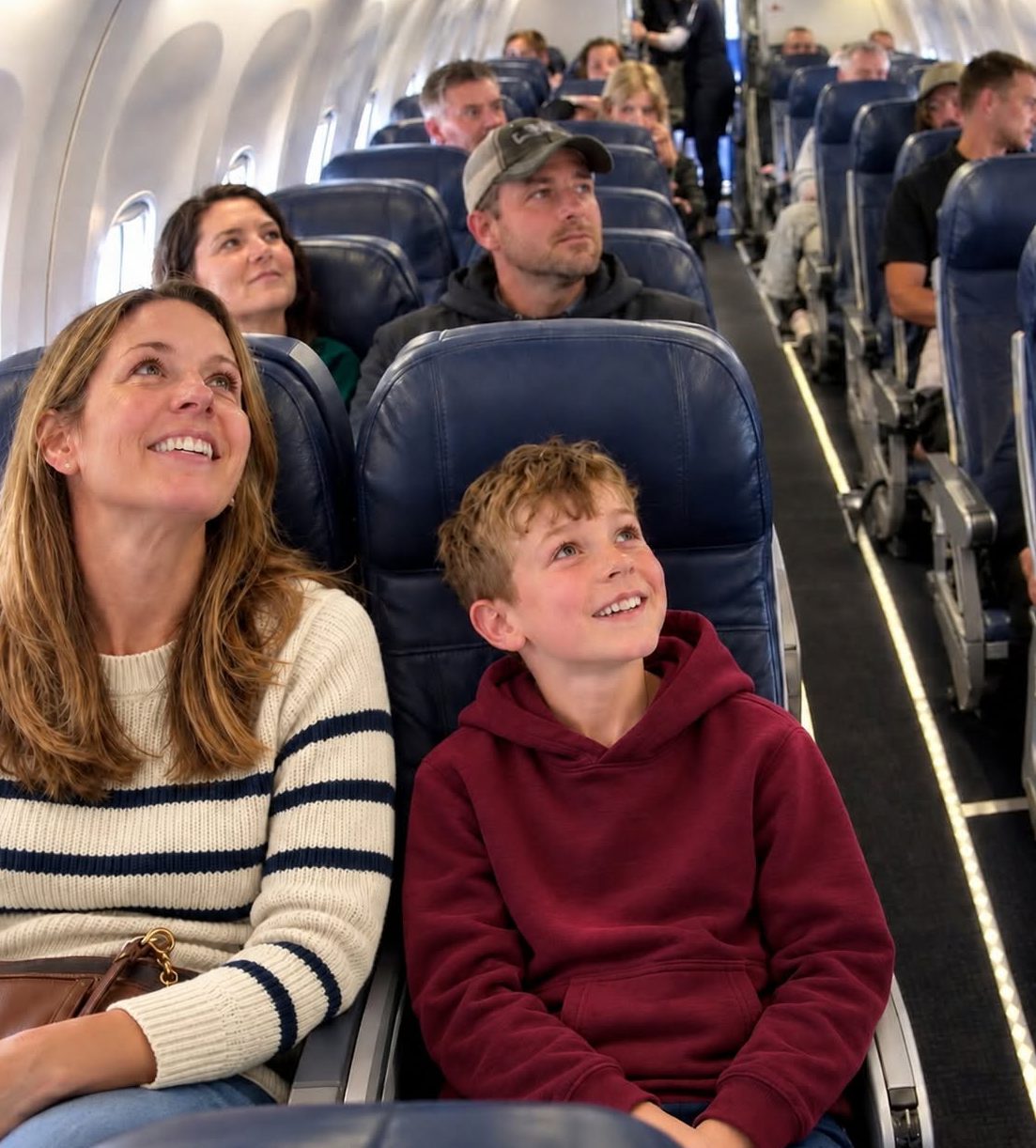
A flight attendant moved through the aisle, checking that passengers had fastened their seat belts and raised their tray tables. She gave Mason a friendly smile, and he responded automatically, the way children do when an adult expects them to be cheerful. When she moved on, he turned toward the window again, pressing his forehead close to the glass.
The engines grew louder, and the aircraft accelerated.
I reached across the armrest and pulled him gently against my side. He leaned into me as the runway lights began to streak past, his small body rigid with the effort of keeping himself quiet. I held him through the lift, through the brief sensation of our stomachs dropping, through the moment when the ground fell away and the city began to shrink beneath us.
Somewhere behind us, a baby fussed and was soothed. A man opened a magazine. The flight attendants settled into their seats for takeoff, and the cabin returned to the ordinary business of a Saturday flight to Chicago.
I stared at the seat back in front of me and understood, with a clarity that made my stomach ache, that the ordinary world had not disappeared.
It had simply continued without asking my permission.
*
By the time the seat belt sign went dark, Mason had unfolded his drawing twice and folded it again.
He kept looking across the aisle, where Ava sat with her sealed envelope resting against her chest. She had turned toward the window, but I could see the reflection of her eyes in the glass. Every few minutes, she glanced in our direction, and every time she did, I felt the same uncomfortable collision of emotions: anger at Tyler, bewilderment at the girl, and a sharp, unwelcome awareness that she looked frightened enough to be my own child.
She was sixteen, Tyler had said. His daughter. A girl whose mother had died eight months earlier, leaving her to discover a father she had apparently never met and a family that did not know she existed.
I tried to imagine what that must have felt like for her. The attempt lasted only a few seconds before my mind returned to the question I could not get past: Why had Tyler been able to make room for her in his life without making room for the truth in ours?
Mason nudged my elbow.
“Is she going to sit with Dad when we get off?”
“I don’t know.”
“Will she come home with us?”
“I don’t know that either.”
He stared at the drawing in his lap. “If she’s his daughter, does that make her my sister?”
The word landed harder than I expected. Sister. A simple word that should have belonged to birthdays, shared bedrooms, family photographs, and the small arguments children had over whose turn it was to choose a movie. Instead, Mason had been forced to consider it while sitting on an airplane, with strangers all around him and his father somewhere behind a locked cockpit door.
“Yes,” I said after a moment. “If Dad is telling us the truth about who she is, then she’s your half sister.”
Mason absorbed that quietly. His little brow furrowed, and he pressed the folded paper between both hands until its edges bent.
“Does she know about me?”
The question hurt more than the others because the answer was obvious, yet I could not bring myself to give it. Tyler had announced her existence to an entire aircraft full of strangers. He had spoken as though the discovery of a daughter were a private revelation that had finally become too heavy for him to carry alone. But he had not told us, the people whose lives would be changed by it.
Of course Ava knew about Mason. She had to know about me, too, unless Tyler had somehow managed to describe his life to her while leaving out the most significant parts of it.
“I think she does,” I said.
“Then why didn’t she say anything?”
I looked across the aisle. Ava’s fingers had curled around the envelope, leaving shallow dents in its pale surface.
“Because I think your dad told her not to,” I answered, though the words tasted bitter. “We’ll have to ask him.”
Mason went quiet again, and I wished I could take the entire conversation back to the moment before the speakers crackled. I wished I could recover the few seconds when he had believed his father was about to surprise him, when his face had lit up with such uncomplicated happiness that I had pulled out my phone to capture it.
I had wanted a memory of Tyler making his son feel special.
Instead, I had watched him make a public announcement that would become the first thing Mason remembered about having a sister.
The flight attendant began the beverage service. She offered us water and juice, and Mason asked for apple juice because it was what he always ordered when we traveled. He drank a few sips, then set the cup carefully into its holder. His gummy bears remained unopened in the little bag beside his feet, and when I asked whether he wanted some, he shook his head.
“I was going to give them to Dad,” he murmured.
I swallowed against the sudden ache in my throat. “You can still give them to him.”
“What if he doesn’t want them?”
I turned fully toward him. “Your dad wanting or not wanting candy has nothing to do with how much you matter to him.”
Mason considered that, then asked, “How do you know?”
I had no answer that would not sound like a promise I was no longer sure I could make.
I tucked his drawing securely into the front pocket of his backpack and kissed the top of his head instead. He accepted the kiss without protest, but he did not lean into me again.
Across the aisle, Ava finally looked directly at me. There was no challenge in her expression, no trace of triumph at having been publicly claimed by the man who had kept her existence from us. She looked like someone waiting to be told whether she had made a terrible mistake simply by being born.
I wanted to hate her. For one ugly, exhausted moment, I wanted the situation to have a villain I could point to, someone who had deliberately entered my life and begun dismantling it. But Ava had not made the announcement. She had not spent eight months withholding the truth from me. She had not bought herself a place in my husband’s life by promising to tell him something later.
Tyler had done those things, or at least he had done the first one, and the rest were questions I intended to ask him.
The aircraft dipped slightly as it began its descent. The captain’s voice returned over the speakers with the routine announcement about our approach to Chicago, and Mason flinched so noticeably that I wrapped an arm around his shoulders.
Tyler’s voice was steady, professional, almost cheerful.
He told the passengers the local time and the expected conditions on arrival. He thanked them for flying with the airline and reminded them to remain seated until the plane had reached the gate. He sounded like the man I had married, the man who could make strangers feel safe with a few calm sentences delivered over a microphone.
I listened until the announcement ended, waiting for some crack in his composure, some indication that he understood what he had done.
There was nothing.
He had managed to frighten his own family and still sound perfectly capable of getting a plane safely onto the ground.
*
The wheels touched the runway with a heavy rumble that traveled through the floor and up the legs of my seat.
Mason grabbed my hand again, but this time he did not look excited. He watched the wing through the window as the engines changed pitch and the aircraft slowed, his lips pressed together so tightly that they had almost disappeared. I kept my fingers wrapped around his until the plane turned off the runway and began taxiing toward the terminal.
The landing was smooth. The aircraft moved past service vehicles and rows of parked planes, then followed the painted lines toward our gate. Around us, passengers began gathering their belongings even before the seat belt sign went dark, reaching for phones and bags with the impatience of people who had somewhere else to be.
I felt a strange urge to stand up, walk forward, and demand that Tyler come out of the cockpit immediately.
I did none of those things.
He was still responsible for the aircraft, and I was not going to create a scene that might interfere with his duties. More importantly, I was no longer willing to let Tyler determine the timing of every difficult conversation simply because he had chosen to conceal something until the last possible moment.
The plane came to a complete stop. The engines quieted, the seat belt sign remained illuminated for several seconds, and then the familiar chime sounded overhead.
Mason unfastened his belt and immediately reached for his backpack.
“Let’s go,” he said.
I placed my hand over the bag before he could lift it. “Not yet, sweetheart.”
He looked up at me, bewildered. “But we’re here.”
“I know.”
“Dad’s going to be waiting.”
“Yes,” I said. “He can wait for us this time.”
Mason’s expression changed, and I saw that he understood more than I wanted him to. He lowered his eyes, his fingers lingering on the backpack strap, then nodded without another argument.
Passengers began moving into the aisle. Overhead bins opened, wheels rattled against the floor, and the cabin filled with the low murmur of people preparing to leave. A woman near the front struggled to retrieve a large bag while the man behind her shifted impatiently from one foot to the other. Nobody seemed interested in the captain’s announcement anymore; whatever it had meant to them, they were already moving on.
I stayed seated with Mason beside me.
Across the aisle, Ava gathered her belongings slowly. She slipped the sealed envelope into the front pocket of her bag, then drew it out again and held it in both hands. For a moment, I thought she might approach us, but she seemed to lose her nerve and turned toward the aisle instead.
She looked back once.
I did not smile. I did not tell her that everything would be fine. I simply held her gaze until she looked away.
When the aisle cleared, I stood and helped Mason put on his backpack. He held the strap with one hand and clutched the folded drawing in the other, keeping it close to his chest as we made our way toward the front of the cabin. The empty seats seemed larger now, their headrests lined up in neat rows beneath the overhead lights.
At the aircraft door, a flight attendant thanked us for flying. I thanked her in return, because she had done nothing wrong and because I needed to hold on to the small courtesies that still made sense.
The jet bridge smelled of warm concrete, metal, and the faint chemical scent of airport cleaning products. Mason hurried ahead by half a step, then slowed when he realized I was not following at his usual pace. I took his hand, and together we walked toward the terminal.
Tyler was not there.
For one brief, irrational second, I felt relief. I would have another minute to prepare myself, to decide how to speak to him without letting the hurt turn into something I could not control. Then I saw the flight bag he carried appear beyond the glass partition near the gate, followed by the unmistakable line of his uniformed shoulders.
He was coming toward us.
And Ava was beside him.
*
Tyler looked exactly as he always did after a flight: uniform neat, tie straight, shoulders squared beneath his jacket. His dark hair was slightly flattened at one side, and there was a crease near the corner of his mouth that usually appeared when he was tired but trying not to show it. He held his flight bag in one hand and kept the other close to Ava’s back, not quite touching her.
The gesture was small, almost unconscious.
It made something inside me go cold.
He had spent eight months learning how to stand beside this girl. He knew where to position himself so she would not feel alone, how close to stand without crowding her, when to reach out and when to give her space. Whatever else he had failed to do, he had clearly been practicing how to be her father.
He stopped several feet away from us, his eyes moving first to Mason and then to me.
“Claire,” he said quietly.
I waited.
“Mason.” His voice softened when he looked at our son. “Hey, buddy.”
Mason did not answer. He pressed the drawing against his chest, and I felt him shift closer to my side.
Tyler’s face tightened. “I know this is a lot to take in. I know I should have—”
“Don’t,” I said.
The word came out so sharply that Ava flinched. Tyler stopped speaking, and for the first time since his announcement, I saw his composure falter.
I looked at him steadily. “You don’t get to tell me what I know or what I should feel. You don’t get to explain this to me in the order that makes it easiest for you. Right now, you’re going to answer questions, and you’re going to let me finish asking them.”
His jaw moved as he swallowed. He glanced at Mason, perhaps hoping our son might offer him the familiar rescue of a smile or a question about the flight. Mason stared at the floor instead.
“All right,” Tyler said.
“Who is she?”
Ava drew a small, uneven breath beside him. She looked as if she wanted to disappear, but she lifted her chin when Tyler turned toward her.
“This is Ava Collins,” he said. His voice caught slightly on her name. “She’s sixteen. She’s my daughter.”
He looked back at me, and I could see him searching my face for some sign that I might accept the statement if he delivered it gently enough.
“I found out about her eight months ago,” he continued. “Her mother had died, and there were things I didn’t know. Things I should have known a long time ago.”
“Eight months,” I repeated.
He nodded.
I glanced at Ava. She had Tyler’s eyes, a grayish blue that seemed to change color beneath different lights, and the same slight crease between her eyebrows when she was trying not to cry. There was something familiar in the way she pressed her lips together, too, although I could not tell whether I was recognizing Tyler in her or simply searching for evidence that the story was real.
“Did you know about her before her mother died?” I asked.
“No.”
“Did you have any contact with her before that?”
“No. I didn’t even know she existed.”
“And in eight months, you never found a single moment to tell your wife?”
Tyler’s gaze dropped to the floor. “I kept thinking I needed to be certain about what was happening. Then I kept thinking I needed to find the right way to tell you. Every time I tried to start the conversation, I convinced myself I needed a little more time.”
“You had eight months.”
“I know.”
“You had eight months, Tyler. Birthdays, dinners, mornings when you kissed us goodbye and told Mason when you’d be home. You had eight months of looking me in the face while you knew there was something this important that you weren’t telling me.”
His shoulders sagged slightly, but he did not interrupt.
I could hear the airport around us: rolling suitcases, distant announcements, the hollow echo of footsteps against polished flooring. A group of passengers walked past, talking about their connecting flight. One of them glanced at Tyler’s uniform and then at Ava, apparently recognizing nothing unusual about the three adults and one child standing together near the gate.
That ordinary indifference was almost unbearable. Our family had changed in a matter of minutes, and to everyone else, we were just another group trying to find their way through an airport.
Ava finally spoke. “I didn’t know she didn’t know.”
Her voice was soft and slightly rough, as though she had been crying for hours. She looked at me directly, although her hands had begun to tremble around the straps of her bag.
“Dad kept telling me he was going to talk to you,” she said. “He said he was trying to find the right time, and that he didn’t want to do it over the phone or when you were busy. He said he was getting everything ready so we could meet properly.”
I turned toward Tyler.
“Getting everything ready?”
He closed his eyes for a moment. “Ava, maybe we should—”
“No,” I said. “She can finish.”
Ava’s face reddened, but she continued. “He said it would be better if we met in person. He told me not to worry because he was working it out. I thought you knew about me, or at least that you knew he was going to tell you soon. I didn’t think he was keeping the whole thing from you.”
The last words came out in a rush. She looked down at her shoes, and the hand holding her bag tightened until her knuckles turned pale.
I believed her.
That was the worst part. I believed the embarrassment in her face, the fear in her voice, the way she had tried to explain herself without once suggesting that she deserved something from me. She had apparently spent months trusting Tyler to manage the truth between us, just as I had spent months trusting him to tell me when something important happened in his life.
He had been making promises in both directions, and neither of us had known what the other had been told.
“What exactly did he promise you?” I asked.
Tyler shifted his weight. “Claire—”
I did not look at him. “I asked Ava.”
Ava glanced at him, then back at me. She seemed to understand that this was a test, although I was not entirely sure what answer I wanted from her.
“He promised he would be there for me,” she said. “He said I wouldn’t have to figure everything out alone anymore. After Mom died, there were a lot of things I didn’t know how to do, and he said I could call him whenever I needed to talk.”
Her fingers brushed the pocket where she had put the sealed envelope.
“He said he’d be my dad,” she added, almost defensively. “Not just somebody who called once in a while. He said we could build something real.”
Mason looked up at that.
“Dad calls you?” he asked.
Ava turned toward him. “Yes.”
“How much?”
She hesitated, and I saw Tyler’s eyes close briefly as though he already knew what was coming.
“Every week,” Ava said. “Sometimes more.”
Mason’s face changed. He looked at Tyler with an expression I had never seen on him before, a mixture of confusion and a child’s desperate attempt to calculate something that should never have required arithmetic.
“Every week?” he repeated.
Tyler crouched slightly, trying to bring himself closer to our son’s height without stepping into the space between us. “Mason, buddy, I need you to understand that none of this changes how much I love you.”
Mason took a small step backward, bumping against my leg.
“You call her every week?”
Tyler’s mouth opened, then closed. “Yes.”
“Do you call me every week when you’re away?”
The question was innocent, but it cut straight through the careful explanations Tyler had been preparing. Mason knew the answer. His father called when he could, sometimes every night, sometimes only for a few minutes between flights or hotel check-ins. But Mason had never needed to count those calls against anyone else’s.
Tyler reached for him, then stopped when Mason pressed closer to me.
“I call you because I love you,” Tyler said. “And I call Ava because she’s my daughter and I love her, too. Those things aren’t in competition.”
Mason stared at him for a long moment. “Then why didn’t you tell us?”
Tyler’s expression crumpled around the edges. For a second, I saw the man who had held our newborn son against his chest and cried so hard he could barely speak. I saw the father who had spent years teaching Mason to identify airplane models from the terminal windows, who had patiently answered every question about engines, wings, and cockpit controls.
Then I remembered the announcement, the public declaration, the eight months of silence, and the look on Mason’s face when he had asked whether his father had another family.
“Because I was afraid,” Tyler said.
Mason’s eyes narrowed. “Of me?”
“No, sweetheart. Never of you.” Tyler’s voice broke slightly. “I was afraid of hurting your mom. I was afraid of changing everything. I kept telling myself that if I could find the right way to explain it, nobody would have to feel bad.”
Mason looked at the drawing in his hands.
“But Mom feels bad.”
Tyler did not answer.
“And I feel bad,” Mason added, his voice growing smaller. “And Ava looks sad.”
Ava covered her mouth with one hand. Tears had gathered along her lower lashes, and she turned away, ashamed of crying in front of us.
Mason watched her for a moment before looking back at his father. “You said nobody would feel bad.”
Tyler lowered his head.
“I know, buddy,” he whispered. “I know.”
I felt the familiar instinct to comfort Mason, to draw him into my arms and reassure him that adults made mistakes and families could survive difficult things. But I also felt the need to keep him from being pulled into the work of comforting his father. Tyler had already placed too much of this burden on a seven-year-old boy.
I put my hand on Mason’s shoulder.
“You don’t have to make anyone feel better right now,” I told him. “You can be upset. You can ask questions. You can take as much time as you need.”
He leaned into my side, and I held him there while Tyler remained crouched in front of us, looking at the son who had once run to the door whenever he heard his father’s key in the lock.
For a few seconds, no one spoke.
Then I turned back to Tyler.
“You said you promised Ava you would build something real,” I said. “What does that mean?”
He straightened slowly. His gaze flicked toward the terminal windows, where aircraft moved along the distant taxiways, their lights blinking steadily in the afternoon haze.
“It means I want to be in her life,” he said. “I want to know her. I want to be there for school things, birthdays, the ordinary things that fathers are supposed to be there for. I don’t want her to feel as though she lost her mother and then discovered that her father was only interested in her when it was convenient.”
His words were sincere. That much I could hear, and perhaps that was why they hurt so much. Tyler was not inventing affection to cover an affair or offering some flimsy excuse for a passing mistake. He genuinely wanted to be Ava’s father, and he had apparently spent eight months trying to become one.
But he had built that relationship behind my back, as though his responsibilities to her existed in a separate world where his marriage and son had no claim on his decisions.
“You could have wanted all of those things and still told me the truth,” I said.
“I know.”
“You could have asked me to help you figure out what being her father would look like. You could have told me you were scared, that you didn’t know how to introduce her, that you were afraid I would be angry. I might have been angry, Tyler, but at least I would have been allowed to be angry about something real.”
He looked at me, and I saw the shame in his face deepen.
“I thought if I told you before I had a plan, it would make everything harder,” he said. “I wanted to be able to answer your questions. I wanted to know what I could offer Ava before I asked you to accept a change in our lives.”
“You decided that I couldn’t handle the truth until you had already decided what the truth would require of me.”
He looked away.
“That isn’t fair,” he said quietly, then immediately shook his head. “No. I’m sorry. It is fair. I don’t know why I said that.”
I almost laughed, but there was nothing amusing about watching a man realize that his instinct to defend himself was so automatic that it escaped even when he knew he had no defense worth making.
Ava wiped her cheek with the heel of her hand. “I didn’t ask him to hide me.”
“I know,” I said, turning toward her. “I need you to understand that. I am angry with Tyler because he kept this from me. I am not asking you to apologize for being his daughter.”
She looked at me as if she did not know whether to believe it.
“I just wanted to meet him,” she whispered. “I wanted to know what he was like. Mom didn’t tell me much about him, and after she died, I had so many questions. I thought if I could finally talk to him, maybe I wouldn’t feel like I was missing an entire part of my life.”
The envelope shifted in her hands. She held it tighter, and I wondered what was inside it, what her mother had written, what words had been left behind for a girl who had lost one parent and was now standing in an airport beside another parent whose choices had hurt people she had never met.
I wanted to ask. I wanted to know everything.
Instead, I asked Tyler the question that had been waiting behind every other one.
“What else have you promised her?”
His face changed.
It was a small change, no more than the tightening around his eyes and the way his fingers curled around the handle of his flight bag. But I had been married to him long enough to recognize the moment when he understood that the conversation had reached something he had hoped to postpone.
“Claire, I think we should sit down somewhere,” he said. “We shouldn’t have this conversation standing in the middle of the terminal.”
“Then find us somewhere to sit.”
He nodded quickly, apparently relieved to be given a task. He gestured toward a quieter seating area near the windows, away from the main stream of passengers. Ava moved to follow him, but she hesitated when she saw that I had not yet taken Mason’s hand.
I reached for it, and Mason slipped his fingers into mine without looking up.
We walked together toward the seating area, Tyler a few steps ahead of us, Ava beside him. The airport’s broad windows let in a wash of pale afternoon light, and the polished floor reflected our movements in faint, distorted shapes. Around us, people checked departure boards, spoke into phones, and hurried toward connecting gates, their lives proceeding along schedules that had not been interrupted by the discovery of a secret family.
Tyler chose a row of seats facing the windows and set his flight bag on the floor beside him. Ava sat at the far end, leaving an empty seat between herself and Tyler, while Mason settled beside me and pressed his backpack between his knees. I kept my hand resting on his shoulder, partly to comfort him and partly because I wanted him to know that I was not going to let him be pushed aside while the adults discussed decisions that affected his home.
Tyler remained standing for a moment, looking down at us as though he were trying to decide where he belonged.
“Sit down,” I told him.
He lowered himself into the seat opposite me.
For the first time since the announcement, there was nowhere for him to go. No cockpit to retreat into, no passengers waiting for his next instruction, no microphone through which he could choose his words and control how they reached us. He was simply my husband, sitting across from me with our son beside me and the daughter he had hidden beside him.
I looked at Ava first.
“Has your father talked about where you’re going to live?”
Her eyes widened. She glanced at Tyler, and that single movement told me more than any answer could have.
“A little,” she said.
“How much is a little?”
Tyler leaned forward. “Claire, I can explain—”
“Then explain.”
He rubbed both hands over his face, leaving a red mark across one cheek. When he lowered them, he looked exhausted, but I no longer mistook exhaustion for an excuse.
“I told Ava that I wanted her to have a place with us,” he said. “A real place. Somewhere she wouldn’t have to feel like she was visiting her own father.”
The words seemed to echo in my head long after he finished speaking.
“With us,” I repeated.
“Yes.”
“In our house.”
He nodded once.
Mason turned his face toward me. I felt the movement before I saw it, the slight pressure of his shoulder against my arm. He had spent his entire life believing that home was the one place where nothing could happen without his parents knowing about it first. Now he was learning that a person could make plans for his bedroom, his family, and his future without ever telling him.
I kept my voice level.
“When did you decide that?”
Tyler looked down at his hands. “I’ve been thinking about it for a while.”
“That isn’t an answer.”
“A few months ago,” he admitted. “Ava’s situation was complicated after her mother died. I didn’t want her to feel that she had nowhere to go if things became difficult. I wanted to make sure she knew she had options.”
“And you decided that option would be our home.”
“I wanted it to be our home,” he said, correcting himself. “I thought we could make it work.”
“You thought we could make it work,” I repeated, feeling each word settle into place. “You thought I would agree to bring a sixteen-year-old girl into our home, change our family routines, change Mason’s life, and take on whatever legal responsibilities came with that decision, all without being told that she existed.”
Tyler’s mouth tightened. “I wasn’t trying to take anything away from you.”
“You don’t get to decide what you’re taking away from me.”
He flinched, and Ava looked down at her lap.
I drew a slow breath, trying to keep my anger from spilling into words I could not take back. “Did you discuss this with anyone else? Did you make arrangements with a school, a lawyer, a social worker? Did you tell anyone that Ava would be living with us?”
“No,” Tyler said quickly. “Not in any final way.”
I stared at him.
He looked as though he had heard the problem in his own answer. “I mean, I haven’t finalized anything. There are things I’ve looked into, but nothing has been signed.”
“Looked into what?”
His fingers tightened around one another. “The practical side of bringing her into my life. The legal side, too.”
Ava’s head lifted sharply. “Dad.”
Tyler glanced at her, and something passed between them, a silent warning or a plea. I watched it happen and felt the last of my uncertainty disappear.
“What legal side?” I asked.
He hesitated so long that the airport announcement overhead finished before he spoke.
“I’ve started the paperwork to become Ava’s legal guardian.”
For a moment, I could not make sense of the words. They sounded as though they belonged to another conversation, another family, another woman who had been told what her husband was planning before the decision was already underway.
“You’ve started what?”
“The guardianship application isn’t finished,” he said quickly. “It’s unsigned. I haven’t filed it. I was trying to understand what would be required.”
“You started an application to become her legal guardian.”
“Yes.”
“Without telling me.”
“Yes.”
“And you’ve been telling Ava that she could come and live in our house.”
He looked at Ava, then back at me. “I told her I wanted that. I told her I was working toward it.”
Ava’s eyes had filled with tears again. “You said you were getting everything ready,” she whispered. “You said once you talked to Claire, we could figure out the details.”
Tyler’s shoulders drew inward. “I thought I could explain it when the time came.”
“When the time came?” I asked. “Tyler, the time came eight months ago. The time came every time you called her and then came home to us. It came every time you sent her something, every time you made another promise, every time you looked at me and decided that I could wait another day to know what was happening to my own family.”
“I know,” he said.
“No, I don’t think you do. I think you know you’re in trouble now, and I think you’re sorry that we found out this way. But you still haven’t explained why you believed you had the right to make these decisions without me.”
He stared at me, and for once he seemed unable to find a sentence that might soften what I had said.
Mason shifted beside me. He had been silent for so long that I had almost forgotten how closely he was listening, but now he reached into his backpack and pulled out the folded drawing. He held it on his lap, smoothing the paper with the flat of his hand, then looked at Tyler with eyes that were bright and uncertain.
“Dad,” he said, “if Ava comes to live with us, will I still have my room?”
Tyler’s face went pale.
“Of course you will, buddy.”
“Will she sleep in my room?”
“No. We would work out a room for Ava.”
Mason looked down at the drawing. “Would you still come to my school things?”
Tyler leaned forward, his voice suddenly urgent. “Mason, listen to me. You are my son. I love you more than I can explain, and nothing about Ava changes that. I would never stop being your dad.”
Mason’s lower lip trembled. He pressed it between his teeth, struggling to keep his face composed.
“Then why didn’t you tell me?”
Tyler’s eyes shone, and he looked away as if the sight of his son was more than he could bear.
I put my arm around Mason and drew him close. “You don’t have to answer that question for him,” I whispered, though I was no longer sure whether I was speaking to Mason or to myself.
Ava began to cry silently. She turned toward the windows, shoulders trembling, and Tyler reached for her without thinking. His hand came to rest on the seat beside her, close enough that she could take it if she wanted.
She did not.
I watched that small refusal and understood that Ava, too, had been promised a place in a family that might not have been ready to receive her. Tyler had made her believe that the hardest part was telling us, that once the secret was out, everything else would fall into place. He had offered her certainty where there was none, just as he had offered me the illusion of an ordinary marriage while quietly planning a future that I had never agreed to.
I looked at the flight bag beside his feet.
“Is the application in there?”
Tyler followed my gaze. His face changed again, and this time there was no mistaking the fear in it.
“Yes,” he said.
“Take it out.”
“Claire, please. Let me explain the circumstances first.”
“Take it out.”
He bent toward the bag, then stopped with one hand on the zipper. His fingers remained there, motionless, while the terminal lights reflected across the windows behind him.
“I was going to tell you,” he said, so quietly that I almost could not hear him.
I stared at him. “You have said that every time you’ve needed to explain why you didn’t.”
He lowered his eyes and unzipped the bag.
Inside were the ordinary things I recognized: his folded uniform sweater, a small toiletry pouch, a charger, a notebook with the airline’s logo on the cover. He moved them aside with careful, unsteady hands, searching beneath the notebook until he found a thick manila folder. He held it for a moment, his thumb pressed against its edge, then placed it on the seat between us.
I did not reach for it immediately.
Ava watched the folder as if it were something dangerous. Mason leaned against my side, his drawing crumpled slightly beneath his fingers. Tyler sat opposite us, his hands empty now, his face drained of the confidence he had worn when he first approached us at the gate.
I opened the folder.
The first page was an unsigned guardianship application. Tyler’s name appeared in the section identifying the proposed guardian, and beneath it were fields describing his relationship to Ava and the legal authority he was seeking. I scanned the page once, then again, unable to stop my eyes from moving toward the section outlining the proposed living arrangement.
There, in neat black type, was the address of our home.
Our home, listed as Ava’s future residence.
I stared at the words until they blurred, while Tyler sat across from me and said nothing.
Part 4 – The Choice He Had No Right to Make
I stared at the words until they blurred, while Tyler sat across from me and said nothing.
The fluorescent lights above the airport seating area gave the paper a yellowish cast, making our home address look strangely unfamiliar. I knew every digit by heart. I had written it on school forms, medical records, birthday invitations, and the countless envelopes that came through our mailbox. Now it sat beneath a heading describing where Tyler intended to bring a sixteen-year-old girl I had met less than an hour earlier, a girl whose existence he had kept from me for eight months.
I turned the page, expecting another explanation, another document that might somehow make the first one less terrible. Instead, I found a checklist of supporting materials and a section for proposed arrangements, with several boxes already marked. Tyler had even written notes in the margins, his handwriting neat and deliberate, the same handwriting he used when he left instructions for the person servicing our car or reminders for Mason’s school projects. He had planned this with the same careful attention he gave everything else in his life, except the one person whose consent should have mattered most.
“How long?” I asked.
Tyler leaned forward, his elbows resting on his knees, and rubbed his palms together. “Claire, the application isn’t finalized.”
“That isn’t what I asked you.”
He looked at the page instead of me. “I started looking into the process a few weeks ago.”
“A few weeks.” I repeated the words slowly, as though their meaning might change if I gave them enough room. “You discovered that you had a daughter eight months ago. You’ve been calling her, sending her gifts, making promises to her, and now you’ve started paperwork to bring her into our home. But you’ve only been thinking about telling me for a few weeks?”
His jaw tightened. “It didn’t happen exactly like that.”
“Then tell me exactly how it happened, Tyler. I have the entire afternoon.”
Mason shifted beside me, his shoulder pressing against my arm. He had stopped trying to smooth the wrinkles out of his drawing, and the paper lay folded between his hands, its bright blue airplane bent down the middle. I wanted to take it from him, flatten it, and tell him everything was fine, because a seven-year-old should not have to sit in an airport and wonder whether his father had been building another family behind his back. But I couldn’t say those words without lying to him, too.
Tyler glanced at Mason, and something in his expression softened. “Buddy, I know this is a lot to hear. I never wanted you to find out this way.”
Mason didn’t answer. He looked at his father with the wary concentration he usually reserved for something he suspected might be dangerous, like a dog barking behind a fence or a loose step on the playground.
“Is she going to live with us?” he asked.
Tyler opened his mouth, then looked at me. That small movement told me more than his answer could have. Even now, with his son sitting inches away and his wife holding the paperwork that exposed him, he was looking to see which version of the truth he could safely offer.
“I was hoping we could talk about that,” Tyler said.
Mason’s fingers tightened around the drawing. “You already put our house on the paper.”
The words came out quietly, without accusation, and Tyler flinched as though Mason had raised his voice.
“You’re right,” Tyler said after a moment. “I did.”
“Did you tell Mom?”
“No.”
“Why not?”
Tyler lowered his head. He seemed to be searching for a sentence that would make sense to a child without revealing how little sense his own choices had made. I watched him struggle, and for the first time since the announcement on the plane, I felt something colder than anger settle inside me. I had spent years believing that when Tyler made a mistake, we would face it together. I had never considered that he might make an entire series of decisions and leave me to discover them only after the consequences had arrived.
“Because I was scared,” he finally told Mason. “And I handled that fear badly.”
Mason looked down at the drawing again. “Were you scared Mom wouldn’t let her come?”
Tyler swallowed. “Yes.”
I shut the folder, not because I had finished reading it, but because I couldn’t bear to see our address printed across another page. “Mason, sweetheart, could you sit with me over there for a minute?” I pointed toward a quieter cluster of seats beyond the windows, away from the gate announcements and the families gathering around their luggage. “I need to talk to your dad and Ava, and I want you close enough to hear me if you need me.”
He hesitated before taking my hand. His palm was warm and slightly damp, and when he stood, he kept the drawing tucked against his chest as if someone might take it away. Tyler started to rise, but I looked at him until he remained where he was.
“Give us a minute,” I said.
He nodded, his face drawn and tired. I led Mason to the other seats, where the noise of rolling suitcases softened to a distant rumble and the airport windows reflected the pale gray afternoon. Ava followed us after a brief glance at Tyler, carrying a small bag on one shoulder and holding a sealed envelope against her stomach. She chose a seat opposite Mason, leaving an empty chair between herself and me.
For several seconds, nobody spoke. Beyond the glass, ground vehicles moved along the service road, their lights blinking against the damp pavement. Mason leaned into my side, and I put my arm around him, trying to give him the familiar pressure of a hug without making him feel that something had to be said immediately. Across from us, Ava kept her eyes on the envelope, rubbing her thumb along its sealed edge.
I had spent the flight imagining the moment Tyler would realize we had surprised him. In my mind, he would laugh, scoop Mason into his arms after landing, and kiss me while our son proudly presented his drawing. I had pictured the three of us walking through the airport together, talking about the flight, with Mason asking a hundred questions about the cockpit. Instead, I was sitting beneath the airport’s harsh lights with a stranger who shared my husband’s eyes, while my son held a drawing of the man he had thought he knew.
I looked at Ava. “Tyler said your mother died eight months ago.”
She nodded, her fingers still wrapped around the envelope. “She was sick for a while, but I didn’t know how bad it was until near the end.”
“I’m sorry.”
“Thank you.” Her voice was quiet, almost formal, as if she had practiced speaking to adults who might decide whether she was welcome. “I didn’t know what to say when he told me about you and Mason. I mean, I knew he had a family. I just didn’t know how to meet you.”
I waited for her to continue, but she seemed to have reached the end of what she could manage. She was sixteen, old enough to understand what a secret meant and young enough that she should never have been expected to carry one this large. There was something painfully careful about the way she sat, her shoulders drawn inward, as though she were trying to occupy less space than the chair allowed.
“Did he tell you that I knew about you?” I asked.
Ava’s eyes lifted to mine. “He said he was going to tell you.”
“When?”
“He didn’t give me an exact date.” She glanced at Tyler, who had approached and stopped a few feet away. “He kept saying he was waiting for the right time. That you had a lot going on, and he wanted to make sure he explained everything properly.”
Tyler took the empty seat beside her, but Ava didn’t look at him again. I could see the tension in her fingers as she pressed the envelope flat against her knees.
“And you believed him,” I said.
“Yes.” Her voice wavered, then steadied. “He was my dad. I wanted to believe him.”
The words struck a place in me I hadn’t prepared to defend. I had spent the last hour thinking about the lies Tyler had told me, the plans he had made without me, and the future he had apparently begun constructing behind my back. I had not spent nearly enough time considering what he had told Ava, or how desperately she might have wanted those promises to be true. My anger had a clear target, but her hope did not.
Tyler leaned forward, his hands clasped between his knees. “I need to explain what happened, Claire. All of it.”
“Then start at the beginning.”
He drew a breath and looked at Ava, whose face had gone pale beneath the airport lights. “When I found out about her, I didn’t know what to do. Her mother had died, and Ava was trying to figure out where she belonged. I was suddenly looking at a daughter I hadn’t known existed, a girl who had grown up without me, and I realized there were sixteen years I could never get back.”
His voice caught on the last words. He paused, and I saw the pain in his face, the genuine grief of a man confronting the life his absence had cost him. It would have been easier if he had looked indifferent, if he had treated Ava like an inconvenience or a passing mistake. Instead, he looked at her with an unmistakable tenderness, and that tenderness made the truth more complicated without making it less painful.
“I wanted to be there for her,” he continued. “At first, I thought I could take things slowly. We talked, and then we talked again. I learned about her school, her friends, what she liked, what she was afraid of. She told me about her mother. I started calling every week, and eventually we began talking almost every day.”
“You had time to build a relationship with her,” I said, “but you couldn’t find ten minutes to tell your wife that she existed.”
“I know how that sounds.”
“It sounds like what you did.”
He looked down. For a moment, the only sound between us was the faint mechanical hiss of the terminal ventilation, blowing cool air across the back of my neck. I wanted him to argue, to defend himself, to give me something I could push against. His silence left me alone with the plain, ugly shape of what had happened.
“I kept thinking I would tell you after the next call,” he said. “Then after the next one, because I wanted to understand what Ava needed before I brought it into our lives. I thought if I could explain the situation clearly, if I had answers to your questions, then it wouldn’t feel so sudden.”
“You thought you could prepare a presentation.”
“No.” He shook his head, then stopped, recognizing the weakness of his denial. “Maybe. I thought I could make it easier.”
“For whom?”
He looked at me, and I watched him struggle to answer without dressing his motives in something more flattering. “For everyone. For you, for Mason, for Ava. For myself, too.”
At least that was honest. It was also the first answer he had given me that did not attempt to make his behavior sound like an act of kindness.
“I was afraid you’d look at me differently,” he said. “I was afraid you’d think I’d hidden something about my past because I didn’t trust you. I was afraid you’d feel betrayed, and then I’d have to explain why I hadn’t told you sooner, and every day I waited made that conversation harder.”
I stared at him. “So you waited until you had eight months of conversations to explain.”
“Yes.”
“And every week you waited, you knew more about Ava, made more promises to her, and gave me less of a chance to make decisions about my own family.”
His eyes filled with something that might have been shame. “Yes.”
I pressed my fingertips against the closed folder on the seat beside me. The paper edges were sharp beneath my skin, and I found myself concentrating on that small sensation because it was easier than looking at him. I could understand fear. I could even understand the instinct to avoid a painful conversation for one more day. What I could not understand was the transformation of that fear into a private life in which Tyler had the freedom to make choices while I was denied even the knowledge that choices existed.
“Did you ever intend to tell me before today?” I asked.
“Of course.”
“When?”
He hesitated.
I laughed once, without humor. “You don’t know, do you?”
“I had been thinking about doing it this weekend.”
“Before or after the flight?”
“After we landed.”
“And what was the plan? Were you going to take Mason for ice cream, tell him he had a sister, and then come home and announce that we’d be rearranging our lives?”
“No. I was going to sit down with you first. I wanted to tell you privately, without Mason there, and then we could decide how to explain it to him.”
“But you couldn’t tell me privately without making sure everything was arranged first.”
His shoulders sagged. “I know.”
“No, Tyler. You know the words. I’m not convinced you understand what they mean.”
Ava shifted in her chair. She looked between us, and I saw her mouth tighten as if she were trying to hold back something she had been carrying since the moment she turned around on the plane. When she finally spoke, her voice was so low that I had to lean forward to hear her.
“He told me he was going to bring me home.”
Tyler turned toward her. “Ava—”
“Not today,” she said quickly. “I know you weren’t going to take me straight home today. But you said you wanted me to have a room there, and that once everything was settled, I wouldn’t have to worry about where I was going to be.”
I looked at Tyler. He didn’t deny it.
“What does ‘once everything was settled’ mean?” I asked him.
He rubbed the heel of his hand against his forehead. “It means I wanted to make sure she had somewhere stable to live. Her situation has been difficult, and I thought—”
“You thought our house would solve it.”
“I thought our home could be a place for her. I thought we could make room.”
“Did you ask me?”
“No.”
“Did you ask Mason?”
Tyler looked at our son. Mason had gone very still, his drawing balanced on his lap, his eyes fixed on the floor between his shoes.
“No,” Tyler said.
“Then stop saying ‘we’ as though you had the right to make that decision for us.”
He flinched, and Ava closed her eyes. I immediately regretted the sharpness of my voice, not because the words were wrong, but because she had been sitting in the path of every blow Tyler had earned. I took a breath and turned toward her.
“Ava, I need you to understand something. I am not angry with you for being Tyler’s daughter. You didn’t create this situation, and you didn’t owe me a confession about a secret he was keeping. Whatever he told you about me, whatever promises he made, the responsibility for telling the truth was his.”
She looked at me, uncertain whether she was allowed to believe what I had said. “But I knew he was married.”
“Knowing I existed isn’t the same as knowing what he was doing to me.”
“I still came here.”
“Because he invited you.”
“He said he wanted us to meet. He said today would be the beginning of everything being different.”
Her voice cracked on the last word, and she pressed her lips together. I saw the effort it took her not to cry, the way she held her head rigidly upright as though tears would make her seem younger than she wanted us to think she was. The sealed envelope bent beneath her fingers, and she quickly straightened it again.
Tyler reached toward her, but she drew the envelope closer to herself before his hand could touch it. The movement was small, almost imperceptible, yet it changed something in his face. He withdrew his hand and sat back, finally recognizing that his daughter could be hurt by him, too.
“I promised her I wouldn’t disappear,” he said, looking at me. “After her mother died, she was terrified that the people she had left would leave her as well. I told her she wasn’t alone. I told her I would be her father, not just someone who called occasionally and sent birthday cards.”
“That’s a promise you can keep without lying to me.”
“I thought I had to figure out how to do both.”
“No. You decided you could only do one at a time, and you chose the version where you got to feel like a good father without risking being an honest husband.”
The sentence landed between us with a finality that made even me want to look away. Tyler’s mouth opened, then closed. I could see him wanting to explain that he had never intended to hurt me, that he had been overwhelmed by a situation he hadn’t expected, that his love for Ava was not a calculated betrayal. None of those things would have changed the fact that he had let me live inside a marriage that looked different from the one he was secretly planning.
“I didn’t want to lose either of you,” he said at last.
“Then why did you act as though you were the only person who got to decide what losing meant?”
He looked at me for a long time. “I don’t have an answer that makes me look better.”
“I’m not asking you to look better.”
“I know.”
“Then tell me the truth without trying to soften it.”
Tyler drew a shaky breath. “I was afraid you would reject the situation. I was afraid you would tell me you couldn’t live with it, that you didn’t want Ava in our lives, and that I’d have to choose between my marriage and my daughter. I didn’t want to face that possibility, so I kept putting off the conversation. Then I started making plans because planning felt like progress, and I told myself that if I could give Ava something solid, I would have something solid to offer you when I finally told you.”
He stopped and looked at the folder. “I convinced myself I was preparing to do the right thing. Really, I was making it harder for you to say no, because by the time you knew, there would already be promises and paperwork and a girl who believed she was coming home.”
Ava’s face crumpled for an instant before she managed to control it. Tyler saw her expression and leaned toward her, but she shook her head. He remained in his chair, his hands clenched together, and I felt the room around us become unbearably quiet despite the movement of the airport beyond the glass.
For the first time, he had said the truth plainly enough that none of us could pretend to misunderstand it. He had not simply hidden Ava because he was afraid. He had built a situation in which the consequences of his secrecy would fall on the rest of us, then hoped that love would make us accept the arrangement he had already begun.
“You made my choice for me,” I said.
“I know.”
“You made Mason’s choice for him.”
“I know.”
“And you made Ava believe she was being welcomed into a family that had agreed to receive her, when the only person who had agreed was you.”
Tyler bowed his head. “Yes.”
Ava stood abruptly, then seemed to realize she had nowhere to go. She sat down again, her hands shaking around the envelope. “I didn’t ask him to do all that,” she said. “I didn’t ask him to put the house on the form. I just wanted to know him. I wanted to have a dad who knew what I was doing on a Tuesday, who would answer when I called, who might actually come to something at school instead of being a name I wondered about.”
Her voice grew steadier as she continued, each sentence sounding as though it had been waiting behind her teeth for months. “When he called me, I used to write down things I wanted to tell him because I was afraid I’d forget them. I told him about my mother’s favorite songs and the places we used to go together. I told him things I hadn’t told anyone else because I thought he was someone who was supposed to know me.”
She looked at Tyler, and for the first time, there was anger in her expression beneath the grief. “I didn’t want a house on a piece of paper. I wanted you to show up and mean it.”
Tyler looked devastated. “I do mean it.”
“Then why does everything feel like a promise you made to me before asking whether anyone else wanted it?”
He had no answer. He sat with his hands clasped, staring at the floor, while Ava’s words settled into the space his explanations had occupied. I wanted to feel satisfaction at seeing him forced to confront the damage he had caused, but there was no satisfaction in watching a sixteen-year-old discover that the father she had finally found could be both sincere and deeply unreliable.
Mason had been silent for so long that I had almost forgotten he was listening. Then he turned toward Tyler, his small face serious in a way that made him look older than seven.
“Dad, if Ava comes to our house, where does she sleep?”
Tyler looked up. “We would make sure she had a room, buddy.”
“Would you move my things?”
“We’d work it out.”
Mason considered this. “My room is small. I can’t share it with someone who is sixteen, because I have toys everywhere, and I get up early, and sometimes I talk in my sleep.” He paused, looking toward Ava. “But I could put my toys in the closet if we needed to.”
My throat tightened. He was trying to solve a problem that no child should have been asked to solve, already offering up pieces of his life to accommodate a decision his father had made without even telling him it was coming. I wanted to tell him that nobody was taking his room, that he didn’t need to give up a single toy, that the adults would figure everything out. But I didn’t want to offer him another promise whose outcome I could not control.
“You don’t need to rearrange your room for anyone right now,” I told him gently. “This is something the grown-ups need to talk about properly.”
“But Dad already did the paper.”
“Yes,” I said, holding his gaze. “He did.”
Mason looked down at his drawing and carefully unfolded one corner. The crease had split the paper just below the airplane’s wing, cutting through a crooked line of blue crayon. He ran his finger along the tear, trying to press it flat, and I felt my heart twist at the sight of the picture he had made for his father before any of us knew what the day would become.
“Does Dad want Ava more than me?” he asked.
Tyler moved forward so quickly that his knee struck the seat in front of him. “No. Mason, no. Absolutely not.”
“Then why did you have a secret family?”
The question was so direct, so devastatingly simple, that Tyler seemed unable to breathe for a moment. Mason’s eyes had filled with tears, but he was not sobbing. He was waiting for an explanation that would fit inside his understanding of the world, where fathers went to work, mothers stayed home when they could, and love was not something that disappeared just because another person needed it.
Tyler lowered himself until he was level with Mason. “Ava isn’t a secret family, buddy. She’s my daughter. I didn’t know about her until recently, and when I found out, I made some bad decisions because I was afraid. But you are my son, and I love you just as much as I always have.”
“Did you love her before you knew her?”
Tyler’s eyes filled. “I didn’t know her, so I didn’t know how I would feel. But now that I do know her, I love her too.”
Mason absorbed that answer in silence. His gaze moved from his father to Ava, who was staring at him with a mixture of sorrow and longing, as if she wanted to reassure him but did not believe she had earned the right. He pressed the drawing against his chest again, and I could feel him trembling beneath my arm.
“I don’t want you to love me less,” he whispered.
Tyler’s face broke. “I won’t.”
I put my hand over Mason’s, trying to keep him anchored in the familiar warmth of my touch. “You don’t have to compete with anyone for your place in this family,” I told him. “Not today, not ever.”
I chose those words carefully. They were true, regardless of what happened to our marriage or where Ava eventually lived. Mason was our child, and no new relationship could erase that. But I could not promise him that nothing would change, and I would not insult him by pretending the changes had not already begun.
Ava wiped her cheek with the heel of her hand. “I’m sorry, Mason. I never wanted you to feel like that.”
He glanced at her, then quickly looked away. “I don’t know you.”
“I know.” She nodded, accepting the words without trying to argue against them. “You don’t have to know me yet.”
For a moment, I saw something pass between them that was not acceptance but recognition: two children who had been placed on opposite sides of a decision they had not made, each frightened that the other might be the reason something precious was taken away. They were not enemies. They had simply been given reasons to fear becoming one another’s loss.
I turned back to Tyler. “What happens now?”
He looked at me as if he had been waiting for that question, though I suspected he had imagined a different answer. “I want Ava to be safe. I want her to know she has a father. I want to be present in her life, and I want to find a way to do that without hurting you or Mason any more than I already have.”
“You keep saying what you want. Tell me what you think you have the right to do.”
He sat back slowly. “I have the right to be her father. I have the responsibility to support her and to show up for her. But I don’t have the right to decide that she will live in our home without talking to you.”
“And?”
He glanced at the folder. “I don’t have the right to begin arranging guardianship as if your agreement is automatic.”
“Or to promise Ava a place in our household before you have discussed what that means for our marriage, our son, and our lives.”
“No,” he said. “I don’t.”
The admission did not soothe me. If anything, it made the months of silence more difficult to bear, because it confirmed that Tyler understood the boundary he had crossed. He had not been incapable of seeing the problem. He had simply preferred the comfort of believing he could manage it later.
I looked at Ava again. “Where are you staying now?”
She hesitated, then answered. “With the people who have been looking after me since my mom died. It’s a temporary arrangement, but I’ve been there for a while.”
“Do they know Tyler has been making plans for you to move?”
She glanced at him. “They know I found my dad. They know we’ve been talking. I told them he wanted me to be part of his family eventually.” Her voice grew quieter. “I thought that meant something had already been decided.”
I closed my eyes for a brief moment. Tyler had not only made promises to Ava; he had allowed her to carry those promises into the rest of her life, to imagine a future with a place to stand, without telling her that the people whose lives would be changed had never been consulted. She had come to this airport expecting a beginning. Instead, she had become the living evidence of his deception.
“Are you expected back there tonight?” I asked.
“Yes. I told them I’d let them know what happened after we met.” She looked at the envelope on her lap. “I haven’t told them anything yet.”
Tyler leaned toward her. “You can stay with me tonight if you want to. We can figure out the arrangements tomorrow, and I’ll make sure you’re taken care of.”
Ava’s face tightened. “At your house?”
He paused. “We could work something out.”
“No,” I said.
The word came out more sharply than I intended, and Ava went rigid. I immediately turned toward her, wanting her to understand that my refusal was not a judgment of her, but I needed Tyler to hear the boundary clearly before he made another promise.
“You cannot offer her our home tonight as though my objection is just a temporary inconvenience,” I said. “Not after what you’ve done. If she needs help getting back to her current arrangement, we can discuss that. If she needs support, she should have it. But you do not get to keep making decisions and tell me we’ll sort out the consequences later.”
Tyler’s face reddened. “I wasn’t trying to force you.”
“You were trying to make the decision before I could object. You have admitted that yourself.”
He looked away, and I saw his shoulders sag. “You’re right.”
Ava stood with the envelope pressed to her chest. “I can go back tonight. I don’t want anyone to feel like they have to take me in.”
“That’s not what I’m saying,” I told her.
“But it’s what happened.” She tried to smile, a small, strained movement that vanished almost immediately. “I came here thinking I was going to meet my family. I didn’t know I’d be walking into something that might break it.”
My anger rose again, but it was no longer directed entirely at Tyler. It was anger at the impossible position Ava had been placed in, at the fact that she believed her very presence was the danger, at the way Tyler’s choices had made every possible outcome feel like a rejection of someone. She had lost her mother and found a father, only to discover that being wanted by him did not mean she had been welcomed by the people whose lives he had promised her.
“You are not responsible for what your father chose to hide,” I said.
She looked at me, and the tears finally slipped down her cheeks. “But I am here now.”
“Yes,” I said. “You are.”
There was nothing I could add that would make those words less complicated. I could not promise her a home, and I would not tell her to leave as though she were an unwanted package Tyler had delivered to our door. I could only refuse to turn her into the villain of a story in which she had been denied the truth almost as thoroughly as I had.
Tyler reached into his pocket and took out his phone, then stopped with his thumb resting against the screen. He looked at me before speaking, as though asking permission to make even the smallest decision had suddenly become unfamiliar.
“I should let the people she’s staying with know she’s safe,” he said. “And we need to make sure she gets back there.”
“Then do that,” I replied. “But don’t tell anyone we’re making arrangements for her to move into our home. We’re not. Not today.”
He nodded and began typing, his face tense with concentration. I watched him send the message, and I wondered how many other conversations had taken place on that same phone while I sat across the dinner table from him, asking about his flights, his passengers, his day. Had he called Ava while I was helping Mason with homework? Had he sent gifts while I was asleep beside him? Had he spoken to her in the quiet moments when he told me he was checking work schedules or catching up on messages?
The questions kept coming, each one revealing another ordinary moment that might have contained a lie. I did not know how many there were, and I hated that I had begun searching the past for evidence instead of remembering it as something we had shared.
“I need to ask you something,” I said.
Tyler put his phone away. “Anything.”
“Did you ever think about telling me and letting me help you figure out how to be Ava’s father?”
He stared at me. The question seemed to hurt him more than my accusations had, perhaps because it offered a version of our marriage he had refused to trust.
“Yes,” he said. “I did.”
“Then why didn’t you?”
He looked toward the windows, where the dull afternoon light had begun to fade. “Because I thought you’d see me as someone who had kept a child from you. I thought you’d wonder what else I hadn’t told you. And I knew you would ask me why I hadn’t found out sooner, why I hadn’t been there, why I hadn’t tried harder to understand what happened before I met you.”
“Those are reasonable questions.”
“I know that now.”
“They were reasonable eight months ago.”
He nodded, his eyes fixed on the floor. “I know.”
I waited, but he offered nothing more. There it was again: the boundary between understanding his fear and accepting the way he had used it. I could believe he had been frightened. I could believe he had wanted to protect Ava from another loss. I could even believe that he had convinced himself the secrecy was temporary. None of those beliefs could restore the months in which he had treated me as someone to be managed rather than a partner to be trusted.
“I don’t know what happens to us now,” I said.
Tyler looked up so quickly that I could see the panic before he managed to conceal it. “Claire, please. I love you.”
“I know you love me.”
“Then don’t make a decision about our marriage today.”
I studied his face. “You have spent eight months making decisions that affected our marriage without telling me. You don’t get to decide how much time I need to understand what you’ve done.”
He pressed his lips together, accepting the rebuke. “You’re right.”
“And I don’t know whether love is enough to repair this.”
He seemed to shrink inside his uniform, the crisp fabric suddenly looking less like a symbol of authority than a costume he could no longer hide behind. “I don’t know either,” he said. “But I want to try.”
I looked at Ava, who had lowered herself back into her chair. She was watching Tyler with an expression I recognized too well: the look of someone who wanted to trust another person but was afraid that doing so would make the next disappointment hurt more. Her mother was gone, and the father she had found was sitting a few feet away, unable to promise anything without exposing another failure. I could not make her loss disappear, and I could not pretend Tyler had earned the faith she had placed in him.
“I can’t promise you forgiveness,” I said.
Tyler went still.
I continued before he could mistake my words for a threat or an invitation to bargain. “I can’t promise that we will be fine in a few days, or that I’ll wake up tomorrow and know how to live with this. I can’t promise that I will agree to Ava moving into our home. I haven’t even had time to understand what that would mean, because you took that decision out of my hands before I knew there was a decision to make.”
“I understand,” he said, though his expression suggested he wanted desperately to believe there was a way to make me say something else.
“No, listen to me. I am not saying Ava has no place in your life. She is your daughter, and I am not asking you to pretend otherwise. But you cannot use her pain to rush me into a decision, and you cannot use your guilt to make me responsible for repairing the damage you caused.”
Tyler nodded slowly. “I won’t ask you to do that.”
“You already have, without saying the words.”
He lowered his eyes.
I turned to Ava. “And I don’t want you to think that you have to earn your right to exist by making yourself easy for everyone else. You don’t have to apologize for needing a father. You don’t have to give up wanting a relationship with him because I am hurt by the way he handled this. Those are separate things, even if he made them collide.”
Ava’s lower lip trembled. “I don’t know how to separate them right now.”
“Neither do I,” I admitted. “But I know the difference matters.”
She looked down at the envelope again. For a long moment, she simply held it, her fingers resting along the sealed flap as if it contained something she needed to protect from the entire world. I had noticed it on the plane, when she had turned around at Tyler’s announcement, and again when she first sat across from us. Until now, I had been too consumed by the revelation of her existence to ask why she carried it so carefully.
“What’s in the envelope?” I asked.
Ava’s fingers closed around it. “A letter from my mom.”
Tyler turned toward her, surprise crossing his face. “Your mother wrote you a letter?”
“She gave it to me before she died.” Ava swallowed. “She told me to keep it until I met you.”
The words seemed to alter the air around us. Tyler stared at the envelope, his expression caught between hope and dread, while I felt the familiar ache of anger rise at the thought of another truth arriving in fragments. There had been a life before me, a relationship before our marriage, a mother whose story I had never known, and a daughter who had spent sixteen years living with questions none of us could answer from the seats of an airport.
“What does it say?” Tyler asked.
“I haven’t opened it.”
“Why not?”
Ava’s eyes filled again. “Because I thought I would open it when I finally met you, and we’d read it together. I thought she’d written something about you, about why she never told you, about what she wanted me to know.” She rubbed the envelope’s edge with her thumb. “I wanted to wait until I had a dad who could read it with me.”
Tyler covered his mouth with one hand. His eyes shone, and he looked as though he wanted to reach for her but no longer trusted himself to do so. I watched him, feeling the uncomfortable pull of sympathy that came whenever I saw how much this meant to him. It would have been easier to hate him if his love for Ava were a lie. It was not. His love was real, and so was the harm he had done while trying to make room for it.
“Maybe we should read it,” he said quietly.
Ava shook her head. “Not yet.”
He lowered his hand. “All right.”
“I don’t want to read it while everyone’s upset. I don’t want it to become another thing you have to explain.” She looked at me, and her voice grew smaller. “I don’t want your first memory of my mom to be a letter that makes you hate me.”
I felt something inside my chest give way, not into forgiveness, but into a sorrow I had been holding back. This girl had carried a sealed letter through the airport, onto a plane, and into a meeting she had hoped would change her life. She had brought the last words her mother had left her to share with the father she had only recently found, and now she was afraid those words might make her even less welcome.
“I don’t hate you, Ava,” I said.
She searched my face. “You don’t know me.”
“No. I don’t. But I know you didn’t write the guardianship application, and I know you didn’t decide to keep me in the dark. I know you came here believing your father had told you the truth about what would happen next.”
Her eyes glistened. “He said you would need time. He said you might be upset, but that you would understand eventually. He said you were a good person.”
I looked at Tyler. He seemed unable to meet my eyes.
“Did he tell you I would agree?” I asked.
Ava hesitated. “Not exactly. He said you loved him, and he thought that once you understood how much I needed him, you’d find a way to accept it.”
I let out a slow breath. There it was, the final piece of his private logic: my love for Tyler had become another resource he could spend without asking, something he could rely on to absorb the consequences of his decisions. He had trusted me to be kind, to be understanding, to put the needs of a grieving child ahead of my own hurt. What he had not trusted me to do was choose freely, knowing the truth.
“Tyler,” I said, “did you tell her that I would accept it because you believed I would, or because you needed her to believe it?”
He stared at the floor. “Both.”
Ava closed her eyes, and the envelope crinkled in her hands. She did not cry again. Instead, she seemed to fold inward, as if some small, carefully guarded part of her had finally understood that the future she had been promised was not waiting just beyond this afternoon. It was something that would have to be negotiated by people who had every reason to be hurt, and she had no way to make them stop.
“I can’t stay here,” she said.
Tyler lifted his head. “Ava, you don’t have to leave because of what happened today.”
“I’m not saying I’m leaving because of you.” She looked at him, and there was a weary firmness in her expression that made her seem older than sixteen. “I’m saying I can’t sit here and wait for everyone to decide whether I’m a problem they can live with.”
“That’s not what you are.”
“Maybe not to you.” She glanced at me, then at Mason, who had been listening with his drawing folded across his knees. “But I don’t want to make things worse for them.”
“You aren’t making things worse,” Tyler insisted. “I did this. I made the choices, and I’m going to take responsibility for them.”
“How?” Ava asked. “Are you going to tell Mom you made a mistake and then bring me home anyway? Are you going to tell me I should wait another few weeks while you find the right time? Are you going to keep calling me every night and telling me that someday I’ll belong somewhere, while everyone else is still trying to understand why I’m here?”
Tyler looked as though each question had struck him physically. He reached for a response, but Ava shook her head before he could speak.
“I believe you love me,” she said. “I do. I know you didn’t make all those calls because you felt sorry for me. I know you wanted to know me. But I can’t keep living on promises that depend on everybody else being ready to forgive you.”
The words hung between them. I could hear the low murmur of an announcement somewhere behind us, followed by the distant roll of luggage over the terminal floor. Life continued around our little circle, indifferent to the fact that our family had been split open in a public place and that none of us knew how to put it back together.
Ava stood and slipped the envelope into the inside pocket of her bag. “I’ll go back to where I’m staying tonight. I can explain that the meeting didn’t go the way I expected. I don’t need anyone to take me anywhere else.”
Tyler rose too. “Let me at least make sure you get there safely.”
She looked at him, and for a second I thought she might agree. Then she glanced at the guardianship folder on the seat, at the pages where our address appeared in his careful handwriting, and something in her expression hardened.
“I need to know that when you say something, it means what you say,” she told him. “I need you to stop making promises because you want me to feel better in the moment. If you want to be my dad, then be my dad. But don’t tell me I’m going to have a home with you when you haven’t even told your wife that I’m your daughter.”
Tyler’s eyes filled completely. He nodded once, slowly, as though he were accepting a verdict he had known was coming.
“You’re right,” he said. “I am sorry.”
Ava did not answer. She looked toward the terminal corridor, where people moved past the windows with the purposeful stride of travelers who knew where they were going. I wondered whether she had imagined walking through this airport beside Tyler, talking about her mother, asking him questions about the years she had missed. I wondered how many times she had rehearsed meeting us, how she had pictured my face, what she had hoped Mason would say when he learned he had a sister.
I wanted to ask her those things, but I could not find a way to do it without making her relive a disappointment she was still trying to understand. I wanted to tell her she had done nothing wrong, but I feared she would hear it as a promise that she would be welcomed into our home. I wanted to protect Mason, and I wanted to protect myself, and I wanted to give this girl some assurance that the truth of her existence did not make her a mistake.
None of those wants came with an easy answer.
“I should go,” Ava said again, more quietly this time. “I’ll tell them I’m coming back tonight. I don’t want anyone waiting for me to decide whether I belong somewhere else.”
Tyler took a step toward her, then stopped. His hands hung uselessly at his sides, and for once he did not try to direct the conversation toward an outcome he preferred. He looked at her as though he were finally beginning to understand that being her father would require more than wanting her, more than calling every week, more than promising that everything would be different someday.
Ava adjusted the strap of her bag and looked at me. Her eyes were red, but her voice was steady when she spoke. “I’m sorry I came into your life this way, Claire. I know I can’t fix what he did. I don’t expect you to forgive him, and I don’t expect you to forgive me just because I’m his daughter.”
“You don’t need to ask me for forgiveness for that,” I said.
She gave a small nod, but I could tell my answer had not reached the part of her that needed it. She had spent months believing Tyler’s assurances that there would be a place for her, and now she was trying to leave before anyone could make her feel that she had been foolish to believe him. Her fingers brushed the pocket where the letter rested, checking that it was still there.
“I’ll go before morning,” she said. “I can pack what I need, and I won’t come back unless everyone really wants me here. Not because Dad promised something. Not because anyone feels sorry for me. I need to know there’s a place for me that doesn’t come at somebody else’s expense.”
Tyler’s face tightened. “Ava, please don’t think—”
“I need you to listen this time,” she interrupted, not raising her voice. “I have spent eight months waiting for you to tell the truth to somebody who matters. I don’t want to spend the next eight months waiting for you to decide what you can actually give me.”
He fell silent.
Ava turned toward the corridor again, and I felt the weight of her words settle into the space between us. She was not asking me to accept her without question, nor was she asking Tyler to choose her over his existing family. She was asking for something he had been unwilling to give either of us: a future built on truth rather than promises made in secret.
I could not tell her she had a place in our lives. Not yet. The words would have been comforting, perhaps, but they would have been dishonest, and I had spent the entire afternoon learning what dishonesty could do to the people who trusted it. I could not promise that I would forgive Tyler, that our marriage would survive, or that I would be ready to share our home with a daughter I had never known existed until today.
But I could see Ava preparing herself to leave, and I could see Mason watching her with an expression I couldn’t quite read. He had spent the day hoping to surprise his father, and now he was watching his family become something he had never imagined. His drawing lay across his lap, its torn crease running through the airplane he had colored so carefully, and his small hand rested over the words he had written for Tyler in crooked blue letters.
Ava took one step away from the seats.
Mason reached out and caught the sleeve of her sweater.
She stopped and turned toward him, startled. Tyler froze, and I felt Mason’s hand slip from my arm as he leaned forward, his face pale and earnest beneath the terminal lights.
“If I want you to stay, does that mean you can be my sister?”
Part 5 – A Place at the Table
Ava stared at Mason’s hand curled around her sleeve, and for the first time since she had walked into our lives, she looked younger than sixteen.
The terminal lights caught the dampness gathering along her lower lashes. She glanced at Mason, then at Tyler, as if one of us might explain what his question meant and save her from having to answer it. Mason didn’t let go of her sweater. His fingers were small and determined, and the paper drawing on his lap rustled when he shifted forward in his chair.
I watched Tyler open his mouth, ready to speak, and felt something harden inside me. For months, he had decided when people were ready to know things, what they could handle, and which promises were worth keeping. He had made himself the authority on everybody else’s feelings, and I wasn’t going to let him take this moment away from our son, too.
“Let her answer you, Tyler,” I said, keeping my eyes on my husband. “Just this once, don’t tell anybody else what they’re supposed to feel.”
Tyler’s mouth closed. The muscles in his jaw tightened, but he stayed where he was, his hands hanging uselessly at his sides.
Ava lowered herself back into the chair beside Mason, moving carefully, as though she were afraid a sudden movement might make him change his mind. “I don’t know,” she admitted, her voice rough around the edges. “I mean, I would like that. More than you probably understand. But being your sister isn’t something I can make happen just because I want it to.”
Mason frowned at her. “Why not? You’re Dad’s daughter, and I’m Dad’s son. So we’re brother and sister already, aren’t we?”
Ava looked down at the sleeve he still held. “It isn’t always that simple.”
“Why does everybody keep saying that?” Mason demanded. “Dad said flying was complicated, but he still taught me how the wings work. He showed me pictures and everything. If something is complicated, you just learn how to do it.”
For a moment, I couldn’t breathe properly. He had arrived at the airport with gummy bears and a drawing, expecting to discover that his father was even more wonderful than he already believed. Now he was trying to solve the wreckage of our marriage with the same earnest logic he used when assembling a model airplane.
Ava’s expression trembled, and she pressed her lips together before answering. “Sometimes learning how to do something takes a long time, Mason. And sometimes people get hurt while you’re figuring it out.”
“Are you going to hurt us?”
The question landed between us with a terrible, childish directness. Ava’s face crumpled before she could hide it, and I saw her glance instinctively toward Tyler, searching for the father who had spent eight months telling her she would eventually belong somewhere.
“No,” she whispered. “I don’t want to hurt anybody. I promise.”
Mason studied her with the seriousness he usually reserved for deciding whether a stranger was allowed to touch his favorite toys. Then he loosened his grip on her sleeve, though he didn’t pull his hand away entirely.
“Okay,” he said. “Then you can stay until we figure it out.”
I looked at my son, at the hope he had offered so freely, and understood that his willingness to make room for Ava did not mean I was ready to do the same. Children could extend an invitation without knowing everything that invitation might require. Adults were responsible for what happened after the invitation was accepted.
I reached across the narrow space between the chairs and touched Ava’s wrist.
“Don’t leave tonight,” I told her.
Her head lifted sharply. “Claire, you don’t have to say that because Mason asked me to stay.”
“I’m not saying it because Mason asked you to stay.” My voice sounded steadier than I felt. “I’m saying it because you shouldn’t have to walk out of this airport believing that the only way to protect a family is to disappear from it.”
Ava’s eyes filled completely. She turned her face away, embarrassed by the tears, and I felt a painful recognition of myself in the gesture. I had spent the last several hours trying not to cry in public, trying not to let strangers see that the life I thought I understood had developed an entire hidden room behind my back.
“But I can’t promise you everything will be fine,” I continued. “I can’t promise you what our home will look like or what happens to my marriage. I won’t lie to you just to make this moment easier.”
“I understand,” Ava said, although her trembling voice suggested she understood much more than any sixteen-year-old should have needed to understand.
“There is one thing I can promise. You don’t have to earn the right to know the truth about your own father. And you don’t have to carry responsibility for what he chose not to tell me.”
Tyler looked down at the carpet.
I let go of Ava’s wrist and turned toward him. “You, on the other hand, have a great deal of work to do.”
“I know,” he said quietly.
“No, Tyler. You know you’ve been caught. I need you to understand what you’ve done, and those are not the same thing.”
He flinched as though I had slapped him, but I refused to soften the words. His pain could not be the center of every conversation simply because he was finally being asked to face it.
Ava reached into the canvas bag at her feet. She moved aside a folded sweatshirt and a small notebook, then drew out a cream-colored envelope with a faint crease running diagonally across its front. Her fingers hovered over it without opening it.
“My mother gave me this before she died,” she explained. “She told me I wasn’t supposed to read it until I met my father. Not until I could look at him and know I had finally found him.”
Tyler’s face changed. “You never told me you had a letter.”
“You never asked what she left me,” Ava replied. “You asked what she was like, whether I had photographs, what subjects I liked in school, and whether I wanted to visit places you remembered from when you were younger. You told me stories about yourself, Dad. You didn’t ask much about the things I was still trying to understand.”
He absorbed that without defending himself. It was a small thing, perhaps, but I noticed it because for once he didn’t reach immediately for an explanation that might make the accusation less painful.
Ava turned the envelope over. Her mother’s handwriting crossed the back in blue ink, the letters slightly uneven, as if the person writing them had been tired. There was no dramatic message on the outside, no explanation of the secret that had brought us all into this airport seating area. Just Ava’s name, written with a tenderness that seemed to survive even the paper.
“I thought I was going to read it with him,” she said, looking at Tyler. “When he introduced me to you. I thought we’d sit down somewhere, and he’d tell you everything, and then I could open it. I didn’t think I’d have to do it in an airport.”
“Neither did I,” I admitted.
She looked at me, uncertain whether I was angry with her for saying it.
I took a slow breath. “Ava, if that letter explains something about your mother’s life or yours, I think you should open it. But I want you to know you don’t owe any of us what’s inside. If you want to read it alone, that’s your choice.”
Ava stared at the envelope for several seconds. Then she looked at Mason, who had abandoned his drawing to watch her hands.
“Would you stay while I read it?” she asked me.
The request surprised me. I had expected her to turn to Tyler, to ask for the comfort of the father she had waited so long to meet. Instead, she was asking me to sit beside her, the woman who had never known she existed until Tyler named her over a plane’s public-address system.
I could have told her I wasn’t the right person. I could have reminded her that I was still trying to understand how my husband had built a relationship with another child while keeping me outside it. Instead, I moved my chair closer.
“Yes,” I said. “I’ll stay.”
Ava broke the seal.
The paper inside was folded into thirds, and when she opened it, a faint scent of old stationery rose from the creases. She smoothed the page against her knees with both palms, as if she were afraid the words might scatter if she didn’t hold them down. Her eyes moved across the first few lines, then stopped, and she swallowed hard.
“Can you read it aloud?” I asked gently. “Only if you want to.”
Ava nodded. She began quietly, stumbling once over a word where the ink had blurred, then continued as her mother’s voice seemed to emerge through her own.
*My dearest Ava,*
*If you are reading this, then you have finally met Tyler. I don’t know how old you will be when that happens, or what your life will look like, but I hope you have found the courage to ask him the questions I should have helped you answer sooner.*
Ava paused. Her thumb moved over the edge of the paper, rubbing it until the corner bent.
*When I was young, Tyler and I were frightened people trying to make decisions about a future neither of us understood. I knew he had plans, and I knew he wanted to build a life that would take him far beyond the place where we met. I was afraid that telling him about you would change everything before either of us had the chance to become the people we might have been.*
Tyler sat very still. I could hear the distant announcement of a boarding group somewhere beyond the seating area, followed by the squeak of a suitcase wheel. The ordinary airport noises continued around us, indifferent to the fact that a dead woman’s words were reaching across years to explain a life none of us had been allowed to see clearly.
Ava continued.
*I told myself I was protecting his future. I told myself I could give you a good life without asking him to be part of it. Those explanations made the decision easier to live with, but they did not make it fair. You deserved the truth about where you came from, and Tyler deserved the chance to know you.*
Her voice broke on the last sentence. She stopped reading, pressed the paper to her knee, and shut her eyes for a moment.
I felt anger rise inside me, but it was not directed at Ava’s mother in the simple way I might have expected. I could imagine the young woman described in the letter, frightened by an unplanned pregnancy and a future that seemed too large to control. I could understand how fear might become a decision, and how a decision might become a secret that grew more difficult to undo with every passing year.
Understanding the choice did not mean I could measure all its consequences from a few paragraphs. It certainly did not mean that the letter explained Tyler’s choices eight months ago, when he had finally learned the truth and decided to conceal it from his wife.
Ava wiped her cheek with the back of her hand and resumed.
*I cannot tell you what kind of father Tyler will be. I cannot promise he will know how to make room for you, or that the people in his life will understand immediately. You must give them the same chance you would want them to give you, but you must also remember that you are not responsible for making everybody happy.*
She glanced at me briefly, and I wondered whether the words had struck her as sharply as they had struck me.
*If Tyler has a family, please don’t believe that loving you means he must love them less. Love is not a chair that becomes smaller every time someone sits down. But the people who love you must learn to make room honestly. You should never have to become a secret in order to belong.*
Ava’s tears slipped onto the paper. She carefully tilted it away from her knees, trying to protect the ink, and Mason moved closer to her without saying anything.
*I wish I had found a better way to tell him. I wish I had trusted both of you with the truth before time made the truth so difficult to carry. I am sorry that my fear became something you have to live with.*
The final lines were shorter, the handwriting less steady.
*Give your father a chance if he earns one. Give yourself permission to want him. And if you ever find a place where people tell you the truth even when it is hard, I hope you will be brave enough to stay.*
*All my love,*
*Mom.*
Ava lowered the letter.
For several seconds, no one spoke. She folded forward, covering her mouth with one hand, and the sob that escaped her seemed to come from somewhere much deeper than the tears she had been holding back all afternoon. Mason looked alarmed, then leaned against her shoulder, not quite sure whether she wanted a hug but unwilling to leave her alone.
I placed my hand on Ava’s back.
Tyler was crying, too. He made no attempt to hide it, and when he reached toward Ava, he stopped before touching her, leaving the choice to her. She saw the movement, hesitated, and finally leaned into him just enough for his arm to settle around her shoulders.
I watched them together and felt the strange, painful separation of two truths. Tyler loved his daughter. That much was undeniable now. He had wanted to know her, had worried about her, and had imagined a future in which she was no longer a stranger. But he had loved her in secret, allowing his fear to determine how much truth the rest of us were permitted to have.
Ava’s mother had made a decision for Tyler when they were young. Tyler had made another decision for Claire, Mason, and Ava eight months ago. The letter could explain the first, but it could not erase the second.
“Your mother was trying to protect you,” Tyler said at last, his voice hoarse. “And I should have protected you better than I did.”
Ava lifted her head from his shoulder. “You did protect me sometimes, Dad. You answered when I called. You listened when I couldn’t sleep, and you remembered my exams, and you sent me those ridiculous birthday balloons.”
A small, broken laugh escaped her. “But you kept telling me we would have a family someday. You kept telling me you were almost ready to tell Claire. I believed you because I wanted to believe you.”
“I know,” Tyler whispered.
“No, I don’t think you do.” Ava carefully refolded the letter, pressing each crease flat. “Every time you said soon, I imagined what soon would look like. I thought about meeting Mason. I wondered whether you’d have a room for me. I even thought about what I would call Claire, because I didn’t want to pretend she was my mother, but I didn’t want her to think I didn’t respect her, either.”
She looked at me, her eyes red and swollen. “I never wanted to take anything away from you.”
“You haven’t taken anything from me, Ava,” I said, and the words surprised me with their certainty. “The decisions Tyler made were his. You didn’t make them, and you couldn’t have made a different choice that would have prevented them.”
“But your marriage—”
“Tyler’s dishonesty has damaged our marriage,” I interrupted, gently but firmly. “Your existence didn’t damage it. There’s a difference, and I need you to understand that difference, even if it takes me time to live by it.”
Tyler lowered his head. I could see him absorbing the distinction, and perhaps for the first time understanding how thoroughly he had confused the consequences of his own actions with the existence of the daughter he loved.
I looked at him across Ava’s shoulder. “The letter says love isn’t a chair that becomes smaller when someone sits down. I agree with that. But a home still needs enough chairs, and people need to agree before somebody starts deciding where everyone else belongs.”
He nodded slowly. “You’re right.”
“That isn’t the same as saying you’ll fix it.”
“I know.” He drew a breath that shuddered before it settled. “I don’t know how to fix everything I’ve done, Claire. I know I can’t ask you to trust me because I’m sorry. I know I can’t bring you an application and tell you I’ve already decided what our family is going to look like.”
“Good,” I said. “Because you don’t get to decide that alone.”
“I won’t.”
“Don’t promise me something just because you’re afraid of losing me.”
He looked at me, and for once I saw no rehearsed explanation in his face, no carefully arranged speech designed to lead me toward the conclusion he wanted. “Then I won’t promise that you’ll forgive me. I’ll promise to tell you the truth, even if the truth means you decide you can’t stay married to me.”
It was the first thing he had said all day that didn’t ask me to make his life easier.
I didn’t tell him it was enough. I simply nodded, and we sat together until the airport lights seemed harsher than before and the first rush of shock began to settle into the exhausting work of deciding what happened next.
*
The following morning, the guardianship application lay on our kitchen table beside two untouched cups of coffee.
Tyler had brought the bag home with us, and I had taken the application out before either of us could pretend it wasn’t there. The document was still unsigned, but his name had been filled into the appropriate spaces, and our home address appeared beneath a section describing the proposed living arrangement. Someone reading it might have thought the decision was almost complete.
I ran my finger along the printed address. The same address appeared on our mortgage statements, Mason’s school forms, and the birthday invitations we sent to friends. It was where I had expected to grow old with Tyler, not a destination he could quietly assign to another person before asking me whether I was ready.
“You filled this out without telling me,” I said.
Tyler stood on the other side of the table, still wearing the wrinkled shirt he had changed into after we got home. “I started it because I thought it would help Ava. I hadn’t signed anything, and I wasn’t going to submit it until I spoke to you.”
“You had eight months to speak to me.”
“I know.”
“You made phone calls. You bought gifts. You talked about her moving in. You told her we would eventually become a family, and then you prepared a legal document with our address on it.” I pushed the paper toward him. “At what point did you imagine I was going to be included in this process? After you’d completed every part that didn’t require my signature?”
He pulled out a chair but didn’t sit down. “I was afraid you’d say no.”
“And because you were afraid I might say no, you decided not to give me the chance to say yes.”
His shoulders sank. “Yes.”
There was no satisfaction in hearing him admit it. I had spent so long imagining what it would feel like to make him acknowledge the damage that I hadn’t understood how little relief the truth would bring once it finally arrived.
“What happens to this?” I asked, tapping the application.
“I withdraw it. I won’t submit anything without us discussing it and agreeing on what we’re doing.”
“And if we disagree?”
“Then we stop and work through the disagreement. I don’t make the decision behind your back.”
I studied him for a long moment. “I want you to contact whoever helped you prepare this and tell them you’re withdrawing the application as it stands. Not because Ava shouldn’t have a home, but because you have no right to use our home as if my consent is a formality.”
“I’ll do that.”
“And we need independent legal advice about what guardianship would mean for Ava, including what she wants and what she needs. We don’t rush her into an arrangement because you want to make up for the years you missed.”
Tyler nodded. He reached for the application, then paused and looked at me. “Will you help me figure out how to do this properly?”
“I will help figure out what is right for our family,” I answered. “That isn’t the same as promising the outcome you want.”
“I understand.”
He took the document and placed it in a folder. I watched him do it, looking for the familiar instinct to explain why he had been right to start the process, why his intentions mattered more than the method, why I should be grateful he had at least waited to sign. None of those arguments came.
The silence did not repair anything, but it was the first silence we had shared in months that didn’t depend on a lie.
*
The weeks that followed were neither peaceful nor dramatic enough to fit into a single conversation.
Tyler contacted the appropriate legal adviser and withdrew the unilateral application. He brought the correspondence home and showed me every page, including the email confirming that the existing application would not proceed. I read it twice, asked questions, and kept a copy in the folder where we would store the documents for any future arrangement we chose together.
We agreed that Ava would stay with her existing caregiver while we worked out a plan that respected her needs and gave all of us time to understand what living together would require. Tyler would remain actively involved in her life, but he would not announce a move, promise a bedroom, or make arrangements on behalf of our household without talking to me and, just as importantly, listening to Ava.
The first time we sat down together to discuss those arrangements, Ava brought a notebook full of questions. She had written them in neat columns, dividing them into things she needed to know, things she wanted to ask, and things she was afraid might sound selfish. Seeing that last heading made my chest ache, because a child who had already lost her mother should not have needed to organize her needs as if preparing a case for admission into a place she might never be allowed to call home.
“You can ask anything,” I told her, settling into the chair across from her. “And you don’t have to make every question easy for us to answer.”
Ava glanced toward Tyler. “What if I ask something and it changes your mind about me?”
“Then we talk about it,” I said. “You don’t have to be perfect to be welcome in a conversation. And I won’t ask you to pretend you’re not hurt just because your feelings make the rest of us uncomfortable.”
She looked down at her notebook and drew a line through the heading she had written. For the first time, she didn’t appear to be preparing an argument for why she deserved to exist in our lives. She appeared to be considering what it might mean to be allowed to ask for something without knowing whether the answer would be yes.
Tyler listened more than he spoke. When Ava asked whether she would be expected to call me Mom, he didn’t answer for me, as he might have done months earlier when trying to make the future sound simple. He turned toward me and waited.
“You can call me Claire,” I told her. “If that feels right to you. We don’t have to force a different word to prove that we’re becoming a family.”
Ava’s shoulders relaxed. “Thank you. I didn’t want to hurt you by not calling you Mom.”
“You don’t have to protect me from every feeling I might have,” I said. “I’m an adult. I can tell you when something hurts, and you can tell me when something hurts you. That’s how we’ll learn to live with each other.”
The conversations were difficult, and not every meeting ended with agreement. There were questions about privacy, school schedules, money, and how much time Tyler would spend with Ava when he wasn’t working. We talked about what Mason understood, what he didn’t understand, and how we could make sure he wasn’t expected to behave like a little adult simply because his father had introduced a life-changing truth in the middle of an ordinary Saturday.
I insisted that Tyler answer Mason’s questions himself. He had to explain that Ava’s existence did not mean he loved Mason less, that his earlier secrecy was not Mason’s fault, and that being a father to two children required him to show up honestly for both of them. He couldn’t repair Mason’s fear by buying a new toy or promising a special trip. He had to listen when Mason asked the same question more than once, because children sometimes need to hear an answer repeatedly before they can trust it.
One evening, I found Mason sitting on the floor beside his bed, holding the torn drawing from the airplane. He had flattened it beneath a stack of books, but the crease still ran through the blue airplane and split the words BEST PILOT EVER down the middle. His bag of gummy bears sat beside his knee, untouched since the flight.
“Are you mad at Dad?” he asked without looking up.
I sat on the edge of his bed. “Yes. I’m very hurt by something Dad did, and we’re working on it.”
“Are you mad at Ava?”
“No, sweetheart.”
He looked up then, his brows drawn together. “But she came and everything got messed up.”
The words hurt because they were honest, and because I could see how easily a child might mistake the moment a truth was revealed for the moment the truth began. I took the drawing from his hands and held it carefully between us.
“Ava didn’t make Dad keep secrets,” I explained. “She didn’t even know everything he was doing. She wanted a father, just as you want a father. You didn’t do anything wrong by wanting him, and neither did she.”
“Does Dad love her more because he didn’t get to see her when she was little?”
I thought about the question before answering. It would have been easy to tell him there was nothing to worry about, that love was simple and nobody’s place in the family could ever change. But I had promised myself I would stop offering comfort that depended on pretending complicated things weren’t complicated.
“Your dad loves you, Mason. He loves Ava, too. Those feelings can both be real, even though he made a very serious mistake by hiding her from us. You don’t have to compete with your sister to make him love you.”
Mason traced the crease in the drawing with one finger. “But if she’s my sister, do I have to share everything?”
I smiled faintly. “No. You can share your time and your feelings when you’re ready, but your things are still yours. We will talk about what sharing looks like, and you can tell us when something feels unfair.”
He considered that, then leaned his head against my arm. “I think I could share the gummy bears.”
I kissed his hair. “I think that’s a very generous place to start.”
*
Tyler’s effort to change did not look like a grand declaration.
It looked like answering questions he wished I would stop asking. It looked like putting his phone on the kitchen counter when we sat down to talk, rather than keeping it in his pocket as if another private conversation might be waiting to pull him away. It looked like admitting when he had not told me something instead of waiting to see whether I would discover it myself.
There were still evenings when I looked at him across the living room and wondered how much of the man I knew had been a version of himself he had carefully arranged for my benefit. Sometimes I asked him a question I already knew the answer to, simply because I needed to hear whether he would answer honestly. I hated that I had begun doing this, and I hated even more that I couldn’t yet stop.
One night, after Mason had gone to bed, I found Tyler standing in the kitchen with the guardianship folder open in front of him. He had spread the papers across the table, but he wasn’t reading them. He was staring at the unsigned application he had once imagined would make everything easier.
“I used to tell myself I was waiting for the right moment,” he said when I entered. “I thought if I could find a way to tell you that made it impossible for you to misunderstand why I’d done it, then everything would be all right.”
I leaned against the counter. “You wanted a confession that didn’t have consequences.”
He looked at me, and after a moment he nodded. “Yes. I wanted you to understand me before you had the chance to be angry with me.”
“I might have understood why you were afraid, Tyler. I might even have agreed that Ava needed us. But you didn’t trust me enough to let me decide what I believed after hearing the truth.”
“I didn’t trust myself to handle your answer.”
“Then you should have told me that, too.”
He lowered his eyes to the paperwork. “I thought being a good father to Ava meant fixing everything I’d missed as quickly as possible. I thought if I could give her a home, a family, and the feeling that she wasn’t unwanted, I could make up for all the years I hadn’t known she existed.”
“And you thought you could accomplish that by treating your wife and son as obstacles to manage.”
His face tightened, but he didn’t interrupt. I knew the accusation was harsh, yet I had no interest in making it easier for him to hear at the cost of making it less true.
“I wasn’t trying to replace Mason,” he said. “I wasn’t trying to push you out. I loved her, and I was afraid that if I told you, I’d lose the chance to be her father.”
“You don’t have to stop loving her to understand what you did to us.”
“I know.” He rubbed both hands over his face. “I don’t expect you to believe that I know yet. I just need to keep proving it.”
I sat opposite him and looked at the unsigned application. “I’m willing to consider a future in which Ava lives with us. I want her to have a place where she can be safe, where she doesn’t have to wonder whether she’s wanted. But we will make that decision together, with her involved, and with proper advice. Not because you need to erase the past, and not because you’re afraid she will leave if we don’t move quickly.”
Tyler looked up. “And our marriage?”
“I don’t know what our marriage will look like when all of this settles. I won’t pretend I do.” I folded my hands on the table. “I am willing to keep working on it, provided you understand that trust isn’t something you can ask me to restore on your schedule.”
He swallowed. “I understand.”
“Then show me.”
He did not reach across the table to take my hand. He did not ask me to tell him everything would be fine. Instead, he closed the folder, moved it to the center of the table, and asked what we should do next.
We spent the next hour discussing the steps ahead. We agreed that any guardianship plan would be based on Ava’s needs, that the legal process would be handled properly, and that no one would be expected to make a life-changing decision merely to reassure Tyler that he was no longer failing his daughter. I insisted that he continue building his relationship with Ava regardless of how quickly the household arrangements changed, and he agreed that his responsibility to her did not depend on my forgiving him.
When we finally turned off the kitchen light, nothing between us had been magically repaired. But the folder remained on the table because we had decided to work through it together, and for the first time since the announcement aboard his flight, that felt like a beginning I could trust enough to take one step into.
*
By the end of the third week, the house had begun to change in small, deliberate ways.
We cleared a shelf in the living room for Ava’s books, not because we had decided that she would move in immediately, but because she needed somewhere to put the things she brought when she visited. Mason insisted that one of the shelves should be for books about airplanes, since he had several and Ava might want to learn about flying. Ava laughed at the suggestion, then admitted that she had never understood why her father loved airplanes so much.
“Because you get to go places nobody can reach by driving,” Mason explained, spreading his arms as though he were describing something enormous. “And you can see the clouds from the top, and sometimes the whole world looks like a map.”
Ava glanced at Tyler. “Is that really what it’s like?”
Tyler started to answer, then stopped himself and looked at Mason. “Your brother might explain it better than I can.”
Mason’s face brightened at the word brother’s sister’s equivalent, and he spent the next ten minutes explaining cloud layers, runways, and why the airplane on his drawing had been colored blue instead of silver. Ava listened seriously, asking questions that made him sit up straighter, and I watched her begin to relax into the ordinary rhythm of our family.
The first time she came over for dinner, she brought a small container of cookies she had baked herself. She apologized for them before we even sat down, saying they had come out a little too dark around the edges. Mason ate two and declared them excellent, which made her laugh in a way I hadn’t heard before.
Tyler sat at the head of the table, but he no longer tried to control every moment of the conversation. When Ava spoke about school, he listened without turning her answers into a story about the daughter he had discovered. When Mason interrupted to explain something unrelated, Tyler let him finish. When I asked Ava whether she had enough time to complete her homework before we drove her back, Tyler didn’t answer for her.
These were small things, but they mattered. We were learning that family could not be built from a collection of declarations. It had to be built from the ordinary decisions that showed whether people respected one another when there was no audience watching.
The question of Ava joining our household remained difficult, but it was no longer a decision Tyler was trying to make alone. We discussed the practical arrangements with appropriate legal guidance, considered what Ava wanted, and talked openly about how the change would affect Mason. Tyler acknowledged that he had begun the guardianship process out of fear and guilt, and he accepted that we needed a shared plan rather than a shortcut.
I did not promise Ava that she would never feel out of place in our home. I could not guarantee that Mason would never become jealous, that Tyler would never make another mistake, or that I would never feel a flare of resentment when I remembered the months I had spent believing I knew everything about my husband. What I could offer was a commitment to speak honestly when those feelings appeared, rather than hide them until they became something none of us could manage.
One afternoon, Ava and I sat together at the kitchen table while Mason worked on a school project in the living room. She had brought her mother’s letter again, folded carefully inside a clear sleeve to protect the paper. She laid it between us, not opening it, and ran her finger over the place where her mother’s handwriting grew faint.
“Do you think she was wrong to keep Dad’s existence from me for so long?” she asked.
I considered the question. “I think she made a decision because she was frightened, and that decision affected people who didn’t get to choose. I can understand why she was afraid without pretending the choice didn’t have consequences.”
Ava nodded. “Dad says he understands that now.”
“I think he’s beginning to understand it.”
“Do you think you’ll ever trust him again?”
I looked toward the living room, where Tyler was helping Mason cut cardboard for his project. His hands were careful, his attention focused on their son’s instructions, and he was allowing Mason to decide where the pieces belonged.
“I don’t know,” I said honestly. “Trust isn’t a switch that turns back on because somebody finally tells the truth. But I can see that he’s trying to behave differently, and I can choose to pay attention to what he does next.”
Ava looked down at the letter. “I don’t want you to think I came here to make you forgive him.”
“I don’t think that.”
“I want to know my dad. I want to have a family. But I don’t want to be the reason you have to pretend everything is okay.”
I reached across the table and placed my hand over hers. “You are not responsible for the choices your father made in his marriage. You are allowed to love him, and you’re allowed to want a place in his life. Those things don’t make you responsible for what happened between us.”
Her fingers tightened around mine. “Thank you, Claire.”
I had no idea whether the words meant she trusted me, or whether she was simply relieved that I had not asked her to choose between her father and the woman he had married. Perhaps it was both. I had learned that trust could begin with something much smaller than certainty.
*
The evening we finally agreed that Ava could join our household, I asked Tyler to sit with me after Mason went to bed.
The guardianship papers were no longer a secret project hidden inside his bag. They had become a shared set of questions we had worked through with care, and the arrangement we were considering reflected Ava’s needs, our family’s circumstances, and the responsibilities we were both prepared to accept. Tyler had withdrawn the unilateral application, and we would proceed only through a plan we had discussed together and understood.
I looked at the man across from me and tried to separate the husband who had betrayed my trust from the father who was learning how to be present for both his children. They were the same person, and I could not choose to see only the parts of him that made forgiveness easier.
“I want Ava here,” I said. “I want her to have a real place in our home, not a temporary invitation that she has to keep earning. I want Mason to know his sister, and I want you to have the chance to be the father you should have been able to be from the beginning.”
Tyler’s eyes filled, but he remained quiet.
“I also need you to understand that this decision doesn’t erase what happened. Agreeing to a future with Ava is not the same as declaring our marriage healed. We will keep working on that, and you will keep answering my questions, even when they make you uncomfortable.”
“I will,” he said.
“And we make decisions together. About the children, about the house, about anything that changes the life we’re building. If you’re frightened, you tell me you’re frightened. If you’re unsure, you tell me you’re unsure. You don’t decide what I can handle and call it protection.”
Tyler nodded, slowly and deliberately. “I won’t do that again.”
I studied his face, aware that no words could guarantee the future. “You may make mistakes. So will I. But if we make a mistake, we tell the truth about it and deal with the consequences together.”
He finally reached across the table, stopping before his hand touched mine. I looked at it, then at him, and after a moment I placed my hand in his. The gesture did not feel like the end of a conflict. It felt like the first careful acknowledgment that we were both willing to keep doing the work.
“Thank you,” he whispered.
“Don’t thank me for agreeing to something that should have been a conversation from the start.”
He lowered his head, and I let him sit with the truth rather than rushing to comfort him.
*
On the evening Ava came to stay, Mason insisted that the first thing she needed was a proper tour of the house.
He showed her the living room, the kitchen, and the backyard, explaining which floorboards creaked and which cupboard held the good cereal. Tyler carried Ava’s bag upstairs while she followed Mason from room to room, smiling at his determination to make every corner of the house feel familiar. I watched them from the hallway, noticing how Ava kept glancing toward me as though she were checking whether she was allowed to be happy.
When she finally stood in the doorway of the room we had prepared for her, she stopped. There was a bed with a clean quilt, a desk beside the window, and an empty shelf for her books. Nothing about the room was extravagant, but the space was hers, arranged after conversations about what she needed rather than decisions made in secret.
“You can change anything you want,” I told her. “We can talk about paint, furniture, whatever would make it feel like your room. You don’t have to be grateful for every single thing just because we’re making space for you.”
Ava stepped inside and ran her hand over the desk. “It’s beautiful.”
“It’s a start,” I said.
She turned toward me, and the uncertainty in her face returned. “Are you sure you want me here?”
I didn’t answer quickly. I thought of the flight, the public announcement, the shock of hearing my husband’s secret delivered to an entire cabin before I had been given the dignity of hearing it privately. I thought of the guardianship application, of the choices Tyler had made without asking, and of the letter that had shown us how one person’s fear could shape another person’s life for years.
Then I looked at Ava, who had spent eight months being promised a future by a father who was too afraid to tell his wife the truth. She had not asked to be placed in the middle of our marriage. She had only wanted to stop being a secret.
“Yes,” I told her. “I’m sure I want you to have a place here. We will still have difficult days, and I may need time when something hurts. But you don’t have to wonder whether you’re allowed to belong.”
Ava’s eyes filled, and she stepped forward to hug me. For a brief second, I stood stiffly, surprised by the warmth of her arms around me. Then I held her back, feeling her shoulders shake against mine.
“I don’t know how to do this,” she whispered.
“Neither do I,” I admitted. “We’ll learn.”
When we separated, she wiped her cheeks and laughed at herself. I smiled, and for the first time, the expression came without the feeling that I was trying to conceal something underneath it.
*
Our first family dinner together took place on a Thursday evening, with rain tapping softly against the kitchen windows and the smell of roasted chicken lingering in the air.
I had set four places around the table, then added a fifth when Mason pointed out that Tyler had forgotten to count himself. Mason found this hilarious, and Tyler accepted the correction with a sheepish smile instead of defending his mistake. Ava helped carry the plates, asking where everything belonged, and I showed her the cupboard where we kept the everyday dishes.
The table felt different with five people around it. There were more elbows, more interruptions, and more opportunities for someone to reach for the same serving spoon at once. It was ordinary in a way that made my throat tighten, because for months Tyler had imagined a future in which Ava would join us, yet he had never trusted us enough to let us begin creating it together.
Halfway through dinner, Mason announced that he had a present for Ava.
He disappeared from the table and returned with the drawing he had carried aboard Tyler’s flight. The crease was still visible, and one corner had begun to curl despite his efforts to flatten it beneath his books. Across the top, the crooked blue letters still read BEST PILOT EVER, and beneath them was the airplane he had drawn for the surprise that had brought us all here.
“I made this for Dad,” Mason explained, smoothing the paper with both hands. “But I think it needs something else now.”
Ava leaned closer. “What does it need?”
“You,” Mason said, as if the answer were obvious. “Because you’re part of our family, too.”
He handed her a blue marker and pointed to the empty space beside the airplane. “You can draw yourself here. And I’ll draw me. We can both be pilots if we want, or you can be something else. It doesn’t matter.”
Ava stared at the marker. “Are you sure? This was your surprise for your dad.”
“It still is,” Mason replied. “But you can be in it. You don’t have to take my place to have your own place.”
I looked at Tyler, who had pressed his lips together and was blinking rapidly. He made no attempt to turn Mason’s gesture into proof that everything had worked out. He simply watched our son offer his sister something he had once expected to give only to his father.
Ava took the marker and carefully drew a small figure beside the airplane. She gave herself long hair, a wide smile, and a pair of wings that were almost comically large. Mason leaned over to inspect the result, then insisted on adding himself beside her, with his own wings and a captain’s hat.
“Now we need names,” he declared, reaching for a black marker. “So nobody forgets who’s who.”
He wrote MASON beneath his figure, then AVA beneath hers, concentrating so hard that the tip of his tongue appeared between his lips. After a moment, he added TYLER beneath the airplane, because, as he explained, the pilot needed to be included even if he was not actually inside the drawing. Ava laughed, and I felt the sound settle warmly into the room.
When Mason finished, he held the paper up for all of us to admire. The drawing was crooked and crowded, the airplane was still blue, and the crease remained visible through the middle. But now there were three names beneath the words BEST PILOT EVER, and for the first time, the picture looked less like a gift intended for one person and more like a family finding its place around a shared hope.
Ava set the drawing carefully beside her plate. Then she reached into her bag and brought out the small packet of gummy bears Mason had packed for the flight.
“I think these belong to you,” she said, placing them in front of him. “Dad told me you brought them because you wanted to celebrate with him when you surprised him.”
Mason grinned. “I was saving them for Dad, but there’s enough for both of us. You can have the red ones because they’re the best.”
Ava laughed and took one. “That’s a very serious offer.”
“It is. Red is the best flavor, and you can have as many as you want. But you have to promise not to eat all the green ones, because those are Dad’s favorite.”
Tyler let out a small laugh that broke halfway through. He reached for the packet, then stopped and looked at Mason, who was already sorting the candies into little piles on his plate. The three of them began negotiating over the colors with the solemnity of people discussing an important treaty, and I watched Ava relax into the conversation, her laughter growing less cautious with every passing minute.
For the first time since the flight, she did not seem to be waiting for someone to tell her when she had overstayed her welcome. She argued with Mason about the green candies, asked Tyler whether he had ever eaten gummy bears in the cockpit, and turned to me when she wanted to know whether we could make cookies together over the weekend. Her questions were ordinary, her requests small, and I realized that this was what belonging often looked like: not a grand declaration, but the freedom to ask what was for dessert without wondering whether the question itself was an imposition.
Tyler put down his fork. “Ava, I need to say something before we finish dinner.”
The room quieted, and I felt my body tense out of habit. I watched him carefully, waiting to see whether he would reach for another speech, another promise designed to make the people around him feel better about what he had done.
He looked first at Ava, then at Mason, and finally at me. “I am sorry that I kept the truth from all of you. I was afraid, and I made decisions that belonged to all of us as if they belonged only to me. I hurt Claire, I frightened Mason, and I made Ava wait for a family I kept promising her without giving anyone else the chance to decide what that family would look like.”
His voice shook, but he continued. “I can’t undo those choices, and I won’t ask any of you to pretend they didn’t happen. I’m going to keep working to be honest, to listen, and to make decisions with you instead of behind your backs. I know that saying that tonight doesn’t prove I’ve changed. I know I have to keep proving it.”
No one rushed to reassure him. Mason looked down at the drawing, Ava held her gummy bear between her fingers, and I sat with the familiar ache of loving someone who had hurt me. The apology did not erase the past, but it did not demand that we erase it for him, either.
I reached across the table and took Ava’s hand.
She looked at me, startled, and I squeezed her fingers gently. I could not promise that every day would be easy, or that the house would never feel crowded, or that the hurt Tyler had caused would disappear. But I could tell her that she had a place at this table, and that she would not have to become a secret to keep it.
Mason beamed at all of us, his cheeks flushed with excitement. “I have a sister now,” he announced proudly, as if he were delivering the most important news in the world.
Ava laughed through her tears, and Tyler lowered his head, smiling at the table. I looked toward the refrigerator, where Mason had insisted we hang the drawing after dinner, and saw the three names beneath the crooked blue airplane: TYLER, MASON, and AVA.
BEST PILOT EVER, the words still declared, written in the same uneven letters Mason had carried onto the plane. Beneath them, the three names remained together, not because the damage had vanished or because love had made every difficult thing simple, but because we had finally begun to make room for one another without hiding the truth.
I held Ava’s hand a little longer, and around our crowded kitchen table, with the gummy bears passed between the children and the rain softening against the windows, we began the slow, imperfect work of being a family.