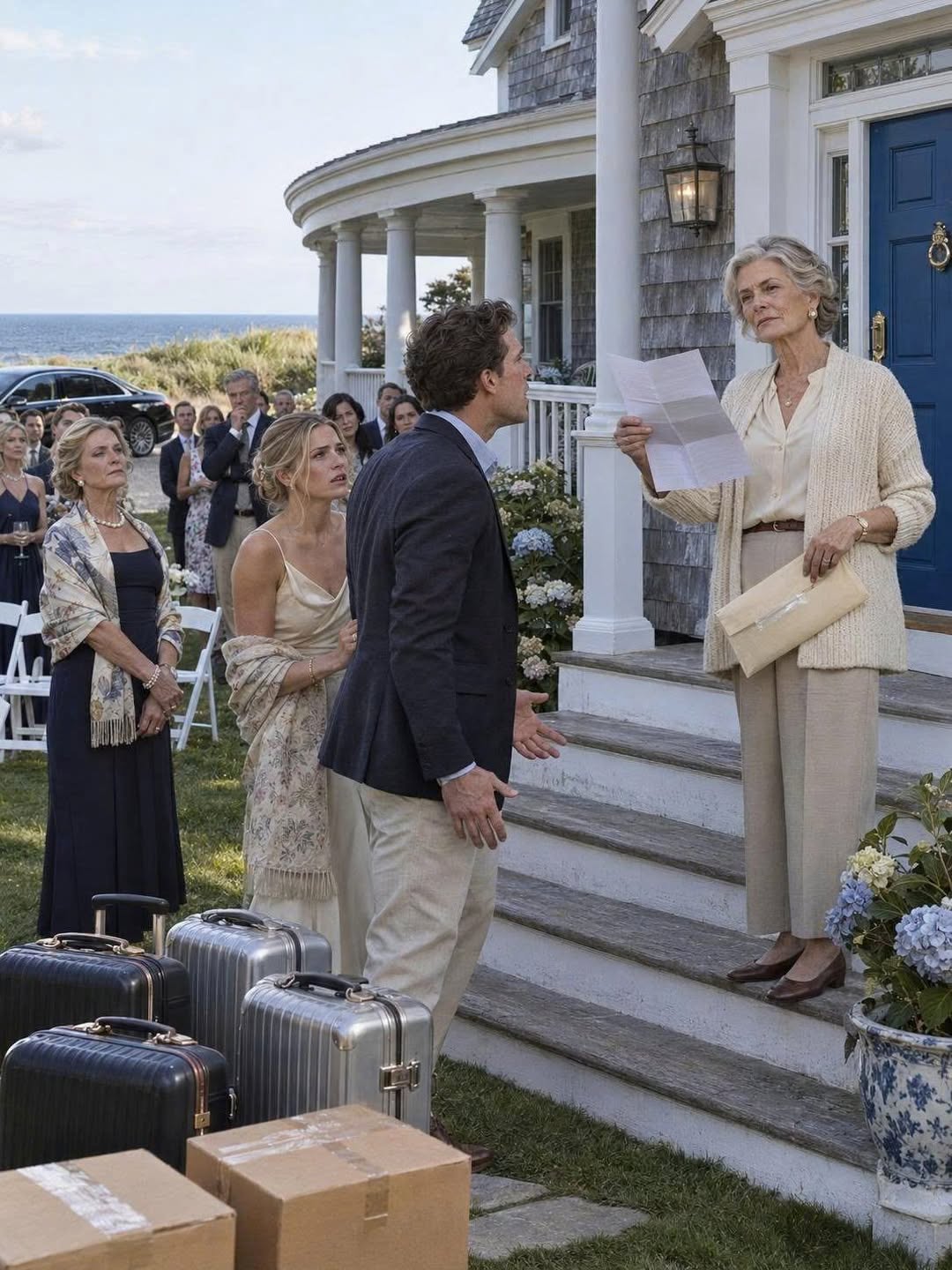
Cullen laughed nervously.
“Mom, please. Don’t turn this into a scene.”
I looked at him.
“You invited thirty-four people to my house to watch you take possession of something that doesn’t belong to you. And now you’re worried about a scene?”
Nobody moved.
I began reading.
“This document is a revocable trust agreement prepared by my attorney on June 14th. It concerns the property located at…”
I read the address.
Everyone recognized it.
It was my beach house.
Cullen stepped forward.
“Exactly! That’s what I’m talking about. The paperwork is done.”
I shook my head.
“No, sweetheart. You haven’t heard the important part.”
I turned to the final page.
The document stated that I remained the sole legal owner of the property. It also established instructions for what would happen to the house after my death.
My intention had been to place the beach house into a family trust, with Cullen as its eventual beneficiary.
I had planned to give him a copy on his wedding day.
Not because he had demanded it.
Because I wanted him to understand that his father and I had spent decades building something that could remain in the family.
But there was another condition.
The trust would only transfer the property after my death, and only according to the terms I had established.
Cullen had no present ownership.
No right to move in.
No authority to sell, rent, borrow against, or occupy the house.
His expression changed.
“But you told me the house would be mine.”
“I told you that I wanted you to inherit it one day. I never told you that it was yours today.”
Blythe suddenly stepped forward.
“That’s not what Cullen told us.”
I looked at her.
“What exactly did he tell you?”
She glanced at her husband.
Then at her parents.
Finally, she said something that made my stomach tighten.
“He said you had already signed everything. He said we could move in as soon as we got back from Hawaii.”
Miles turned toward Cullen.
“You told me the deed was transferred.”
Cullen rubbed his forehead.
“I said the paperwork was being handled.”
“No,” Miles replied. “You said it was finished.”
I unfolded the next page.
“And there’s something else.”
I showed them the section containing my attorney’s instructions.
The trust agreement had never been finalized or recorded as a transfer of ownership. It was a draft awaiting my final approval.
In other words, even the inheritance arrangement had not yet become effective.
Cullen stared at the pages.
Then he looked at me.
“Why would you do this to me?”
I almost laughed.
“Do what to you? Keep ownership of my own house?”
He lowered his voice.
“Mom, you’re embarrassing me.”
That was when I finally understood.
He wasn’t embarrassed that he had lied.
He was embarrassed that his lie had been exposed.
I folded the document and placed it back inside the envelope.
Then I noticed Laurelai whispering something to Miles.
They both looked frightened.
Not disappointed.
Frightened.
And I suddenly remembered the strange phone call Miles had made several days earlier.
The question about the paperwork.
I turned toward him.
“Miles, there’s something I need to ask you.”
He swallowed.
“What’s that?”
“Why were you so interested in whether the paperwork was signed?”
He looked at Cullen.
Cullen looked away.
Nobody answered.
Then Miles quietly said:
“Because my daughter told me the house was being used as security for a business loan.”
My hand tightened around the envelope.
“What loan?”
And that was when the real story began.
PART 3 – THE SECRET THEY NEVER EXPECTED ME TO DISCOVER
For several seconds, nobody spoke.
The ocean was crashing against the rocks behind the house, and a cold breeze moved through the guests standing on my lawn.
I looked at Blythe.
“What business loan?”
She shook her head immediately.
“Dad, don’t.”
Miles ignored her.
“Cullen told me he was arranging financing for a hospitality business. He said the beach house would serve as collateral until the business became profitable.”
I turned toward my son.
“Did you use my house to apply for a loan?”
“No.”
His answer came too quickly.
Miles pulled his phone from his pocket.
“Then explain this.”
He opened an email and showed me a message.
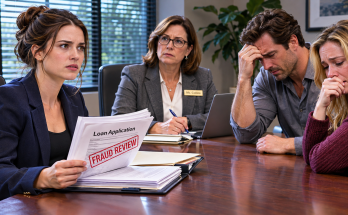
It contained a preliminary loan application.
The property address was mine.
The estimated value was listed as $1.94 million.
And under the section titled Proposed Collateral, someone had entered my beach house.
There was also a scanned copy of a document attached.
I recognized the handwriting immediately.
It looked like mine.
But it wasn’t.
My signature had been copied from an old document.
I felt something cold settle inside my chest.
Cullen stepped forward.
“Mom, I can explain.”
I looked at the paper.
“Did you forge my signature?”
“It’s not what you think.”
“Then tell me what I should think.”
He glanced at Blythe.
She began crying.
“Cullen said you had agreed. He said the house was going to be ours anyway.”
I looked at her.
“You knew I hadn’t agreed to give you the house.”
She didn’t answer.
Laurelai suddenly interrupted.
“This is a family matter. We shouldn’t be discussing financial arrangements in front of all these people.”
I turned toward her.
“You organized a party at my house, invited thirty-four people, and planned to make me hand over my keys in front of them. You don’t get to decide which parts of this are private.”
A few guests lowered their eyes.
One elderly woman quietly stepped away from the group.
Miles was still staring at the email.
Then he said something else.
“There is another attachment.”
He opened it.
It was a proposed agreement describing Cullen and Blythe as the future occupants of the property.
The document included a paragraph stating that I had agreed to surrender possession of the house.
I had never seen it before.
I had never signed it.
And the date on the document was three months earlier.
I looked at my son.
“Cullen, how long have you been planning this?”
He rubbed his face.
“Mom, I was trying to build a future.”
“With my money?”
“With the house.”
“My house.”
He raised his voice.
“You don’t even live here anymore! You have your apartment. What are you going to do with a place this big?”
I stared at him.
I remembered the six summers Nile and I had spent repairing the roof.
The evenings we had painted the shutters.
The mornings when he carried lumber across the porch while I held the other end.
I remembered the hurricane that nearly destroyed everything.
And I remembered Nile telling me that someday our son would understand what the house meant.
Apparently, he didn’t.
I reached for my phone.
I called my attorney, Eleanor.
She answered on the second ring.
“Good afternoon. Is everything all right?”
“No, Eleanor. I have a situation at the beach house. I need you to come here immediately.”
“Is Cullen there?”
I looked at my son.
“Yes.”
There was a pause.
Then she said:
“Don’t sign anything. Don’t hand over any keys. And don’t let anyone remove any additional documents.”
“I understand.”
I ended the call.
Cullen looked furious.
“You called a lawyer?”
“Yes.”
“Against your own son?”
I put my phone away.
“Against anyone who thinks they can take my property without my permission.”
Blythe was crying harder now.
Laurelai tried to pull her aside.
But Miles remained standing in the driveway, looking at the documents on his phone.
Finally, he turned to his daughter.
“Tell me the truth. Did you know the signature wasn’t your mother-in-law’s?”
Blythe looked down.
And then she said:
“I knew the paperwork wasn’t finished.”
It was the first honest thing I had heard from her.
But it wasn’t the last.
PART 4 – THE LETTER MY HUSBAND LEFT BEHIND
Eleanor arrived forty minutes later.
She was sixty-three, wore dark glasses, and carried a leather briefcase she had owned for as long as I had known her.
She greeted me first.
Then she looked at the crowd.
“I assume nobody here has been given permission to occupy this property?”
“No,” I answered.
She nodded.
“Good. Let’s establish that clearly.”
Cullen immediately began explaining.
He told her that his father had always intended for him to inherit the house.
He told her that I had discussed transferring it.
He told her that the family had made plans around the property.
Eleanor listened without interrupting.
Then she opened her briefcase.
“Mr. Cullen, intentions and legal ownership are two different things.”
She placed a certified copy of the current property deed on the porch table.
My name was the only name listed.
She then examined the loan application Miles had received.
Her expression became serious.
“Where did this document come from?”
Miles explained that it had been sent to him by a business associate who had been asked to review the proposed financing.
Eleanor took photographs of the pages.
Then she asked me a question.
“Have you ever authorized anyone to sign your name?”
“Never.”
She nodded.
“Then we’ll preserve these records and address the matter through the appropriate legal channels.”
Cullen began pacing.
“This is ridiculous. I’m her only son!”
Eleanor looked directly at him.
“Being someone’s only child does not make you the owner of their property.”
He stopped.
Then Eleanor turned toward me.
“There’s something else. Did you ever give Cullen the letter from his father?”
I shook my head.
“I was going to give it to him at the wedding.”
Eleanor opened another section of her briefcase.
Inside was a photocopy of a handwritten letter.
Nile had written it shortly before he died.
He had given it to Eleanor with instructions that I should keep it until I believed Cullen was ready to understand it.
I had read it many times.
But I had never shared it.
I took a breath.
“Would you read it?”
Eleanor handed it to me.
My hands trembled slightly as I unfolded the page.
The handwriting was unmistakably Nile’s.
I began reading aloud.
My dear Cullen,
If you’re reading this, I hope your mother has finally decided that you’re ready to understand what this house means.
Your mother and I did not build this place because it was expensive. We built it because it gave us somewhere to begin again.
When the hurricane damaged our home, we could have walked away. Instead, your mother insisted we rebuild.
I watched her carry wood, paint walls, repair windows, and work until her hands hurt.
I learned something during those summers.
The value of a home is not measured by what someone would pay for it.
It is measured by what the people inside it are willing to protect.
I stopped reading.
My eyes were filling with tears.
Eleanor waited.
Then I continued.
If this house ever becomes yours, I hope you remember that inheritance is not an entitlement.
It is a responsibility.
Never make your mother feel like a guest in the place she helped build.
Never confuse money with love.
And never take something from her simply because you believe you deserve it.
Love, Dad.
Nobody spoke.
Even Laurelai had stopped moving.
Cullen stared at the ground.
For the first time that afternoon, he looked like the little boy who used to sit beside his father on the porch.
I folded the letter.
“I wanted to give you this on your wedding day,” I told him.
He looked up.
“Mom…”
“But you weren’t there to receive it.”
He wiped his face.
“I didn’t know you were going to give me that.”
“You didn’t know because you never asked.”
Blythe quietly stepped away from him.
Miles put his phone back in his pocket.
And Eleanor closed her briefcase.
“Now,” she said, “I believe everyone needs to leave this property.”
Laurelai protested.
“But we have guests!”
Eleanor looked at the chairs, decorations, and tables.
“Then you should inform them that the event has been canceled.”
One by one, people began leaving.
Some apologized.
Some avoided looking at me.
A few stopped to tell me that they had been given a very different version of the story.
By sunset, the lawn was empty.
Except for the suitcases.
And my son.
PART 5 – THE CHOICE I MADE ABOUT MY SON
Cullen stayed behind.
Blythe had left with her parents.
He stood near the front steps, looking at the blue door his father had painted.
“Can I talk to you alone?”
I nodded.
We sat on the porch.
For several minutes, neither of us spoke.
Then he finally said:
“I made a mistake.”
I looked at him.
“A mistake is forgetting someone’s birthday. What you did was something else.”
He nodded.
“I know.”
“Why did you tell people I was sick?”
He looked uncomfortable.
“Blythe thought it would be easier.”
“Easier for whom?”
He didn’t answer.
“Why wasn’t I invited?”
He stared at his hands.
“The wedding was expensive. Her family wanted a certain kind of event. They thought it would look better if it was smaller and more exclusive.”
“So you decided I didn’t belong?”
“No. That’s not what I meant.”
“Then what did you mean?”
He took a long breath.
“I was afraid you’d embarrass me.”
That sentence hurt more than the others.
I looked toward the sea.
For years, I had believed that being a good mother meant making sacrifices.
I had paid for his education.
Helped him through difficult periods.
Lent him money when his business struggled.
And whenever he made a mistake, I had found a way to help him start again.
Perhaps I had helped him too much.
Perhaps I had made it easy for him to believe that my love would always come without boundaries.
“I need you to understand something,” I said.
“I love you. That hasn’t changed.”
He looked at me.
“But loving you doesn’t mean allowing you to lie about me, disrespect me, or take what belongs to me.”
He began crying.
“I don’t want to lose you, Mom.”
“Then stop treating me like someone you can use.”
He nodded.
I told him that the house would remain mine.
The trust arrangement would be reviewed with Eleanor, and I would decide its future independently.
Any attempt to use my signature or property without authorization would be handled formally.
There would be no immediate transfer.
No free occupancy.
No promises made behind my back.
And there would be no more financial rescues.
He asked whether I would forgive him.
I told him forgiveness wasn’t a switch I could turn on simply because he had apologized.
Trust would have to be rebuilt.
Slowly.
Honestly.
And without expecting a reward.
He sat beside me until the sun disappeared.
Then he stood.
“Can I at least take my suitcases?”
I almost smiled.
“They’re yours.”
He carried them to his car.
Before leaving, he turned around.
“Mom?”
“Yes?”
“I’m sorry I didn’t invite you.”
I nodded.
“Good night, Cullen.”
He drove away.
And for the first time in twelve days, I slept peacefully.
PART 6 – THE CONSEQUENCES OF THEIR LIES
The following weeks were difficult.
Eleanor helped me preserve every document connected to the attempted property transaction.
She also arranged for the suspicious paperwork to be reviewed by the appropriate professionals.
I learned that the loan application had never been approved.
The lender had requested additional verification before proceeding.
That was fortunate.
The forged signature and false representations were serious matters, and Eleanor advised me not to handle them through family arguments or private promises.
Meanwhile, Cullen and Blythe’s marriage began experiencing problems.
I didn’t celebrate that.
I didn’t want their marriage to fail.
But I also couldn’t pretend their decisions had no consequences.
Blythe eventually contacted me.
She sent a long message explaining that Cullen had told her the house was already his.
She said she had believed the arrangement was legitimate.
Then she admitted something else.
She had seen the missing photograph of Nile in the drawer.
She knew it was important.
She had not put it back.
I read the message twice.
Then I replied:
“You don’t have to love me. You don’t even have to like me. But you should never have treated my husband’s memory as something that could be put away because it didn’t match your plans.”
She apologized.
I didn’t respond immediately.
A few days later, Laurelai called.
Her tone was completely different.
She said she was sorry that the welcome-home gathering had become unpleasant.
I corrected her.
“It wasn’t unpleasant because of the gathering. It was wrong because you organized it without my permission.”
She was silent.
Then she said:
“I thought we were doing what was best for the children.”
I answered quietly.
“Sometimes what is best for children is learning that other people have rights, too.”
That was the end of our conversation.
Cullen eventually moved into a small rental apartment.
He found temporary work while trying to reorganize his finances.
Blythe stayed with her parents for a while.
Their relationship became strained, and they began attending counseling.
I didn’t involve myself.
They were adults.
They needed to work through their own decisions.
One afternoon, about two months after the incident, Cullen sent me a photograph.
It was of the old wedding cake.
The miniature beach house was still sitting on top.
Beneath the photograph, he wrote:
I should never have made you feel like you were less important than a house.
I looked at the photograph for a long time.
Then I put my phone down.
Because the truth was that it had never been about the house.
It had been about the way he had treated the woman who gave him everything she could.
PART 7 – THE HOUSE THAT FINALLY BECAME A HOME AGAIN
Six months passed.
I returned to the beach house every weekend.
I repaired the porch railing.
Repainted the blue door.
And placed Nile’s photograph back on the mantel.
I also made one important decision.
I no longer wanted the house to be a prize waiting for someone to inherit.
I wanted it to mean something while I was still alive.
So I spoke with Eleanor about establishing a charitable program using part of the property’s future proceeds.
The plan was simple.
A portion of the eventual estate would support families rebuilding homes after natural disasters.
I had seen what a hurricane could take away.
And I knew what it meant to rebuild when everything seemed lost.
The remaining inheritance arrangements would be handled according to the final documents I approved, not according to anyone else’s expectations.
The house would not be transferred simply because someone demanded it.
It would be protected.
One Sunday morning, Cullen called.
His voice sounded different.
Quieter.
“Mom, could I visit?”
I looked out toward the water.
“Yes.”
“Would that be okay?”
“You don’t need an invitation to have a conversation with your mother. But you do need to respect her home.”
He laughed softly.
“I understand.”
He arrived that afternoon alone.
No expensive car.
No crowd.
No decorations.
Just my son carrying a small paper bag.
Inside was a framed photograph of Nile.
It was an old picture I hadn’t seen in years.
His father was standing on the porch, holding a paintbrush, with Cullen sitting on his shoulders.
I couldn’t speak for a moment.
“Where did you find this?”
“In Dad’s old toolbox. I found it when I was going through some things.”
I held the frame against my chest.
“Thank you.”
We sat together for an hour.
We talked about his father.
About the hurricane.
About the summer we rebuilt the porch.
He asked questions he had never asked before.
And for once, I felt that he was listening.
Before he left, he stood at the front door.
“Mom, I know things won’t go back to how they were.”
“No,” I said. “They won’t.”
He nodded.
“But maybe we can build something better.”
I looked at him.
“Maybe. But this time, we’ll build it honestly.”
He hugged me.
It wasn’t a perfect reconciliation.
There were still legal matters to resolve.
There were still apologies that needed to become actions.
And there were boundaries that would remain in place.
But it was a beginning.
After he left, I walked out onto the porch.
The sun was setting.
The waves were rolling toward the shore.
I looked at the blue door Nile had painted fourteen years earlier.
Then I remembered his letter.
Never make your mother feel like a guest in the place she helped build.
I finally understood that the most important thing I had protected wasn’t the $1.94 million property.
It was my dignity.
My memories.
And the right to decide what happened to the life my husband and I had built together.
I still loved my son.
I probably always would.
But I had learned something at seventy-one that I wished I had learned much earlier.
Being a mother does not mean surrendering your identity, your home, or your self-respect.
And an inheritance is not something a child can demand.
It is something a parent chooses to leave.
That evening, I placed two cups of coffee on the porch table.
One for myself.
And one beside Nile’s photograph.
For the first time in a long while, the house felt peaceful again.
And nobody was waiting outside for my keys.
THE END.