I thought opening the door would be the hardest part.
I was wrong about what would stay with me.
The wooden dowel was out of the track.
The sliding door could move again.
Zach and Jodie were no longer standing in the freezing Ohio weather.
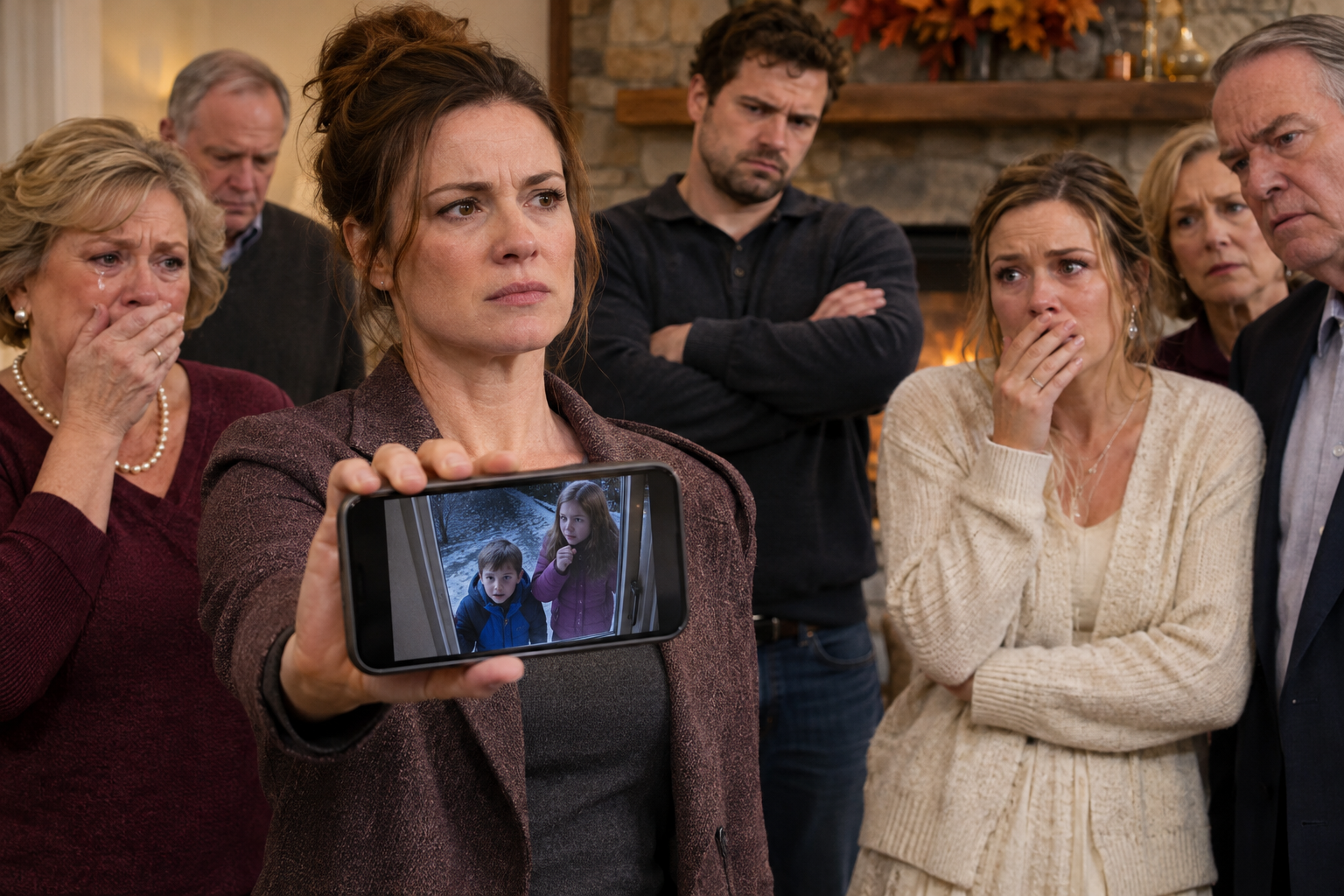
But I couldn't stop seeing them on the other side of the glass.
My six-year-old son trembling.
My nine-year-old daughter holding him.
Both of them waiting for someone to let them inside.
I remembered the way Zach had stumbled toward me.
His fingers had touched my neck.
They were painfully cold.
I had pulled him close without thinking.
Then Jodie had come through the doorway.
Her cheeks were red.
Her knuckles were pink.
She had looked at me and told me she had tried to get somebody's attention.
I believed her.
There was no reason not to.
And when I had asked why nobody opened the door, she had looked toward Roland.
My brother.
The same man who had been eating one of the dinner rolls I had made that morning.
The same man who had spoken about my children as though they were somehow less deserving than the people sitting at the table.
I could still hear the meaning of his words.
He thought the people he considered real family should eat first.
My children could wait.
That was what he had made clear.
I looked around my parents' kitchen.
Pearl had been eating when I noticed the children.
Harold had just come in from the garage.
Roland had been seated at the table.
Those were the facts.
I didn't know everything that had happened before I entered.
I didn't know who had first picked up the dowel.
I didn't know how long the children had been unable to open the door.
And I wasn't going to pretend I did.
But I knew the door had been deliberately blocked.
I knew my children had been outside.
I knew Jodie had knocked.
And I knew I was the one who removed the wood so they could come inside.
That was enough to change the way I looked at the room.
I had always thought of my parents' kitchen as a place where my children belonged.
Not because they had earned a seat.
Not because they had pleased anybody.
Simply because they were family.
I hadn't expected that to be questioned.
I certainly hadn't expected the question to be answered by leaving two children outdoors in the cold.
I looked at Zach again.
He was six years old.
Whatever the adults believed about family, none of it should have been placed on him.
He should not have had to understand why he was being excluded.
He should not have needed to wonder why the door wouldn't open.
He should not have been standing outside trembling while dinner continued a few feet away.
Jodie was only nine.
Yet she had put her arms around him.
She had tried to protect him from the wind.
That detail hurt more each time I remembered it.
She had recognized that her little brother needed help.
She had done what she could.
And the people inside had not opened the door before I reached it.
I looked toward the table again.
There were the rolls I had made.
Ordinary Thanksgiving food.
Something I had prepared because I expected us to share a meal.
I hadn't spent the morning thinking about which relatives deserved to eat.
I hadn't divided the family into categories.
I had made bread.
For Thanksgiving.
For the people gathered there.
And now that ordinary act felt different.
Roland had eaten what I brought while speaking about my children as though they did not have the same right to be included.
I couldn't make that contradiction disappear.
I had contributed to a meal where my children were being kept outside.
I had expected the family gathering to include them.
Roland had said otherwise.
The glass door stood open now.
That should have made everything feel settled.
But opening a door did not undo what had already happened.
It didn't erase the cold from Zach's hands.
It didn't erase the redness from Jodie's cheeks.
It didn't erase the fact that somebody had placed a piece of wood in the track to prevent the door from sliding.
I kept thinking about that dowel.
It had been so easy to remove.
One movement.
Then the door opened.
The simplicity bothered me.
Nobody needed special tools.
Nobody needed to repair anything.
The children hadn't been trapped by a broken door.
The obstruction had been put there.
And until I removed it, they couldn't get inside.
I knew I would remember that piece of wood long after I forgot the rest of the Thanksgiving meal.
I would remember how small it was.
How ordinary.
And how much it had meant to two children standing in freezing weather.
I looked at my mother.
Pearl was someone I had expected to care about Zach and Jodie.
I couldn't tell myself what she was thinking.
I couldn't claim to know why she hadn't moved before I reached the door.
But I had seen her continue eating.
That image stayed with me.
My father had come from the garage.
I didn't know what Harold had seen before entering the kitchen.
I could not fairly claim he had witnessed everything.
Still, the sight of both my parents in that room made me realize how much I had assumed about family gatherings.
I had assumed somebody would notice if my children needed help.
I had assumed a closed door would be opened.
I had assumed nobody would treat Zach and Jodie as outsiders.
Those assumptions had seemed so ordinary that I had never put them into words.
Now I wished I had never needed to question them.
I looked at Roland.
I didn't need to invent an explanation for his behavior.
He had already expressed how he regarded my children.
He had made a distinction between them and the people he considered proper family.
That distinction had been cruel.
It was especially cruel because he had said it while the children were outside.
He wasn't discussing an abstract question about relationships.
He was talking about Zach and Jodie.
Two children who were cold.
Two children who wanted to come inside.
I looked at them again.
Neither child had done anything that could justify being left outdoors.
Not that anything could have justified that treatment.
They were children.
That should have been the end of the discussion.
I didn't know whether Zach would remember Roland's words.
I didn't know how much he had heard.
I didn't know what Jodie had understood before I opened the door.
I only knew she had looked toward my brother when I asked why nobody helped them.
She had given me an answer without needing a long explanation.
That look carried more weight than I wanted it to.
I couldn't ask her to pretend nothing had happened.
I couldn't expect Zach to forget the cold simply because he was indoors again.
And I couldn't tell myself the whole thing was harmless because we were related.
Being family didn't make the children less cold.
It didn't make the dowel disappear from the memory of what happened.
It didn't make Roland's words acceptable.
I had to admit something I didn't want to admit.
Before that afternoon, I had expected the word family to mean protection.
I had expected it to mean belonging.
I had expected it to mean that Zach and Jodie would be welcome in my parents' home.
But a word was not the same thing as an action.
Roland had used the idea of family to exclude them.
Jodie had shown what caring for family looked like when she wrapped her arms around Zach.
The difference was impossible to ignore.
One person had spoken about who belonged.
A child had tried to keep another child warm.
I knew which of those actions mattered more.
I thought about the first thing I had seen through the glass.
Zach shaking.
Jodie holding him.
The wind moving around them.
I had stood there for a moment, unable to understand why they weren't inside.
Then I had noticed the wood.
I remembered the sudden realization that the door had been blocked.
I remembered pulling the dowel free.
I remembered Zach moving toward me.
Those moments would not become less important simply because the children were safe from the cold now.
They had happened.
And I had witnessed them.
I didn't know what the rest of that Thanksgiving would bring.
The portion of our family's story I could account for ended in that kitchen, with my children inside and my brother still at the table.
But one thing had already changed.
I no longer believed that sharing a family name guaranteed my children would be treated with kindness.
I could not control what Roland believed about belonging.
I could not change the words he had already spoken.
I could not give Zach and Jodie back the moments they spent outside.
But I could recognize the difference between the people who spoke about family and the child who had actually protected someone she loved.
I looked at Jodie.
Then at Zach.
They were both inside.
They were both with me.
For that moment, those were the facts I wanted to hold on to.
The Thanksgiving table was still there.
The food was still there.
The people I had known as family were still in the room.
But I could no longer look at the gathering in quite the same way.
I had entered expecting an ordinary holiday meal.
I had found my children shut outside.
And I had learned that when a door needed opening, I could not simply assume somebody else would do it.
Click here to continue reading: PART 5: I Left Thanksgiving Dinner With Two Cold Children and Finally Understood Why My Brother Had Never Treated Them Like His Own Family
I Walked Into My Parents’ Kitchen Expecting Thanksgiving Dinner, but My Brother Had Decided Which Children Deserved a Place at the Table
Part 4 of 10