Christmas morning was quieter than the ones I remembered.
There was no rush to get ready.
No argument about what time we needed to leave.
No worrying about whether my mother would be disappointed if we arrived late.
My daughter and I stayed home.
I woke to the sound of something moving in the kitchen.
For a moment, I thought I had overslept.
Then I remembered.
We didn't have anywhere we were expected to be.
I got out of bed and walked down the hallway.
My daughter was standing near the kitchen table.
She was wearing her pajamas.
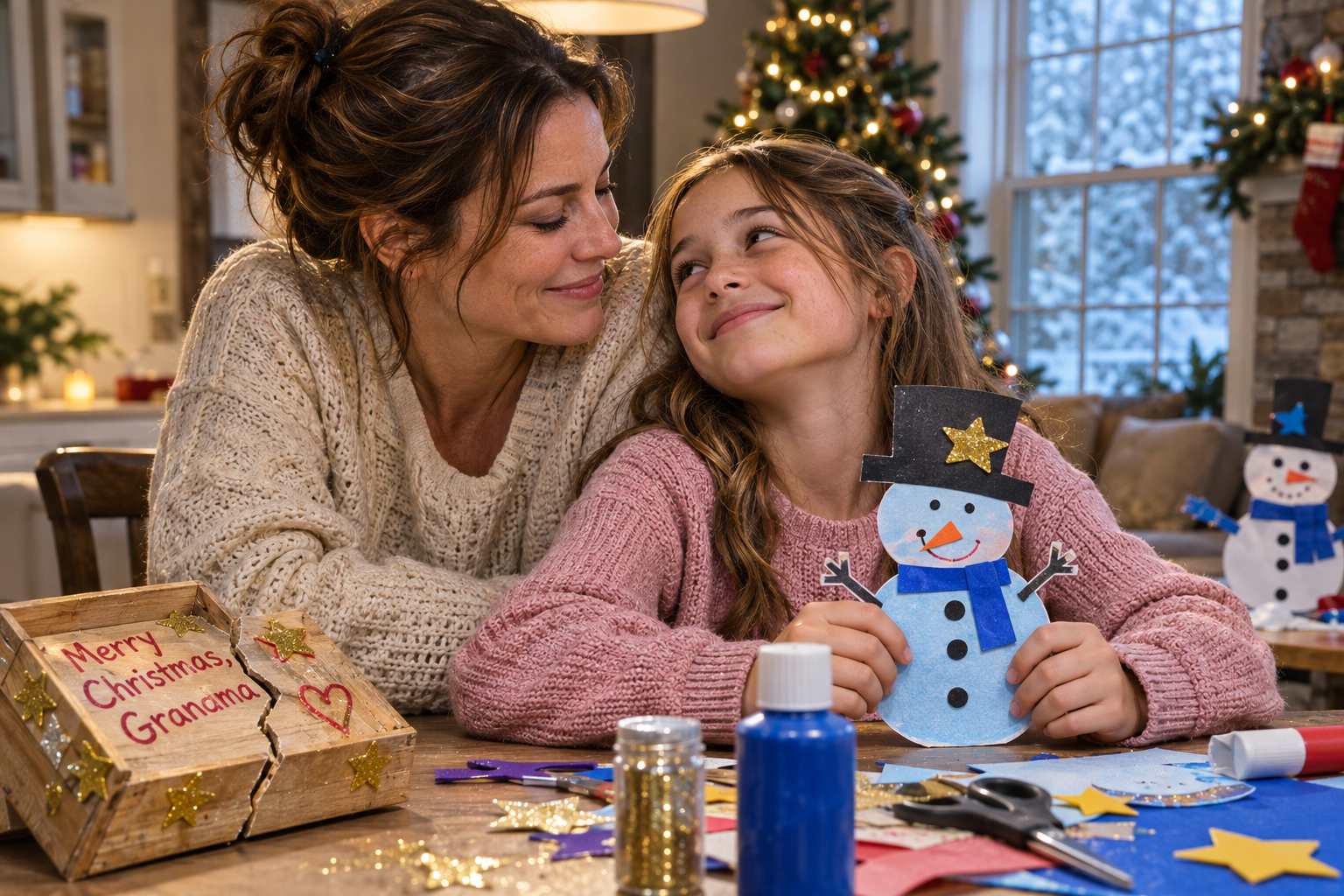
The blue paper snowman sat beside a small stack of decorations.
She looked up when she heard me.
“Merry Christmas, Mom.”
I smiled.
“Merry Christmas, sweetheart.”
She came over and hugged me.
I held her longer than usual.
Then she stepped back.
“Can we make pancakes now?”
I laughed.
“That's the first thing you want?”
She nodded seriously.
“Christmas pancakes.”
I agreed.
We made breakfast together.
She helped with the ingredients.
I watched the pan.
She decided the pancakes needed to be different sizes.
One large.
One small.
One that came out shaped like something neither of us could identify.
She laughed at that one.
I put it on her plate.
We sat at the table together.
No one was missing an invitation.
No one was competing for a bigger present.
No one was telling her she was less important than another grandchild.
It was simply our Christmas.
For the first time in several days, I didn't check my phone before breakfast.
I didn't want my family deciding how our morning would feel.
My daughter talked about the decorations she had made.
She wanted to keep the blue snowman even after Christmas.
I told her that was fine.
She asked whether we could go skating again during the school break.
I promised we would make time.
Then she looked at me.
“Are you happy, Mom?”
I thought about the question.
I wasn't happy about everything that had happened.
My mother had hurt my child.
My parents had involved the police in a dispute over my own vehicle.
My sister had used my signature without permission on a financial document.
Those things didn't disappear because we were having pancakes.
But sitting across from my daughter, watching her smile, I felt something I hadn't felt in a long time.
Peace.
“Yes,” I said. “I'm happy to be here with you.”
She smiled.
“Me too.”
After breakfast, we opened our presents.
I had been worried that she would feel disappointed.
That she would compare our quiet celebration to the larger gathering at Grandma's house.
But she seemed content.
She took her time.
She wanted to show me each thing.
And when she opened her craft supplies, she immediately started talking about what she could make.
I listened.
I didn't rush her.
There was no schedule to follow.
Later, she brought out the decorations she had been working on.
She wanted to make a little Christmas display.
We cleared a space.
She arranged the snowmen.
Then she added a few felt stars.
I noticed that she had used some of the same colors as the wooden gift box she had made for her grandmother.
Blue.
Gold.
Red.
I didn't mention the broken box.
But I remembered it.
The crooked heart.
The glitter.
The words she had written so carefully.
I wondered whether she was thinking about it too.
Then she held up another piece of paper.
“Does this look okay?”
I looked at it.
“It's beautiful.”
She grinned.
And kept working.
Around midday, my phone began vibrating.
I glanced at the screen.
My mother.
I let the call go unanswered.
A message arrived afterward.
She wished us a merry Christmas.
She said she hoped my daughter was doing well.
It was the first message from her in days that asked about my child without also demanding something from me.
I read it carefully.
Then I put the phone down.
I wasn't ready to turn one pleasant message into a reconciliation.
My daughter noticed.
“Was that Grandma?”
“Yes.”
“What did she say?”
“She wished us a merry Christmas.”
My daughter looked at the table.
Then she asked whether Grandma was still having the family gathering.
“I think so.”
She nodded.
For a moment, I thought she might ask why we weren't there.
Instead, she returned to her decorations.
I felt relieved.
And a little sad.
Because I knew she had stopped expecting something from her grandmother that she once took for granted.
A place at Christmas.
I didn't know how long that feeling would last.
I didn't know whether their relationship could be repaired.
But I wasn't going to force it.
That afternoon, Stacy stopped by.
She brought a small gift for my daughter.
My daughter was delighted.
She showed Stacy the blue snowmen.
She explained how we had made them.
Stacy listened as though every detail mattered.
I watched them together.
It reminded me that family wasn't the only place a child could find kindness.
People who cared could show it in ordinary ways.
By listening.
By remembering.
By making time.
Stacy stayed for a while.
We talked over coffee.
She asked whether anything had changed with the financial agreement.
I told her the attorney was working to complete the necessary steps.
My sister had acknowledged copying my signature.
The agreement was being withdrawn.
And I had made clear that I would not accept responsibility under it.
Stacy looked relieved.
“That's good.”
“It is.”
“Are your parents still asking for money?”
“Not the way they were.”
I didn't tell her that everything had become easy.
It hadn't.
My parents were adjusting to a situation they had avoided for a long time.
The SUV was no longer available to them.
The voluntary payments I had been covering were ending or had already stopped.
They needed to make decisions about their own finances.
I knew that was difficult.
But difficulty didn't make the old arrangement fair.
And it didn't justify creating false paperwork.
A few days after Christmas, my attorney contacted me.
The disputed financial agreement had been formally withdrawn by the family members who had been relying on it.
My sister's written explanation had been preserved.
The document would no longer be presented as evidence that I had agreed to continue supporting my parents.
I read the update twice.
Then I asked whether there was anything else I needed to do immediately.
We discussed the records that should be retained and the importance of ensuring no separate obligations remained outstanding in my name.
I followed the advice.
I didn't destroy the documents.
I didn't delete the messages.
I kept the full record.
I wanted the matter settled.
But I also wanted to be prepared if anyone tried to revive the same claim.
There was no dramatic courtroom scene.
No judge reading a shocking document aloud.
No crowd watching my sister admit what she had done.
The truth emerged through questions, records, and her own written explanation.
That was enough to change the situation.
The agreement had claimed I was obligated to keep supporting my parents.
My sister had admitted that she put my signature on it without permission.
And the people who relied on it had withdrawn their claim.
I felt relieved.
Not triumphant.
Relieved.
For days, I had been forced to defend myself against something I hadn't knowingly agreed to.
Now that dispute was no longer hanging over me in the same way.
My parents still had their financial problems.
My sister still had to live with what she had done.
And I still had to decide what kind of relationship I wanted with them.
Those were separate questions.
I wasn't going to confuse them anymore.
My father contacted me after the agreement was withdrawn.
He said he and Mom were working out how to manage without my regular contributions.
They had begun reviewing their expenses.
They were making transportation arrangements.
He didn't sound pleased.
But he wasn't demanding that I return the SUV.
I listened.
Then I told him I hoped they would find a manageable solution.
He thanked me.
There was a silence.
Then he said something unexpected.
“We shouldn't have called the police.”
I looked toward the window.
My SUV was parked outside.
The same vehicle I had bought before my husband became sick.
The same one I had lent my parents when Dad's truck stopped working.
The same one they had reported stolen after I reclaimed it.
“No,” I said. “You shouldn't have.”
He sighed.
“I was angry.”
“I know.”
“I thought you'd change your mind if you understood how badly we needed it.”
I felt my stomach tighten.
“So you used the police report to pressure me?”
He didn't answer directly.
But he didn't deny being angry about losing the vehicle.
I told him the report had frightened my daughter.
He became quiet.
“She saw the officers at our door,” I continued. “She thought they were there because Grandma didn't want her at Christmas.”
He exhaled slowly.
“I didn't think about that.”
Those words were familiar.
My mother hadn't thought about how the message would affect my daughter.
My father hadn't thought about what the police visit would do to her.
My sister hadn't thought about the consequences of using my signature.
They had all been thinking about what they wanted.
And I had spent years helping them get it.
I didn't say all that aloud.
I simply told Dad that his actions had consequences.
He said he understood.
I hoped he did.
But understanding was something he would have to demonstrate over time.
Not something I could accept because he said it once.
My sister sent a message later that week.
She apologized for preparing the agreement and copying my signature.
She acknowledged that she should never have done it.
She also admitted that accusing me of pretending not to remember signing it had been wrong.
I read her message carefully.
It was more direct than anything she had said before.
There were no excuses about trying to help our parents.
No claim that I was overreacting.
No demand that I restore the payments.
She simply acknowledged what she had done.
I appreciated that.
But appreciation wasn't the same as immediate forgiveness.
I answered.
“Thank you for acknowledging it. I need time before we can rebuild trust.”
She replied that she understood.
I put the phone away.
I didn't feel the need to explain further.
For once, my feelings didn't have to be defended in a long conversation.
Then came my mother's message.
It arrived one evening while my daughter was reading in the living room.
Mom said she had been thinking about Christmas.
She apologized for sending the exclusion message directly to my daughter.
She admitted that she should have spoken to me rather than making a ten-year-old feel responsible for other children's feelings.
I sat down to read the rest.
She wrote that she hadn't understood how hurtful her decision would be.
She said she wanted an opportunity to apologize to my daughter.
I looked across the room.
My daughter was comfortable on the couch.
Her feet were tucked beneath a blanket.
The blue snowman was still on display.
I thought about how much effort it had taken to help her feel safe and happy again.
I wasn't going to hand that progress back to someone simply because she wanted forgiveness.
I answered my mother.
“I appreciate your apology. My daughter needs time, and I won't pressure her to talk before she's ready.”
Mom replied that she understood.
I hoped she meant it.
A little later, I sat beside my daughter.
I didn't want to hide something important from her.
But I also didn't want to make her responsible for an adult relationship.
“Grandma sent me a message,” I said.
She looked up.
“Is she mad?”
“No.”
“What did she say?”
“She said she was sorry about telling you not to come for Christmas.”
My daughter was quiet.
I let her think.
Then she asked something that surprised me.
“Did she say why she did it?”
I considered the answer.
“She said she was trying to make the holiday easier for your cousins.”
My daughter looked down.
“But it made it harder for me.”
“I know.”
She held her book against her chest.
Then she asked whether she had to call Grandma.
“No.”
“Even if she's sorry?”
“Even then.”
She seemed relieved.
I continued gently.
“You can decide when you're ready to talk. You don't have to make someone else feel better before you've had time to feel better yourself.”
She nodded.
Then she leaned against me.
I put my arm around her.
We sat together for a while.
I didn't ask her to forgive.
I didn't tell her that Grandma meant well.
I didn't ask her to forget the message.
I let her have her feelings.
That was something I wished I had learned sooner.
The following weeks were quieter.
My parents stopped expecting me to cover their household expenses.
They had to make choices about what they could afford.
My father arranged transportation without relying on my SUV.
My sister no longer handled any financial arrangements involving my name.
And I kept my documents organized.
The title remained in my folder.
The bank records stayed filed.
The disputed agreement and my sister's admission were preserved with the attorney's correspondence.
I didn't consider those papers trophies.
They were reminders.
Reminders that generosity needed boundaries.
That family relationships didn't eliminate the need for consent.
And that I shouldn't be ashamed of asking questions when someone claimed I owed them something.
I also began doing something I hadn't done consistently before.
I reviewed my own finances.
Not because I was afraid of helping people.
I still believed in helping.
But I wanted to make deliberate decisions.
I wanted to know where my money went.
What I had promised.
What I could afford.
And whether the people receiving my help respected the difference between a gift and an obligation.
The SUV stayed with me.
Sometimes I used it.
Sometimes it sat in the driveway.
I didn't need to justify keeping it.
It belonged to me.
That simple fact had become important in a way I never expected.
One afternoon, my daughter asked if we could go skating again.
I agreed.
We returned to the rink.
She held my hand as we stepped onto the ice.
At first, she moved carefully.
Then she grew more confident.
She let go for a few seconds.
I watched her glide forward.
Not far.
Just enough to make her proud.
“Mom, did you see?”
“I saw.”
She laughed.
Then she reached for my hand again.
We skated together.
I thought about the first time we'd come.
How frightened and unhappy she had been.
How grateful I'd felt just to hear her laugh.
Now she was looking forward instead of down.
I knew that didn't mean every hurt was gone.
But she was learning that she could still enjoy her life.
And I was learning that protecting her didn't always require a confrontation.
Sometimes it meant saying no.
Sometimes it meant leaving a gathering.
Sometimes it meant refusing to let other adults place their comfort ahead of a child's dignity.
And sometimes it meant spending an afternoon holding her hand on the ice.
Later that evening, we returned home.
She took off her shoes near the door.
Then she went to the living room.
I followed her.
The two blue paper snowmen were still on display.
One had a bent arm.
The other had a felt star that wasn't quite straight.
My daughter looked at them.
“Can we keep these until next Christmas?”
I smiled.
“Absolutely.”
She looked pleased.
Then she asked whether we could make more decorations next year.
“Of course.”
She began planning immediately.
Different colors.
More stars.
Maybe another little box.
I felt something catch in my throat when she mentioned that.
But I didn't interrupt.
She wasn't talking about replacing the gift she had broken.
She was talking about making something new.
Something she wanted to make for herself.
And I understood how important that was.
That night, after she went to bed, I sat alone in the kitchen.
The financial folder was closed.
My phone was quiet.
The SUV keys were in the drawer.
Everything looked ordinary.
The same kitchen counter.
The same table.
The same house where my daughter had handed me her phone and asked whether she had done something wrong.
I thought about the woman I had been that afternoon.
I had believed keeping my family together meant absorbing whatever discomfort came my way.
I had believed being a good daughter meant saying yes whenever my parents needed me.
I had believed silence could preserve peace.
But silence hadn't protected my daughter.
It had only made it easier for other people to ignore her feelings.
I couldn't change the past.
I couldn't bring her father back.
I couldn't make my mother become the grandmother I had hoped she would be.
And I couldn't guarantee that my sister would never betray my trust again.
But I could choose what happened in my own home.
Who was welcome.
What behavior I accepted.
What financial commitments I made.
And what I taught my daughter about her own worth.
I thought about the little wooden box.
The gold stars.
The glitter.
The crooked heart.
The broken lid I had found in the trash.
For a while, I had seen that box as proof of what my family had taken from her.
But I no longer wanted that to be the only thing I remembered.
I wanted to remember the blue snowman too.
The pancakes.
The ice rink.
Her laughter.
The Christmas morning when she no longer had to wonder whether she was wanted.
I had spent years trying to make sure everyone in my family had enough.
Enough money.
Enough help.
Enough comfort.
Enough reasons to be happy.
But the person who needed me most was the little girl sleeping down the hallway.
She didn't need me to pay everyone's bills.
She didn't need me to keep peace with people who mistreated her.
She needed me to believe her when she was hurt.
To stand beside her.
And to show her that being excluded did not make her less valuable.
I looked at the blue snowmen one last time.
Then I turned off the kitchen light.
The agreement was withdrawn.
The SUV was mine.
The financial arrangements had changed.
My family relationships were still being rebuilt, slowly and carefully.
But my daughter no longer had to earn her place at our Christmas table.
She already belonged there.
And she always would.
The End
Read more original stories on Feel Every Story.
My Daughter Had Made Her Grandmother a Christmas Present, but One Message Made Her Wonder Whether She Belonged in Our Family
Part 10 of 10