
I used to believe that seven days was too short a time for someone's whole world to change.
Then my eighty-year-old mother came home from a visit, and I almost failed to recognize her.
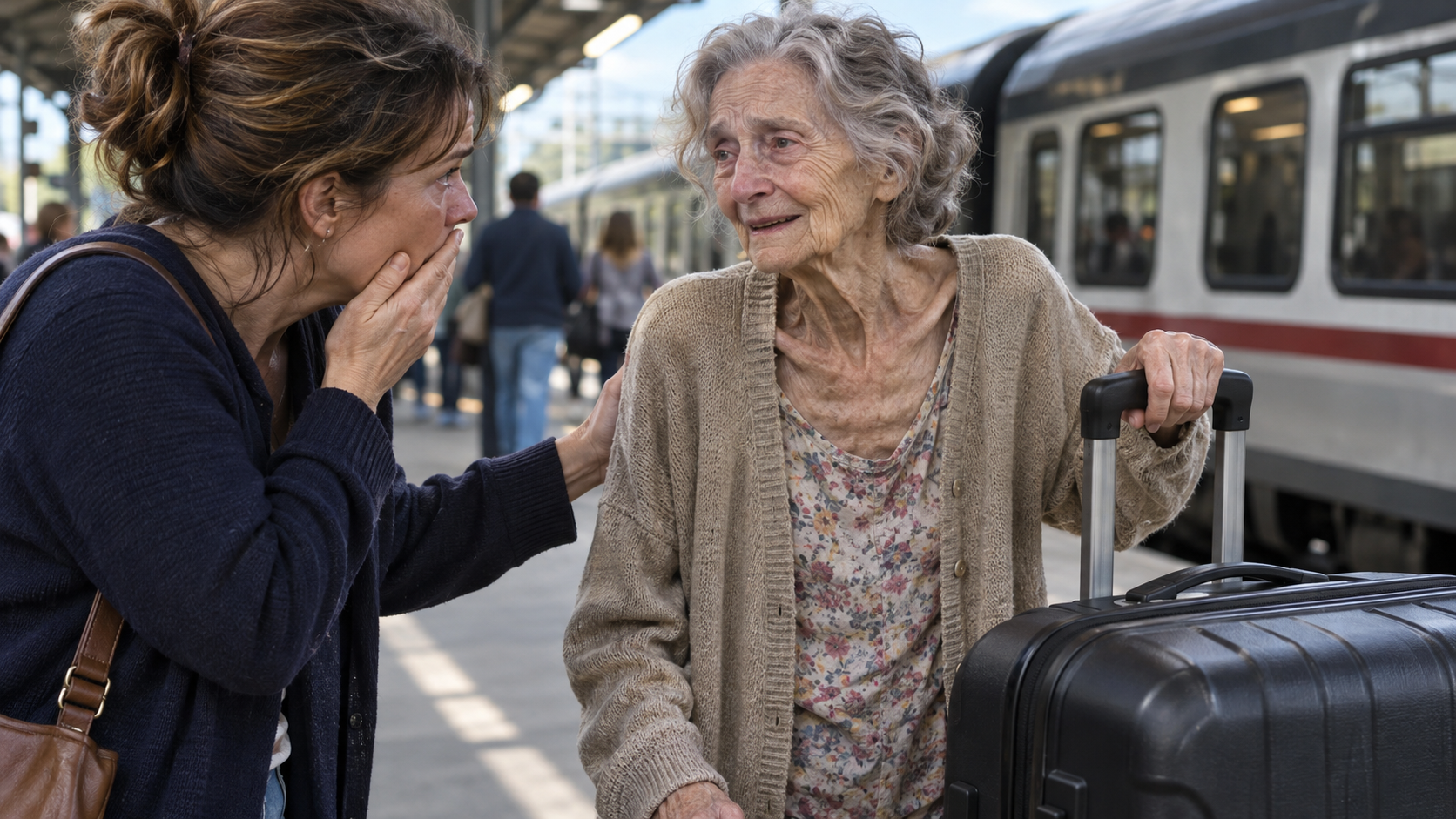
I was standing at the train station when I first saw her.
For a moment, I thought I had mistaken another elderly woman for my mother.
The woman walking toward me was thin.
Not a little thinner.
Frighteningly thin.
Her clothes seemed too large for her body, and she was pulling a heavy-looking black suitcase behind her.
I kept looking at her face.
I knew that face.
I had known it my entire life.
But something about it was terribly wrong.
Seven days earlier, my mother had been a cheerful woman with round cheeks and a comfortable figure.
She had never been particularly concerned about her weight.
She enjoyed food.
She enjoyed preparing it even more.
Baking was one of the small pleasures that made her happy.
She was the kind of woman who could spend an afternoon in the kitchen and still look forward to sitting down for a proper dinner.
And Sunday dinner mattered to her.
It always had.
She didn't treat it as just another meal.
It was part of how she kept the family close.
I had grown so accustomed to that routine that I hardly thought about what it meant anymore.
There would be food.
There would be conversation.
There would be Mom.
Simple things.
The kind of things you assume will always be there until something makes you question them.
I wish I had appreciated that ordinary life more.
I wish I had understood how much I depended on seeing her the same way every week.
Healthy.
Comfortable.
Happy to be surrounded by familiar things.
Because when I looked at her at that station, I realized how quickly a familiar person could become someone you barely recognized.
And all I could think was that she had looked perfectly well when she left.
I kept returning to that fact.
She had been well.
I was certain of it.
There hadn't been any reason for me to worry when she first mentioned the trip.
Her childhood friend Margaret lived about three hours away.
They had known each other since they were young, but they had not seen one another for twenty years.
Twenty years.
I remember thinking that was a terribly long time to go without seeing someone who had once been important to you.
People grow older.
Their lives move in different directions.
They settle into routines, and the years pass without anyone quite noticing.
I understood that.
I also understood why Mom might want to see Margaret again while they still had the chance.
At eighty, you cannot pretend that time is unlimited.
I didn't say that to Mom.
I didn't need to.
When she told me she wanted to spend a week visiting Margaret, I was genuinely pleased.
A whole week with an old friend.
Seven days to talk about things they remembered.
Seven days away from the familiar surroundings of home.
It sounded good for her.
It sounded ordinary.
And that was what made everything afterward so difficult to understand.
There had been nothing in the plan that struck me as dangerous.
Nothing unusual about an elderly woman wanting to reconnect with a childhood friend.
Nothing that suggested I should ask more questions.
I accepted the visit for exactly what Mom told me it was.
A reunion.
Looking back, I keep returning to that word.
Reunion.
It sounds warm.
Safe.
The kind of thing people look forward to for years.
I had no reason to associate it with fear.
And yet, after Mom returned, even thinking about Margaret's name made me uncomfortable.
But I'm getting ahead of myself.
Before the trip, Mom was still the woman I had always known.
She was cheerful and slightly overweight.
She liked baking.
She didn't miss Sunday dinner.
Those details might seem too ordinary to matter.
They mattered to me because they were the last clear picture I had of her before she left.
I knew the shape of her face.
I knew how her clothes usually fitted.
I knew what she looked like when she was tired and what she looked like when she was feeling well.
A child learns those things without trying.
Even when that child is grown, they don't disappear.
You can recognize your mother's expression from across a room.
You can tell when she is pleased about something.
Sometimes you can tell when she is worried before she says a word.
At least, that is what I believed.
I thought I knew my mother well enough to notice when something was wrong.
That belief would trouble me later.
Because when she came home, I would realize that recognizing a face and understanding what the person behind it is hiding are two very different things.
At the time, though, I was simply happy about her visit.
I had no objection to the distance.
Three hours wasn't so far that the trip seemed unreasonable.
And a week wasn't so long that I expected to miss any important change in her life.
I thought about the twenty years the two women had spent apart.
I thought about how strange it must be to see someone again after that much time.
They would both be older.
They would have memories that no one else could share in quite the same way.
The friend who remembered you as a girl might see something in you that even your own family no longer noticed.
That seemed precious to me.
It seemed worth the trip.
I wanted Mom to have that experience.
There was no argument about it.
No reason for me to object.
No concern serious enough to make me reconsider.
She was eighty years old, yes.
But she was still my mother.
She had lived a long life.
She was entitled to make her own decisions.
I respected that.
And I didn't want to become the kind of adult child who treated an elderly parent as though every ordinary choice required permission.
That mattered to me.
It still does.
There is a fine line between caring for someone and making them feel as though they have lost control of their own life.
I believed I was respecting that line.
Maybe I was.
Maybe I was also taking her good health for granted.
I have questioned both possibilities since.
The last image I held in my mind before her return was her leaving with a small blue travel bag.
That bag suited the visit.
It was modest.
Nothing about it suggested she expected to bring much home.
She was going away for seven days, not moving to another house.
I remembered the color clearly.
Blue.
It would later become one of the smallest details I could not stop thinking about.
At the time, it was just luggage.
There was nothing mysterious about it.
I didn't imagine I would be looking for it when she returned.
I certainly didn't imagine I would be comparing it with a black suitcase that looked nothing like hers.
But those were things I learned afterward.
Before the visit, the plan remained simple.
My mother would travel to see Margaret.
They would spend a week together.
Then Mom would come home.
That was all.
And for seven days, I held on to that ordinary explanation.
I pictured an elderly woman enjoying time with an old friend.
I didn't picture illness.
I didn't picture the frightening change in her face.
And I didn't picture the strange luggage she would be bringing back.
I had no reason to.
That is the part I have struggled with most.
I wasn't ignoring a warning I understood.
I was living through something that had not yet given me a reason to be afraid.
Still, when I look back at those seven days, I wish I had understood one thing sooner.
A familiar name does not guarantee a familiar situation.
And when someone tells you where they are going, that doesn't necessarily mean you know what is waiting there.
I knew Margaret was supposed to be my mother's childhood friend.
I knew she lived three hours away.
I knew they had spent twenty years apart.
And I knew my mother was excited enough about seeing her to spend an entire week away from home.
What I didn't know was that, by the time Mom returned, those simple facts would no longer fit together.
That morning at the station, I stood waiting for the woman I expected to see.
I was looking for the mother who had left with her little blue bag.
The mother who never missed Sunday dinner.
The mother whose cheeks were full and whose clothes fitted her comfortably.
Instead, I saw someone who seemed to have aged far more than seven days.
And before she had spoken a single word, I knew I could no longer treat the visit as an ordinary reunion.
Click here to continue reading: PART 2: When I Recognized My Mother at the Train Station, Her Face Told Me Something Was Wrong Before She Tried to Explain Her Condition
I Thought My Mother Was Taking a Harmless Trip to See an Old Friend, Until I Saw What Seven Days Had Done to Her
Part 1 of 10