Harold opened another folder.
This one was thicker.
Inside were bank transfers, account statements, authorization forms, receipts, and copies of correspondence I had never seen.
He arranged several pages across the desk.
Every transfer carried my name.
Five hundred dollars.
Eight hundred.
Two thousand.
Fifteen hundred.
Month after month.
Year after year.
The money had gone into the account I believed was helping cover my mother's medical expenses.
I recognized my own signatures.
I recognized the dates.
I remembered every sacrifice attached to them.
What I didn't recognize was the truth.
“My grandmother knew about these?”
Harold nodded.
“Eventually.”
I stared at the pages.
“Then why didn't she tell me?”
“She was trying to determine who was responsible.”
“For what?”
“For creating the account.”
My mouth went dry.
Harold pushed the next statement toward me.
“Your mother's surgery was already paid for. The account was not being used for that purpose.”
I looked down.
The transactions were itemized.
Vacation deposits.
Private school tuition.
Furniture.
Golf memberships.
Wine clubs.
Jewelry.
Electronics.
Restaurant charges.
Travel.
Then I saw the Disney payment.
The same amount I had seen at the restaurant.
The same month Noah and I had canceled our beach trip.
I covered my mouth.
“No.”
Harold didn't respond.
I kept reading.
There was a payment connected to Eric's vehicle.
Another for a resort.
Another for a designer furniture order.
Another for school expenses for Eric's children.
Another for a family holiday.
My hands began to shake.
“How much?”
Harold looked at the summary.
“More than one hundred eighty-four thousand dollars over three years.”
I stared at the figure.
Almost all of it had come from me.
I couldn't speak.
Harold waited.
Finally I said, “They lied.”
“Yes.”
“I thought I was paying medical bills.”
“Yes.”
“I worked weekends.”
“I know.”
“I skipped things for Noah.”
“I know.”
“We canceled vacations.”
“I know.”
My eyes burned.
“And they knew?”
Harold nodded.
“Your grandmother eventually discovered the pattern.”
“How?”
“She overheard Eric thanking your mother.”
“For what?”
Harold paused.
“For keeping you unaware.”
My entire body went still.
“What did he say?”
Harold looked down at the notes.
“He thanked your mother for making sure you continued believing the account was necessary.”
I closed my eyes.
For a moment, I could hear Noah's voice from the night before.
You don't have to.
Eight years old.
He had understood what I had refused to see.
Harold continued.
“Your grandmother confronted your mother.”
“What did Mom say?”
“She admitted that you were considered the reliable one.”
I opened my eyes.
“The reliable one?”
“The person most likely to keep giving without asking questions.”
I stared at him.
“And Eric?”
“He had children.”
“So?”
“Your mother believed his responsibilities mattered more than yours.”
I felt something break inside me.
Not loudly.
There was no dramatic outburst.
Just a quiet realization that the version of my family I had protected for years had never existed in the way I believed.
Harold reached into the folder.
“There is something else.”
He placed a sealed envelope in front of me.
My grandmother's handwriting covered the front.
For Claire.
I recognized it instantly.
My fingers trembled as I opened it.
The letter was only one page.
My dearest Claire,
If you are reading this, then I am gone, and your father has finally retired.
I wanted to tell you these things myself. I hoped I would have the chance. But I learned a long time ago that we don't always get to choose when the truth arrives.
You have spent much of your life believing that love requires you to keep giving until you have nothing left.
It does not.
When generosity is expected instead of appreciated, it stops being freely given.
I watched you carry responsibilities that belonged to other people because you were too kind to refuse them.
That kindness is one of the finest things about you.
But kindness needs boundaries.
Otherwise, people begin to mistake your generosity for something they are entitled to.
I left this trust to you because I believe you can possess money without allowing it to possess you.
Do not spend it trying to purchase forgiveness.
Do not use it to make people stay.
If your family loves you, they will come to you without needing something from you.
And if they do not, then let Noah grow up knowing that his mother eventually chose him without apology.
That is the inheritance I hope matters most.
Love always,
Grandma.
By the time I reached the end, I couldn't see the page clearly.
Harold quietly pushed a box of tissues across the desk.
I took one.
For several minutes, neither of us spoke.
I had spent years believing my grandmother was simply old-fashioned.
Careful with money.
Suspicious of unnecessary expenses.
Now I understood that she had been watching.
She had seen the pattern long before I had.
Harold waited until I had composed myself.
“There is one final legal provision.”
I looked up.
“What provision?”
“If anyone challenges the trust, your grandmother instructed me to release the supporting evidence.”
“What evidence?”
“Her journals.”
He opened another document.
“Financial records.”
Another.
“Written statements.”
Another.
“Signed acknowledgments.”
Then he placed a small black digital recorder on the desk.
I stared at it.
“What is that?”
“Your grandmother anticipated that someone might deny what happened.”
My throat tightened.
“Deny what?”
“Conversations.”
I didn't touch the recorder.
Harold did not either.
“She recorded more than sixty hours.”
I looked at him.
“Of what?”
“Family conversations.”
My stomach turned.
“Why?”
“Because your grandmother knew that written records could be challenged.”
He tapped the recorder lightly.
“She wanted the truth preserved in voices.”
I stared at the little device.
“Is my mother on it?”
“Yes.”
“Eric?”
“Yes.”
My heartbeat quickened.
“What did they say?”
Harold's expression changed.
There was sympathy in it now.
“Your grandmother confronted your mother about the account.”
I swallowed.
“And?”
“She admitted she knew the money wasn't being used for your mother's medical care.”
The room seemed suddenly smaller.
Harold pressed the play button.
Static crackled.
Then a woman's voice filled the office.
My grandmother.
Older than I remembered, but unmistakable.
“Evelyn Thompson. June fourteenth.”
A chair scraped somewhere in the recording.
Then another voice.
My mother.
“I don't understand why you're recording this.”
Grandma answered calmly.
“Because I don't want anyone claiming later that they misunderstood.”
Silence.
Then Grandma asked the question.
“Margaret, why is Claire paying bills that have already been paid?”
My breath caught.
My mother's recorded voice came after a long pause.
“You wouldn't understand.”
“Then help me understand.”
Another silence.
Then Mom said something that made my stomach twist.
“Claire doesn't need the money.”
Grandma asked, “What makes you say that?”
“She lives simply.”
“And?”
“She doesn't complain.”
A pause.
“She'll work harder if she has to.”
My eyes filled.
Grandma's voice became harder.
“And Eric?”
My mother hesitated.
“Eric has expectations.”
I closed my eyes.
There it was.
The reasoning.
Not an accident.
Not confusion.
Not some bookkeeping mistake.
A choice.
Grandma asked, “So you lied to your daughter?”
My mother's answer came immediately.
“We protected her.”
“No,” Grandma replied. “You took from her.”
“We borrowed it.”
“When were you planning to repay her?”
The recording went silent.
I could hear faint breathing.
Then my mother's voice returned.
“We weren't.”
The sentence landed harder than the restaurant bill ever could.
I opened my eyes.
Harold had stopped the recording.
I stared at the recorder.
“Play it again.”
He did.
I listened.
Again.
Every word was clear.
There was no ambiguity.
No misunderstanding.
No chance that I had imagined the meaning.
My mother knew.
Eric knew.
And for three years, they had allowed me to sacrifice my own comfort while they spent the money on things they wanted.
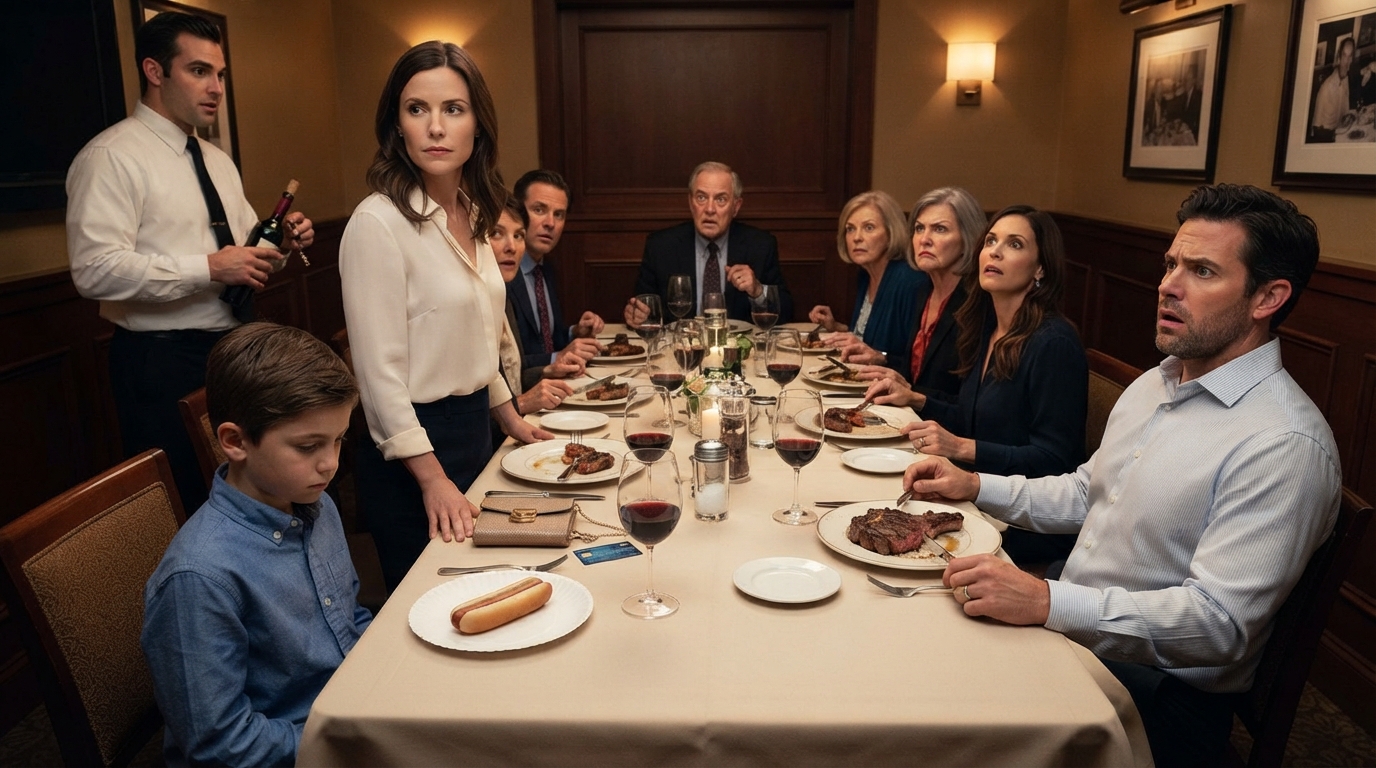
I thought of Noah's face at the dinner table.
The paper plate.
The dry hotdog.
The steaks across from him.
Then I thought about the letter my grandmother had written.
If they truly love you, they will come without price.
I wiped my eyes.
“What happens now?”
Harold folded his hands.
“That depends on what you want.”
I looked at him.
“For the first time in my life…”
I took a slow breath.
“…I think I want to stop fixing things for people who keep breaking them.”
He nodded.
“You have that right.”
I looked again at the brass key.
317.
I had spent the entire night wondering what it opened.
Now, somehow, that question seemed smaller.
The key had opened a door.
But the records had opened something else.
The truth.
And somewhere outside that office, my family was probably already deciding how to respond.
For years, they had counted on my silence.
They had counted on my guilt.
They had counted on the belief that family meant paying whatever price was necessary to keep everyone together.
I picked up the recorder.
Then I looked at Harold.
“Make copies.”
He nodded.
“Of everything.”
“Of course.”
“And send one set to my attorney.”
“I can arrange that.”
I stood.
For the first time since entering the office, I felt steady.
Not because the truth had made anything easier.
It hadn't.
It had simply removed the last excuse I had been using to stay where I no longer belonged.
I put my grandmother's letter into my bag.
Then I closed my hand around the brass key.
Before I left, Harold said my name.
I turned.
“Your grandmother left one more instruction.”
I waited.
He looked toward the folder.
“She said that once you learned the truth, you should decide what kind of family you wanted Noah to inherit.”
I thought about my son.
His small hand gripping mine beneath the restaurant table.
His quiet voice telling me I didn't have to rescue everyone.
I looked at Harold.
“I already know.”
Then I walked out of the office, carrying the evidence my family had spent twelve years hoping I would never find.
Click here to continue reading: PART 5: The Brass Key Led Me Somewhere My Family Had Forgotten, and What I Found There Explained Why Grandma Had Waited Until Dad Retired
My Son Watched His Cousins Eat Steak While My Brother Served Him a Hotdog, and I Finally Decided to Stop Pretending Nothing Was Wrong
Part 4 of 20