Harold arrived before sunrise.
He brought the accountant and two investigators.
Nobody wanted to say the obvious conclusion aloud.
If Bell's wife had been dead for nineteen years, then someone had been copying her handwriting.
Or someone had been using her records.
We returned to the office.
The investigators searched every document bearing her name.
They found letters.
Contracts.
Receipts.
Old correspondence.
The handwriting matched the disputed annotations perfectly.
The accountant compared samples under magnification.
“It's her handwriting,” she said.
“How can someone copy it so well?”
“With practice.”
“Who had access?”
“Family members. Employees. Anyone who handled her files.”
Harold looked at the investigators.
“Find out who.”
They searched employee records.
One name appeared repeatedly.
Marianne Vale.
Former executive assistant.
Bell's wife had employed her for eighteen years.
“Where is she now?” I asked.
One investigator checked.
“Still alive.”
“Where?”
“Florida.”
Harold looked at me.
“Don't contact her.”
“I wasn't going to.”
I was.
But before I could say anything, the investigator continued.
“She changed her name.”
“To what?”
“Marianne Cross.”
The surname meant nothing.
Then Dad looked at the photograph.
“It does to me.”
We turned.
“What?”
“She was at Grandpa's funeral.”
Mom shook her head.
“No.”
Dad pointed.
“Near the back.”
I looked closely.
There she was.
Older.
Gray hair.
Standing alone.
The same woman who had once worked for Bell's wife.
The same woman who might have copied her handwriting.
Harold called the investigators.
“Locate her.”
They did.
She wasn't in Florida.
She had returned to our town two months earlier.
My skin prickled.
“Why?”
Nobody knew.
Then we found the address.
It was a house three streets from the courthouse.
She had been watching the case.
We went with investigators.
An elderly woman opened the door.
Her eyes went immediately to me.
“You found it.”
I stared.
“Found what?”
She smiled sadly.
“The part he couldn't erase.”
She invited us inside.
There were boxes everywhere.
Folders.
Old photographs.
Bank statements.
She pointed to a chair.
“Sit.”
I remained standing.
“Were you Bell's assistant?”
“Yes.”
“Did you copy your employer's handwriting?”
She looked surprised.
“No.”
“Then why do the notes match hers?”
“Because they are hers.”
I looked at Harold.
He asked, “Your employer's wife?”
“Yes.”
“She's been dead nineteen years.”
“I know.”
“Then explain.”
Marianne walked to a cabinet.
She removed a small tape recorder.
Old-fashioned.
She placed it on the table.
“I kept this.”
She pressed play.
A woman's voice filled the room.
Bell's wife.
Older.
Tired.
Angry.
She was speaking to Marianne.
The recording was dated twenty years ago.
The conversation concerned the trust.
Grandma's trust.
Bell's wife had known about it.
She had also known about the property fraud.
And she had been afraid of her husband.
The recording ended with a sentence that changed the entire case.
“If Charles ever tells them I agreed to this, he's lying.”
I looked at Marianne.
“What did she agree to?”
“Nothing.”
“Then why was she making notes?”
“She was documenting him.”
“Why?”
“Because she intended to expose him.”
“What happened?”
“She died before she could.”
I looked at the recorder.
“Why keep it hidden?”
“Because Charles threatened my family.”
“Your family?”
“My daughter.”
“Where is she?”
Marianne looked at me.
“She became a lawyer.”
Harold stiffened.
“What is her name?”
Marianne hesitated.
Then said it.
The name was familiar.
I had seen it on Bell's legal filings.
She was one of his attorneys.
I stared at Harold.
“You're saying Bell's attorney is your daughter?”
“Yes.”
“And she knows?”
“She knows some of it.”
“Does she know her mother recorded this?”
“No.”
“Why not?”
“Because Charles told her I abandoned the family.”
I sat down.
The web was larger than I had imagined.
Bell had not merely manipulated our family.
He had constructed relationships around secrecy.
People inherited lies along with property.
Marianne handed Harold a box.
“These belong to you.”
Inside were copies of old correspondence.
Some came from Bell.
Others from his wife.
One letter was addressed to Grandma.
The envelope had never been opened.
I opened it.
The first line read:
Thomas has crossed a line I cannot defend.
I kept reading.
Bell's wife explained that she had discovered the shell companies.
She had confronted her husband.
He told her the transactions were harmless.
She didn't believe him.
She wrote that she intended to meet Grandma.
But the meeting never happened.
A second letter was inside.
This one was from Grandma to Bell's wife.
Thank you for trusting me. Do not come to the house again. Charles is watching.
I looked up.
“Grandma knew.”
“Yes,” Marianne said.
“She knew Bell was dangerous.”
“Yes.”
“Why didn't she expose him?”
“She tried.”
“What stopped her?”
Marianne looked toward the recorder.
“Your grandfather.”
My heart sank.
“Why?”
“Because he threatened to destroy Bell publicly only if Bell destroyed the family first.”
“That doesn't make sense.”
“It does if you understand how the money was arranged.”
She opened another file.
“Your grandfather had personal debts.”
I knew that.
“He had borrowed against several properties.”
I knew some of that.
“But the loans were guaranteed by Bell's companies.”
I looked at Harold.
“So Bell controlled the debt.”
“Yes.”
“And Grandpa couldn't expose him without losing everything.”
“Yes.”
“Then Grandma's trust was the escape.”
Marianne nodded.
“She created it to separate the legitimate assets from the fraudulent ones.”
I looked at the documents.
“And Bell spent years trying to prevent that separation.”
“Yes.”
The missing piece had finally appeared.
The conflict wasn't really about inheritance.
It was about ownership.
Who had the right to decide what belonged to whom.
Bell wanted the whole system preserved.
Grandma wanted it dismantled.
And I had inherited the responsibility for doing what neither of them had been able to finish.
Harold asked Marianne one final question.
“Why did you return now?”
She looked at me.
“Because I heard the trust had been challenged.”
“By Bell.”
“Yes.”
“And you knew what he would do.”
“I knew he would try to make Claire look unstable.”
I frowned.
“Why me?”
“Because your grandmother chose you.”
“Why not Dad?”
“Because your father had spent too long trying to keep peace.”
Dad nodded quietly.
“She was right.”
Marianne reached into another box.
She handed me a sealed envelope.
“Your grandmother left this with my employer.”
I opened it.
Claire,
If this reaches you, then Charles has finally decided that the past is worth fighting over.
Do not fight him on his terms.
Make the records public through the court.
Do not negotiate.
Do not trade silence for money.
And remember this: not everyone who helped him knew what they were helping.
I looked at Mom.
The letter continued.
Some people acted from fear. Some from greed. Some from loyalty. Judge each action by what it caused, not by the excuse attached to it.
I folded the page.
That sentence settled something inside me.
Mom had done wrong.
Eric had done wrong.
Dad had hidden things.
But Bell had designed the system.
That difference mattered.
Harold took the evidence to the court.
The hearing resumed two days later.
Bell's attorney was different this time.
His daughter.
She stood when we entered.
Our eyes met.
She looked at me.
Then at the box in Harold's hands.
Her expression changed.
After the judge called the case, she approached Harold.
“I need to speak with you.”
He listened.
Then returned to us.
“What did she say?” I asked.
“She wants to withdraw from representing Bell.”
“Why?”
“She discovered her mother left evidence.”
Marianne's daughter entered the courtroom.
She stood before the judge.
“Your Honor, I have a conflict.”
Bell stood.
“You're making a mistake.”
She turned toward him.
“No.”
Her voice was quiet.
“I've been making the mistake for years.”
She withdrew.
Bell looked genuinely shaken.
The judge asked whether he had new counsel.
He did.
But the damage was done.
The prosecution investigators presented the financial records.
The old recordings.
The original deeds.
The physician's testimony.
Eric testified.
Dad testified.
Mom testified.
Eleanor testified.
Marianne testified.
And finally, the accountant explained the contingency chart.
She described how Bell's operation had anticipated every possible failure of the trust.
The judge asked who would benefit if the trust collapsed.
The accountant answered.
“Charles Bell's company.”
“And after that?”
She looked at the chart.
“Several affiliated entities.”
“Who controls them?”
“Mr. Bell.”
The room fell silent.
The judge looked toward Bell.
“Mr. Bell, do you wish to respond?”
He stood.
For the first time, he looked old.
“I protected those assets.”
“From whom?”
“From people who would have squandered them.”
“Whose assets were they?”
Bell didn't answer.
The judge asked again.
“Whose?”
Bell sat down.
The judge ordered an independent accounting of the entire estate.
The disputed properties would remain frozen.
The legitimate assets would remain under the trust.
The records would be preserved.
And the investigation into Bell would continue.
It wasn't the final judgment.
But the structure he had built was collapsing.
Outside the courthouse, Mom approached me.
“I need to tell you something.”
“What?”
She looked toward the courthouse.
“I wasn't the person who changed the beneficiary list.”
“I know.”
“Then who was?”
I looked at the documents.
“The person who had access to both Bell's files and Grandma's.”
Mom shook her head.
“No.”
“What?”
“You're missing someone.”
“Who?”
She whispered the name.
“Dad's older brother.”
I froze.
“My uncle died before I was born.”
“Yes.”
“He was involved?”
Mom nodded.
“He worked with Bell before your grandfather did.”
I stared at her.
“How do you know?”
“Because Grandma told me.”
I felt the ground shift again.
“Why didn't she write it down?”
“She did.”
“Where?”
Mom pointed toward the farmhouse.
“In the room we never opened.”
I knew immediately.
The locked study.
The room Grandma had kept sealed.
The room where the old records had supposedly disappeared.
We drove home.
The house was dark.
Dad opened the study.
Behind a bookshelf was a narrow panel.
Inside was a second compartment.
And inside that was a photograph.
My grandfather.
Bell.
My uncle.
And one more person.
I stared.
The fourth person was Grandma.
She was holding the original ledger.
On the back of the photograph was a single sentence.
We all knew.
But only one of us tried to stop it.
Click here to continue reading: PART 19: Grandma Had Known the Whole Family Was Compromised, and the Final Records Showed Exactly What She Sacrificed to Break the Cycle
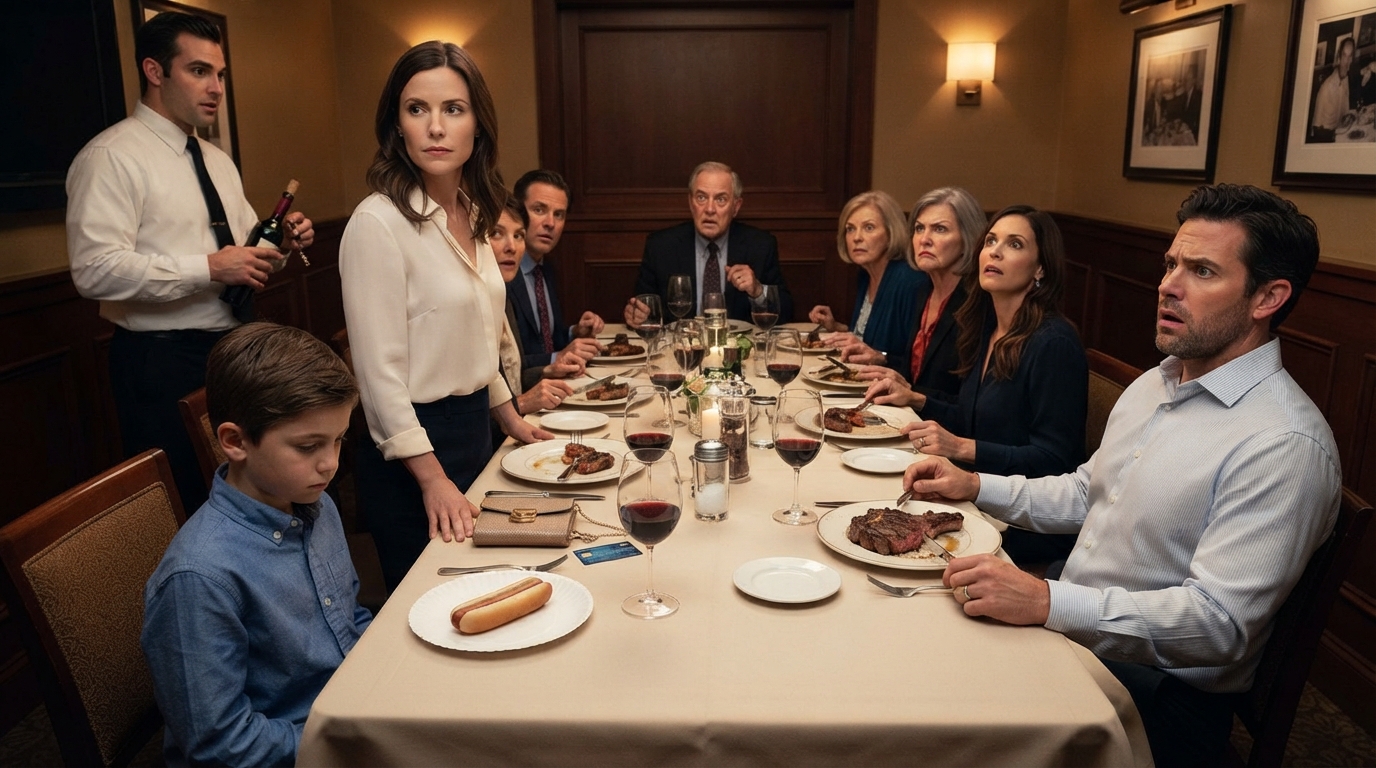
My Son Watched His Cousins Eat Steak While My Brother Served Him a Hotdog, and I Finally Decided to Stop Pretending Nothing Was Wrong
Part 18 of 20