I kept the phone against my ear.
For several seconds, I couldn't speak.
Harold's words had reduced the farmhouse, the trust, the ledger, and every argument over money to a single question: who actually owned the property?
“What happens if the records prove the land was acquired illegally?” I asked.
“Then the affected assets may have to be returned or otherwise dealt with according to the law,” Harold said. “Your grandmother anticipated that possibility.”
“And she still put everything in my name?”
“She put the responsibility in your hands. Those are not the same thing.”
I looked across the study at Dad.
He was sitting in the chair beneath the window, staring at the floor.
“Did she know I would have to investigate?”
“Yes.”
“Why didn't she tell me?”
“Because she believed you would approach the evidence differently if you didn't begin with a conclusion.”
I almost smiled.
“That sounds like her.”
“It does.”
I glanced at the black ledger.
“Harold, how much of this did you know?”
“Enough to understand why your grandmother was cautious. Not enough to answer every question.”
“Then I need everything.”
“You'll have it.”
“When?”
“Tomorrow morning.”
I ended the call.
Dad remained silent.
I turned toward him.
“You said you signed papers when you were twenty-three.”
“Yes.”
“What kind?”
“Property transfer documents.”
“Which properties?”
“I don't remember all of them.”
“That isn't good enough.”
He rubbed his palms against his trousers.
“I was working for your grandfather then. He said the papers were routine.”
“Were they?”
“No.”
“What changed?”
“Edward Taylor showed me a ledger.”
I waited.
“He told me the companies listed on the documents weren't operating businesses. They were holding companies.”
“For what?”
“Land.”
I looked at the property records on the desk.
“How much?”
“I don't know.”
“You keep saying you don't know.”
“Because I didn't.”
He looked up at me.
“I was twenty-three, Claire. I was trying to prove myself. Your grandfather told me I was being trusted with something important.”
“And you signed.”
“Yes.”
“Did you ask what the documents meant?”
“I asked.”
“What did he say?”
“That everything had already been approved.”
“By whom?”
“My grandmother.”
I stared at him.
“Grandma approved it?”
“She had signed some earlier documents.”
“But later she discovered the truth.”
“Yes.”
“How?”
“Edward.”
Dad leaned back.
“Edward was the accountant for your grandfather's business. He had access to the books. He discovered that money from several property sales wasn't appearing where it should.”
“Where was it going?”
“Into shell companies.”
The word sat between us.
“Who controlled them?”
“Your grandfather.”
I felt a chill.
“And Grandma knew?”
“Eventually.”
“Then why didn't she go to the police?”
Dad's face tightened.
“Because she was afraid.”
“Of Grandpa?”
“Of what would happen to the family.”
I shook my head.
“She protected the family again.”
“Yes.”
“And Edward?”
“He wanted to expose everything.”
“What happened to him?”
Dad looked toward the closed study door.
“He disappeared.”
“You said that before.”
“I know.”
“Tell me what you haven't told me.”
Dad swallowed.
“The last time I saw Edward, he came here.”
“To the farmhouse?”
“Yes.”
“When?”
“Three days before he disappeared.”
“What did he say?”
“He told me he had found something in the original accounts.”
“What?”
“A list.”
“Of what?”
“People.”
I felt my pulse quicken.
“Which people?”
“Everyone involved.”
“Did he show you?”
“No.”
“Why?”
“He said he didn't trust me.”
I stared at him.
“Can you blame him?”
Dad looked away.
“No.”
I walked to the desk and opened the ledger again.
There were names throughout the pages, but the handwriting became more abbreviated toward the end.
Initials.
Parcel numbers.
Bank references.
Crossed-out entries.
I noticed one notation I'd missed.
E.T. — original ledger secured.
Below it:
Do not destroy.
My finger followed the words.
“Dad.”
He came closer.
“What?”
“What's this?”
He leaned over the page.
His face drained of color.
“I've never seen that.”
“Grandma wrote it.”
“When?”
I pointed to the date.
The entry had been made six months after Edward disappeared.
Dad stared.
“She found the ledger.”
“Apparently.”
“Then why didn't she turn it over?”
I turned another page.
There was a handwritten explanation.
Not until the children are safe.
I looked at Dad.
“Which children?”
He didn't answer.
“Dad.”
He took a slow breath.
“You.”
“Me?”
“You were pregnant with Noah.”
The room became very still.
“That was years after Edward disappeared.”
“Yes.”
“So what did my pregnancy have to do with the ledger?”
“I don't know.”
I turned another page.
There were three names.
Claire.
Eric.
Margaret.
Beside them was the same number.
17.
Then a fourth name.
Robert.
No number.
I stared at it.
“Why am I listed with Mom and Eric?”
“I don't know.”
“You keep saying that.”
“Because I genuinely don't.”
I pulled out my phone and photographed the page.
Then I noticed a faint pencil mark beside my name.
A small arrow.
It pointed to another page.
I turned to it.
The page contained one sentence.
The beneficiary must know the difference between inheritance and restitution.
I read it twice.
Dad sat heavily.
“She knew.”
“What?”
“She knew the money might not be ours.”
I looked at him.
“She knew when she created the trust.”
“Yes.”
“Then why did she call it an inheritance?”
“Because she needed the assets protected until the truth could be established.”
“Protected from whom?”
Dad looked at me.
“Everyone.”
I closed the ledger.
A knock sounded at the front door.
Both of us froze.
Dad whispered, “Did you tell anyone we were here?”
“No.”
He moved toward the hallway.
I followed.
Another knock.
Dad looked through the window.
“It isn't Eric.”
A woman stood on the porch.
Late sixties.
Gray coat.
Dark handbag.
She looked directly at the house.
Dad opened the door only a few inches.
“Can I help you?”
She said his name.
“Robert.”
Dad stiffened.
“How do you know me?”
“My name is Eleanor Taylor.”
The name hit me.
I stepped forward.
Dad opened the door wider.
The woman looked at me.
“You must be Claire.”
I nodded.
She held up both hands.
“I am not here for the money.”
“Then why are you here?”
She looked at the study.
“Because my brother left something with your grandmother.”
“Edward?”
“Yes.”
Dad's voice became almost inaudible.
“You're alive.”
She gave him a sad smile.
“I was never the one who disappeared.”
I stared at her.
“What happened to Edward?”
She stepped inside.
“That is what your grandmother wanted you to learn.”
She placed her handbag on the table.
Then removed a small envelope.
It was old.
The edges had yellowed.
Across the front was written:
For Claire, when she is ready to know why the money was never the point.
My heart sank.
“Where did you get that?”
“Your grandmother gave it to me.”
“When?”
“The week before she died.”
I opened it.
Inside was a photograph of Edward Taylor standing beside a younger version of Grandma.
On the back:
He found the first ledger.
I found the second.
Together, we found the truth.
I looked at Eleanor.
“Where is the second ledger?”
She didn't answer immediately.
Then she said, “Your grandmother hid it where nobody would think to look.”
“Where?”
“In the one place your family has spent years fighting over.”
I looked toward the fields.
“The land?”
She nodded.
“The farmhouse?”
“No.”
“The business?”
“No.”
I stared at her.
“What place?”
She looked directly at me.
“Your father's house.”
Dad went completely still.
“My house?”
Eleanor nodded.
“Your grandmother believed the safest hiding place was inside something everyone assumed belonged to Robert.”
I looked at Dad.
He seemed as confused as I was.
“What did she hide?”
“The original ownership ledger.”
I felt my pulse quicken.
“Where?”
Eleanor reached into her handbag again.
This time she removed a folded floor plan.
She spread it across the table.
The house was marked with several red circles.
One was beneath the stairs.
One was behind the fireplace.
One was in the basement.
Then she pointed to the fourth.
“Here.”
I stared.
“My bedroom?”
“Not anymore,” she said.
“What does that mean?”
“Your father renovated that room twelve years ago.”
Dad frowned.
“I don't remember anything hidden there.”
Eleanor looked at him.
“Then someone removed it.”
A cold silence filled the room.
I thought about the timing.
Twelve years.
Grandma's death.
The renovation.
The trust.
Everything suddenly seemed connected.
I folded the floor plan.
“We're going home.”
Dad looked at me.
Eleanor stood.
“Don't.”
I stopped.
“Why?”
“Because if the ledger is gone, whoever took it may already know you found the first one.”
I thought about the sedan.
The messages.
Eric's warning.
Then Eleanor said the words that made my stomach drop.
“Your grandmother believed the person who removed the ledger would eventually come looking for the trust.”
I looked at Dad.
“Who?”
Eleanor's expression hardened.
“Your mother.”
Click here to continue reading: PART 10: Eleanor Taylor Explained Why Grandma Trusted No One With the Second Ledger, and I Returned Home to Search the Room Dad Had Renovated Twelve Years Earlier
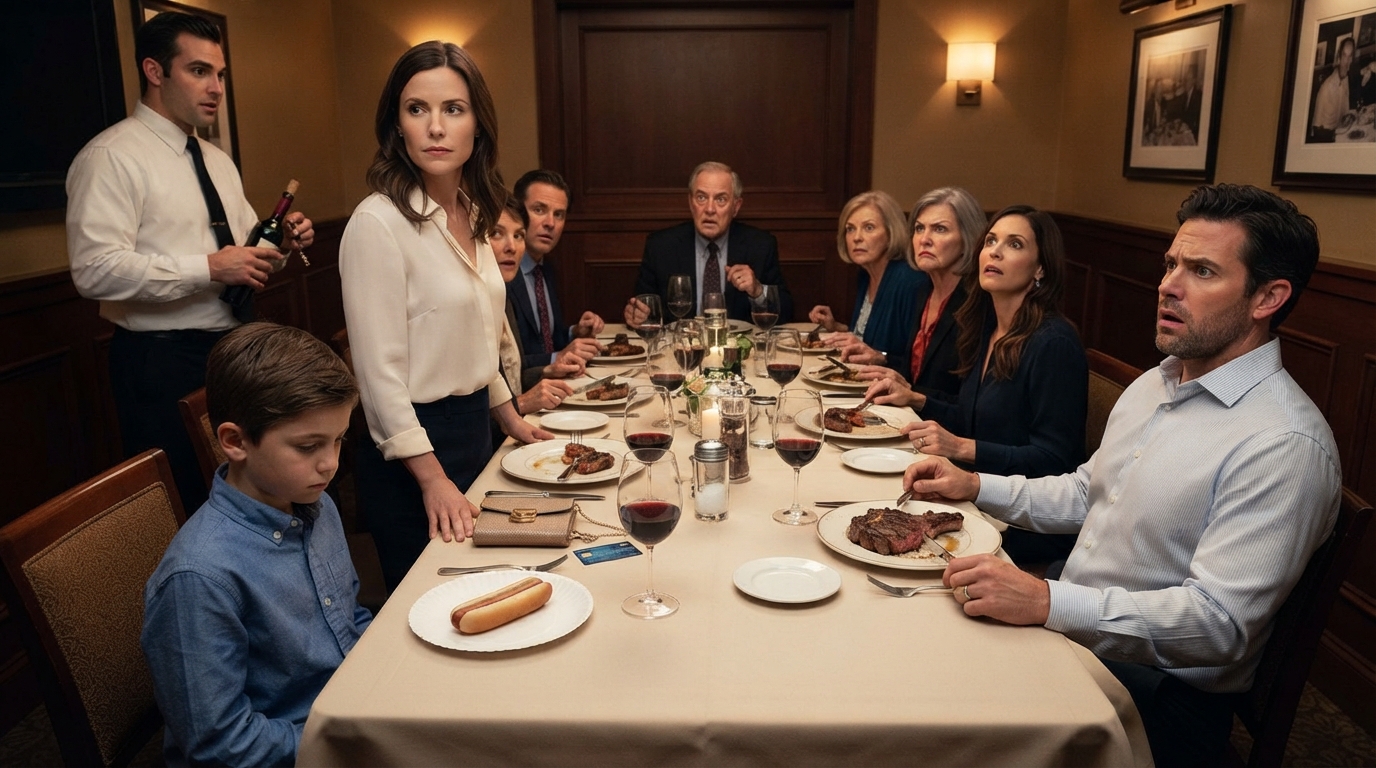
My Son Watched His Cousins Eat Steak While My Brother Served Him a Hotdog, and I Finally Decided to Stop Pretending Nothing Was Wrong
Part 9 of 20