I kept the paper folded in my hand while everyone watched me.
No one spoke.
Mom was the first to break the silence.
“Let me see it.”
I handed it to her.
She read the list twice.
Then she sat down.
“I swear I never saw this.”
Dad took the page.
His eyes moved slowly over the names.
When he reached Mom's, his jaw tightened.
“This doesn't mean you were involved.”
“I know,” I said.
Mom looked at me.
“You don't believe me.”
“I believe you don't remember seeing it.”
“That isn't the same thing.”
“No.”
She folded her hands together.
“I never received money from Bell.”
Eric gave a humorless laugh.
“Not directly.”
Mom turned toward him.
“What does that mean?”
“It means money moved through accounts.”
“How do you know?”
“Because I saw the records.”
“Which records?”
“The ones Bell kept on me.”
I looked at Eric.
“You said the police had them.”
“They do.”
“Then why didn't you tell me about the beneficiary list?”
“Because I didn't understand it.”
Dad leaned against the counter.
“Maybe we should stop trying to understand this ourselves.”
He was right.
The next morning, Harold arranged for the list to be examined by a forensic accountant.
We waited at his office while the accountant compared the names against the ledgers, deeds, bank records, and trust documents.
For nearly two hours, she said very little.
Then she placed three folders on the table.
“This is not a beneficiary list in the legal sense.”
I looked at her.
“What is it?”
“A contingency chart.”
“Meaning?”
“It appears someone was tracking who would receive control if the trust failed in different ways.”
Harold frowned.
“Different ways?”
She pointed to the dates.
“Death. Litigation. Default. Sale. Bankruptcy.”
My stomach tightened.
“Why would anyone prepare that?”
“Someone was planning for the trust to collapse.”
Dad looked at Mom.
“Before Bell filed the motion?”
The accountant nodded.
“Years before.”
I asked the question nobody wanted to hear.
“Who created it?”
“We don't know yet.”
She pointed to the handwriting.
“The names are typed, but these annotations are handwritten.”
“Can you identify the handwriting?”
“Possibly.”
She compared them with samples from the ledgers.
Then she stopped.
“This is interesting.”
“What?”
“The annotations match two different writers.”
“Two?”
“Yes.”
She separated the pages.
“These marks appear to have been made by Bell.”
“And these?”
She looked at Mom.
“Your mother's handwriting.”
Mom went pale.
“I don't understand.”
Neither did I.
The accountant placed the pages side by side.
The annotations beside Bell's name were in one hand.
The notes beside several other names were in Mom's.
Mom shook her head.
“I didn't write those.”
“You may have,” the accountant said carefully. “But that doesn't mean you knew what the document meant.”
I remembered something.
“Mom, did you ever keep notes for Grandma?”
“Yes.”
“Where?”
“Her study.”
“What kind?”
“Appointments. Medication. Property calls. Things she asked me to remember.”
“Did Bell ever give you paperwork to organize?”
Mom hesitated.
“Yes.”
“What paperwork?”
“I don't remember.”
I looked at Dad.
He suddenly said, “The blue folders.”
Mom turned.
“What?”
“Bell always sent blue folders.”
Dad rubbed his forehead.
“He told us they were ordinary property documents.”
“How many?”
“Dozens.”
“Where are they now?”
“Most were destroyed.”
“Most?”
Dad looked toward the hallway.
“I kept one.”
He disappeared into the spare room.
When he returned, he carried a battered blue folder.
He put it on the table.
The accountant opened it.
Inside were copies of property statements.
At the bottom of several pages were handwritten initials.
M.T.
Mom stared at them.
“I wrote those.”
“You said you didn't know what the list meant.”
“I didn't.”
The accountant examined the papers.
“These initials indicate review, not approval.”
Harold nodded.
“That's important.”
Mom looked relieved for only a moment.
“Then why am I on the contingency list?”
Nobody answered.
The accountant turned another page.
There was a date.
The day before Grandma changed the trust.
I looked at Mom.
“What happened that day?”
She closed her eyes.
“She called me into the study.”
“What did she say?”
“She told me Bell was trying to frighten everyone.”
“Did she mention me?”
“Yes.”
“What did she say?”
Mom's voice trembled.
“She said you were the only person she trusted to refuse an easy answer.”
I swallowed.
“Why?”
“Because she knew you hated conflict.”
I almost smiled.
“She was wrong about that.”
“No,” Mom said. “She wasn't.”
She looked at the list.
“Claire, I think she knew this would happen.”
Harold took the document.
“There's another problem.”
He pointed to the bottom of the page.
The notation beside Mom's name had been crossed out.
Then rewritten.
The new name was mine.
My chest tightened.
“Who changed it?”
The accountant shook her head.
“We'll need to examine the original.”
“Where is it?”
She looked at Harold.
He answered.
“Bell's office.”
Silence.
The investigators had seized his files.
But access would require a court order.
Harold made the request that afternoon.
The judge granted it.
We returned to Bell's office with investigators.
The place looked ordinary.
That was what unsettled me.
No secret room.
No dramatic hiding place.
Just shelves, filing cabinets, framed certificates, and a desk polished to a dull shine.
An investigator opened the first cabinet.
Property records.
Second cabinet.
Trust correspondence.
Third.
Bank statements.
Then they found the blue folders.
Dozens.
Some had names.
Others had numbers.
One folder was labeled 317.
I reached toward it.
The investigator stopped me.
“We'll open it.”
Inside was a single photograph.
Grandma.
Standing beside Bell.
The date on the back was forty years earlier.
There was another photograph beneath it.
My grandfather.
Bell.
And a third man.
I recognized him.
Samuel Reed's father.
The man whose family had sold the first disputed property.
My pulse quickened.
“Why were they together?”
Harold studied the picture.
“Because Bell wasn't merely handling the transaction.”
The investigator found a memorandum beneath the photograph.
It described a private meeting.
Three men.
One property.
One agreement.
And a payment.
The payment had never appeared in the official records.
I felt the old anger return.
Then I noticed something else.
A second sheet.
Handwritten.
The same handwriting as the notes on the contingency chart.
Mom's.
I stared at it.
Mom stepped closer.
“I don't remember writing that.”
The investigator read it.
“‘Claire must never see this until the trust is secure.’”
Mom covered her mouth.
Dad looked at her.
“What did you know?”
“I don't know.”
The words came out broken.
“I don't know.”
I wanted to accuse her.
I wanted a simple answer.
Instead, I looked at the date.
It was written eleven years ago.
The year Grandma died.
And below the sentence was another line.
“Bell believes she will choose money.”
I looked at Mom.
“Who is ‘she’?”
Mom whispered.
“You.”
I stared at the paper.
“Why would you write that?”
“I don't know.”
The investigator placed the page into an evidence sleeve.
Harold looked at me.
“We need to find out before anyone else does.”
That night, I couldn't sleep.
I returned to the kitchen.
The ledgers were still on the table.
I opened the first one.
The entries seemed different now.
Not because the words had changed.
Because I knew to look for something.
A pattern of initials.
M.T.
They appeared beside several transactions.
But the dates didn't match.
Some were years before Mom had supposedly known anything.
Others were after Grandma's death.
Then I found one beside a payment to Bell.
The notation read:
Approved for protection.
I called Mom.
She answered immediately.
“What is it?”
“You need to come here.”
She arrived twenty minutes later.
I showed her the entry.
She stared.
“I didn't approve that.”
“Then who did?”
She shook her head.
“Claire, there was another woman.”
“What woman?”
“At Grandma's office.”
“When?”
“After my father died.”
“You never told me.”
“I forgot.”
“You don't forget someone like that.”
Mom closed her eyes.
“She was an assistant.”
“Name?”
“I don't know.”
“What did she look like?”
“Dark hair. Tall. Maybe forty.”
I looked at the photograph from Bell's office.
The third man stood beside my grandfather.
Behind him, partially visible through a doorway, was a woman.
Dark hair.
Tall.
My mother stared at the photograph.
“That’s her.”
My pulse accelerated.
“Who is she?”
Mom whispered.
“Bell's wife.”
I looked at the date.
Forty years ago.
Then at the recent notes.
The same initials.
The same handwriting.
But the handwriting wasn't Mom's.
The accountant had mistaken it.
It belonged to Bell's wife.
And suddenly the entire contingency chart looked different.
Someone had been preparing a succession plan.
Not for the trust.
For Bell's operation.
I called Harold.
He answered on the first ring.
“What's happened?”
“We found the person behind the annotations.”
“Who?”
“Bell's wife.”
There was a pause.
Then Harold said something that made my blood run cold.
“Claire, Bell's wife has been dead for nineteen years.”
Click here to continue reading: PART 18: The Dead Woman’s Notes Connected Bell’s Oldest Transactions to a Living Account, and the Trail Led Somewhere None of Us Had Thought to Look
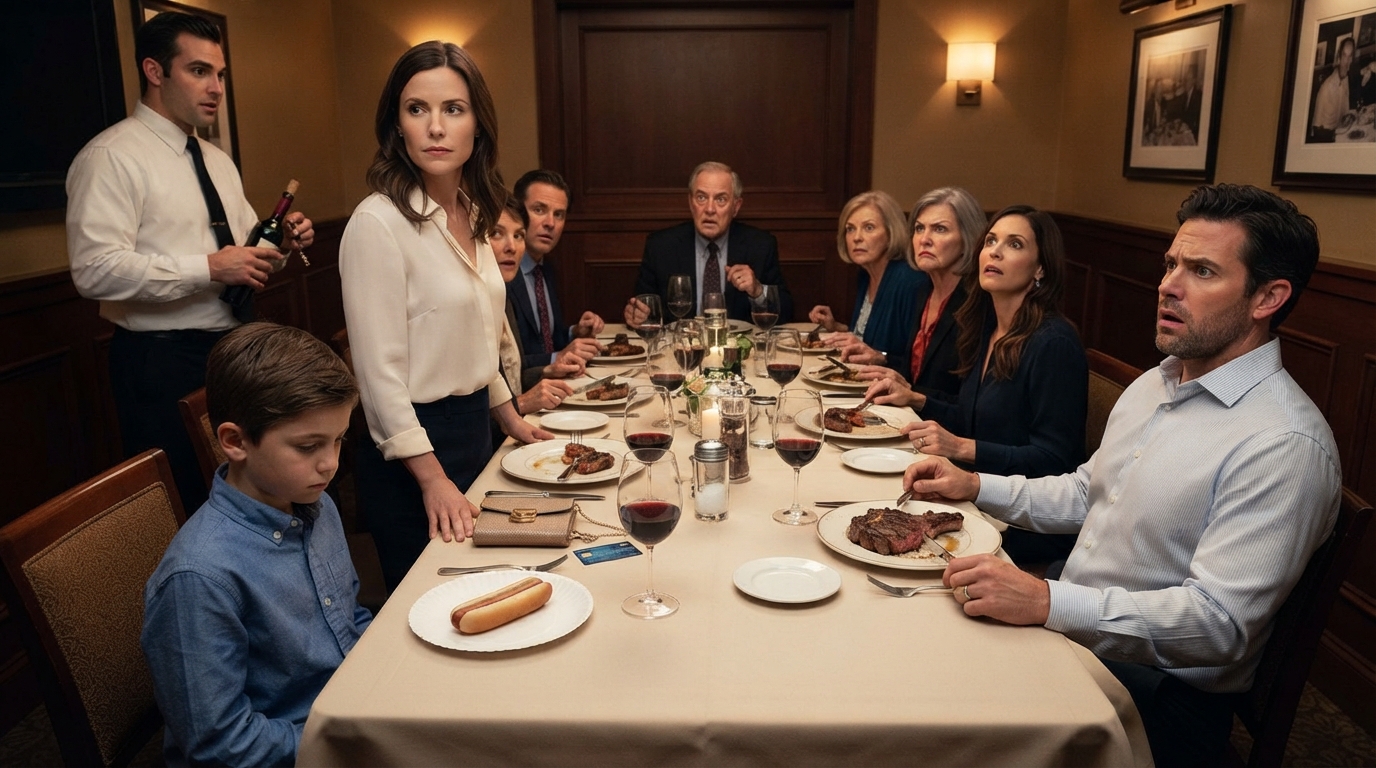
My Son Watched His Cousins Eat Steak While My Brother Served Him a Hotdog, and I Finally Decided to Stop Pretending Nothing Was Wrong
Part 17 of 20