Retirement turned out to be badly named.
I still woke before dawn.
My body ignored the fact that nobody required it.
For the first two weeks, I made coffee around four-thirty and sat in the kitchen listening to a silence that felt unnatural.
No dispatch.
No pre-trip.
No route clock.
No weather decision.
Sarah tolerated this for six days.
On the seventh, she came downstairs in a robe.
“You’re haunting the house.”
“I’m drinking coffee.”
“In darkness.”
“I like darkness.”
“You like truck stops.”
“Sometimes.”
She switched on a lamp.
I complained.
Then adjusted.
That became retirement.
Small adjustments.
I trained three days a month.
Exactly three.
Jamal tried adding a fourth once.
I sent it back.
He respected the boundary afterward.
Mostly.
The training work suited me better than I expected.
I did not have to pretend I knew every answer.
That was useful.
New drivers responded better to someone saying I don’t know than I had imagined.
Maybe because they were used to trainers who treated uncertainty like weakness.
I told them what Dennis had taught us.
A driver could be experienced and still need to stop.
A dispatcher could have data and still miss what mattered.
A mechanic could inspect something and still need a second look.
A policy could be good and still need revision.
The important part was not eliminating uncertainty.
It was building ways to respond to it honestly.
I never told Victor’s name.
Eventually most trainees had no idea who he was.
Good.
A few knew the old story from archived material.
They asked questions.
I answered facts.
Not mythology.
Yes, I stopped.
Yes, my supervisor told me to keep moving.
Yes, I was disciplined.
Yes, my schedule was cut.
Yes, records were changed.
Yes, the customer happened to be the family I helped.
Yes, that coincidence helped expose the problem.
No, that coincidence did not make the original decision right.
It was right or wrong before I knew who Julian was.
That distinction remained the one I cared about most.
The first year after leaving full-time driving passed quickly.
Sarah and I traveled.
Not constantly.
Enough.
I discovered hotels were better than sleeper cabs.
Controversial, apparently.
We visited places I had driven through dozens of times without seeing anything beyond highway exits and loading docks.
Cities looked different when no appointment waited.
Roads looked different without freight behind me.
Sometimes worse.
Mostly better.
I still watched truck drivers automatically.
Lane position.
Braking.
Trailer movement.
Sarah called it occupational haunting.
She was probably right.
One autumn afternoon, Julian invited us to dinner.
Lily was home from college.
Transportation systems had become transportation engineering.
She talked about roadside design, emergency shoulders, barrier placement, driver sightlines.
I understood perhaps sixty percent.
That was enough to be proud without taking credit.
At one point she said, “We’re studying human factors.”
I looked at Julian.
“Dangerous.”
Lily ignored me.
“Basically how systems fail because designers assume people behave perfectly.”
I laughed.
“What?”
“Nothing.”
She frowned.
“You always do that.”
“What?”
“Laugh when something sounds like your job.”
“It does.”
Human factors.
Yes.
That had been the whole story.
The road.
The dispatcher.
The driver.
The manager.
The customer.
The system.
Everyone making decisions under incomplete information.
Policies often failed because they were written for ideal people.
Real people got angry.
Tired.
Afraid.
Proud.
Impatient.
Distracted.
They wanted good metrics.
They hated being embarrassed.
They feared losing income.
They took shortcuts.
They also helped strangers.
Admitted mistakes.
Preserved evidence.
Changed.
A system had to account for both.
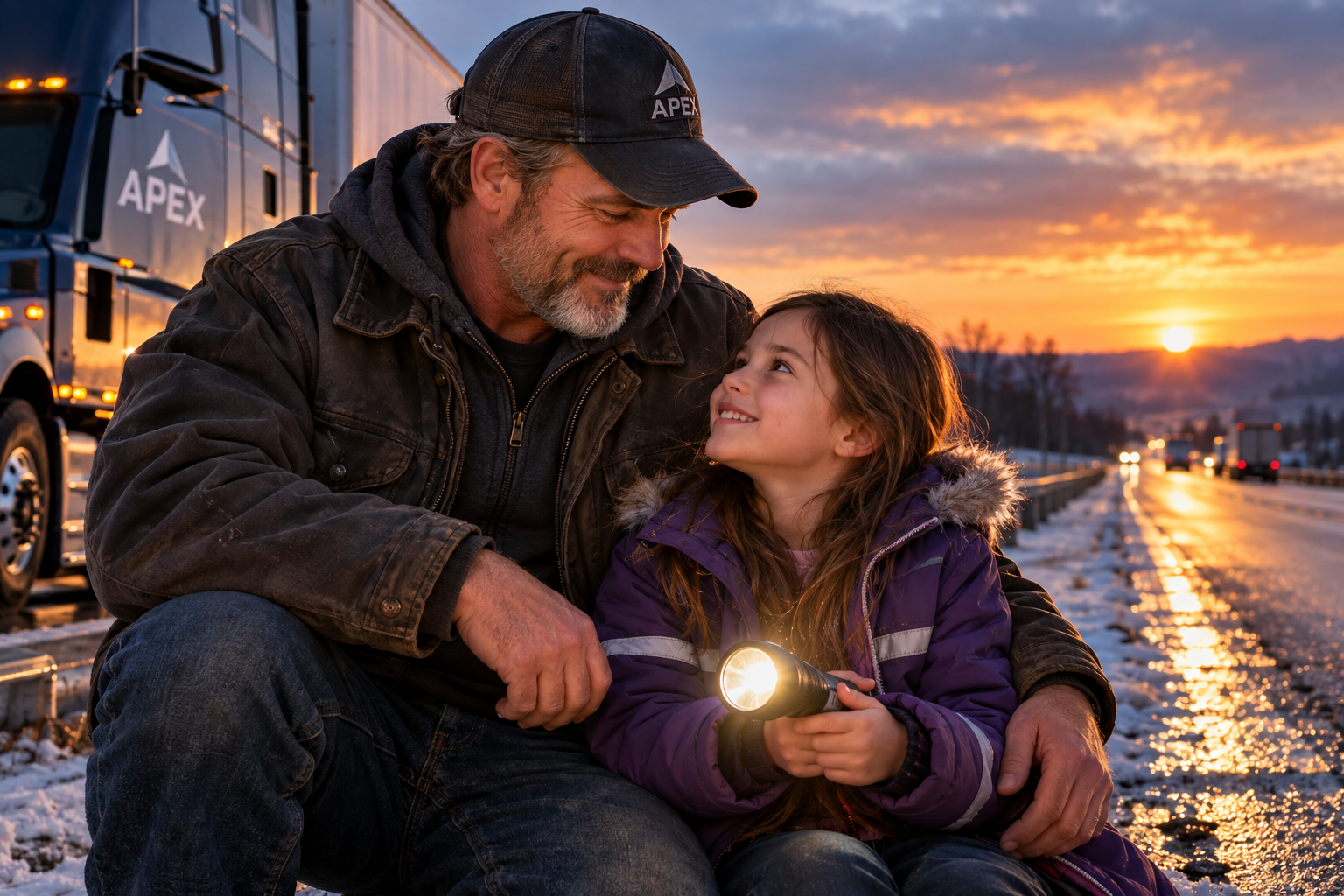
Lily asked, “Do you still have the first flashlight?”
“Yes.”
“Does it work?”
“Yes.”
“I’m surprised.”
“Backup maintenance program.”
She smiled.
“Good.”
The flashlights no longer lived in a work bag.
The old one sat in a drawer near the front door beside the newer one.
The keychain light stayed on my keys.
Ordinary household objects.
That felt healthy.
The refrigerator changed too.
The drawing eventually came down when Sarah repainted the kitchen.
I expected that to bother me.
It didn’t.
We moved it to a small frame in the hallway.
Adrian’s thank-you card went into a box with other letters.
My safety plaque stayed on a shelf because Sarah refused to let me throw it away.
The faded tow receipt finally became unreadable.
One afternoon I held the blank-looking paper under a lamp, trying to make out the amount.
Couldn’t.
Sarah watched.
“You keeping it?”
I thought for a long moment.
“No.”
I threw it away.
Nothing happened.
No loss of evidence.
No loss of memory.
No betrayal.
Just old thermal paper becoming trash.
That felt like another kind of closure.
Apex continued without me.
Jamal remained terminal manager.
Alex eventually moved into a national driver-representative role, which I mocked relentlessly.
Rosa became a full-time trainer.
Carla retired from long-haul work and moved into a local schedule.
Ben finally retired after announcing it three separate times and changing his mind twice.
Paula became regional vice president.
She hated when I called her corporate.
So I did.
Monica’s efficiency program survived several revisions.
The safety firewall remained.
Automated scheduling improved.
New problems appeared.
Of course they did.
Once, Alex called about an AI dispatch-support tool that tried to classify driver reports by urgency.
I said, “No scores.”
He replied, “I knew you’d say that.”
They designed it to surface facts instead of verdicts.
I considered that victory enough.
I did not join the meetings.
That mattered.
The system could evolve without pulling me back into every fight.
Occasionally something went wrong.
A supervisor somewhere mishandled a report.
A driver lied.
An algorithm produced a bad assignment.
A customer applied pressure.
The company investigated.
Sometimes management was wrong.
Sometimes drivers were.
Usually reality was mixed.
That was fine.
The goal had never been perfection.
It was correction before harm hardened into normal practice.
Years after my retirement, Apex sent me an invitation to an anniversary event marking the safety program’s tenth year.
I almost declined.
Sarah made me go.
“You’re ridiculous.”
“I’m retired.”
“You’re also curious.”
She knew me too well.
The event was larger than I expected.
Drivers from across the country.
Managers.
Maintenance teams.
Customers.
Insurance representatives.
People I had never met discussing processes that once started as arguments in our little terminal conference room.
No banner showed my face.
Thank God.
The program was no longer called by any name connected to the storm.
It had an ordinary corporate title.
Operational Safety Decision Framework.
Terrible.
Perfect.
Boring things lasted.
Howard had retired by then but attended.
Rachel too.
Richard appeared, older and even more pleased with himself.
“You came.”
“Against my judgment.”
“Consistent.”
We shook hands.
Paula found us.
“Look at this.”
“Too many managers.”
“Retired drivers get disrespectful.”
“I was always disrespectful.”
“True.”
A panel began.
I sat near the back.
No microphone.
That was a requirement.
The speakers were people I barely knew.
A young dispatcher.
A mechanic.
A driver from Texas.
A safety analyst.
They discussed a recent event involving severe crosswinds.
The driver stopped.
Dispatch questioned.
Data was gathered.
Decision reviewed.
Customer notified.
No retaliation.
No drama.
Then the driver said, “I didn’t think of it as using a special policy. It’s just how we do things.”
I felt something shift inside me.
Just how we do things.
That was the finish line.
Not a plaque.
Not a training story.
Not someone remembering the storm.
A driver who did not realize the process had ever been controversial.
After the panel, Rachel sat beside me.
“You heard that.”
“Yes.”
“Worth coming?”
“Maybe.”
She smiled.
We watched people leaving the room.
Then she said, “Do you ever think about what would’ve happened if Julian hadn’t called?”
“Yes.”
“What do you think?”
“I don’t know.”
Still the only honest answer.
Maybe I would have filed the complaint.
Maybe Ben eventually spoke.
Maybe someone else forced attention.
Maybe nothing happened.
Maybe I quit.
Maybe Victor stayed.
There was no useful way to know.
Rachel said, “I used to wish we could prove the system would have caught it anyway.”
“Can you?”
“No.”
“Then don’t pretend.”
“I don’t.”
Good.
She had not changed in that respect.
I looked around the conference hall.
“All this still bothers me a little.”
“What?”
“That it took an important customer.”
Rachel nodded.
“Me too.”
We sat quietly.
Then she said, “But what happened afterward didn’t depend on him.”
That was true.
Julian opened the door.
Evidence carried the investigation.
Other drivers widened it.
The company chose whether to learn.
Years of maintenance kept the changes alive.
No single person owned the result.
That mattered.
Julian arrived later with Elena.
Lily could not attend.
Work.
Apparently engineers had jobs.
She sent a video message instead.
Sarah insisted I watch.
Lily appeared wearing a hard hat and reflective vest.
“Truck Marcus.”
I groaned.
People nearby looked over.
She continued.
“I’m at a roadway redesign site, so I can’t come to your truck-company thing.”
Her terminology remained disrespectful.
“We’re adding wider emergency shoulders here.”
She turned the camera toward a stretch of highway under construction.
Then back.
“Not because of you.”
I laughed.
“But I thought you’d like it.”
I did.
Very much.
She finished:
“Still carrying a light. You should too.”
Video ended.
Julian looked at me.
“Not because of you?”
“She’s learned boundaries.”
“From Elena.”
“Obviously.”
We ate dinner together after the event.
No business discussion for almost an hour.
Then inevitably someone mentioned the storm.
Julian said, “I still remember the exact moment you said you’d paid for the tow.”
“I remember thinking you were going to argue.”
“I did.”
“You lost.”
“I was busy.”
Elena said, “You both looked ridiculous.”
“Thank you,” I said.
She smiled.
“I remember Lily asking why your truck couldn’t tow us.”
“So do I.”
“She was furious your truck was bigger but less useful.”
Julian laughed.
That memory had survived all the corporate consequences.
A child annoyed by equipment specialization.
Good.
The real night contained ordinary absurdities too.
Not just lessons.
Before we left, Julian held out his hand.
For a second, we both stopped.
Same gesture.
Different men.
Older.
Dry.
No traffic screaming past.
We shook hands.
“Thank you,” he said.
I smiled.
“You did that already.”
“I know.”
“So did Lily.”
“I know.”
“Elena probably did too.”
“She did.”
“Then we’re covered.”
He didn’t let go immediately.
“I mean for stopping.”
I looked at him.
Years earlier, I might have answered with something modest.
Anybody would have.
No big deal.
I knew better now.
Not everybody stopped.
It had been a big deal to them.
Pretending otherwise did not make me humble.
It only denied the truth of the moment.
“You’re welcome,” I said.
That was enough.
Sarah and I drove home through light rain.
She drove.
Another retirement change I had resisted.
I watched headlights move across the windshield.
At one point, hazard lights flashed ahead.
My body reacted before thought.
Attention sharpened.
A car on the shoulder.
Tow truck behind it.
Everything handled.
Sarah glanced at me.
“You saw.”
“Yes.”
“Need to stop?”
“No.”
We passed.
I watched the lights disappear in the side mirror.
No guilt.
No unfinished obligation.
Someone else was there.
The responsibility belonged to them now.
At home, I opened the drawer near the front door.
Old flashlight.
New flashlight.
I picked up the first one.
Scratched casing.
Faded tape.
LILY.
Pressed the switch.
The beam came on.
Not especially bright compared with newer lights.
Enough.
I stood in the dark hallway holding it.
That first night, I had seen Lily’s light through rain.
Small.
Barely visible.
Enough to make me look twice.
Enough to make me slow.
Enough to make me decide.
Everything afterward had become larger than the moment.
Victor’s warning.
Routes.
Investigation.
Policies.
National programs.
Training.
Years of argument.
But the beginning had been small.
A family on a shoulder.
A driver with a deadline.
A child holding a light.
One decision made before anybody knew who mattered to whom.
I turned the flashlight off.
Sarah called from the bedroom.
“You coming?”
“Yeah.”
I put the flashlight back in the drawer.
Not on display.
Not framed.
Ready if needed.
Then I switched off the hallway light and walked upstairs.
The dark did not feel threatening.
It was simply dark.
And somewhere beyond our house, trucks were moving through the night.
Drivers were making thousands of decisions no one would ever hear about.
Most would not become stories.
That was good.
The important choices were not important because people remembered them.
They were important because, in the moment, somebody had to make them.
Years earlier, beside a storm-darkened highway, I had not known whether stopping would cost me money.
I had not known Julian’s name.
I had not known who owned the freight.
I had not known whether anyone would thank me.
I had not known that my boss would punish me.
I had not known the records would later matter.
I had not known anything about the ending.
I only knew a family was stranded in a dangerous place.
So I stopped.
Everything that mattered came after.
The End
Read more original stories on Feel Every Story.
The Storm Was Already Costing Me Time When a Child’s Flashlight Appeared Through the Rain Beside the Highway
Part 30 of 30