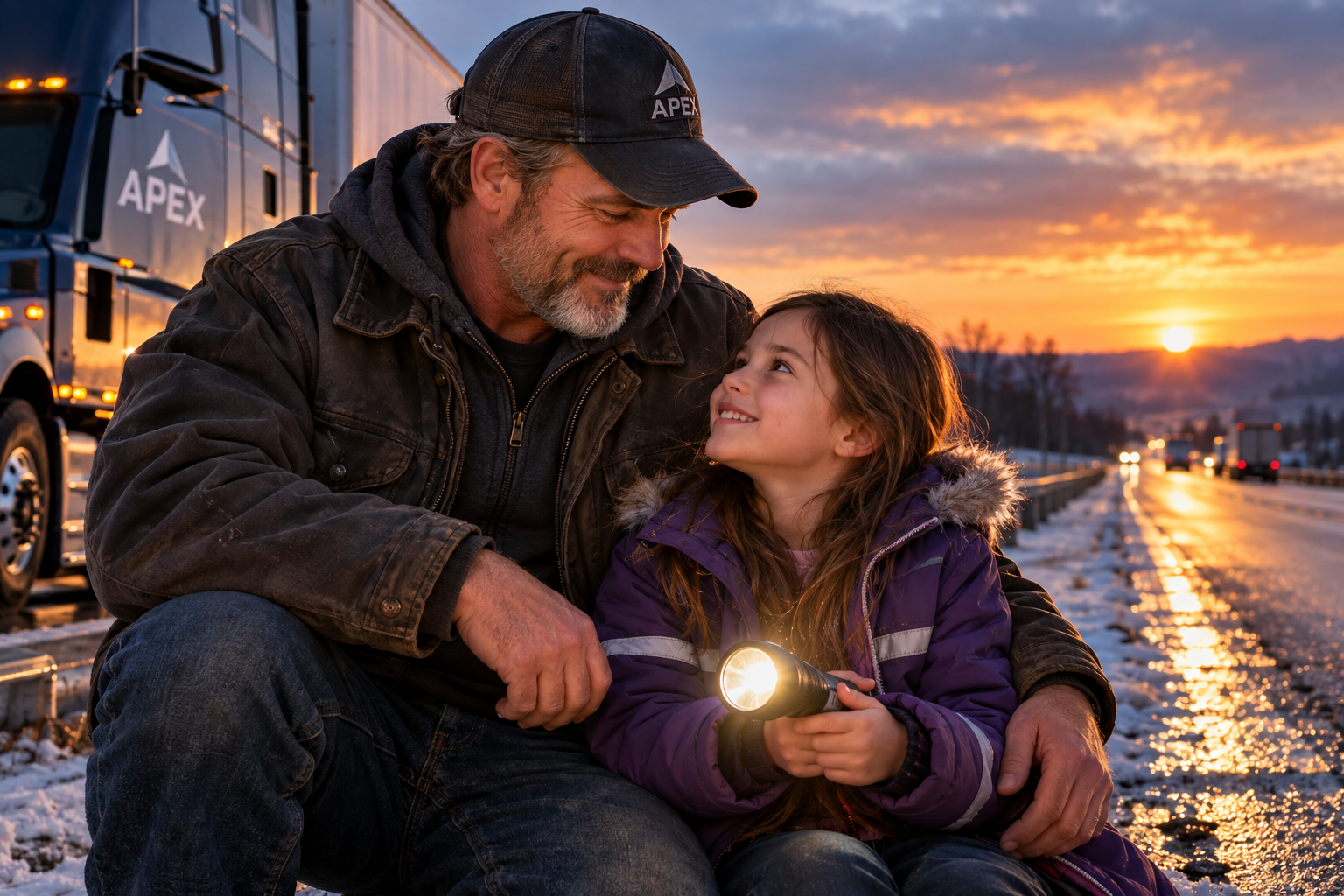
Dennis survived.
That was the first fact Paula made clear.
Two cracked ribs.
A fractured wrist.
A deep cut along his scalp that required stitches.
Painful.
Serious.
But he was alive.
The tractor was not.
Pictures circulated unofficially before management asked people to stop sharing them.
Cab crushed along one side.
Trailer partly overturned beyond the shoulder.
Medical supplies scattered inside the damaged box.
No other vehicle had been struck.
That last part felt miraculous.
I went to the hospital that afternoon.
Sarah came with me.
Dennis looked smaller in the bed than he ever had in the terminal.
His gray beard had dried blood caught near one side despite the nurses cleaning most of it away.
His right arm was wrapped.
When he saw me, he managed a crooked smile.
“Training scenario number three.”
I stared at him.
“Not funny.”
“A little.”
Sarah touched his shoulder.
“How are you feeling?”
“Like a truck rolled over.”
I glared.
Dennis sighed.
“Fine. Like half a truck.”
He was joking because the alternative was thinking too hard.
I understood.
We talked about ordinary things first.
Food.
His wife driving in from their home.
His daughter arguing with a nurse about visiting hours.
Then the room grew quieter.
I asked the question carefully.
“What happened?”
Dennis looked at the window.
“I told dispatch it was slick.”
“When?”
“Maybe forty minutes before.”
“Did you stop?”
“No.”
“Why?”
He shifted and winced.
“Road wasn’t that bad yet.”
“What did dispatch say?”
“That cameras looked clear.”
“Who?”
“Eric.”
That surprised me.
Eric had been part of the working group.
He knew the policies.
Dennis saw my face.
“Don’t turn him into Victor.”
“I didn’t say anything.”
“You thought it.”
Maybe.
“What happened after?”
“I kept going.”
“Did it get worse?”
“Yeah.”
“Did you call again?”
He hesitated.
My stomach tightened.
“No.”
“Why?”
Dennis looked at me.
“Because I’d already called once.”
I didn’t understand.
“So?”
“He said cameras looked okay. Traffic was moving.”
“Did he tell you not to stop?”
“No.”
“Did he threaten anything?”
“No.”
“Mention the delivery?”
“No.”
“Then why didn’t you call again?”
Dennis stared at the blanket.
“Because I felt stupid.”
That answer stopped me.
He continued.
“I’ve been doing this twenty-three years, Marcus. I call and say it feels slick. Dispatcher checks cameras and says looks fine. So I figure maybe I’m overreacting.”
“That’s not—”
“I know.”
His voice sharpened.
“I know now.”
Sarah touched my arm.
Let him finish.
Dennis took a shallow breath.
“Ten miles later the trailer moved.”
“How much?”
“Just a little.”
“Then?”
“I slowed down.”
“You should’ve stopped.”
“I know.”
He looked at me again.
“I know.”
The guilt in his face made me regret saying it.
“What happened at the crash?”
“Bridge deck.”
I understood instantly.
Those froze before normal pavement.
“The tractor went light. Trailer started coming around. I corrected once. Thought I had it. Didn’t.”
His eyes closed.
“Next thing I remember, glass everywhere.”
We sat quietly.
Then Dennis said something I did not expect.
“The policy didn’t fail.”
I frowned.
“You crashed after reporting ice.”
“Eric didn’t stop me from stopping.”
“No.”
“He didn’t threaten me.”
“No.”
“I did it.”
“Dennis—”
“I did.”
Sarah spoke gently.
“You made the decision based on what you knew.”
Dennis looked at her.
“I knew enough.”
That ended the conversation for a while.
When we left the hospital, I was angry.
At Eric.
At Dennis.
At the weather.
At myself for not knowing who deserved it.
Sarah waited until we reached the parking garage.
“You’re doing that thing.”
“What thing now?”
“Trying to make the facts choose a villain.”
I looked at her.
“A driver reported ice and crashed.”
“Yes.”
“The dispatcher told him cameras looked clear.”
“Yes.”
“Then Dennis kept going.”
“Yes.”
She opened the car door.
“Those can all be true without one of them being evil.”
“I know.”
“Do you?”
I got in.
On the drive home, Paula called.
“We pulled the recordings.”
“And?”
“I can’t discuss details until Dennis authorizes it.”
“He told me Eric answered.”
“He did.”
“Was Eric wrong?”
“Not that simple.”
Of course.
Nothing important ever was.
The next morning, Dennis gave written permission for me to participate in the safety review because of my work on the driver group.
We met with Howard, Paula, Eric, Rachel, and a union-free employee advocate Apex had brought in for Dennis.
The call recording played through speakers.
Dennis’s voice sounded normal.
“Road’s getting slick around Mile 88.”
Eric answered.
“I’m looking at cameras now.”
Keyboard clicking.
“Traffic’s moving normally.”
Dennis said, “Feels greasy under me.”
Eric replied, “Weather advisory doesn’t start for another hour.”
I felt my jaw tighten.
There it was.
Another official-threshold problem.
But then Eric continued.
“If you’re not comfortable, you can stop.”
The room went quiet.
Dennis responded.
“I’ll keep an eye on it.”
Eric said, “Copy. Call if it worsens.”
That was all.
No threat.
No pressure.
No route comment.
Nothing like Victor.
Howard stopped the recording.
Nobody spoke.
Finally he asked Dennis, who joined by video from home, “How did you interpret that conversation?”
Dennis rubbed his beard with his uninjured hand.
“That Eric thought I was worrying too early.”
Eric looked sick.
“I didn’t mean that.”
“I know.”
“I told you to stop if you weren’t comfortable.”
“I heard you.”
“Then why—”
Howard raised a hand.
“Let Dennis answer.”
Dennis looked at Eric.
“Because you sounded like the facts said I was wrong.”
Eric leaned back.
The sentence hit him hard.
Howard asked, “What facts?”
“Cameras. Traffic. Advisory time.”
Dennis continued.
“You checked all that. I only had the steering wheel.”
That phrase stayed with me.
I only had the steering wheel.
The dispatcher had data.
The driver had feel.
Both mattered.
The system had become better at protecting explicit safety decisions.
It was still weak at recognizing uncertainty before the decision became explicit.
Howard played the call again.
This time I listened for tone.
Eric was not dismissive.
But he sounded confident.
Traffic moving.
Advisory later.
Facts presented like a conclusion.
I remembered Kyle telling me the road was open.
Same instinct.
If official information did not yet confirm danger, the driver’s judgment felt less credible.
Paula asked Eric, “What would you say differently now?”
He stared at the table.
“I’d ask what he was feeling.”
“What else?”
“I’d tell him cameras can’t show traction.”
Howard nodded.
“And?”
Eric swallowed.
“I’d say if the truck feels wrong, treat that as information.”
Exactly.
The camera could show traffic moving.
It could not show the slight looseness through the steering wheel.
It could not feel the trailer breathe sideways.
It could not tell a driver what the seat of his pants had learned over twenty years.
Dennis spoke from the screen.
“I still should’ve stopped.”
Howard nodded.
“Yes.”
Nobody protected him from that truth.
That mattered too.
The review concluded Dennis had retained full authority to stop and that dispatch had not retaliated or ordered him onward.
But it also found that Eric’s response unintentionally gave more weight to remote data than to the driver’s firsthand report.
Dennis’s own decision to continue was listed as a contributing factor.
Road conditions were another.
Bridge icing another.
No single neat cause.
No simple blame.
That felt more honest than anything we had done before.
Apex paid Dennis’s medical costs under workers’ compensation.
There was no discipline.
Eric was not fired.
He asked to remain on the safety group.
Some drivers disliked that.
Ben said, “If this was Victor, we’d have destroyed him.”
“It wasn’t Victor.”
“Still.”
“He told Dennis he could stop.”
Ben frowned.
“You sound like management.”
“No. I sound like the recording.”
He hated that answer.
Two days later he came back.
“You’re right.”
I raised my eyebrows.
“Can I record this?”
“Shut up.”
Carla had a different reaction.
“If Dennis got hurt after calling, drivers are going to stop trusting dispatch again.”
She was right about that too.
Rumors moved faster than facts.
By the end of the week, I had heard three different versions.
Eric ordered Dennis to continue.
Eric threatened his route.
Management ignored an ice warning.
None was accurate.
At the next driver meeting, Dennis insisted on speaking by video.
He looked exhausted.
But he was direct.
“Nobody ordered me to drive.”
The room went quiet.
“I told dispatch it was slick. Eric checked what he had. He told me I could stop. I chose to continue.”
Someone asked, “So what’s the lesson?”
Dennis looked at the camera.
“The lesson is I shouldn’t need someone sitting fifty miles away to confirm what I’m feeling through my steering wheel.”
Nobody argued.
Then Eric spoke.
“And dispatch shouldn’t answer a driver’s judgment with data that sounds like a verdict.”
That was harder.
More useful.
Apex added another line to training.
Remote information supports driver judgment; it does not replace firsthand vehicle and roadway assessment.
Simple sentence.
Costly lesson.
Dennis returned to work six weeks later.
No driving at first.
Light duty.
Paperwork.
He hated it.
Every day he stood near dispatch looking at trucks leaving without him.
One afternoon I found him holding Lily’s flashlight.
I had left my bag open.
“What’s this?”
“Gift.”
“From storm girl?”
“Lily.”
He clicked it on.
Bright beam.
“She still check on you?”
“Occasionally.”
He switched it off.
“You know, I used to think your whole thing was overblown.”
“What whole thing?”
“The Victor thing.”
I looked at him.
“You said he treated you fine.”
“He did.”
Dennis put the flashlight back.
“That made it easy for me to think everybody else should’ve handled him better.”
I said nothing.
He continued.
“Then I crashed without anybody threatening me at all.”
“Different problem.”
“Yeah.”
He looked toward dispatch.
“But I get something now.”
“What?”
“A system can make a person doubt himself without anyone breaking a rule.”
That was exactly what his accident had exposed.
Victor had used fear.
The newer problem was subtler.
Data.
Tone.
Authority.
The human instinct to assume the person with more screens knew more than the person holding the wheel.
We updated training again.
I began to wonder whether it would ever stop.
Maybe it shouldn’t.
Safety was not a policy you finished writing.
It was a habit of correcting what the last incident revealed.
Then, just as Dennis returned to short local driving, Apex received a legal notice connected to his crash.
Not from Dennis.
Not from his family.
From the owner of property damaged when his trailer left the roadway.
The claim alleged that Apex had allowed a driver to continue after receiving advance warning of hazardous conditions.
The allegation was understandable.
It was also incomplete.
And for the first time since Victor’s termination, the company had a powerful incentive to make the record look better than reality.
That frightened me more than the claim itself.
Because now we were going to find out whether the new commitment to accurate documentation survived when honesty became expensive.
Click here to continue reading: PART 15: When Lawyers Asked Apex to Defend Dennis’s Crash, the Company Faced the Exact Temptation Its New Rules Were Supposed to Prevent
The Storm Was Already Costing Me Time When a Child’s Flashlight Appeared Through the Rain Beside the Highway
Part 14 of 30