The rain was harder than it had looked through the windshield.
By the time I reached the sedan, water was running from the brim of my cap and down the back of my collar. The man standing beside the car kept glancing toward the passenger side rather than at me, one hand held out as if he were trying to block someone from stepping around him.
“Sir,” I called.
He turned.
He was younger than I expected, maybe thirty, wearing hospital scrubs beneath a thin jacket that offered almost no protection from the weather.
“Stay off the lane,” I said.
“I’m trying.”
Then I saw why.
An elderly man stood on the passenger side of the sedan.
Bareheaded.
Confused.
He kept reaching for the door handle as though he intended to walk away.
The younger man hurried around the hood.
“Dad, no.”
The older man pulled his arm free.
“We have to go.”
“We are going. We just have to wait.”
“We can’t wait.”
His voice carried genuine urgency.
Not impatience.
Fear.
I shifted the flashlight toward the ground so I would not shine it in his face.
“Everything okay?”
The younger man gave me a look that answered before he spoke.
“Car died.”
“That part I figured out.”
He nodded toward the older man.
“My dad has dementia.”
That changed the situation immediately.
The older man looked at me.
“You know where the station is?”
“What station?”
“The bus station.”
His son closed his eyes for half a second.
“There isn’t a bus station, Dad.”
“There is.”
“Not here.”
The older man stepped toward the shoulder.
I moved sideways, not touching him, simply placing myself between him and the traffic.
“Sir, the ground’s slick.”
He looked at my reflective vest.
“Are you police?”
“No.”
“Then why are you telling me where to stand?”
Fair question.
“Because trucks are moving fast behind me.”
He glanced toward the headlights streaking through the rain.
That seemed to reach him.
He stopped.
His son exhaled.
“Thank you.”
“What’s your name?”
“Adrian.”
He pointed gently toward his father.
“Samuel.”
I nodded.
“I’m Marcus.”
Samuel studied me.
“Bus driver?”
“Truck driver.”
He looked disappointed.
“Wrong uniform.”
I almost smiled.
Adrian did not.
He looked exhausted.
“What happened to the car?” I asked.
“Engine shut down. Warning lights came on. I barely got to the shoulder.”
“Phone?”
“Mine’s at twelve percent.”
“Service?”
“One bar.”
“Any medical emergency?”
“No. Not exactly.”
Adrian lowered his voice.
“We were coming back from my sister’s. Long day. He gets worse when he’s tired.”
Samuel interrupted.
“I’m not tired.”
“I know, Dad.”
“You said I was.”
“I was talking about myself.”
Samuel looked suspicious but accepted it.
I called dispatch.
Jamal answered immediately.
“Secure?”
“Yes.”
“Occupants?”
“Two. One older adult with dementia. Car disabled. Passenger keeps trying to leave the vehicle.”
Jamal’s tone sharpened professionally.
“Medical needed?”
“Not currently.”
“Patrol?”
“Yes.”
“I’m calling.”
No hesitation.
No lecture.
No commercial questions.
The system worked.
I gave him the location.
Then I called roadside assistance through the company’s emergency coordination line.
The operator estimated forty-five minutes because of the weather.
Too long.
Samuel tried to open the passenger door again.
Adrian caught it.
“Dad.”
“We’re late.”
“For what?”
Samuel stared at him.
His expression changed.
For a moment, the confusion became visible rather than hidden.
“I don’t know.”
Adrian’s face tightened.
That was harder to watch than anger.
He opened the rear door.
“Sit with me for a second.”
Samuel refused.
“I need to see the road.”
I understood why Adrian was outside now.
He was not being reckless.
He was choosing the place where he could intercept his father.
I looked at my tractor several hundred yards ahead.
Wide shoulder where I had parked.
Warm cab.
Safe from traffic.
But transporting civilian passengers in the tractor created complications, especially an older confused passenger needing help climbing.
I called Paula directly.
She answered on the second ring.
“What do you need?”
“Advice.”
That word still felt strange to use with management.
I explained.
She listened.
“Can he safely climb into your cab?”
“Probably with help.”
“Do you believe leaving him beside the sedan creates greater risk?”
“Yes.”
“Then we can authorize temporary shelter in the cab while emergency services respond.”
I blinked.
“You sure?”
“Yes.”
“Liability?”
“We’ll document why.”
That answer mattered.
Not because liability disappeared.
Because the company was willing to make a decision instead of leaving me personally exposed to it.
I told Adrian.
He looked toward my truck.
“That far?”
“Few hundred yards.”
Samuel immediately said, “I’m not walking.”
Adrian almost laughed from exhaustion.
“You were trying to walk to a bus station that doesn’t exist.”
“That’s different.”
“How?”
Samuel had no answer.
I said, “What if we drive there?”
Both looked at me.
The sedan could not move.
My truck was ahead.
Then Samuel pointed to my tractor.
“You said truck.”
“Yes.”
“You drive that?”
“Yes.”
He studied it.
“Big.”
“Very.”
That appealed to him.
“Can I see it?”
Adrian looked at me.
I nodded.
“That’s the plan.”
We waited for a break in traffic noise, then moved along the shoulder slowly.
I walked nearest the lane.
Adrian kept one hand near his father’s elbow without gripping him.
Samuel asked questions every thirty seconds.
How old is the truck?
How much does it weigh?
Did I own it?
Was it a bus?
No.
Still not a bus.
When we reached the tractor, getting Samuel inside took patience.
He distrusted the high step.
Then he became fascinated by the grab handles.
Once seated on the passenger side, he stared across the dashboard.
“There are too many buttons.”
“I agree.”
“What does that one do?”
“Trailer brake.”
“And that?”
“Lights.”
“That?”
“Don’t touch that one.”
He looked at me.
“What does it do?”
“Something you’ll want to touch if I tell you.”
He smiled.
For the first time, Adrian did too.
I gave them towels from my emergency kit.
Jamal called with an update.
Patrol was delayed fifteen minutes.
Roadside still forty.
Paula had arranged for a local deputy trained in vulnerable-adult response to be notified as well.
That detail impressed Adrian.
“You guys have a system for this?”
“Not specifically this.”
“How’d they know what to do?”
“We learned.”
I left it there.
Samuel asked whether we were going to Chicago.
“No.”
“Good. Terrible traffic.”
Adrian rubbed his forehead.
“We live outside Chicago.”
Samuel looked at him.
“We do?”
A silence opened between them.
I turned slightly toward the windshield.
Some moments deserved privacy even in a truck cab.
Adrian answered gently.
“Yeah, Dad.”
Samuel looked forward.
“Oh.”
Then, after a minute:
“Your mother hates traffic.”
Adrian’s mouth tightened.
“My mother died nine years ago.”
Samuel turned.
The confusion cleared just enough for grief to arrive.
“Oh.”
Adrian looked away.
I wished I were anywhere else.
Then Samuel said quietly, “I forgot again.”
Adrian swallowed.
“It’s okay.”
“No.”
“It is.”
“No.”
The word came sharper.
“I keep losing things.”
Adrian reached across the center space and held his father’s hand.
“You’re still here.”
Samuel looked at their hands.
For several seconds, the cab contained nothing except rain and the idle of the engine.
I stared through the windshield.
This was not the kind of emergency a performance metric could capture.
No crash.
No injury.
No mechanical catastrophe involving my truck.
Just a son trying to keep his father safe while the man slowly lost pieces of the world.
The deputy arrived first.
A woman named Owens.
She approached my cab, introduced herself, and spoke to Samuel with the easy calm of someone who understood confusion should not be treated like disobedience.
She asked him about the truck.
Not his diagnosis.
Not why he had tried to leave.
The truck.
That worked.
Samuel told her there were too many buttons.
She agreed.
Adrian visibly relaxed.
Roadside arrived twenty minutes later.
This time the right vehicle came.
The sedan needed towing to a repair garage.
Deputy Owens helped arrange transportation for Adrian and Samuel so they would not have to ride in the tow truck if Samuel became distressed.
Everything took time.
My freight waited.
Nobody mentioned it.
Finally, Adrian stood beside my cab in the rain again.
His father was seated safely in the deputy’s vehicle.
“I don’t know what to say.”
“You don’t have to say anything.”
“I was about five minutes from losing control of that situation.”
“You didn’t.”
“Because you stopped.”
I shook my head.
“Because you kept him away from traffic before I got there.”
Adrian looked toward his father.
“He used to take care of everything.”
That sentence carried years inside it.
“Now I can’t even get him home without—”
He stopped.
I knew better than to fill the silence.
After a moment he said, “Sorry.”
“For what?”
“This isn’t your problem.”
I almost laughed.
I had heard versions of that sentence before.
Not your responsibility.
Not your job.
Someone else’s problem.
I looked toward Samuel.
“He was near traffic.”
Adrian nodded.
“That was enough?”
“Yes.”
He studied me.
Then he said, “You’ve done this before.”
“Something like it.”
He offered his hand.
I shook it.
The gesture no longer surprised me.
But it still carried memory.
As the deputy drove away, Samuel looked out the window.
He raised one hand.
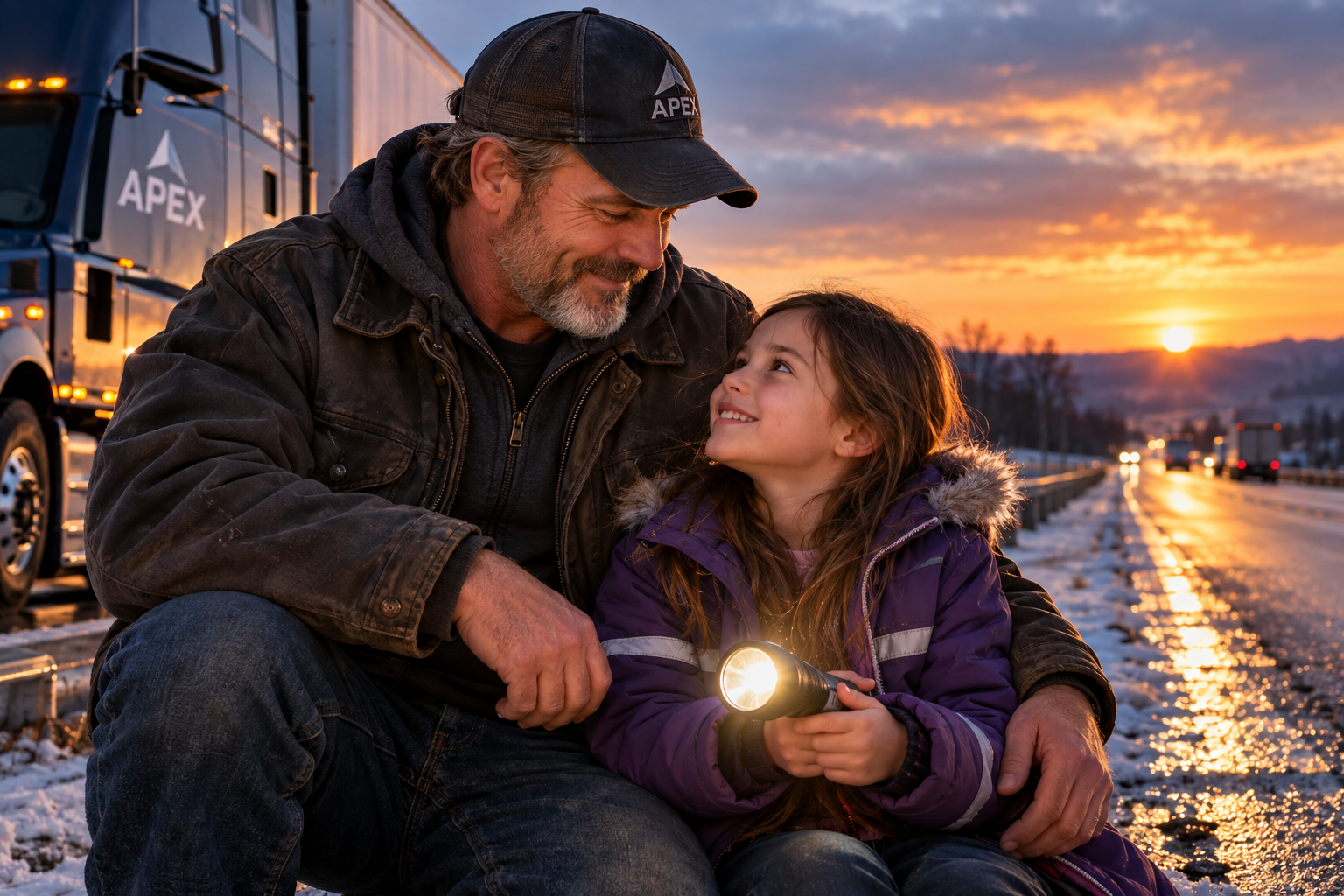
I lifted Lily’s flashlight and switched it on once.
Samuel smiled.
Then they disappeared into the rain.
I returned to the tractor.
Jamal called.
“Everything clear?”
“Yes.”
“Freight status?”
“Still attached.”
“Very funny.”
“What’s the customer say?”
“They’re moving the appointment.”
“No penalty?”
“Not your problem.”
I smiled.
Someone had learned Paula’s phrasing.
“Copy.”
I documented the handoff.
Adrian.
Samuel.
Deputy Owens.
Tow.
No injuries.
Temporary shelter authorized.
Every material fact.
Then I resumed the route.
The rain eased an hour later.
At the receiving dock, a young clerk checked my paperwork.
“You’re late.”
“Yes.”
He scanned the load.
“Dispatch called.”
“Good.”
He signed.
That was it.
No catastrophe.
No secret consequence.
Just a late load.
Two days later, Paula showed me the internal review of the stop.
APPROVED SAFETY ASSISTANCE EVENT.
No discipline.
No schedule impact.
Then she pointed to another section.
“Read this.”
The report recommended adding guidance for vulnerable occupants at roadside incidents.
Not because I had asked.
Because the event revealed a gap.
“What kind of guidance?”
“Temporary shelter. Emergency-service escalation. When drivers should not transport civilians. Documentation.”
I nodded.
“Good.”
Paula looked at me.
“You see what keeps happening?”
“What?”
“You find weird situations.”
“I drive at night.”
“Still.”
She smiled.
Then became serious.
“We’re also reminding drivers they are not required to stop at civilian incidents when stopping creates greater danger.”
“That matters.”
“Yes.”
I had worried about that.
Stories about helping could create another kind of pressure.
Drivers might start believing the company expected roadside heroics.
It didn’t.
It shouldn’t.
Sometimes the safest choice was to call and continue.
The decision still required judgment.
At the next safety briefing, Paula said exactly that.
“Assistance is not mandatory when stopping would create additional risk.”
Then:
“Your first responsibility remains safe operation of your vehicle.”
I liked hearing it aloud.
The story was not becoming help everyone at any cost.
That would simply replace one bad rule with another.
A few weeks later, Adrian mailed a letter to the terminal.
Inside was a thank-you card.
No money.
No gift.
Just a message.
Samuel did not remember the roadside incident.
Adrian did.
He wrote that his father had moved temporarily into a memory-care program while the family arranged longer-term support.
He thanked me for treating Samuel like a person instead of a problem.
I read that sentence several times.
Then I put the card beside Lily’s drawing at home.
Sarah noticed.
“New refrigerator exhibit?”
“Temporary.”
“Sure.”
She read it.
Then her face softened.
“You keep collecting these.”
“I’m not trying to.”
“Maybe that’s why.”
I looked at Lily’s faded flashlight on the counter.
The beam still worked.
The stories around it had multiplied.
Family in a storm.
Passenger van.
Samuel.
Different people.
Different circumstances.
Same basic decision.
Notice someone.
Decide whether stopping helps.
Call the people who actually know what to do.
Stay when staying matters.
Leave when leaving is safer.
No grand philosophy.
Just judgment.
Then Howard sent me an email.
The national program was entering its second-year review.
Driver trust scores had improved.
Reported retaliation continued falling.
Safety-stop volume had stabilized.
One statistic was worse.
Managers reported uncertainty about when civilian-assistance stops should qualify for company protection.
Of course.
Every solution created a boundary question.
What counted as legitimate?
What if a driver stopped for something minor?
What if someone used roadside assistance as an excuse?
What if helping exposed company freight?
I stared at the questions.
Then I laughed.
Sarah looked over.
“What?”
“They’ve created a committee problem out of being decent.”
She smiled.
“That’s what companies do.”
Howard wanted feedback.
I gave him one sentence.
Protect reasonable judgment, not specific acts.
He called me ten minutes later.
“What does that mean?”
“It means don’t write a list saying you can stop for stranded families but not stranded individuals or vans or dogs or whatever.”
“Dogs?”
“You know somebody will ask.”
“True.”
“Judge whether the driver reasonably believed stopping was safe and useful.”
“That’s vague.”
“Yes.”
“Executives hate vague.”
“Reality is going to disappoint them.”
Howard sighed.
“Can I quote you?”
“No.”
He probably did anyway.
Months later, Apex adopted guidance based on exactly that principle.
No exhaustive list.
No promise every compassionate stop was protected.
A reasonableness test.
Safety of the truck.
Severity of apparent risk.
Availability of emergency services.
Freight security.
Duration.
Documentation.
Human judgment constrained by facts.
Not perfect.
Better.
I thought that closed the issue.
Then Adrian called.
He had gotten my number from the terminal after I consented.
His voice sounded tired.
“Marcus, my dad died last night.”
I sat down.
“I’m sorry.”
“He went peacefully.”
I waited.
He continued.
“I know you barely knew him.”
“Doesn’t matter.”
“I wanted you to know.”
“Thank you.”
There was a pause.
Then Adrian laughed softly through whatever emotion he was holding.
“You know the truck thing?”
“What about it?”
“He remembered that.”
I said nothing.
“Not the breakdown. Not the deputy. Not me arguing with him.”
Adrian’s voice cracked.
“But a few days before he died, he told my sister he once sat in a truck with too many buttons.”
I closed my eyes.
“He remembered?”
“Something.”
“That’s good.”
“Yeah.”
Another silence.
Then Adrian said, “He said the driver had a bright light.”
Lily’s flashlight.
I looked at it sitting on the kitchen counter.
Small.
Scratched.
Ordinary.
Adrian thanked me again.
When the call ended, I stayed seated.
Sarah found me there.
“What happened?”
I told her.
She sat beside me.
Neither of us spoke for a while.
Eventually she picked up the flashlight.
“This thing has had a strange life.”
“Yeah.”
She set it down carefully.
Samuel had forgotten almost everything about that night.
But somewhere inside the confusion, a truck and a bright light had stayed.
That did not make me special.
It made the moment special.
There was a difference.
And it reminded me that outcomes were not always the part people carried forward.
Sometimes what remained was simply how someone felt while they were frightened.
Visible.
Safe.
Not alone.
I thought about Victor telling me that stranded people were someone else’s responsibility.
Years later, I understood why that sentence had bothered me so much.
Because responsibility was not always a formal assignment.
Sometimes it was simply the temporary obligation created when you were the person who noticed.
Click here to continue reading: PART 22: The National Safety Program Was Working Until One Terminal Found a Way to Turn Protection Itself Into a New Kind of Pressure
The Storm Was Already Costing Me Time When a Child’s Flashlight Appeared Through the Rain Beside the Highway
Part 21 of 30