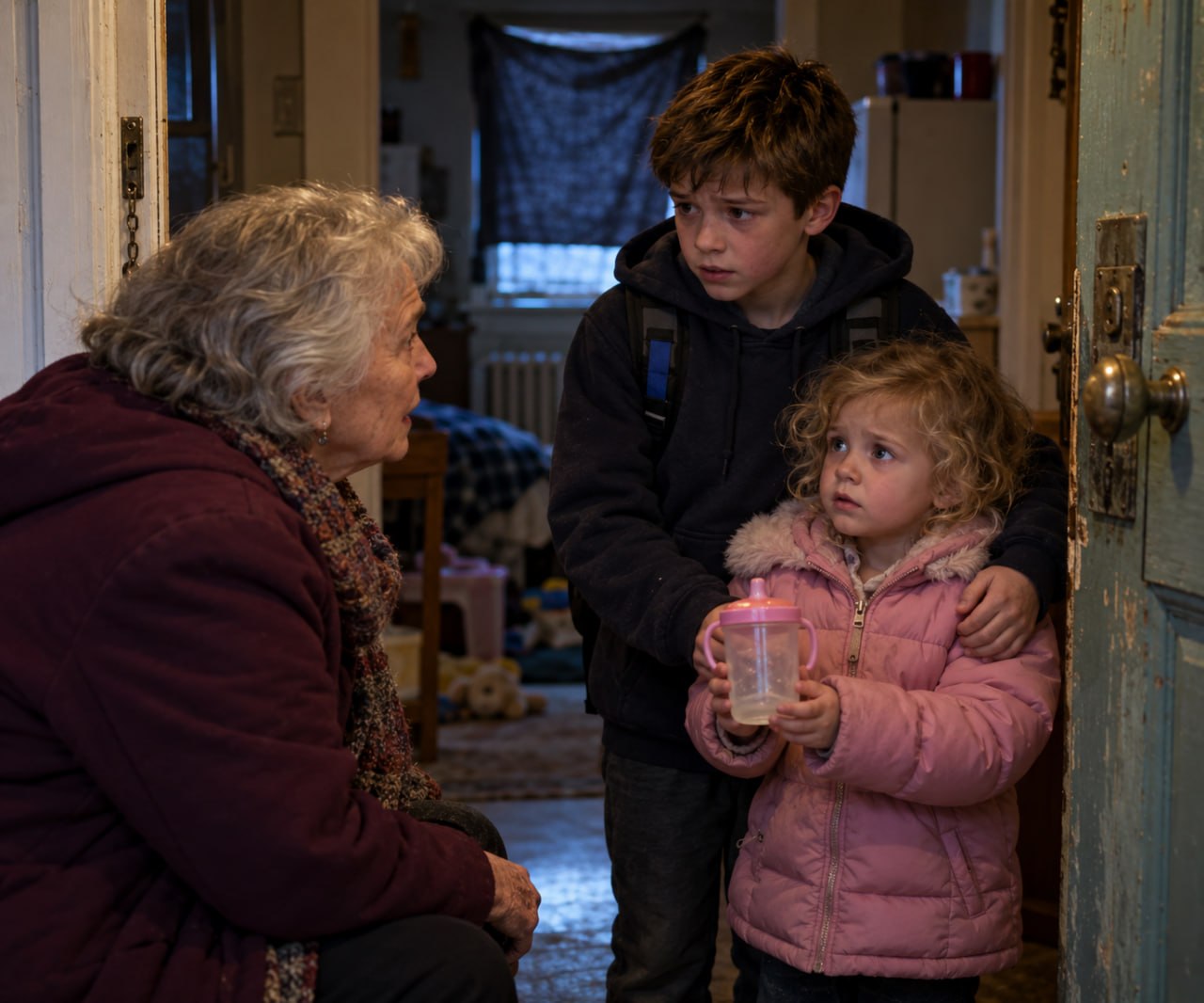
By the tenth morning, I was waiting before Bentley knocked. I had been awake since five, sitting at the kitchen table with coffee growing cold between my hands while rain tapped against the window over the sink. I had spent the night assembling possibilities, rejecting them, then circling back. Perhaps Amber had taken another job. Perhaps a relative was staying there. Perhaps she was sick and embarrassed. Every harmless explanation failed against the same facts: Bentley had missed school, the water had been shut off, he was carrying food home, and nobody—not Doug, not me, not apparently the school—had seen his mother.
At 7:09 I stood beside the front door.
At 7:10 came the knocks.
I opened it immediately.
Bentley jumped.
“Morning.”
“Morning, Miss Arlene.”
He looked worse than the day before. His shirt was buttoned incorrectly, leaving one side of the collar higher than the other. A faint smear of something orange marked his sleeve. His backpack looked almost empty.
“Come in.”
He hesitated. “I just need the bathroom.”
“I know.”
While he was down the hallway, I made a decision that would have horrified Doug and probably delighted Ray.
I put on my shoes.
Bentley returned and found me waiting with my coat.
“What are you doing?”
“Walking with you.”
His face tightened. “To the bus?”
“To wherever you’re going.”
“I’m going to school.”
“Then I’ll walk you to the stop.”
“I can go myself.”
“I know you can.”
He stood absolutely still.
That was the terrible thing about Bentley. He had learned to make stillness look like obedience when it was really defense.
Finally he stepped outside.
We walked side by side toward the maple tree. Rainwater dripped from the branches. The neighborhood was waking around us—garage doors lifting, engines starting, porch lights going dark. Ordinary life was occurring within yards of something I increasingly suspected was anything but ordinary.
Bentley stopped beneath the tree.
“You can go home now.”
“I’ll wait until you’re safely on the bus.”
His jaw tightened.
“Miss Arlene.”
“Yes?”
“I need you to go home.”
He had never spoken to me that firmly.
I studied him. “Why?”
His eyes filled instantly, but he blinked hard and turned his face away.
The bus appeared at the far end of Kilgore.
Bentley took one step behind the tree.
I took one step with him.
He stared at me.
The bus drew nearer.
“Please,” he whispered.
The word contained more fear than any scream could have.
I let the bus pass.
Neither of us moved.
When the sound of its engine faded, Bentley began walking back toward the duplex. I followed several paces behind.
He spun around. “Stop.”
“I can’t.”
“Yes, you can.”
“No, honey. I don’t think I can anymore.”
His hands clenched around his backpack straps. “Mom said we’re not supposed to bother anybody.”
“You keep saying that.”
“Because it’s true.”
“Needing help isn’t bothering someone.”
“We don’t need help.”
A small cry came from inside the apartment.
Bentley froze.
So did I.
Then came another cry.
“Maddie?” I called.
Bentley rushed to the door, fumbling with the key around his neck.
The moment he opened it, the smell reached me.
Stale air. Unwashed dishes. Damp fabric. Something scorched.
Bentley tried to block the doorway.
“She’s okay.”
Maddie cried again.
I stepped forward.
“Move, Bentley.”
“No.”
It was the first time he had openly defied me.
His entire body shook, but he planted himself in front of that door as if he were six feet tall instead of a skinny ten-year-old wearing mismatched socks.
“You can’t come in.”
“Why?”
“Because Mom said nobody comes inside.”
“When did she say that?”
He stared at me.
I waited.
“Bentley.”
His chin began trembling.
“Before she left.”
There it was.
Not before work.
Not before sleeping.
Before she left.
I kept my voice low. “Where did she go?”
His eyes darted toward the living room.
Maddie appeared there wearing pink pajama pants and a shirt with a faded yellow duck across the front. Her hair was tangled. She held an empty plastic cup in one hand.
“Ben,” she whimpered. “Water.”
Bentley turned immediately.
“I’ll get you some.”
He rushed toward the kitchen.
I followed him inside.
The apartment looked less like a neglected home than a place where somebody had tried desperately to maintain routines with no idea how. Toys had been pushed into neat piles. Blankets were folded badly on the couch. A row of canned food sat on the counter beside a manual can opener. Children’s clothes hung from chair backs, apparently washed and left to dry there. On the coffee table lay several picture books, crayons, a flashlight, and a sheet of paper covered with Bentley’s handwriting.
MONDAY
CEREAL
MADDIE MEDICINE
BUS
LUNCH
NAP
TUESDAY
TOAST
BUS
MAC CHEESE
BATH
The list continued.
I stopped breathing for a moment.
Bentley had created a household schedule.
Not for a game.
For survival.
He carried Maddie’s cup to the kitchen sink and turned the faucet.
Nothing happened.
He turned it harder.
A dry metallic cough came from the pipes.
His shoulders sagged.
I understood then why he had been visiting my bathroom every morning. It wasn’t merely the toilet. He was filling himself with water before returning here. Washing his hands. Sometimes carrying bottles beneath his jacket. Using the one functioning bathroom he could reach without exposing what was happening next door.
“When did the water stop?” I asked.
He didn’t answer.
I already knew.
Doug.
Maddie tugged his sleeve. “Thirsty.”
“I know.”
He opened the refrigerator.
The light came on, illuminating almost nothing.
Half a loaf of bread.
Butter.
Ketchup.
A nearly empty milk carton.
No fruit.
No vegetables.
No leftovers.
No mother.
Bentley noticed me looking and pushed the refrigerator closed.
“We have food.”
“I can see.”
“There’s cans.”
“How are you cooking?”
“The stove works.”
“You’re ten.”
“I know how.”
Those three words landed harder than they should have.
He said them without pride.
Without complaint.
Simply as a fact required by circumstance.
Maddie leaned against his leg.
He stroked her hair automatically.
“When did your mother leave?” I asked.
“Monday.”
“Which Monday?”
He looked at me.
My stomach dropped.
“Last Monday?”
He nodded.
Nine days.
Amber had been gone nine days.
“Where is she?”
“The hospital.”
“What happened?”
“She got sick.”
“What kind of sick?”
“She couldn’t breathe.”
I pulled out a kitchen chair and sat because my knees suddenly felt unreliable.
“Tell me exactly what happened.”
Bentley looked toward the door, as though expecting his mother to appear and stop him.
“She was coughing a lot. Then somebody came over.”
“Who?”
“I don’t know.”
“A man?”
He nodded.
“Did you know him?”
“No.”
“What happened after he arrived?”
Bentley swallowed.
“They argued.”
“About what?”
“I was with Maddie.”
“Did you hear anything?”
He stared at the floor.
“He wanted money.”
A cold sensation traveled through my chest.
“And then?”
“I heard something fall.”
He rubbed his thumb over a scratch on the kitchen table.
“I went to the bathroom. Mom was on the floor.”
“Was the man still there?”
“No.”
“Was she conscious?”
“A little.”
“What did you do?”
“I called 911.”
“You called?”
He nodded.
“They asked our address. I remembered it.”
Of course he remembered it. Bentley remembered everything because for nine days forgetting anything had apparently carried consequences.
“The ambulance took her?”
“Yes.”
“And nobody stayed with you?”
He shook his head.
“What did your mother tell the paramedics?”
“That somebody was coming.”
“Who?”
“She said my aunt.”
“Where is your aunt?”
Bentley looked at me.
“We don’t have one.”
For several seconds the only sound in the kitchen was the refrigerator humming.
I closed my eyes.
Amber had lied because she was afraid the children would be taken somewhere while she was transported. The paramedics must have believed another adult was on the way. Bentley had apparently understood enough to continue the lie after the ambulance left.
“What happened that night?”
“I made Maddie noodles.”
“Then?”
“She cried.”
“Did you call anyone?”
“No.”
“Why not?”
“Mom said she’d come back.”
His voice broke on the final word.
I reached for him.
Bentley stepped backward.
“No.”
“All right.”
“If people know, they’ll take Maddie.”
“Who told you that?”
“Nobody.”
“Then why do you think it?”
He finally looked directly at me.
“Because kids can’t live alone.”
There was no sensible answer to that.
He was right.
And yet the terror on his face made it equally clear that calling authorities without thinking through what came next could feel to Bentley like punishment for keeping his sister alive.
Maddie held up her cup again.
“Water.”
That decided the immediate question.
Whatever else happened, these children were coming next door.
I lifted Maddie onto my hip. She came without resistance, resting her cheek against my shoulder as though she had been waiting nine days for an adult to pick her up.
Bentley followed us to the door.
“We can’t leave.”
“You’re walking twenty feet.”
“What if Mom comes back?”
“We’ll see her.”
“What if she comes while we’re inside?”
“I’ll leave a note.”
“What if she thinks we’re gone?”
I turned.
His face was terrified.
Not of me.
Of failing his assignment.
For nine days, Bentley had believed his mother had given him one job: keep Maddie safe until she returned.
He had built his entire existence around it.
I took a sheet of paper from the counter and wrote in large letters:
BENTLEY AND MADDIE ARE WITH ARLENE NEXT DOOR. THEY ARE SAFE.
I taped it inside the front window.
Bentley read every word twice.
Then he locked the door.
He checked the knob.
Checked it again.
And slipped the key beneath his shirt.
Watching that small ritual, I realized he had probably performed it dozens of times while the adults around him remained comfortably unaware.
In my kitchen, Maddie drank two glasses of water so quickly I had to slow her down. Bentley took his in careful sips. I made grilled cheese, cut Maddie’s sandwich into squares, and placed a whole one in front of Bentley.
He didn’t touch it.
Maddie ate one piece.
Then another.
Only when she reached for her third did Bentley finally pick up his sandwich.
He finished it almost without breathing.
I quietly made another.
Then another.
I didn’t tell him I had noticed.
Afterward Maddie fell asleep in Ray’s old recliner beneath a quilt. Bentley stood beside my bookshelf and ran one finger across the spines.
“You like books?”
“I read to Maddie.”
“I’ve heard you.”
He turned, startled.
“The walls are thin.”
His expression clouded.
“I was trying to keep her quiet.”
“You were comforting her.”
He looked at the floor.
I handed him Charlotte’s Web.
“Ray loved this.”
“Your husband?”
“Yes.”
“Is he dead?”
“Three years now.”
Bentley held the book carefully. “Did you miss him when he didn’t come home?”
The question caught me unprepared.
“Every day.”
“How did you know he wasn’t coming back?”
I looked at this exhausted ten-year-old child and finally understood the question beneath the question.
Bentley did not know whether Amber was alive.
Nobody had told him.
For nine days he had fed Maddie, hidden from neighbors, pretended to catch a school bus, rationed food, searched for water, and waited for a mother who might never walk through that door.
I sat beside him.
“Bentley, we’re going to find your mother.”
His fingers tightened around the book.
“What if you can’t?”
“Then we keep trying.”
“What if she’s dead?”
There it was.
The fear he had refused to speak.
Before I could answer, my phone rang.
Doug.
I looked at Bentley, then at Maddie asleep beneath Ray’s quilt.
I answered.
“Ma, tell me you didn’t go into Amber’s apartment.”
I stared through the kitchen window at the silent left half of the duplex.
“Yes,” I said. “I did.”
His voice sharpened.
“You had no right.”
I lowered my own.
“Then you had better sit down, Doug, because what I found in there is going to make your paperwork the least important thing we discuss today.”
Click here to continue reading: PART 3: Doug Arrived With Eviction Papers, but One Detail About Bentley’s Fake School Routine Finally Made Him Stop Defending Himself
Every Morning at 7:10, Bentley Knocked on My Door With the Same Polite Request and a Different Excuse
Part 2 of 40