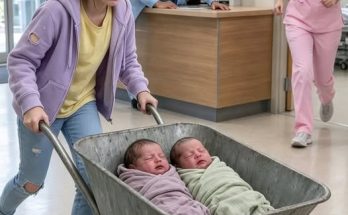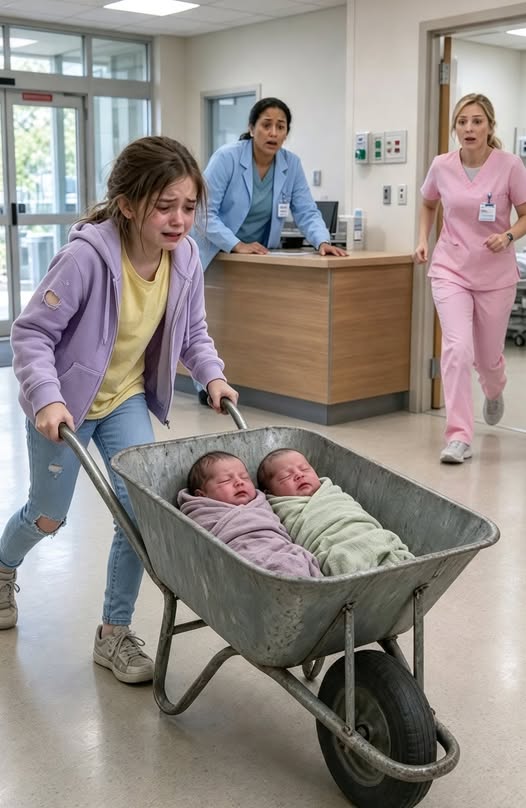
I kept my promise to Chloe.
I was at the hospital the next morning.
But when I walked through the employee entrance, I had no idea how much would change before the day ended.
I had spent the previous evening thinking about her drawing.
The little house.
The yellow sun.
The three children standing beside their mother.
And the blue square Chloe had drawn next to the front door.
A key.
She had drawn a key even in the picture where everyone was safe.
I wondered whether she would ever be able to look at a locked door without remembering those three days.
I hoped she would.
I wanted that for her more than I wanted anything else.
Karen was waiting beside the nurses' station when I arrived.
She had a cup of coffee in one hand and several patient charts in the other.
I stopped beside her.
"How's Sarah?"
"Much better than she was."
I felt my shoulders relax.
"Is she awake?"
"Yes. She's been asking about the children."
Karen explained that Sarah's blood chemistry had continued improving overnight.
Her doctors were still monitoring her closely.
She remained weak.
But the immediate danger had begun to ease.
I looked toward the intensive care corridor.
"Does she remember everything?"
"Not everything."
Karen lowered her voice.
"She's remembering more."
I knew what that meant.
The medical emergency had left Sarah confused about parts of the days before she collapsed.
Now that her condition was improving, those memories were beginning to return.
I asked whether Rachel knew.
Karen nodded.
"She's already been here."
I thanked her and went to reception.
The morning registrations were waiting.
I placed my bag beneath the counter.
Opened the computer.
And started working.
For nearly an hour, I managed to concentrate.
Then Rachel appeared beside my desk.
She was carrying the same thick folder I had seen the day before.
But this time, she had a photograph tucked inside it.
"Martha, do you have a minute?"
I stood.
"Of course."
She led me into the small consultation room.
Ben Jenkins was already there.
So was Deputy Harris.
I had seen the deputy briefly during the emergency response, but we had never spoken properly.
He introduced himself.
Then he asked me to sit down.
I looked at Rachel.
"Has something happened?"
"Sarah's safe," she said.
I breathed out.
That was the answer I needed first.
Deputy Harris placed a notebook on the table.
It was the small notebook found beside Sarah's bed.
He did not hand it to me.
He simply opened it to a page he wanted to discuss.
I recognized the handwriting from the older medical records.
Small letters.
Careful spacing.
Dates written along the left edge.
Harris explained that the investigators had been examining the notebook alongside the property documents recovered from the locked outbuilding.
They had also interviewed Sarah.
Her medical team had approved short conversations with appropriate breaks.
I nodded.
"Did she explain the key?"
"She did."
I looked at the notebook.
Harris told me the brass key belonged to the old storage building behind the farmhouse.
Sarah had kept important papers there because she did not want them destroyed or removed.
The documents included records of the farm's ownership, household finances, and correspondence concerning the property.
They were being reviewed by investigators and legal authorities.
I remembered Alan standing in our consultation room with his polished shoes and thick folder.
He had spoken as though the farm was an example of Sarah's inability to manage her life.
Now there were records that needed to be compared with what he had claimed.
Harris turned another page.
Sarah had made notes about missing belongings.
The car keys.
Certain financial papers.
And problems with the telephone.
I looked at the dates.
They had been written before her medical collapse.
Not afterward.
Sarah had noticed things going wrong.
She had been keeping track of them.
I felt cold.
"What did she say about the gate?"
Harris looked at me.
"She said she hadn't locked it."
I thought about the new chain.
The clean metal.
The padlock fastened from the road side.
He continued.
Sarah had reported that the gate was accessible before her condition became serious.
She had not given anyone permission to block the driveway.
I looked at Ben.
He was staring at the table.
I knew he was remembering what he had found.
Harris explained that investigators were still establishing who had secured the gate and when.
They were comparing statements with physical evidence and available records.
I understood.
They could not simply decide somebody was responsible because the circumstances looked suspicious.
But Sarah's statement mattered.
She had not chosen to lock herself away.
At least, that was what she was now telling investigators.
And the evidence was beginning to support important parts of her account.
Rachel looked at me.
"There's another reason we wanted to speak with you."
I waited.
"Chloe's first statements have been important."
I thought about the cereal box.
The muddy shoes.
The way she had described the tractor lane.
"She was very clear about what she saw."
Rachel nodded.
"Yes. And you've consistently separated her words from your own conclusions."
I looked down.
That was not always easy.
There had been moments when I wanted to decide the whole story before anyone had finished examining the facts.
But I had learned something from those early mistakes.
The truth needed care.
Especially when a child was involved.
Harris asked whether Chloe had ever described her mother's condition before leaving the farm.
I repeated what she had said.
Mommy was in bed.
She had not been talking anymore.
She was still wearing her boots.
She had been asleep for three days.
Harris wrote everything down.
Then he asked whether Chloe had explained why she used the wheelbarrow.
I told him she had brought both babies.
That she knew the path.
That Sarah had given her directions before becoming too ill to speak.
He nodded.
That matched information they had gathered separately.
I felt a strange sadness.
Every little detail Chloe had told us was being placed into an official record.
The things she had said while exhausted and frightened were becoming evidence.
I understood why.
But I wished she had never needed to speak those words at all.
After the meeting, I went to see Sarah.
Dr. Ross had approved another short visit.
She was sitting slightly upright in bed.
Her hair had been brushed.
A fresh blanket covered her legs.
She looked different from the woman I had seen arriving on the stretcher.
Still ill.
Still tired.
But present.
She smiled when I entered.
"Martha."
I moved toward the chair.
"How are you feeling?"
"Like I've been asleep for a year."
I smiled a little.
"You're doing better."
She nodded.
Then she looked toward the window.
"Rachel told me you found my old medical record."
I felt uncomfortable.
"Dr. Ross needed to know about your diabetes."
Sarah turned back toward me.
"Thank you."
I sat down.
I did not know what to say.
She continued.
"I thought I had everything under control."
I watched her face.
"I knew my sugar was getting bad."
Her voice was weak.
She paused to breathe.
"I was trying to get help before it got worse."
I waited.
She told me she had been frightened by how quickly her strength disappeared.
She had been caring for the babies.
Trying to feed Chloe.
Trying to keep the house warm.
And trying to understand why things she relied upon were no longer available.
The car keys were missing.
The telephone was not working.
She could not get through the main gate.
Each problem had become more serious as she grew weaker.
I felt my chest tighten.
"Did you know the telephone wires had been cut?"
She shook her head.
"Not until they told me."
She looked away.
"I thought it was broken."
I remembered the photograph.
The little utility box.
The bright copper ends.
I wondered how frightening it must have been to pick up a telephone and hear nothing while two newborn babies needed care.
Sarah began rubbing the edge of the blanket.
"Chloe kept asking what she could do."
I said nothing.
"She wanted to help."
Sarah's voice broke.
"I kept telling her to stay close."
She looked at me.
"But I knew I was getting worse."
I leaned forward.
She told me she had explained the route through the fields.
Not because she wanted Chloe to make the journey alone.
Because she was afraid the children might have no other way to reach help.
She had shown Chloe where the old tractor tracks led.
She had told her to stay away from the main road if she needed to go for assistance.
She had reminded her where the hospital stood.
And she had told her to protect the brass key.
"Why the key?" I asked gently.
Sarah looked at the ceiling.
"Those papers were the only proof I had of some things."
I waited.
She explained that she had become worried about the property records and financial arrangements connected to the farm.
There had been disagreements with Alan.
He had made claims about her ability to manage the land and care for the family.
She had begun keeping copies of important documents away from the house.
I thought about the little shed.
The old lock.
The brass key on its blue string.
Sarah looked at me.
"I didn't know what would happen if I couldn't speak for myself."
I felt tears behind my eyes.
She had been afraid of losing more than the farm.
She had been afraid that nobody would believe her.
And when she became unconscious, that was almost exactly what happened.
Alan arrived with documents.
Sarah arrived on a stretcher.
He could talk.
She could not.
I took her hand.
"The records are being reviewed."
Sarah nodded.
"Rachel told me."
I wanted to promise her that everything would be resolved fairly.
But I could not know that.
So I said something smaller.
"You're able to tell your side now."
She looked at me.
Then she closed her eyes.
"That's what I needed."
We sat quietly for a moment.
When the nurse came in to check her, I stood.
Sarah caught my hand again.
"How is Chloe?"
"She's doing well today."
"Is she still asking about the wheelbarrow?"
I smiled sadly.
"Sometimes."
Sarah looked down.
"I don't want her to think she has to do that again."
I nodded.
"Then keep telling her."
She squeezed my hand.
"I will."
I left her room feeling both relieved and angry.
Not angry at Sarah.
Angry at the situation.
Angry that a mother had been forced to make impossible choices while her health was failing.
Angry that a child had learned how to survive before learning how to feel safe.
And angry that the entire emergency could so easily have been mistaken for ordinary neglect.
By early afternoon, the hospital had another visitor.
A representative from the county's legal office arrived to meet Rachel.
I saw them pass reception.
Neither spoke to me.
They went directly into the consultation room.
I returned to work.
But a little later, Rachel came back with an update she was authorized to share.
There would be no immediate transfer of the children into Alan's care.
The temporary protective arrangements would remain in place while the family court and investigators examined the evidence.
I sat very still.
"All three children?"
"Yes."
I felt my eyes fill.
Rachel continued.
The court would need to consider Sarah's recovery, the infants' medical needs, Chloe's safety, and the evidence concerning the farmhouse.
Alan's legal rights had not simply disappeared.
But his request for immediate control had not been granted.
That distinction mattered.
I understood it.
There would be hearings.
Reviews.
Further decisions.
Nothing had been completely settled.
But the children would not be sent away simply because Alan had arrived with a folder of papers.
I thanked Rachel.
She looked at me.
"There's more work ahead."
"I know."
She nodded.
Then she returned to her office.
I sat behind the reception counter.
For a long moment, I did nothing.
The computer screen glowed in front of me.
The telephone was quiet.
I thought about Alan's first visit.
His clean coat.
His polished shoes.
His calm explanations.
I had almost been embarrassed into silence.
He had told me that family matters belonged to other people.
And I had wondered whether he was right.
Now I knew something I had not understood then.
A person did not need to be a police officer or a lawyer to notice when a child needed help.
But noticing was only the beginning.
After that came careful questions.
Proper reporting.
Medical treatment.
Evidence.
And patience.
I had wanted answers immediately.
The people handling the case had needed time to establish them.
That afternoon, Ben stopped by.
He had heard that the temporary care arrangements were continuing.
He looked relieved.
I told him Sarah was speaking more clearly.
He smiled.
"Good."
Then he asked whether I had seen the wheelbarrow.
I shook my head.
"Not since they stored it."
He told me it remained in secure custody with the other evidence.
The old red tray.
The crooked wheel.
The worn handles.
I pictured it standing alone in a storage room.
For some reason, that made me sad.
It was just a farm tool.
Something used to carry dirt or firewood.
But Chloe had turned it into the only transport she had.
I wondered whether Sarah would ever want it back.
Or whether she would be glad never to see it again.
Ben looked at me.
"She made it the whole way."
I nodded.
"Yes."
He paused.
"Three miles."
I thought about the measured path.
The old tractor ruts.
The wet ground.
The deep hole where the wheel had become stuck.
And Chloe pulling it free.
"She shouldn't have had to."
Ben nodded.
"I know."
That evening, I visited Chloe again.
She was sitting at the small table.
Her latest drawing was in front of her.
The sun was bigger this time.
The house had four windows.
She had drawn two small beds inside one room.
I sat beside her.
"Who sleeps there?"
"The babies."
I smiled.
"And where do you sleep?"
She pointed to the upstairs room.
"Here."
Then she looked at me.
"Mommy says we're going to be together."
I nodded carefully.
"She's working hard to get better."
Chloe looked at the drawing.
"Can she walk now?"
"She's getting stronger."
She considered that.
Then she picked up a brown crayon.
She drew a path leading away from the house.
I watched her.
It looked like the tractor lane.
But this time, she drew three people walking along it.
Not one.
I asked who they were.
"Me, Mommy, and Ben."
I laughed softly.
"Ben?"
She nodded.
"He drives the ambulance."
I smiled.
"Yes, he does."
She added a fourth shape.
A little red wheelbarrow.
But it was empty.
I looked at it for a long moment.
Chloe noticed.
"Nobody's in it."
"I see that."
She picked up a green crayon.
She drew grass around the wheel.
Then she looked up.
"We don't need it."
I felt my throat tighten.
"No," I said. "Not today."
She went back to coloring.
I sat beside her until Karen came to take her for dinner.
After Chloe left, I remained at the table.
The drawing was still there.
The empty wheelbarrow.
The family.
The path.
I thought about the days ahead.
Sarah would need rehabilitation and follow-up medical care.
The twins would need time to grow stronger.
Chloe would need support for what she had experienced.
And the investigation would continue.
I knew those things.
The outcome was not guaranteed.
But the family had something now that they had not possessed inside the farmhouse.
People were listening.
People were watching.
People were asking the questions that should have been asked earlier.
I stood and went back to reception.
Before leaving that night, I saw Rachel again.
She was holding a folder marked for the next court review.
She told me Sarah's attorney had begun organizing the documents recovered from the shed.
The financial records were being compared with Alan's claims.
The investigators were still reviewing the cut telephone line, the locked gate, and the missing keys.
No final determination had been announced.
But the case was moving forward.
I nodded.
Then Rachel said something that stayed with me.
"Sarah told us she thought no one would believe her if something happened."
I looked toward the pediatric corridor.
"Chloe made sure we had to look."
Rachel nodded.
"She did."
I drove home after dark.
The road was nearly empty.
When I passed the turn toward Route 4, I slowed slightly.
I thought about the farmhouse beyond the fields.
The gate.
The locked shed.
The little bedroom upstairs.
And the kitchen table with three bowls.
I imagined Sarah returning there someday.
Not to the same fear.
Not to the same isolation.
But to a place where her children could sleep without worrying about whether she would wake.
I hoped that would happen.
But first, there were still decisions to be made.
And people who had important questions to answer.
The story was not finished.
Not yet.
The next morning, I would return to the hospital.
Chloe would be waiting for news about her mother.
Sarah would continue getting stronger.
The twins would continue receiving care.
And the evidence would continue being examined.
That was enough for one night.
I turned onto my road.
Then I remembered something Chloe had said during her first visit to the hospital.
She had asked whether she had brought both babies correctly.
I had told her she had done something important.
Now I understood how much those words had left out.
She had done everything she could.
And because she did, the adults finally had a chance to do what they should have been able to do for her all along.
Click here to continue reading: PART 10: Months After Chloe Pushed Her Wheelbarrow Three Miles, I Saw Her Family Together Again and Finally Understood What Saving Them Had Cost
I Thought It Was Another Ordinary Morning Until a Six-Year-Old Girl Pushed a Rusty Wheelbarrow Through Our Emergency Room Doors
Part 9 of 10