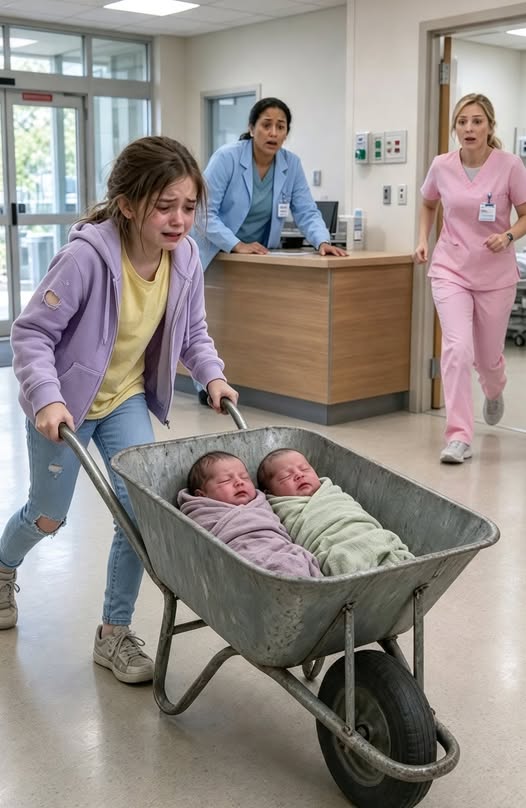
The last time I saw Chloe beside the red wheelbarrow, she was not pushing it.
She was standing next to it.
Her hands were clean.
Her sneakers were dry.
And there were two adults beside her.
For a moment, I could hardly believe it was the same little girl who had come through our emergency room doors.
But I am getting ahead of myself.
Because before that afternoon could happen, Sarah and her children had a long road to travel.
The first weeks were difficult.
Sarah survived the medical emergency.
That was the most important thing.
But surviving was not the same as recovering.
Her body had been pushed far beyond what it could safely endure.
She needed continued treatment.
She needed help regaining her strength.
And she needed time before she could safely care for three children again.
I saw her several times during those weeks.
Some days, she looked better.
Other days, she seemed exhausted after only a few minutes of conversation.
She hated that.
I could tell.
She wanted to get out of bed.
She wanted to hold the twins.
She wanted to prepare Chloe's breakfast.
She wanted to go home.
But the doctors made her take things slowly.
I remember one morning when she became frustrated because she could not walk the length of the corridor without stopping.
She sat down on a chair near the nurses' station.
I was there delivering a form.
She looked at me.
"I used to carry feed sacks heavier than Chloe."
I smiled.
"I believe you."
She shook her head.
"Now I can't even walk to the elevator."
I sat beside her.
"You nearly died, Sarah."
She looked down at her hands.
"I know."
For a moment, she said nothing.
Then she whispered something.
"I keep thinking about what happened while I was lying there."
I waited.
She rubbed her palms together.
"She was alone."
I knew she meant Chloe.
"She had two babies to care for."
I nodded.
Sarah looked toward the window.
"And I couldn't help her."
I wanted to tell her not to think that way.
But grief does not disappear because somebody says the correct words.
So I let her speak.
She told me she remembered hearing the babies cry.
She remembered trying to stand.
She remembered falling back onto the bed.
She remembered Chloe bringing her water.
And she remembered realizing she might lose consciousness before anyone came.
Those memories had returned slowly.
Not all at once.
A few minutes.
A sound.
A face.
Then another piece.
She looked at me.
"I never wanted her to make that trip."
"I know."
"I thought somebody would stop."
I nodded.
"She told us."
Sarah closed her eyes.
"Three miles."
I let the words remain between us.
There was no way to make the distance smaller.
No way to change the mud on Chloe's shoes.
No way to erase the blisters on her hands.
The only thing we could do was make sure she never had to carry that kind of responsibility again.
That became the real work.
Not the photographs.
Not the attention her story eventually received.
The real work was much quieter.
It happened in hospital rooms.
Therapy appointments.
Meetings with social workers.
And long conversations about what safety would look like when the family left our care.
The twins improved steadily.
The smaller baby gained weight.
The little boy began feeding more reliably.
Their doctors continued monitoring both infants closely.
There were still appointments ahead.
But the frightening uncertainty of those first hours began to ease.
I remember the day Chloe was allowed to sit beside both babies while Sarah held them.
The family was together in a small room near neonatal care.
Sarah sat in a chair with a baby resting in each arm.
Chloe stood beside her.
She looked at the infants.
Then at her mother.
"Are they both full?"
Sarah smiled.
"Yes."
Chloe studied their faces.
"Good."
That was all she said.
But I understood.
She had spent days trying to make them stop crying.
She had carried them because she thought they might die.
Now she could stand beside them without needing to solve anything.
Sarah looked up at me.
Her eyes filled.
I smiled.
Then I stepped outside.
Some moments belong to a family.
I did not need to be part of every one.
The investigation continued while Sarah recovered.
I was not present for the interviews.
I did not attend every legal meeting.
And I did not know everything the investigators discovered.
But I learned enough through official updates and information Sarah later chose to share.
The documents recovered from the outbuilding became important.
They provided records of Sarah's ownership interests and financial circumstances.
They also helped authorities examine claims made during the dispute over the farm and the children.
The old notebook mattered too.
It contained dates.
Missing items.
Problems with communication.
And concerns Sarah had written down before becoming unconscious.
Those notes did not answer every question by themselves.
But they provided a timeline.
And that timeline could be compared with other evidence.
The cut telephone wires were documented.
The chain and padlock were examined.
The missing car keys remained part of the investigation.
Alan's statements were reviewed alongside those facts.
I remember how important that distinction became to me.
At first, I had wanted one simple answer.
One person responsible.
One explanation for everything.
But real investigations do not work like the stories people tell afterward.
Evidence has to be tested.
Witnesses have to be questioned.
Documents have to be checked.
And conclusions have to be supported.
I had learned that lesson the hard way.
The family court eventually made decisions based on the evidence before it.
Sarah's medical emergency was not treated as automatic proof that she was an incapable mother.
The circumstances of her illness were considered.
So were the children's needs.
And the concerns surrounding their safety.
Alan did not receive the immediate control he had sought.
That mattered.
I had feared that the first person to arrive with official paperwork might be the one everyone believed.
Instead, Sarah had an opportunity to speak for herself.
Her records were examined.
Her medical condition was properly understood.
And the children remained protected while the necessary decisions were made.
There were further legal proceedings concerning Alan's conduct and the property.
Sarah told me they were exhausting.
I believed her.
Some matters were resolved through court orders and documented agreements.
Others required continuing review.
I will not pretend every question disappeared.
I did not personally see the outcome of every legal issue.
And I did not need to.
What I could see was that Sarah no longer had to face the situation alone.
She had legal help.
Medical care.
Support from the county.
And a plan for the children.
That was a different life from the one Chloe had left behind in the farmhouse.
A few weeks after Sarah's condition stabilized, she was well enough to leave the hospital under a structured care plan.
I watched the preparations from the nurses' station.
She wore a blue cardigan.
Her hair was pulled back.
She moved slowly.
But she was walking.
Chloe held her hand.
The twins were still receiving the care they needed, and their discharge arrangements were being coordinated separately.
Sarah stopped when she saw me.
"Martha."
I walked toward her.
She smiled.
"You kept coming back."
I looked at Chloe.
"So did she."
Sarah's eyes filled.
She reached for my hand.
I held it.
There was no speech.
No grand moment.
Just a woman standing in a hospital corridor with her daughter.
A woman who had nearly died.
A child who had nearly lost everything.
And a few people who had been fortunate enough to help them reach that day.
Chloe looked up at me.
"Mommy can walk now."
I smiled.
"I can see that."
She looked pleased.
Then she said something that made Sarah laugh.
"She still needs to rest."
Sarah nodded.
"Apparently, I have a new boss."
Chloe did not laugh.
She was very serious.
"You have to listen to the doctor."
I looked away for a moment.
Because even then, she was watching over her mother.
We had made progress.
But Chloe had not yet learned how to put down every responsibility she had carried.
That would take time.
Sarah knew it too.
She arranged for Chloe to receive emotional support.
Not because the little girl had done something wrong.
Because she had lived through something frightening.
She had heard newborn babies cry without knowing how to help.
She had watched her mother become unresponsive.
She had carried the fear of being the only person who could save them.
Children do not simply forget experiences like that.
Even when the outcome is good.
Some nights, Chloe woke frightened.
Sarah told me about it later.
Sometimes Chloe asked whether her mother had taken her medicine.
Sometimes she checked whether the telephone worked.
And sometimes she wanted to know where the car keys were.
Sarah answered her.
Every time.
She showed Chloe the telephone.
She showed her where the keys were kept.
She explained that adults were now responsible for emergencies.
And she reminded her that she did not have to solve everything.
I was glad Sarah understood that.
Because people had begun calling Chloe a hero.
The story of the little girl and the wheelbarrow had spread beyond the hospital.
People were amazed.
Some wanted photographs.
Some wanted to send gifts.
Some offered help for the family.
The community responded with kindness.
That meant something.
But Sarah was careful about how Chloe's story was shared.
She did not want her daughter to become a spectacle.
She wanted her to have a childhood.
I respected that.
More than anything, I wanted Chloe to be allowed to forget about being brave for a while.
I wanted her to play.
To complain about homework.
To ask for another cookie.
To run through the grass without looking over her shoulder.
Ordinary things.
Things a child should be allowed to take for granted.
The hospital staff helped where they could.
Karen arranged donated baby supplies through the appropriate community programs.
Rachel helped Sarah connect with support services.
Ben checked in whenever his ambulance brought him near the hospital.
Dr. Ross continued following the children's recovery through the medical team.
And I did what I knew how to do.
I answered calls.
Helped with appointments.
Made sure Sarah had the correct contact numbers.
And listened when she needed someone to hear her.
I had nearly lost my job because I became involved in that family's emergency.
I did not forget that.
The hospital had withdrawn my formal warning.
But the experience had changed how I thought about my work.
I still believed in procedures.
I still believed confidential information had to be protected.
And I still knew that receptionists were not investigators.
But I also knew that an unusual situation should not be ignored simply because the person noticing it had a small title on their badge.
A frightened child might not know which department was responsible.
A sick mother might not be able to ask for help.
And an emergency might begin with something as ordinary as a scraping wheel.
Several months passed.
Winter settled over Ohio.
The fields outside town turned brown.
Cold rain replaced the softer autumn weather.
I continued working at Oak Ridge.
The hospital remained busy.
People came and went.
Some days were good.
Others were difficult.
But whenever I heard a metal cart rolling across the entrance floor, I looked up.
I could not help it.
The sound brought Chloe back to me.
The red wheelbarrow.
The muddy shoes.
The towels.
The two tiny babies.
And the little girl who had not stopped pushing.
One afternoon, Sarah called the hospital.
She asked whether I would be working the following Friday.
I told her I would.
She sounded pleased.
"There's something we'd like to show you."
I smiled.
"What is it?"
"You'll see."
I did not press her.
She had earned the right to keep a small surprise.
Friday arrived.
I was helping a patient at the front desk when I saw Sarah enter.
She was walking steadily.
Her face had regained its color.
She wore a simple winter coat.
Chloe walked beside her.
Behind them came Ben.
And he was pushing something.
A red wheelbarrow.
I stared.
For a moment, I could not move.
It had been cleaned.
The crooked wheel had been repaired.
The metal tray was still scratched.
The handles still showed the worn places where Chloe had gripped them.
But it rolled smoothly now.
Ben brought it to a stop beside the waiting chairs.
I stepped away from my desk.
"Is that the same one?"
Sarah nodded.
"Yes."
I looked at the wheel.
Then the handles.
Then the little metal tag.
884-02.
The same number I had written down on the morning Chloe arrived.
My eyes filled.
Ben smiled.
"The investigators released it after they finished documenting what they needed."
I ran one hand along the red metal.
I remembered how dirty it had been.
How the wheel had clicked against the tile.
How Chloe had refused to let go.
I looked at her.
"Do you remember bringing this here?"
She nodded.
Then she smiled.
"It doesn't make that noise anymore."
Ben laughed softly.
"No. We fixed that."
I crouched beside her.
"Do you still want to push it?"
She shook her head.
"Not with babies."
I felt something catch in my throat.
Sarah stepped closer.
She told me the family had decided to keep the wheelbarrow.
Not as a reminder that Chloe had to be strong.
But as a reminder of what she had done when nobody else could help.
They planned to put it in the garden.
Fill it with flowers.
Let it become something different.
I looked at the empty tray.
For days, I had imagined those two newborn babies lying inside it.
Wrapped in towels.
Struggling to survive.
Now there was nothing in it.
No blankets.
No frightened infants.
No emergency.
Just an old wheelbarrow.
Waiting for flowers.
Sarah touched my arm.
"The twins are doing well."
I smiled.
"I'm glad."
She told me they were gaining weight and continuing their medical follow-up.
They were still small.
But they were growing.
Both were at home with her under the family's ongoing care arrangements.
She showed me a photograph.
Two babies lying on a blanket.
Chloe sitting between them.
All three looking toward the camera.
I held the photograph carefully.
The little boy had his fist near his mouth.
His sister was staring wide-eyed at something outside the frame.
And Chloe was smiling.
Not the tired, cautious smile I had seen at the hospital.
A real smile.
The kind children make when they are not worrying about what will happen next.
I gave the photograph back.
Sarah told me that life was still complicated.
There were appointments.
Legal matters.
Bills.
And days when the memories returned.
She did not pretend everything had become easy.
But she had help now.
She had a safer living arrangement.
The children were receiving care.
And decisions about the farm and custody were being addressed through the proper legal process.
She no longer had to rely on a six-year-old girl to keep the family alive.
That was what mattered.
I looked down at Chloe.
She was examining the repaired wheel.
"Does it roll better?"
She nodded.
"Ben made it straight."
Ben smiled.
"Mostly straight."
Chloe gave the wheel a little push.
It turned smoothly.
No clicking.
No scraping.
Just a quiet circle.
I felt tears run down my face.
I did not try to hide them.
Sarah put her arm around me.
I hugged her.
Then I hugged Chloe.
She wrapped her arms around my neck.
For a moment, I could feel how small she still was.
She had grown since October.
But she was still a little girl.
That was what I wanted everyone to remember.
Not the distance.
Not the wheelbarrow.
Not the headlines.
Her size.
Her age.
How much had been placed on her small shoulders.
And how much she deserved to have taken off them.
Before leaving, Sarah handed me an envelope.
I opened it after they had gone.
Inside was a photograph of the family.
Sarah sat in a chair with the twins.
Chloe stood beside her.
There was a handwritten message on the back.
It thanked me for listening when Chloe could barely explain what had happened.
I read it twice.
Then I put the photograph beside my computer.
For several days, people asked about it.
I told them only what Sarah had given me permission to share.
A little girl had reached the hospital.
Her family had received help.
And they were recovering.
There were parts of the story that belonged to them alone.
I wanted to protect those parts.
A week later, Sarah sent another photograph.
The wheelbarrow was sitting in the garden.
It had been filled with soil.
Small flowers were growing inside.
Yellow ones.
White ones.
A few red ones near the handles.
Chloe stood beside it holding a watering can.
There were no babies in the tray.
No towels.
No mud on her shoes.
No frightened child struggling to keep the wheel moving.
I stared at the photograph for a long time.
Then I placed it beside the first one.
I thought about the morning Chloe arrived.
I had been drinking cold coffee.
Sorting forms.
Thinking about the ordinary work ahead.
Then the doors opened.
And a little girl brought an emergency into our hospital without a siren.
I had nearly misunderstood what I was seeing.
I had nearly treated the wheelbarrow as a strange interruption.
A problem for somebody else.
That thought still shamed me.
Because if Karen had not looked inside quickly, the babies might not have survived.
If Ben had not followed the directions, Sarah might have remained undiscovered.
If Dr. Ross had not prepared the team, her medical emergency might have ended differently.
If Rachel and the investigators had not examined the evidence, the family's circumstances might have been misunderstood.
And if Chloe had stopped pushing, none of us might have known they needed help in time.
I understood that every person had played a part.
But Chloe had started it.
A six-year-old girl.
Three miles.
A broken wheel.
Two newborn babies.
And a mother waiting in a locked farmhouse.
I did not think of Chloe as fearless.
She had been frightened.
I knew that from the way she watched doors.
From the way she asked about her mother.
From the way she held the brass key.
She had been afraid.
And she had kept going anyway.
That was the part I could never forget.
But I did not want her life to be defined by that one terrible morning.
I wanted her to become an ordinary teenager someday.
I wanted her to grow up complaining about school and choosing clothes and arguing about bedtime.
I wanted her to have birthdays where nobody mentioned the wheelbarrow.
I wanted her to learn that being loved did not require saving everybody.
And I wanted Sarah to live long enough to show her that.
One evening, after my shift, I stood beside the hospital entrance.
The automatic doors opened.
Cold air moved across the floor.
A maintenance worker pushed an empty cart past me.
Its wheels made a quiet rattling sound.
I turned.
For one foolish second, I expected to see Chloe.
The green sweatshirt.
The muddy sneakers.
The red handles.
But it was only a cart.
The worker nodded politely and continued.
I stood there a little longer.
Then I looked through the glass toward the parking lot.
Cars were arriving.
People were walking toward the entrance.
The hospital was carrying on.
I knew another emergency would come.
Another family would need help.
Another frightened person might struggle to explain what was wrong.
I could not prevent every tragedy.
I had learned that long before Chloe came into my life.
But I could listen.
I could notice.
I could ask the next question.
And I could remember that the person asking for help might not arrive in a way I expected.
I went back inside.
On my desk were two photographs.
One showed Sarah with her three children.
The other showed a red wheelbarrow full of flowers.
I placed them beside each other.
Then I sat down to finish my shift.
I still had work to do.
Forms to complete.
Calls to answer.
People to direct toward the care they needed.
But I was no longer quite the same woman who had been sitting behind that counter on the morning Chloe arrived.
I had learned to look twice.
To listen longer.
And to remember that sometimes the most important person in a room was the one everyone nearly overlooked.
I looked at the photograph of the flowers.
Then I smiled.
The wheelbarrow had finally stopped moving.
And Chloe's family was together.
That was enough.
The End
Read more original stories on Feel Every Story.
I Thought It Was Another Ordinary Morning Until a Six-Year-Old Girl Pushed a Rusty Wheelbarrow Through Our Emergency Room Doors
Part 10 of 10