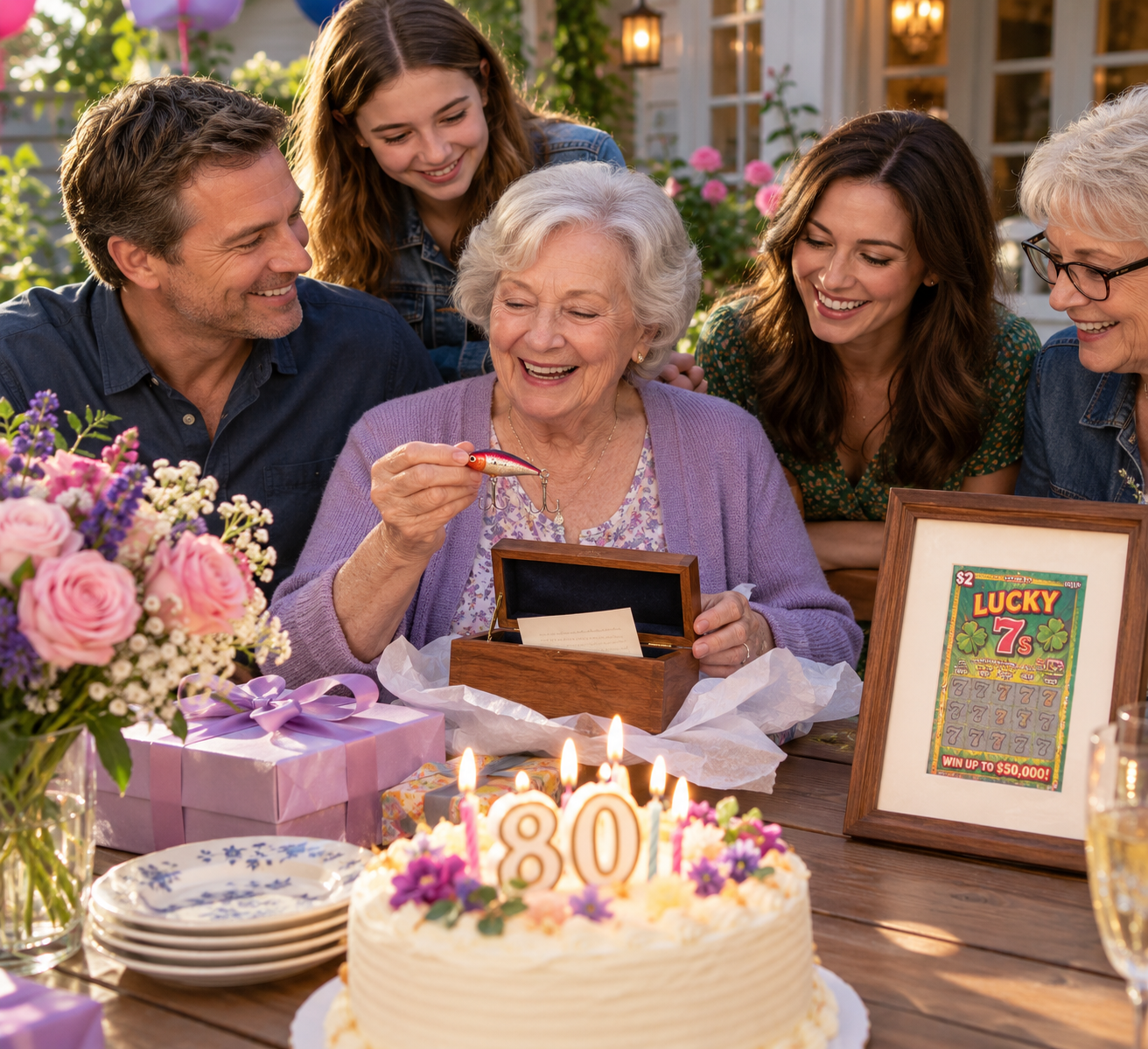
The scratch ticket cost two dollars, which was apparently exactly what Renata thought I was worth.
She slid it across the table inside a flimsy birthday card decorated with purple balloons and watched me pull it from its little paper sleeve. My son Daniel sat beside her, smiling into his coffee. Across the table, my grandchildren were waiting for cake. I had turned seventy-three that afternoon, and somehow I was the only person in the room who had not been told that my birthday had become a joke.
“Go on, Dolores,” Renata said. “Maybe you’ll win enough for bus fare.”
Daniel laughed.
Not cruelly, perhaps. That was what I told myself at first. It was the lazy laugh of a man who had learned that keeping his wife amused was easier than deciding whether she was being unkind.
I rubbed the edge of a quarter over the silver coating.
The first number matched.
Then the second.
By the third, I stopped hearing the conversation around me.
I checked the instructions twice because my eyes were seventy-three years old and because the amount printed beneath the final symbol could not possibly mean what I thought it meant.
Eleven million dollars.
My fingers closed around the ticket.
Renata was cutting the cake. “Anything?”
I looked at her.
There are moments when a person has only seconds to decide which version of herself will survive the rest of her life. The woman I had been for years would have gasped. She would have shown Daniel. She would have let everyone crowd around. She would have watched Renata become affectionate before the cake plates were cleared.
Instead, I folded the ticket once.
“Nothing exciting.”
Renata laughed. “Told you.”
I put it in my cardigan pocket.
Daniel looked at my hand.
Only for a second.
Then Sophie asked for the corner piece of cake, somebody dropped a fork, and the moment disappeared beneath ordinary family noise.
I did not sleep that night.
My bedroom was at the back of Daniel and Renata’s rented house, a room they had called “Mom’s room” since I moved in after Harold died four years earlier. My husband and I had been married fifty-one years. After his death, grief made ordinary tasks feel strangely complicated. Daniel insisted I should not be alone.
At the time, I had mistaken being wanted for being safe.
I sat on the edge of my bed at two in the morning with the ticket under the lamp.
Eleven million.
I checked the numbers again.
Then again.
At three fifteen, I searched the lottery website.
At three twenty-two, I began shaking.
By four, I had placed the ticket inside one of Harold’s old fishing photographs and hidden it in the lining of my suitcase.
At breakfast, Renata complained that I had used the last of the expensive coffee.
“We have to watch groceries,” she said.
“I can buy another bag.”
“That isn’t the point.”
Daniel kept reading something on his phone.
I looked from my daughter-in-law to my son and wondered how different that conversation would sound if I put an eleven-million-dollar ticket beside the sugar bowl.
I said nothing.
Three days later, I took a taxi to a lawyer.
I told Daniel I had a dental appointment.
That small lie bothered me more than it should have. Harold and I had never been people who hid things from our son. Yet by the time I reached the lawyer’s office, I understood that secrecy and dishonesty were not always the same thing. Sometimes secrecy was simply a locked door placed between your life and people who had grown too comfortable walking into it.
The attorney made me repeat the story twice.
Then he inspected the ticket, verified the information, and asked the question that became the foundation of everything that followed.
“Mrs. Fenn, who knows?”
“Nobody.”
“Keep it that way.”
He helped me establish legal and financial protections before the claim became connected to anything my family could easily trace. A trust followed. Then professional advisers. I signed documents I read three times each because I had spent four years letting other people tell me what was convenient.
When the money finally became real, I did not buy a car.
I did not buy jewelry.
I did not change my clothes.
I went home and washed Daniel and Renata’s dinner dishes.
That evening Renata stood at the kitchen counter with a calculator.
“Electricity is up again.”
Daniel glanced toward me.
Renata did too.
Nobody said my name.
They did not have to.
I dried the plate in my hands and placed it carefully in the cupboard.
Something inside me had begun keeping records.
Not of dollars.
Of choices.
A week later, I heard Renata tell Daniel that my Social Security barely covered what I cost them.
I was in the hallway.
They thought I was asleep.
“She eats here,” Renata whispered. “She uses everything. We pay for the house, insurance, utilities. How long are we supposed to do this?”
“She’s my mother.”
“And I’m your wife.”
Silence.
Then Daniel said, “What do you want me to do?”
That sentence hurt more than anything Renata had said.
Not because he agreed with her.
Because he asked her to decide.
I returned quietly to my bedroom and shut the door.
On the dresser stood a photograph of Harold holding a fish at Lake Arlen. He had written one word on the back years earlier.
PATIENCE.
I had always thought he meant endurance.
That night I began wondering whether patience could mean waiting until you knew exactly where to move.
I started paying closer attention.
Renata corrected me when I remembered appointments accurately.
She told people I was “slowing down.”
She began asking whether I still drove comfortably, even though I had sold my car after Harold died because Daniel insisted I would not need one.
Then came the brochure.
Sunrise Pines.
I found it beside their printer one Tuesday morning.
The cover showed a silver-haired couple laughing over a jigsaw puzzle.
Inside, one room had been circled.
Budget residential wing.
A deposit amount was written in Renata’s handwriting.
I stood beside the printer until my tea went cold.
Then I found another page.
MOM MOVE-OUT.
Cancel extra phone line.
Move sewing boxes to garage.
Convert bedroom to home office.
Ask facility about furniture restrictions.
Sell old dresser?
My dresser.
The one Harold had refinished in 1987.
I copied every page with my phone.
Then I returned everything precisely where I had found it.
At dinner, Daniel asked whether I wanted more potatoes.
I looked at my son.
He smiled.
I wondered whether he already knew which pieces of my furniture would be allowed in the room they had chosen for me.
“Yes,” I said. “Thank you.”
Ten months remained before the date written on the Sunrise Pines paperwork.
Ten months before my family intended to reorganize my life.
They believed I had nowhere else to go.
They believed I had almost no money.
Most important, they believed I did not know.
I decided not to correct any of those assumptions.
The following morning, I called my lawyer.
“I want to buy a house.”
“For yourself?”
“Eventually.”
There was something else first.
Daniel and Renata had rented their home for nine years. I knew the owner was considering selling because Daniel had complained about it repeatedly.
I gave my lawyer the address.
“Find out whether it can be purchased quietly.”
He called me back two days later.
“It can.”
I looked through the kitchen doorway.
Renata was standing at the counter comparing assisted-living prices.
“How quietly?”
“Very.”
I smiled for the first time in days.
“Then buy it.”
Click here to continue reading: PART 2: While My Family Planned My Move to Sunrise Pines, I Quietly Became Their Landlord and Prepared a Home They Knew Nothing About
My Daughter-in-Law Called Me a Household Expense, but the Two-Dollar Birthday Joke in My Hand Was About to Change Everything
Part 1 of 35