By lunchtime, I had stopped pretending to work.
I read the same paragraph in a contract six times.
I approved a budget without remembering the amount.
When my assistant brought me coffee, I asked whether she had heard from the bank.
"Not yet, sir."
I nodded.
Then I asked her to check again.
She didn't point out that only three minutes had passed.
That was one reason I paid her so well.
She knew when silence was more useful than honesty.
At twelve thirty, I canceled lunch with a business partner.
At twelve forty, I canceled a call with London.
At twelve forty-five, I admitted to myself that I was waiting for another notification.
I kept the banking app open on my phone.
No new charges appeared.
That should have reassured me.
Instead, I began inventing possibilities.
Perhaps Mara had discovered that the card didn't work.
Perhaps she had tried to pay for a room and been embarrassed at the counter.
Perhaps someone had taken it from her.
I told myself I was concerned about fraud.
It sounded more respectable than admitting I was worried about a stranger.
At one fifteen, the bank confirmed that the transactions were legitimate.
Both had been made in person.
The card had not been duplicated.
Nobody had attempted to withdraw cash.
I asked for the exact locations.
The representative repeated the names already on my screen.
A hospital pharmacy.
An emergency registration desk.
I thanked him and ended the call.
Then I stared through the glass wall of my office.
Below me, Boston moved through its ordinary afternoon.
Cars stopped at traffic lights.
People crossed streets with paper bags swinging from their wrists.
Some hurried.
Others stood outside cafés and checked their phones.
I wondered how many of them had spent the morning worrying about a bill they couldn't pay.
I had never wondered that before.
At two, I called the hospital's public number.
I didn't ask for patient information.
I knew better than to expect strangers to discuss someone's medical circumstances simply because I had money.
I asked whether the two transactions had gone through successfully.
The billing representative confirmed that they had.
"Can you tell me whether the cardholder needs assistance?"
"I'm afraid I can't discuss a patient's circumstances."
"I understand."
And I did.
For once, I didn't try to push past the answer.
I hung up.
Then I noticed something about the second transaction.
Emergency registration.
Not a restaurant bill.
Not a hotel deposit.
Someone had gone to a hospital.
Someone had paid to begin a process that usually meant paperwork, waiting, and fear.
I remembered Lily's cough.
I remembered the way Mara had held her.
I picked up my phone again.
My assistant called before I could dial.
"The bank has completed its review, sir. There is no indication of unauthorized use."
"Fine."
"Would you like me to block further purchases?"
I looked at the card controls on my screen.
One tap would end the arrangement.
One tap would return everything to a state I understood.
"No," I said.
"Very well."
After the call, I tried to remember the exact words I had used when giving Mara the card.
Whatever she needed.
I had said it as though the phrase were simple.
It hadn't occurred to me that whatever she needed might be something I could not fix with a transfer.
At three, I left the office.
I told my driver to take me to the hospital.
On the way, I rehearsed what I would say.
I wouldn't demand details.
I wouldn't embarrass Mara.
I would simply make sure the transaction hadn't created a problem.
It was a reasonable explanation.
I repeated it until we reached the entrance.
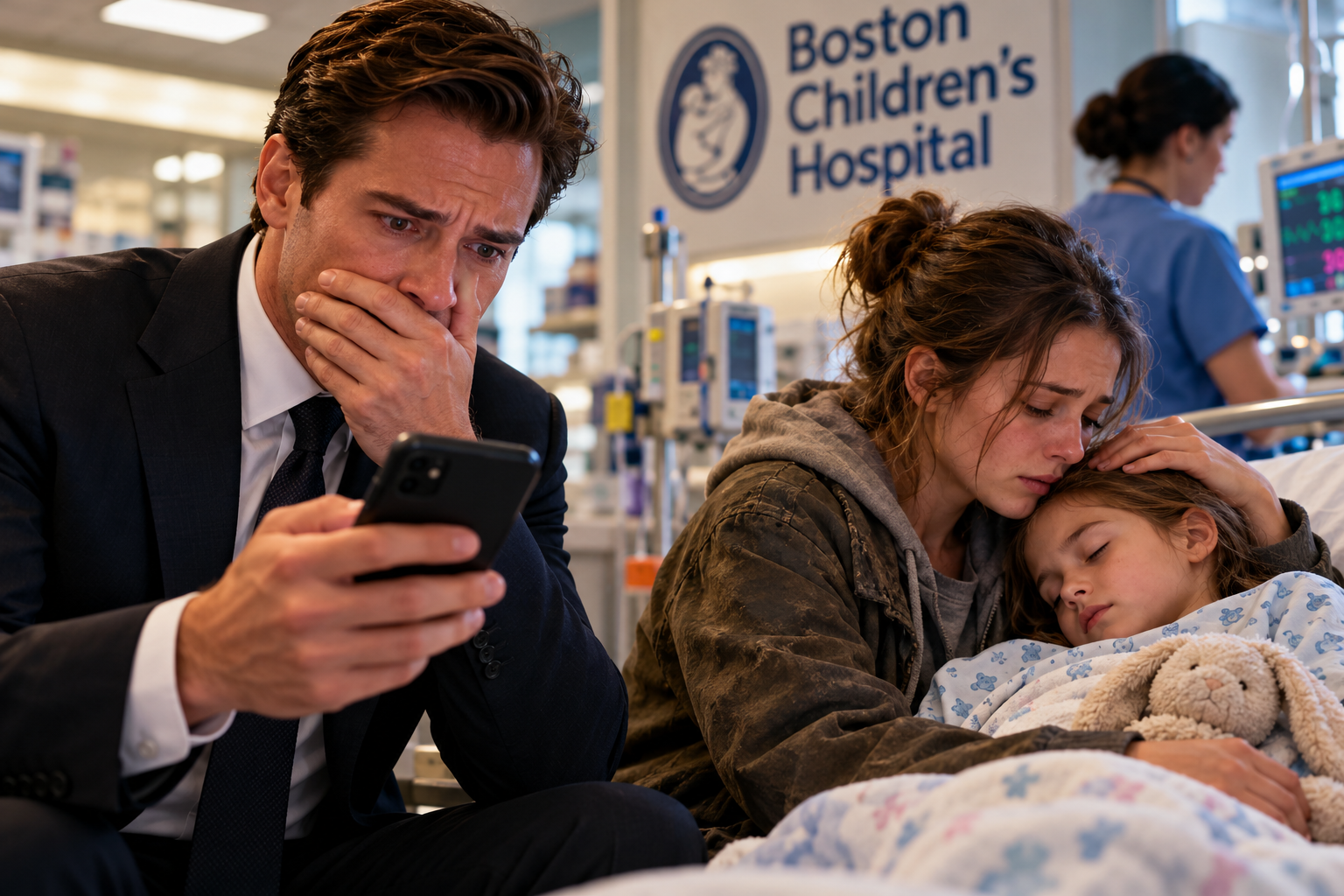
Inside, the hospital smelled of disinfectant and warm food.
A child in a red sweater sat beside a vending machine.
A man held a paper cup with both hands.
A woman near the reception desk was trying to calm a baby who wouldn't stop crying.
Nobody paid attention to me.
That surprised me more than it should have.
At my office, people noticed every movement I made.
Here, I was just another man in an expensive coat.
I approached the information desk.
"I'm trying to find out where I can ask a general billing question."
The receptionist pointed me toward the financial services department.
I explained that I had authorized someone to use my card and wanted to make sure there had been no payment problem.
The employee checked the transaction records she was permitted to discuss.
"Both payments were processed," she said.
"Was there any difficulty?"
"Not that I can see."
I thanked her.
I had no right to ask more.
As I turned away, I saw a small blue blanket draped over the back of a waiting-room chair.
For one foolish second, I thought it might belong to Lily.
Then I realized how little I knew about the child.
I didn't even know whether Mara had managed to find a place to sleep the night before.
I walked toward the exit.
I was almost outside when I noticed a woman sitting alone near a row of windows.
Her coat was the same faded brown one Mara had worn.
She held a folded piece of paper in one hand.
The other rested on a small pink backpack.
I stopped several feet away.
"Mara?"
She looked up sharply.
For a moment, she seemed ready to stand and leave.
Then she recognized me.
"What are you doing here?"
"I came to make sure the card worked."
"It worked."
Her answer was flat.
I glanced at the backpack.
"Where's Lily?"
"She's being looked after."
"Is she all right?"
Mara folded the paper and slipped it into her pocket.
"She's getting help."
I wanted to ask what kind of help.
I wanted to ask why the money had gone to the hospital before anything else.
But I remembered the question she had asked me the day before.
Why?
So I asked something else.
"Do you need anything?"
Mara studied me.
"I needed the card to work."
"I know."
"No," she said. "You know the payment went through. That's different."
I felt my face grow warm.
She wasn't being rude.
She was telling me the truth.
I sat in the chair across from her.
For several seconds, neither of us spoke.
A nurse walked past carrying a stack of folders.
Somewhere behind a closed door, a child laughed.
Mara looked toward the sound.
Her expression softened for a moment.
Then it disappeared.
"Can I ask you something?" she said.
"Yes."
"If somebody you loved needed help, how long would you wait before asking for it?"
I considered giving her an easy answer.
I could have said I would act immediately.
I could have told her that money was never a problem when family was involved.
Instead, I remembered how long I had waited before calling the hospital.
How many meetings I had canceled only after the transactions became impossible to ignore.
"I don't know," I admitted.
Mara looked down at the folded paper.
"That's probably the honest answer."
I didn't understand why she had asked.
Not yet.
But for the first time that day, I stopped thinking about my bank card.
I started thinking about the person holding it.
Click here to continue reading: PART 3: I Had Spent Years Paying Other People to Handle Difficult Situations, Until One Quiet Conversation Left Me With Nothing to Say
I Thought Money Could Solve Any Problem Until a Stranger Asked Me for Something I Could Never Buy Back
Part 2 of 20