The call from Marcus came on a quiet morning.
I was at home, getting ready for work, when my phone rang.
I recognized the office number.
I answered immediately.
"Mr. Miller, this is Marcus Cole."
"Good morning."
"Good morning. I'm calling to arrange a time to speak with you about the status of the review."
I stopped what I was doing.
"Has something been established?"
"I want to discuss the information properly in person. I don't want to give you an incomplete explanation over the telephone."
My heart began beating faster.
I held the phone against my ear and tried to keep my voice steady.
"All right. When would you like me to come in?"
We arranged a meeting.
After we hung up, I stood in the kitchen for several seconds.
The call had not given me an answer.
It had told me only that Marcus wanted to speak with me about the status of the review.
I reminded myself of that distinction.
I did not know whether the information was conclusive.
I did not know whether it concerned the historical case, my current records, or the next step in the process.
I knew only that a meeting had been arranged.
I went to work and completed the tasks I needed to finish.
That was harder than it sounds.
My thoughts kept returning to the phone call.
I wanted to believe it meant the investigation had finally produced a clear answer.
I also feared that I might leave the office with another explanation of why the answer remained unknown.
I tried not to prepare myself for either outcome.
There was no point in rehearsing a conversation that had not happened.
On the morning of the appointment, I arrived at the benefits office with my notebook.
I did not bring the original documents.
Marcus had not asked for them, and I had learned not to assume that every meeting required another stack of papers.
The receptionist checked my appointment.
I sat in the waiting room and watched the clock.
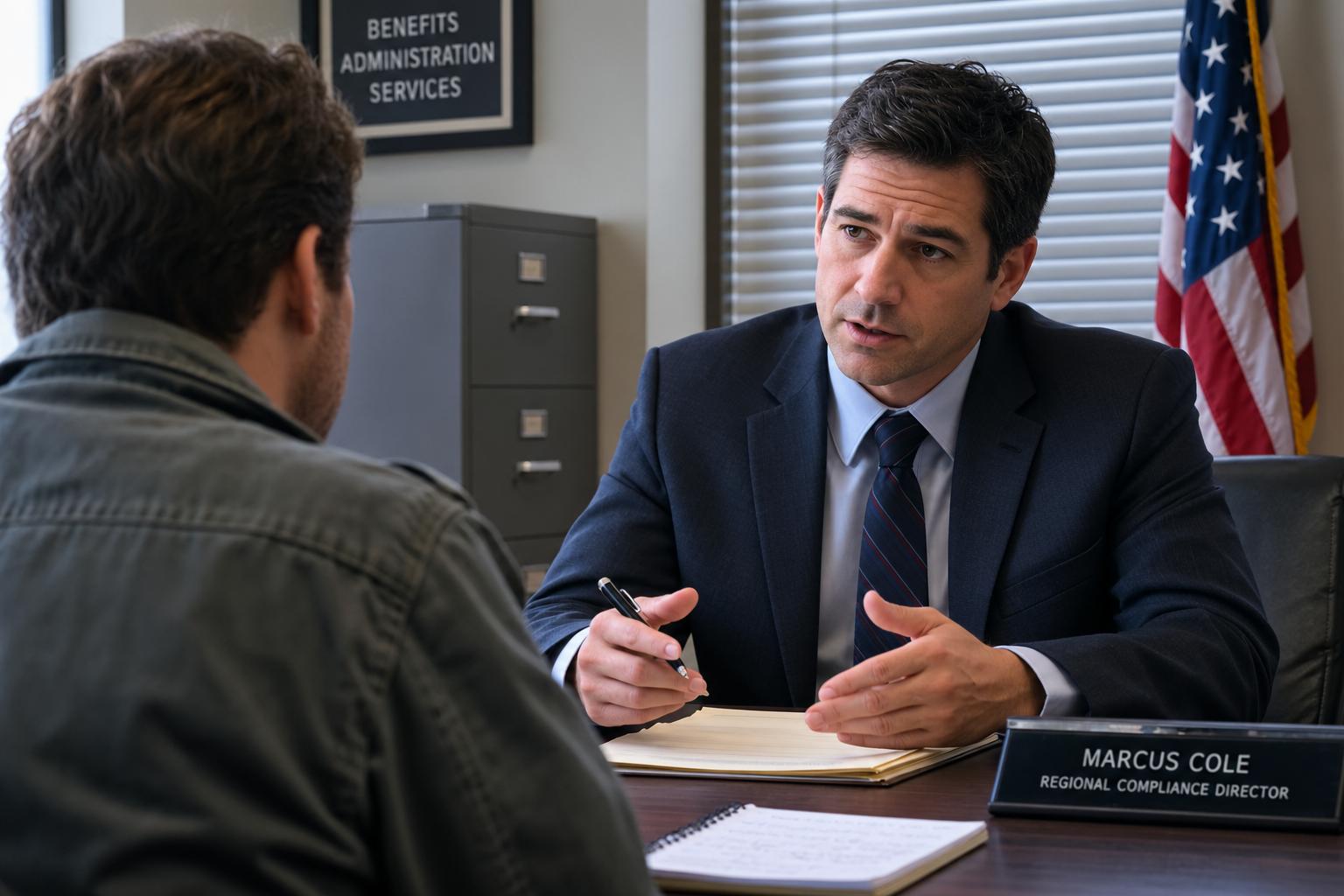
When Marcus appeared, he greeted me and led me to the private office.
The familiar room seemed smaller than I remembered.
The desk was in the same place.
The filing cabinet stood beneath the window.
The American flag hung beside the closed blinds.
I sat down and placed my notebook on the desk.
Marcus opened a folder.
"I want to begin by being clear about the status of the review," he said.
I waited.
"The historical case remains the central issue. We are examining the record involving the child who disappeared in 1990, the death designation associated with that case, and the connection to your Social Security number."
I nodded.
"Has the review established that I am the child?"
"I don't have a verified finding that allows me to tell you that."
The answer hurt, even though I had prepared myself for it.
I had wanted the call to mean that the central question had finally been settled.
It had not.
Marcus continued.
"I also don't have a verified finding that allows me to explain the circumstances behind the death designation or identify the precise reason your number is connected to the historical case."
I looked down at my notebook.
"So the main questions are still open."
"Yes. I don't want to suggest otherwise."
For a moment, I felt the old frustration return.
I had attended meeting after meeting.
I had organized documents, reviewed dates, and contacted someone from my past.
I had tried to separate evidence from speculation.
And I still did not know who the child was.
But this time, I did not mistake my disappointment for proof that the review had been useless.
I looked up again.
"Is there anything new that you can verify?"
Marcus reviewed the information in front of him.
He explained what he could responsibly confirm about the status of the review, while making clear that he did not have a final determination about the child's identity or the reason for the record connection.
I listened without interrupting.
I did not ask him to fill the gaps with an explanation he could not support.
When he finished, I asked the question I had written down before coming in.
"What is the next verifiable step?"
Marcus explained that the review would need to continue examining the relevant historical information and the identity records connected to the discrepancy.
If further information became available, it would need to be checked before any conclusion could be reached.
He could not promise a completion date.
He could not promise that every question would eventually be answered.
But he could explain what the review was examining and contact me when there was information he could share.
I wrote down the points I needed to remember.
Then I closed my notebook.
"I want you to continue the review," I said. "I also want to make sure you understand that I'm willing to provide anything relevant that I actually have."
"I understand."
"But I don't want to be told that something is true unless the evidence supports it."
"That is how we need to approach the case."
I nodded.
I had once believed that the truth would arrive as a single revelation.
I now understood that the process might be slower, more limited, and less complete than I had hoped.
That did not make the questions less important.
It made accuracy more important.
I asked whether there was anything else I needed to do immediately.
Marcus said there was nothing additional he needed from me at that time.
He reminded me to keep my documents safe and to contact him if I found anything that might be relevant.
I thanked him.
Before I stood, I looked at the folder on his desk.
I could not see what was written inside.
I did not ask him to show me a page he had not offered to share.
I had learned that the existence of a file did not mean I understood its contents, and the existence of a record did not mean I knew the full story behind it.
I could ask for an explanation.
I could cooperate with the process.
I could wait for verified findings.
But I could not make the file answer questions it had not yet answered.
I stood and collected my bag.
Marcus walked me to the doorway.
"I know this has been difficult," he said.
"It has."
"I'll contact you if there is information I can share."
"Thank you."
I left the office and walked through the waiting room.
The reception desk was busy, and several people sat with forms in their hands.
They had come to handle their own problems.
I walked past them and stepped outside.
The air was bright, and the parking lot was warm beneath the afternoon sun.
I stood beside my car for a moment.
I had come hoping for a final answer.
I was leaving without one.
That was disappointing, but I did not feel the same helplessness I had felt during my first visit.
I understood the facts available to me.
A child had disappeared in 1990.
A historical record associated with that case contained a death designation.
My Social Security number was connected to the case.
The investigation had not established that I was the child.
It had not established why the designation was recorded or how the number became connected.
And Marcus had no basis, from the information available to him, to accuse me of knowingly using a false identity.
Those were the limits of what I knew.
I could not honestly claim more.
I drove home and placed my notebook on the kitchen table.
Then I took out the envelope of identity records and checked that everything was still in order.
I put the papers back in the drawer.
I did not throw them away.
I did not hide them.
I did not treat them as proof of a conclusion they could not establish.
They remained what they had always been: records from different points in my life, useful but incomplete.
I closed the drawer and went to prepare dinner.
As I worked, I thought about the person I had been when I first entered the benefits office.
I had believed that one official record could overturn everything I knew about myself.
I had been frightened that the historical connection meant I had somehow been living a lie.
Now I understood that the record had raised a serious question, not supplied a complete answer.
I still wanted to know what had happened to the child.
I still wanted to understand the death designation and the connection to my number.
I still wanted to find the earliest verified record of my own identity.
Those questions had not disappeared.
But I no longer intended to answer them with fear.
If the review produced evidence, I would examine it.
If a finding was established, I would ask what it meant and what steps followed.
If the records left part of the story unresolved, I would acknowledge that honestly.
I could not promise myself that the eventual answer would be easy.
I could promise not to invent one.
That night, I sat at the kitchen table after dinner and looked at the drawer where my papers were stored.
I did not open it.
There was nothing more I could learn from the same documents that evening.
I turned off the light and went to bed.
The case was not finished.
The historical child's identity remained unconfirmed.
The reason for the death designation remained unexplained.
The connection between the record and my Social Security number still needed to be understood.
I would continue cooperating with the review and remain ready to provide relevant information.
But I would not spend the rest of my life treating every unanswered question as evidence of a hidden truth.
I had learned to distinguish what I knew from what I feared.
For now, that was the most honest place I could stand.
And from there, I would keep looking for the truth.
The End
Read more original stories on Feel Every Story.
I Went to the Benefits Office Expecting a Simple Answer, but One Red Warning on a Computer Screen Changed Everything
Part 20 of 20