I barely slept that night.
Every time I closed my eyes, I saw the heading on the page Marcus had shown me.
A child.
A disappearance.
A death recorded in 1990.
I kept trying to fit those words into the story I had always told myself about my life.
Nothing fit.
By morning, I had decided I needed answers more than I needed to protect myself from them.
I went to work and did what I could to keep my mind occupied.
I answered questions.
I followed instructions.
I tried not to make mistakes.
But I found myself looking at ordinary paperwork differently.
Names.
Dates.
Numbers.
All the things I had spent my adult life treating as simple facts suddenly seemed capable of hiding something enormous.
During a break, I checked the information Marcus had given me.
I considered calling the office immediately.
Then I stopped.
I didn't want to sound desperate.
I also didn't want to wait another day.
I had spent too much of my life accepting whatever answer someone gave me because asking another question seemed pointless.
I wasn't going to do that now.
After work, I contacted the office and asked whether Marcus was available.
The person who answered said he could arrange a time for me to return.
I agreed.
The next time I entered the building, I carried the documents I had managed to gather at home.
They weren't much.
Some identification papers.
A few old records.
Documents I had kept because they were useful, not because I thought they might someday prove I had existed.
I handed them over when Marcus met me.
He reviewed them carefully.
I watched his expression, searching for a reaction I could understand.
He didn't look surprised.
He looked focused.
"Will these help?"
"They give us information to compare."
"Do they prove I'm the person I say I am?"
"They help establish parts of your history."
I waited for him to say more.
He didn't.
I asked whether the restricted file had been reviewed.
He said he had been able to examine additional information, although there were still details he needed to verify.
I felt my patience thinning.
"I came here because I need medical insurance. I didn't come here to spend my life proving I exist."
"I understand."
"Then please tell me what you know."
Marcus nodded.
He led me down the hallway again.
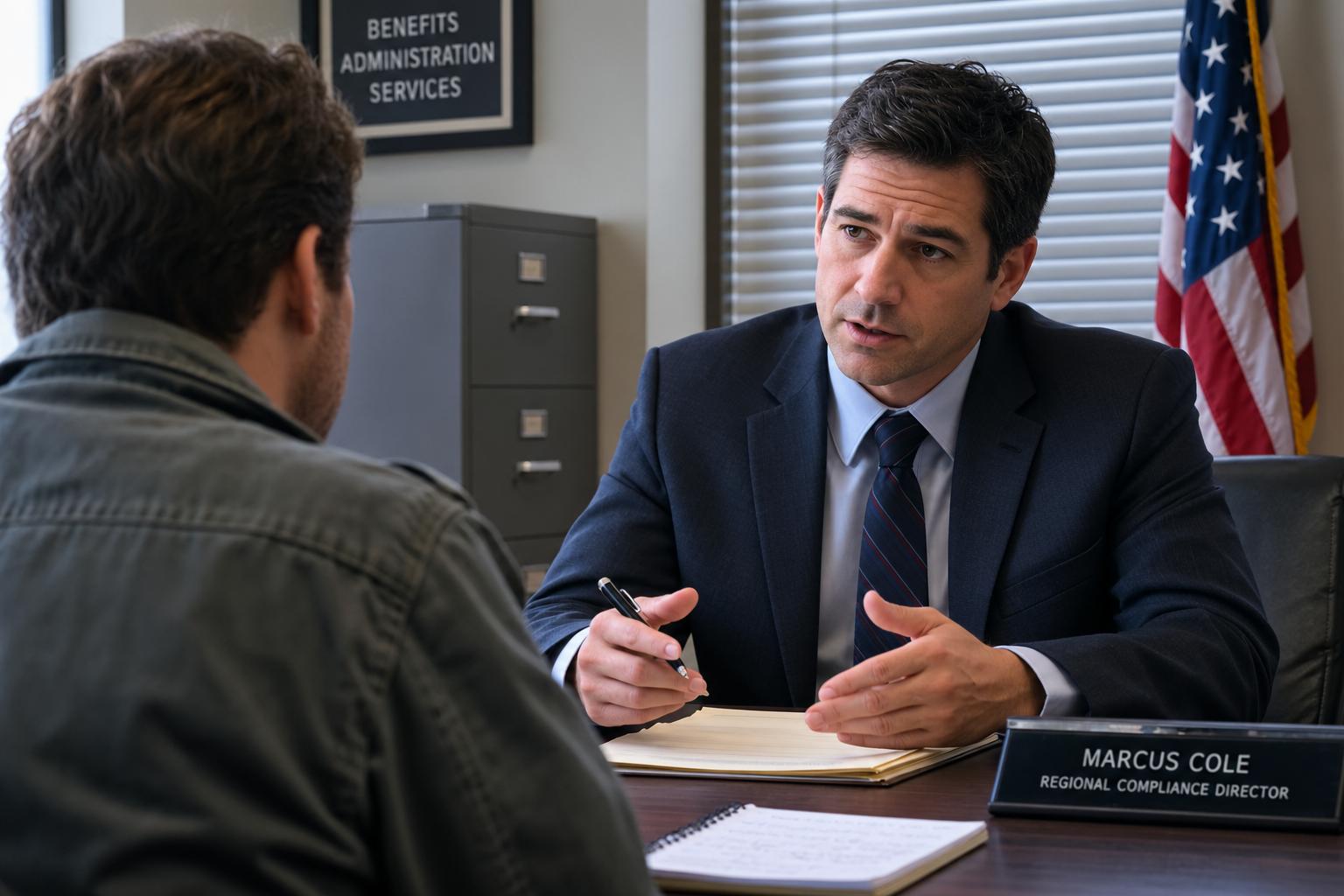
I recognized the small office, the filing cabinet, and the flag beside the window.
The blinds were still closed.
This time, I sat in one of the chairs.
I placed my documents on my lap and waited.
Marcus remained standing for a moment before taking his seat.
He explained that his responsibility was to review identity discrepancies involving federal records.
That much I already knew.
What I needed to understand was why my case had been treated differently from an ordinary error.
He opened the folder.
"The record connected to your Social Security number is part of a restricted historical case."
I leaned forward.
"About the child who disappeared."
"Yes."
"And the child was declared dead."
"That is what the record indicates."
I rubbed my forehead.
"How can a record say someone disappeared and died? Those aren't the same thing."
"Not necessarily. The file contains information that needs to be interpreted in context."
"Then interpret it."
He didn't respond immediately.
I could see that he was choosing his words carefully.
I had never been good at waiting for explanations.
When people withheld information from me, I usually assumed they were trying to control what I knew.
Marcus seemed different.
He looked less like someone guarding a secret and more like someone who understood that the next thing he said could change how I saw my life.
That didn't make it easier to hear.
He asked me to confirm my name again.
I did.
He asked whether I had ever used another name.
I told him I hadn't.
He asked whether I had ever been told that my birth records had been changed.
Again, I said no.
He compared my answers with the information in the file.
Then he closed the folder halfway.
"I need to be careful about what I tell you before the records are fully reconciled."
I looked at him.
"Do you think I'm lying?"
"No."
"Do you think someone gave me a stolen identity?"
"I don't have enough information to make that conclusion."
"Then what do you have enough information to say?"
He took a breath.
"The historical case involves a child who disappeared in 1990. The child's identity is connected to the number you provided."
I felt the same coldness I had felt the day before.
I had hoped that seeing the documents might make the problem smaller.
Instead, the connection seemed harder to dismiss.
I looked down at my hands.
They were the hands of a man who had worked for everything he owned.
They had carried boxes, repaired equipment, tightened bolts, and held a steering wheel through long drives.
They had filled out applications and signed tax forms.
I knew what those hands had done.
I didn't know what the records said about the boy they belonged to.
I raised my head.
"Are you saying I might not be who I think I am?"
Marcus didn't rush to answer.
"I'm saying the records raise questions about your identity history that we need to resolve."
I let out a breath through my nose.
That was the kind of answer people gave when they wanted to be accurate without being comforting.
I understood why he was doing it.
I still hated hearing it.
I asked what would happen to my insurance application.
He explained that the identity discrepancy would need to be addressed before the office could complete the process.
I asked whether I should bring more documents.
He said any additional records from my early life might be useful.
I told him I would search again.
Then I asked the question I had been avoiding since the first meeting.
"Why would anyone declare a child dead if that child was still alive?"
Marcus looked down at the folder.
"I can't tell you why that happened in this case yet."
"Could it have been an error?"
"It could have been. I can't confirm that."
"Could somebody have done it deliberately?"
He paused.
"I can't rule out possibilities before the evidence has been reviewed."
I sat back.
I had wanted him to tell me that the whole thing was a clerical mistake.
I had wanted him to point to a wrong digit or a misplaced document.
Instead, he was giving me a list of possibilities without enough evidence to choose between them.
I looked toward the closed blinds.
The room felt too quiet.
I thought about my family again.
I remembered the years when I had tried to earn approval by staying out of trouble.
I had worked hard.
I had learned to be independent.
I had accepted that some people would never give me the affection I wanted.
For years, I had believed the problem was me.
Now I wondered whether the adults around me had understood something about my past that I hadn't.
I didn't want to accuse anyone without evidence.
I also couldn't pretend the thought hadn't entered my mind.
Marcus asked whether there was anyone I could contact who might have kept records from my childhood.
I told him I would have to think about it.
He said that was reasonable.
Then he gathered the documents I had brought and explained which ones the office needed to examine further.
I listened, trying to remember each instruction.
When he finished, I asked him to tell me one thing plainly.
"Am I listed as dead?"
He looked directly at me.
"The record associated with your Social Security number contains a death designation dating to 1990."
I swallowed.
"So, according to the government, I'm dead."
"According to that historical record, the person connected to the number was declared dead."
I stared at him.
He had made the distinction again.
The person connected to the number.
Not necessarily me.
I had noticed the wording before, but now it felt deliberate.
I asked why he kept saying it that way.
He folded his hands on the desk.
"Because we haven't finished establishing whether the identity in the historical record and the identity you use today are the same."
I wanted to argue.
I wanted to tell him that I had been using the same name and number for as long as I could remember.
But I had already told him that.
Repeating it wouldn't change what he had found.
I sat quietly for a moment.
Then I asked what he could tell me about the missing child.
Marcus glanced at the folder.
He said the case was restricted, and he couldn't disclose details that hadn't been cleared for release.
I felt anger rise again.
"How am I supposed to understand my own life if you won't tell me what the records say?"
"You deserve answers," he said. "But I need to make sure I'm giving you information that is accurate."
I studied him.
For the first time, I understood that his caution might be the only reason I was getting any information at all.
He could have dismissed me as a man with an inconsistent record.
He could have told me to return when I had more documents.
Instead, he was examining the connection.
That didn't mean I trusted him completely.
It meant I was willing to keep listening.
I gathered my papers and stood.
Marcus told me he would continue reviewing the case and that I should bring any additional childhood records I could find.
I said I would.
At the door, I stopped.
"One more question."
He waited.
"If the child in that record was declared dead in 1990, how did my number end up attached to the life I've been living?"
Marcus looked at the folder for several seconds.
Then he raised his eyes to mine.
"That is the question we need to answer before anything else can be settled."
I left the office carrying my documents.
The hallway seemed longer than it had when I arrived.
I walked past the waiting room, where people were still sitting with folders in their hands, expecting help with problems they understood.
Outside, I stopped beside my truck.
I had spent my whole life thinking my identity was the one thing nobody could take away from me.
A job could disappear.
A home could be lost.
People could leave.
But I had always believed that I knew who I was.
Now a restricted file had placed that belief in doubt, and I had no explanation that made sense.
I opened the truck door and put the papers on the passenger seat.
Then I sat down behind the wheel.
For a long time, I didn't start the engine.
I kept thinking about the child in the record.
The child who had disappeared.
The child who had been declared dead.
And the possibility that the answer to both questions might be waiting somewhere in the history of my own family.
Click here to continue reading: PART 5: I Searched Through the Few Papers I Had Saved, Hoping One Ordinary Document Could Explain Why My Life Was in Question
I Went to the Benefits Office Expecting a Simple Answer, but One Red Warning on a Computer Screen Changed Everything
Part 4 of 20