I thought I knew who I was.
I had a name, a Social Security number, and a lifetime of memories that belonged to me.
Then a clerk looked at her computer and told me something that made no sense.
According to the records in front of her, I was dead.
I remember staring at her, waiting for a smile or some sign that she had made a mistake.
She didn't smile.
She looked down at the screen again, pressed a few keys, and called for her supervisor.
That was when I began to feel afraid.
Not because I believed I was dead.
I knew I wasn't.
I was thirty-two years old, standing in a government office, wearing a faded shirt and the same work boots I'd worn for three days straight.
My truck was parked outside.
My rent was due soon.
I had come to ask about medical insurance because I couldn't keep putting off appointments and hoping whatever was wrong with me would disappear on its own.
I had expected paperwork.
Maybe a long wait.
I hadn't expected someone to question whether I existed.
The clerk asked me to confirm my full name and date of birth.
I gave her both.
She checked the information against what she had entered.
Then she asked me to repeat my Social Security number.
I did.
She read it back slowly, one digit at a time.
Every number was correct.
I'd known that number since childhood.
It had followed me through school, my first job, apartment applications, bank accounts, tax forms, and the purchase of my old truck.
It was the number I gave employers when they hired me.
It was the number printed on forms I filled out without thinking.
Nothing about it had ever seemed unusual.
Until that morning.
The clerk leaned toward her screen.
"I'm sorry, sir. There's something I need to check."
"What kind of thing?"
She hesitated.
"There's a problem with your record."
I asked her to explain.
Instead, she picked up the telephone beside her desk.
I watched her speak quietly to someone I couldn't hear.
She gave them my name and part of my identifying information.
Then she listened.
Her expression changed.
She thanked the person, hung up, and asked me to wait.
I had already been waiting for nearly an hour.
There were people behind me who needed help, and I could feel their eyes on my back.
I stepped away from the counter and sat in one of the plastic chairs against the wall.
A television hung in the corner with the sound turned low.
Someone was coughing.
A child was kicking the legs of a chair.
Ordinary sounds.
Ordinary people.
I looked around and wondered whether anyone else in that room had ever been told something so absurd about themselves.
Probably not.
I tried to convince myself that it was a computer error.
Government offices made mistakes.
People entered the wrong dates.
Files got mixed up.
I had seen enough paperwork in my life to know that a wrong number could cause a lot of trouble.
Still, I couldn't shake the way the clerk had looked at me.
She hadn't looked confused.
She had looked worried.
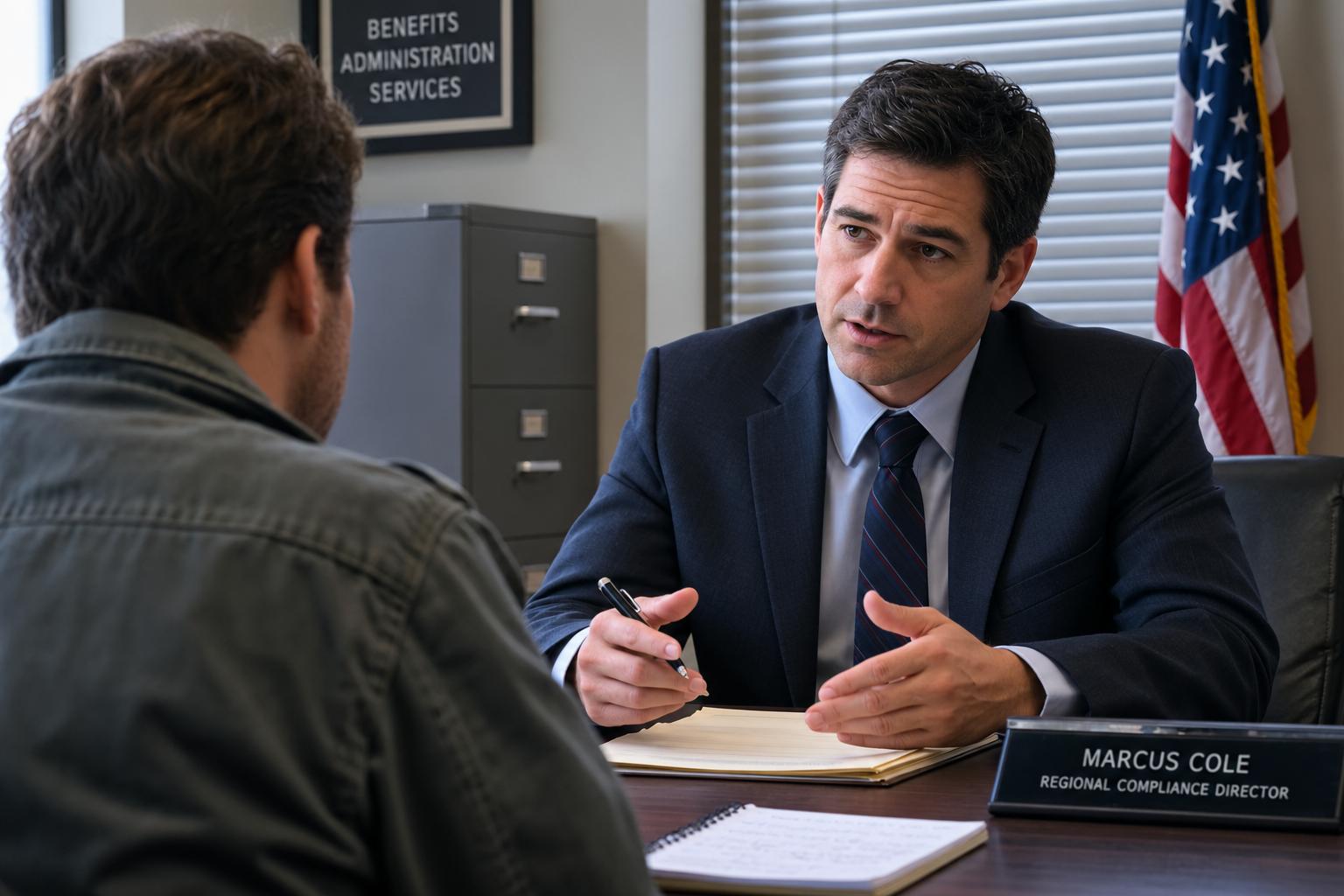
A few minutes later, a man came through a door behind the counter.
He was middle-aged, neatly dressed, and carried a thin folder.
He introduced himself as Marcus Cole.
He said he was responsible for handling certain complicated cases at the office.
He didn't explain what made mine complicated.
Instead, he asked me to confirm my identity again.
I gave him my name and date of birth.
He checked the folder.
Then he looked at the clerk.
She said something too quietly for me to hear.
Marcus nodded and turned back to me.
"Could you tell me how long you've been using this Social Security number?"
I frowned.
"Using it? Since I was a kid."
"Do you remember when you first received it?"
"Not exactly. My family handled that when I was young."
He wrote something down.
I watched the pen move across the paper.
"What does any of this have to do with my insurance?"
He put the pen down.
"I'm trying to establish how your identity was originally documented."
"Is there something wrong with the number?"
He didn't answer immediately.
That silence told me more than I wanted to know.
I had spent most of my life learning how to recognize trouble before someone admitted it was there.
I learned it at home.
I learned it at work.
When money was tight, when a supervisor wanted to blame someone, or when a person had already made up their mind about you, there was usually a moment when the truth showed on their face.
Marcus had that look.
He wasn't angry with me.
He wasn't treating me like a criminal.
He looked like a man who had found something he didn't understand and was trying to decide how much he could safely say.
I leaned forward.
"Just tell me what's happening."
He glanced toward the clerk's desk.
Then he closed the folder.
"Your record has been flagged for review."
"Why?"
"The information attached to your number doesn't match what you've told us."
I felt my jaw tighten.
"What information?"
He drew a slow breath.
"There is a historical record associated with this number that needs to be examined before we can proceed."
That sounded like official language designed to make a simple problem impossible to understand.
I told him I had never used another person's identity.
I'd never stolen a number.
I'd never given false information to get a job or open an account.
I had worked for every dollar I earned.
I had paid taxes.
I had signed my name on every document that required it.
If their records said something different, I wanted to know why.
Marcus listened without interrupting.
When I finished, he asked whether I had any identification with me.
I gave him my driver's license.
He studied it, checked the details, and handed it back.
Then he asked for my birth certificate.
I told him I didn't carry it around.
I had documents at home, but I hadn't brought them because nobody had told me I would need to prove that I was alive.
He accepted that answer.
For a moment, I thought the conversation might finally move toward something useful.
Then he looked at the folder again.
His next question was quieter.
"Have you ever been told that your identity was changed or corrected when you were a child?"
I stared at him.
"No."
"Has anyone in your family ever mentioned a legal problem involving your birth records?"
"No."
"Or a missing-child investigation?"
I almost laughed.
It was the kind of question that seemed so far removed from my life that laughing felt like the only reasonable response.
But Marcus wasn't joking.
I told him I had never been involved in anything like that.
He asked whether I could remember anything unusual about the paperwork my family kept.
I couldn't.
My childhood hadn't been filled with family history lessons.
There were things we didn't discuss.
There were questions that went unanswered.
But I had never thought any of that meant my identity was false.
My family had always made me feel as if I was the extra person in the room.
I had assumed that was a matter of affection, or the lack of it.
I had never considered that the explanation might be written in a government file.
Marcus thanked me for answering.
Then he said he needed a little more time.
I returned to my chair.
I watched people approach the counter, hand over documents, and leave with folders tucked under their arms.
A woman complained about a missing payment.
An older man asked where he needed to sign.
A young father bounced a restless child on his knee.
Everyone had come to settle some ordinary problem.
I wondered how many of them would have kept their composure if someone told them their own records said they no longer belonged among the living.
I took out my phone.
There was no one I wanted to call.
That was one of the things I had learned to accept as an adult.
When something went wrong, I usually dealt with it alone.
I had been doing that for years.
At eighteen, I had left home because I was no longer welcome there.
I found work, paid my own bills, and learned to stretch a paycheck until the next one arrived.
I had become good at surviving.
I wasn't particularly proud of the way I lived, but I had never asked anyone to carry me.
That morning, I had only wanted help paying for medical care.
Now I was sitting in a government office wondering whether the life I had built rested on a mistake.
Marcus returned with the folder tucked beneath his arm.
He stopped in front of me.
"Mr. Miller, there's a matter we need to discuss privately."
I stood up.
"Is my insurance approved or not?"
"We haven't reached that point."
"Then what point have we reached?"
He looked at me for a moment.
"The point where I need to explain what our records show."
I waited.
He lowered his voice.
"The record connected to your Social Security number indicates that the person originally associated with it was declared dead in 1990."
For a second, I couldn't make the words fit together.
I heard him.
I understood each word separately.
But together, they made no sense.
I was thirty-two.
I had spent my life working, paying rent, buying groceries, and trying to stay out of trouble.
I had memories of being a child.
I remembered schoolrooms, family arguments, cheap meals, and the feeling of being unwanted.
How could a government record say I had died before I was old enough to understand what death meant?
I shook my head.
"That's impossible."
Marcus didn't argue.
He simply waited for me to look at him again.
And that was when I realized he wasn't trying to convince me of anything.
He was trying to prepare me for something he had already seen.
Click here to continue reading: PART 2: The Man With the Folder Asked Me Questions About My Childhood, and Every Answer Made My Own Memories Feel Less Certain
I Went to the Benefits Office Expecting a Simple Answer, but One Red Warning on a Computer Screen Changed Everything
Part 1 of 20