
That afternoon, I spread my documents across the kitchen table.
I had already searched through them once, but the first search had been hurried. I had looked for anything that might immediately explain the connection between my number and the historical case.
This time, I tried to be methodical.
I began with the oldest papers I had.
There were copies of school records, a few employment documents, old tax papers, and identification cards I had kept after they expired.
Some papers had yellowed around the edges.
Others were folded along the same lines they had carried for years.
I arranged everything by date.
The earliest documents were the hardest to interpret because they contained very little information beyond my name and the dates associated with particular events.
I could see that I had been recorded under the name Miller at different points in my life.
I could see that the number had appeared on documents I had used as an adult.
But none of that explained how the number had first become connected to me.
I sat at the table with a pencil and a blank sheet of paper.
On the left, I wrote the things I could verify.
On the right, I wrote the questions that remained unanswered.
The first column filled slowly.
The second filled much faster.
I knew the name I had used for most of my life.
I knew the number I had supplied whenever an employer or agency requested it.
I knew that I had never intentionally claimed to be someone else.
I knew that Marcus had described a historical case involving a child who disappeared in 1990.
I knew the case included a death designation.
I knew the number connected to that case was the same one I used.
I did not know the child's name.
I did not know the circumstances of the disappearance.
I did not know what evidence had supported the death designation.
I did not know how my number had become connected to the record.
And I did not know whether the connection reflected a mistake, an incomplete history, or something else.
I put the pencil down.
The list looked almost ridiculous on the table.
It contained so many questions and so few answers that I wondered whether writing any of it down had helped.
Then I realized why I had done it.
The list prevented me from confusing what I feared with what I knew.
I could look at the paper and see the difference.
That mattered more than I expected.
I continued sorting through the documents.
One envelope contained old tax returns. Another held employment records from jobs I had left years earlier.
I checked the dates on each one.
None reached back far enough to explain my earliest identity records.
The papers showed a person moving through adulthood, changing jobs, paying taxes, and maintaining the same basic information.
They did not show how that information had originated.
I had expected the documents to provide a path backward.
Instead, they showed me where the path became difficult to follow.
I gathered the papers into separate piles and placed them in a large envelope.
I wrote Identity Records on the front.
Then I stopped, looked at the words, and almost crossed them out.
The papers were records associated with my identity. They did not establish every part of its history.
I left the label as it was.
I had no better name for the collection.
That evening, I considered calling someone who had known me when I was younger.
The idea had been following me since my first meeting with Marcus.
If the historical case involved a child who disappeared in 1990, perhaps someone from my past remembered something that I did not.
But I could not decide whom to contact or what to ask.
A vague question about childhood would probably produce vague answers.
A direct question about a missing child might sound so strange that the person on the other end would assume I had misunderstood something.
I also worried that I would unintentionally lead someone toward an answer they did not genuinely remember.
If I told them about the case before asking what they recalled, their memories might become mixed with the information I had given them.
I did not want that.
I wanted to know what someone remembered before I told them what I was afraid of.
For the moment, I decided not to make a call.
That did not mean I was giving up.
It meant I wanted to understand the limits of my own knowledge before involving someone else.
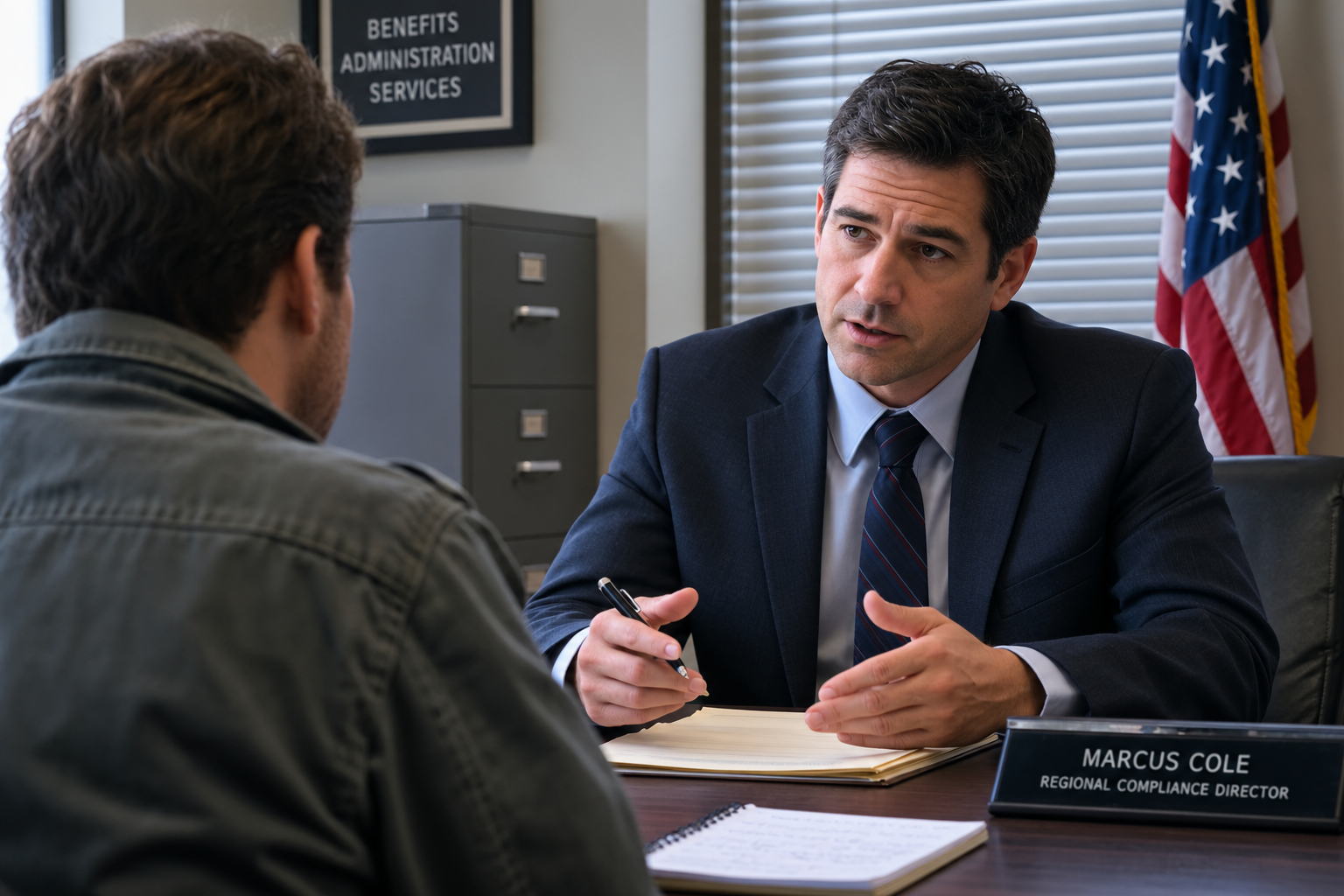
The following morning, I returned to the benefits office.
I had not been asked to come in that day, but I wanted to know whether there was a proper way to submit the documents I had gathered.
At the reception desk, I explained that I had been working with Marcus Cole on an identity discrepancy.
The clerk checked the system.
"Mr. Cole is not available at the moment," she said.
"Can I leave documents for him?"
She asked me to wait while she confirmed the procedure.
A few minutes later, she returned with a short form.
She explained that I should not leave original documents without an established process for receiving them.
I understood.
I had brought copies of the records, but I did not want them separated from the information explaining why they mattered.
"Could I make an appointment to discuss submitting them?" I asked.
She checked the schedule and gave me the available options.
I chose the earliest time that fit my work schedule.
Before leaving, I asked whether there was any written information about the review that I could take home.
She explained that she could not provide details about a restricted historical case from the reception desk.
I thanked her and walked out.
The answer was reasonable.
It was also another reminder that I could not solve the problem by collecting paperwork from every office I visited.
Some information would have to come from the people responsible for examining the historical record.
Until then, my own documents could only tell me what had been recorded about me at different points in my life.
They could not explain why.
At home, I returned the envelope to a drawer.
I placed it beside the other papers I had kept over the years.
Then I made myself eat something.
I had spent too much time thinking about the case and too little time attending to ordinary things.
I prepared a simple meal, washed the dishes, and answered a message I had ignored earlier.
The tasks were small, but they helped restore some sense of proportion.
My life had not stopped because a record was being reviewed.
I still had work to do.
I still had responsibilities.
I still had to make decisions based on the information actually available to me.
That night, I looked once more at the list on the kitchen table.
The questions remained unanswered.
But the list had done its job.
It reminded me that the absence of an explanation was not proof of the worst explanation I could imagine.
I folded the sheet and placed it inside the envelope.
Then I turned off the kitchen light.
Click here to continue reading: PART 11: I Wanted Someone From My Past to Explain the Missing Years, but I Knew I Could Not Ask a Question That Already Contained an Answer
I Went to the Benefits Office Expecting a Simple Answer, but One Red Warning on a Computer Screen Changed Everything
Part 10 of 20

One Comment on “PART 10 – I Tried to Reconstruct the Paper Trail of My Life, but the Documents I Trusted Could Only Tell Me When My Name Had Been Used”