For the next several days, I tried to keep my routine steady.
I went to work, handled the tasks assigned to me, and answered the calls I needed to answer.
From the outside, nothing had changed.
I was still Mr. Miller.
I still used the same identification.
I still had the same address and the same responsibilities.
Only I knew how much attention I was paying to details I had once ignored.
When someone asked me to confirm information on a form, I checked it twice.
When I came across an old document, I wondered whether it contained something I had overlooked.
I did not want the investigation to take over my entire life, but I could not pretend it had become unimportant.
The question of whom to contact remained.
I kept thinking about the people who had known me when I was younger.
Some had been part of my life for a short time. Others had known me long enough that I assumed they remembered things I had forgotten.
But memory was not a filing cabinet.
People remembered certain moments clearly and lost others entirely.
They also interpreted the past through what they believed at the time.
If I asked someone a question now, I might receive a sincere answer that was still incomplete.
I needed to accept that before I started asking.
One evening, I took out the blank sheet I had used to separate facts from questions.
I read the list again.
I had written down that I did not know how my identity had originally been established.
I had also written that I did not know whether anyone from my past had information about the historical case.
That second statement bothered me.
I had no reason to believe anyone I knew was connected to the case.
I had no evidence that someone had concealed anything from me.
The fact that I lacked an explanation did not mean another person possessed one.
Still, I wanted to speak with someone who could help me reconstruct the earliest parts of my life.
I decided I would begin with ordinary questions rather than accusations.
I would ask what they remembered about my childhood documents, the name I used, and the circumstances in which I first began using my Social Security number.
If they remembered nothing, I would accept that.
If they remembered something specific, I could write it down and consider how it might be verified.
I would not tell them what I thought the answer might be before hearing what they had to say.
The next morning, I made a short list of the information I wanted to understand.
I kept the questions simple.
When did I first receive the documents I used as a child?
Who helped me complete the forms?
Did anyone ever mention a change in my records?
Were there documents I had been told to replace or avoid using?
I read the list several times.
None of the questions assumed that a secret existed.
That was important to me.
I had begun this process with a record that contradicted something I believed about my identity. I did not want my search for an explanation to become a search for someone to blame.
Later that day, I contacted a person from my past.
I will not pretend I felt calm when the call began.
My mouth was dry, and I had to remind myself to speak slowly.
We exchanged the usual greetings before I explained that I was reviewing some old personal records.
I asked whether they remembered much about the documents I had used when I was younger.
There was a pause.
"What sort of documents?" the person asked.
"Identity papers. The things I needed for school and other official matters."
"I don't remember the details."
"That's all right," I said. "I'm trying to put together a timeline."
I asked whether they remembered when I first began using the name Miller on official paperwork.
They said they remembered me using that name, but they could not recall the first time it appeared on a document.
I asked whether they remembered anyone discussing a change to my records.
Again, the answer was uncertain.
"I don't remember a specific conversation," they said. "That doesn't mean there wasn't one. I just can't tell you that I remember it."
I appreciated the distinction.
It was the kind of answer I had hoped to receive, even though it gave me very little new information.
I did not mention the missing child.
I did not mention the death designation.
I did not want to put those ideas into the conversation before I had a clearer understanding of what the person genuinely remembered.
We spoke for a little longer about ordinary matters.
Then we ended the call.
I sat quietly afterward, trying to assess what I had learned.
The conversation had not produced a revelation.
It had not uncovered a hidden document or confirmed a suspicion.
It had given me one useful piece of information: the person remembered the name I used but could not recall how my official records had first been established.
That was all.
I wrote a short note in my notebook, including the date of the call and the limits of what I had been told.
I made sure not to turn uncertainty into certainty.
I did not write that the person knew nothing.
I wrote that the person did not remember.
Those statements were different.
Over the next few days, I considered whether to contact anyone else.
I decided to wait until I had spoken with Marcus again.
I wanted to know whether the historical review had identified a specific period or type of document that could guide my questions.
Without that information, I risked contacting people without knowing what I needed to establish.
I also wanted to avoid repeating the same conversation with several people and gradually shaping my own expectations around their uncertain answers.
The more I thought about it, the more I understood how easily a person could become attached to an explanation simply because it filled an empty space.
I was frightened by the possibility that my past might not be what I believed.
That fear could make almost any answer seem meaningful.
A pause could become suspicious.
A forgotten detail could become evidence.
A person's inability to remember something could begin to look like an attempt to hide it.
I did not want to treat anyone that way.
I wanted facts, not a collection of reactions interpreted through my anxiety.
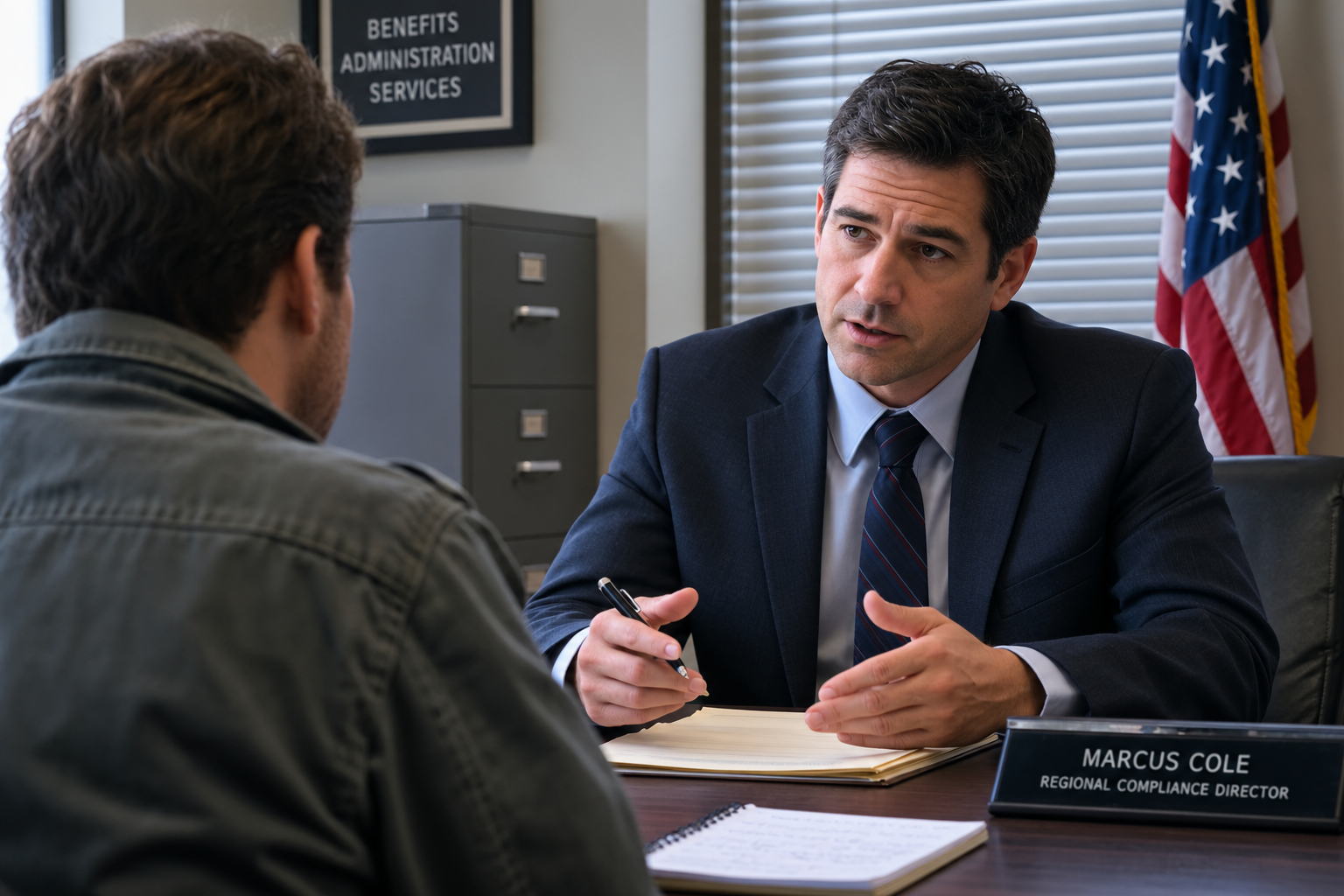
When the day of my next appointment arrived, I placed my notebook and the envelope of identity records into a bag.
I checked that I had not forgotten the appointment information.
Then I left for the office.
I did not expect Marcus to answer every question.
I hoped he could tell me which questions the evidence was capable of answering next.
For the first time since the original meeting, I felt I had a clearer purpose.
I was no longer going simply to demand an explanation.
I was going to ask what could be verified, what could not, and what information would be useful to the investigation.
That was a smaller goal than the one I had wanted.
It was also a goal I could actually pursue.
Click here to continue reading: PART 12: Marcus Reminded Me That a Historical Record Could Be Incomplete, and I Finally Understood Why He Would Not Let Me Turn Uncertainty Into a Conclusion
I Went to the Benefits Office Expecting a Simple Answer, but One Red Warning on a Computer Screen Changed Everything
Part 11 of 20