The morning felt different because I had stopped trying to make the bill seem reasonable.
I hadn't found an explanation overnight.
I hadn't discovered some missing part of the invitation.
Nothing had changed.
The paper still said two thousand dollars.
And I still didn't know why my daughter-in-law believed I should pay it.
But I had made one important decision.
I would not agree to something I didn't understand.
That might sound obvious.
It should have been obvious.
Yet I had spent the entire week saying yes without stopping to think.
Yes, I could help with the children.
Yes, I could cook.
Yes, I could clean.
Yes, I could take care of the shopping.
By the end, I had almost forgotten what it felt like to question an expectation.
I had become the person who handled things.
And because I handled them, there was always something else waiting.
I thought about that as I prepared to face Bianca.
I didn't want a fight.
I had never enjoyed family arguments.
They left words behind that people remembered long after the original problem was forgotten.
I didn't want Maisie and Oliver growing up with stories about their grandmother shouting at their mother.
But I didn't want them growing up believing that love required a person to accept whatever was demanded, either.
Those two thoughts stayed with me.
I could be calm.
I could be respectful.
And I could still refuse to pretend that the bill made sense.
I took it out again.
The fold had become firm.
It opened along the same crease.
I flattened it against my hand.
There was the amount.
Two thousand dollars.
The number had lost its power to surprise me.
Now it made me sad.
I thought about the money I had spent preparing for the visit.
The presents.
The jam ingredients.
The long drive.
The shopping I had done during the week.
I had never calculated all of it.
That wasn't why I had done any of those things.
I didn't want to start measuring my love in receipts.
But Bianca's paper had forced money into a week that I had never understood as a transaction.
That was what I couldn't overlook.
If she expected me to pay, what exactly had she believed the arrangement was?
Was my presence a favor to her?
Was it a visit for the children?
Was it something else entirely?
I couldn't answer those questions alone.
Only Bianca could explain her thinking.
I reminded myself not to guess.
There had already been too much guessing.
I had guessed that her strained voice meant she was overwhelmed.
I had guessed that the children were the main reason she wanted me there.
I had guessed that doing the chores would make the week easier for everyone.
Maybe some of those guesses were right.
Maybe all of them were.
But none of them explained the bill.
I wanted to know how she could see the same seven days so differently.
I went over the week one final time.
Not every minute.
Just the things that mattered.
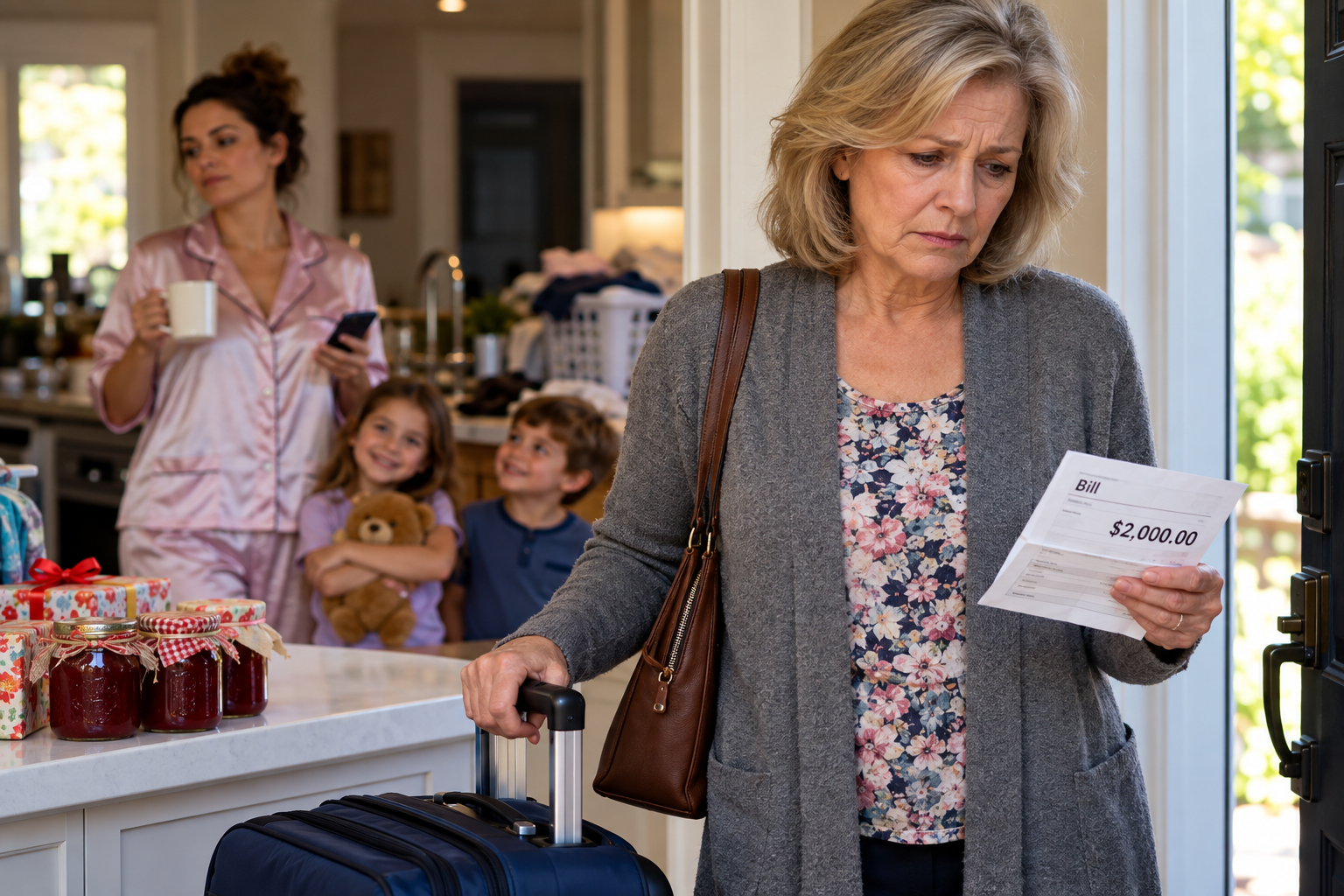
I had arrived Monday morning.
She had opened the door in silk pajamas.
Her phone was in her hand.
The kitchen sink had been full.
The living room had been covered with laundry.
I had seen the work.
And I had started helping.
That part wasn't in dispute.
The days afterward had been filled with ordinary household tasks.
I had prepared food.
I had cleaned.
I had helped with supplies.
I had looked after Maisie and Oliver.
I had stayed until the week was finished.
I had done what Bianca said she needed.
I hadn't refused.
I hadn't left early.
I hadn't demanded anything in return.
I couldn't see how any of that made me responsible for a two-thousand-dollar charge.
The more I thought about it, the more I understood that the amount wasn't the entire problem.
If the bill had been smaller, I would still have felt hurt.
If it had said two hundred dollars, I would still have wondered why.
Even twenty dollars would have changed the meaning of the invitation.
Because I hadn't agreed to pay for a visit.
I hadn't agreed to rent a room.
I hadn't agreed to purchase the right to see my grandchildren.
I had been asked to come because I was family.
That was what made the situation so strange.
The number was shocking.
The idea behind it was worse.
I felt a little stronger after admitting that.
I didn't have to argue over the size of the charge.
I had to address the fact that there was a charge at all.
I folded the bill again.
Then I stopped myself.
I had been handling that paper as though it might somehow provide the answer if I looked at it often enough.
It wouldn't.
I already knew what the number said.
What I needed was a conversation.
I put the bill away.
I thought of Bianca standing across from me.
I imagined myself asking why she had given it to me.
Then I imagined her becoming upset.
I could feel my old instincts rising.
Don't make trouble.
Don't embarrass anyone.
Don't spoil the family relationship.
I had followed those instincts for seven days.
I had used them to silence every small discomfort.
I had told myself that I could get through the week.
That all the work was temporary.
That helping mattered more than feeling appreciated.
And perhaps some of that had been true.
But now those instincts were asking me to accept something I believed was wrong.
I couldn't keep obeying them.
I sat down for a moment.
My back still ached.
It was a dull ache.
Nothing dramatic.
Just the kind that came after too many hours bending, standing, lifting, and working.
I remembered how good it had felt to finish a task during the week.
To wash the last dish.
To put away the last piece of clothing.
To finish preparing a meal.
Those little moments of satisfaction had kept me moving.
But the work hadn't truly ended until the seventh day.
Now I could feel the cost of it.
Not only in my body.
In my trust.
I had trusted that Bianca would understand why I was there.
I had trusted that an invitation from family meant I was welcome.
I had trusted that my help would be received in the spirit in which I offered it.
I hadn't asked for special treatment.
I hadn't asked for gratitude every hour.
I had simply expected fairness.
It was painful to realize how much that mattered to me only after it seemed to be missing.
I wondered whether I had taught Graham that I would always manage.
When he was growing up, I had tried to make his life easier wherever I could.
I had done what mothers often do.
I had worked quietly.
I had solved problems.
I had kept going when I was tired.
I hadn't thought of those things as sacrifices worth announcing.
They had been part of loving my son.
But perhaps I had become too good at hiding the effort.
Perhaps when people saw that I could manage something, they assumed it didn't cost me anything.
That wasn't necessarily Graham's fault.
And I wasn't going to blame him without knowing what he understood.
Still, the thought stayed with me.
I had spent so many years being dependable that I hadn't always shown where my limits were.
There had never seemed to be a reason.
Until now.
I wanted to tell Bianca that I loved her children.
I wanted her to know that the week hadn't been a punishment to me.
There had been good moments.
There had been time with Maisie and Oliver that I would always value.
I didn't want the bill to erase those memories.
But I also wanted her to understand that those good moments didn't make every other part of the week fair.
I had done two things at once.
I had been a grandmother.
And I had been the adult taking care of a great deal of household work.
Those things could happen together.
But they weren't the same thing.
I wondered if Bianca had ever considered that.
Maybe she had.
Maybe she hadn't.
Again, I couldn't know.
I could only ask.
I pictured the paper between us on the table.
I had folded it instead of arguing.
I had put it in my purse.
I had said I would deal with it in the morning.
That had been a deliberate choice.
I was glad I hadn't reacted immediately.
Not because Bianca's action deserved my silence.
Because I needed time to find words that came from understanding rather than shock.
I had those words now.
I didn't need a speech.
I didn't need to explain every minute of the week.
I could simply say that I had come because she asked for help and that no payment had been discussed.
Then I could ask what she meant by the charge.
I practiced the thought silently.
It sounded clear.
It sounded fair.
And it sounded like something I should have been able to say without fear.
Still, my stomach tightened.
Family confrontations were never easy.
Especially when the family involved your son, your daughter-in-law, and the grandchildren you loved.
I knew a poorly handled conversation could affect future visits.
I knew Bianca might not like being questioned.
I knew Graham might be caught between two people who mattered to him.
But avoiding the matter wouldn't protect those relationships.
It would only leave the hurt untouched.
I had learned that much during the night.
I stood up.
My purse was beside me.
I checked that the bill was still inside.
Then I closed it.
I didn't know what Bianca would say.
I didn't know whether she would offer an explanation I hadn't considered.
I didn't know whether she would apologize, argue, or insist the money was owed.
Those possibilities were still ahead of me.
I wouldn't invent her answer before hearing it.
I had spent years believing that a good grandmother should make things easy for everyone.
That morning, I began to understand something else.
Being a good grandmother didn't require becoming invisible.
My time mattered.
My effort mattered.
And I was allowed to ask why someone expected more from me after I had already given so much.
I picked up my purse.
The paper remained folded inside.
I was ready to ask the question I should never have needed to ask.
Click here to continue reading: PART 7: I Had Driven Three Hours to Help My Son’s Family, and Now I Needed to Know Whether Graham Understood What Happened
I Thought My Grandchildren Needed Me for One Week, but I Had No Idea What Was Waiting Inside That House
Part 6 of 20