I used to think the hardest part of helping family was finding the energy.
I was wrong.
The hardest part was learning when help had stopped being freely given and started being expected.
I hadn't noticed that change during the week.
Not clearly.
There had been moments when I felt tired.
Moments when I wished I could sit down.
Moments when I looked toward the next unfinished chore and wondered whether I would ever catch up.
But I had kept going.
It was what I knew how to do.
I had spent much of my life taking care of practical things.
A kitchen needed cleaning.
A meal needed preparing.
A child needed attention.
Someone had to handle it.
I had always been comfortable being that person.
Perhaps too comfortable.
Because when I arrived at Bianca's house and saw the mess, I didn't ask who was responsible for it.
I asked myself how quickly I could help.
That was how the week began.
One task.
Then another.
Then an entire day.
Then seven days.
I hadn't realized how much I had taken on until the work was finished.
By then, I was exhausted.
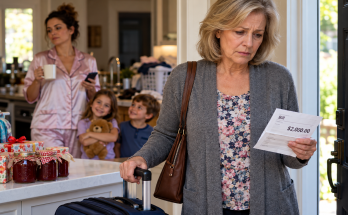
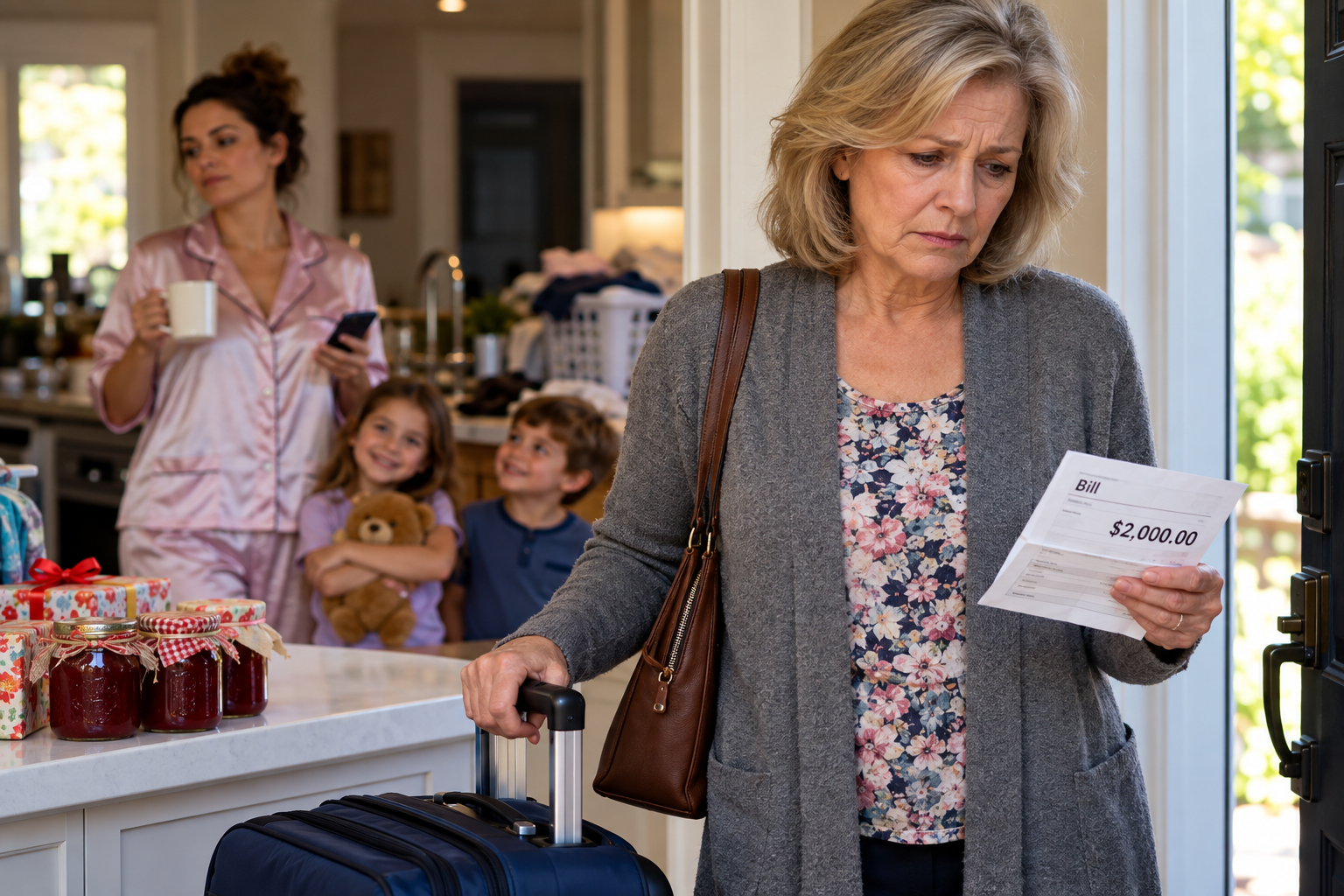
And Bianca's bill made everything feel different.
I wished it hadn't.
I wished I could separate the paper from the memories of the visit.
But every time I thought about one, I remembered the other.
I remembered the dishes.
Then the amount.
I remembered carrying shopping.
Then the amount.
I remembered cooking.
Then the amount.
Two thousand dollars.
It had become an unwanted part of the week.
I was determined not to let it become the only part.
There had been good moments.
I knew that.
Maisie and Oliver were still my grandchildren.
They hadn't changed.
Their affection hadn't become less real because I was disappointed with their mother.
I wanted to hold on to that distinction.
It was important.
I didn't want to become someone who punished children for an adult's behavior.
Nor did I want to begin measuring the value of visiting them in dollars.
That was exactly what felt so wrong about the bill.
I had never thought of my grandchildren that way.
I wanted to see them because I loved them.
I wanted to be there for them because being their grandmother mattered to me.
Their company wasn't something I had agreed to purchase.
My help wasn't something I had intended to sell.
Yet the paper in my purse had pulled money into a relationship where I had never expected it.
I thought about whether I should make a list of everything I had done.
The idea came naturally.
If Bianca believed money was owed, perhaps I could show her the value of my time.
I could count the meals.
The cleaning.
The shopping.
The hours spent watching the children.
I could calculate what such help might cost if someone hired a person to do it.
But the more I considered that approach, the less comfortable I felt.
I didn't want to send my daughter-in-law an invoice.
I didn't want to say that every hour with Maisie and Oliver had a price.
I didn't want to turn the week into an argument about whose bill was larger.
The children weren't a business arrangement.
Neither was my affection for them.
I wanted Bianca to understand that without making the same mistake in return.
So I put the thought aside.
I would not answer one unexpected bill with another.
That decision mattered to me.
It was a boundary of its own.
I could defend myself without trying to punish someone.
I could question a demand without inventing a counter-demand.
I could say I had given a great deal without insisting that every part of it be repaid.
I hoped Bianca would understand the difference.
I couldn't be certain.
But I knew it was the difference I wanted to preserve.
I thought about the shopping.
That had been one of the things I hadn't expected when I left home.
I knew families needed groceries and household supplies.
Of course they did.
But I hadn't pictured myself spending part of the visit making sure those needs were handled.
Still, I had done it.
I had treated it as another way to help.
I had been proud that I could make myself useful.
Now I wondered whether I had been too eager to prove that.
I had arrived already prepared to give.
I brought jam.
I brought gifts.
I brought my time.
Then I gave my energy.
And whenever another task appeared, I gave a little more.
I hadn't stopped to ask how much was reasonable.
Maybe I was afraid the answer would disappoint someone.
That thought embarrassed me.
I was a grown woman.
I had raised a child.
I had managed a household.
I knew how to make difficult decisions.
Yet when it came to my family, I sometimes behaved as though disappointing anyone was the worst thing I could do.
I could see that habit now.
It had been with me long before Bianca's invitation.
I didn't need to blame her for creating it.
But I did need to stop allowing it to guide every choice.
I remembered how quickly I had agreed to the visit.
I hadn't even checked whether I really wanted to be away from home for a full week.
I had heard that Maisie and Oliver missed me.
That was enough.
There was love in that response.
I wouldn't deny it.
But there was also a fear of not being needed.
I hadn't wanted to miss an opportunity to matter.
Looking back, that was difficult to admit.
I didn't want to seem like a grandmother who needed constant reassurance.
But I loved being important in my grandchildren's lives.
I loved knowing they wanted me around.
And perhaps I had allowed that feeling to make me less careful.
The invitation had felt like proof that I was wanted.
The bill had made me question whether I had misunderstood why.
That was the injury I couldn't explain away.
It wasn't only about money.
It was about trust.
I had trusted the invitation.
I had trusted that the week meant roughly the same thing to Bianca as it meant to me.
I had trusted that helping would be received as helping.
I hadn't asked for anything more.
Now I needed to know whether that trust had been misplaced.
I couldn't answer by guessing.
I needed Bianca's explanation.
I returned to that thought again and again.
Not revenge.
Explanation.
Not a fight.
Understanding.
Not an invoice of my own.
A fair discussion about the one she had given me.
I wanted to keep the matter that simple.
But my feelings weren't simple.
I was angry.
I was disappointed.
I was embarrassed that I had been so surprised.
And beneath those feelings was sadness.
I had enjoyed looking forward to visits with my family.
I didn't want that happiness replaced by caution.
I didn't want to hear Bianca's name on my phone and immediately wonder what she wanted from me.
I didn't want to become suspicious whenever Graham traveled.
I didn't want an invitation to see the children to sound like the beginning of another obligation.
But I knew that trust couldn't be restored simply by deciding to trust again.
Something needed to be explained.
Something needed to change.
And whatever happened, I would need to be more honest about my limits.
I thought about how that might look in the future.
If Bianca asked me to stay, I could ask what she needed.
I could say how long I was comfortable visiting.
I could explain which things I was willing to help with.
And if money was part of the arrangement, it would need to be discussed before I agreed.
Not afterward.
Those were ordinary expectations.
I felt almost foolish for finding them so difficult.
But I had never needed to speak about visiting my son in those terms before.
It made me sad that I might need to.
Still, sadness wasn't a reason to ignore reality.
I had learned that much.
I looked at the bill again.
The folded edges were beginning to wear.
I had handled it too often.
I knew that.
But every time I held it, I felt a little more certain that I shouldn't simply pay it and forget.
I didn't owe Bianca my silence.
And I didn't owe her agreement.
I did owe her the chance to explain herself before I decided what her actions meant.
That was the fairness I wanted to practice.
It would have been easy to decide she had planned everything.
It would have been easy to imagine her waiting until the end of the week because she knew I would be too tired to argue.
But those were possibilities, not facts.
I refused to treat them as truth.
I knew what I had experienced.
I knew what she had handed me.
The rest required a conversation.
I thought about the children again.
I could picture the presents I had carried into the house.
I remembered being eager to see their reactions.
That happiness still belonged to me.
I didn't want to regret it.
So I made myself a quiet promise.
Whatever happened with the bill, I would not stop loving them openly.
I would not make them feel responsible.
I would not use time with them as a weapon in a disagreement.
But I would also stop believing that being their grandmother meant accepting anything their mother expected of me.
Those two promises belonged together.
I could be warm.
And firm.
Helpful.
And honest.
Generous.
And careful.
It sounded simple.
Living it would take practice.
But I was ready to begin.
I returned the paper to my purse.
There was no satisfaction in doing it.
No feeling of victory.
Just a steady understanding that I could not solve the problem by pretending it didn't exist.
The week was over.
The work was done.
The bill remained.
And I was no longer willing to make myself responsible for resolving it by paying simply to keep everyone comfortable.
Click here to continue reading: PART 15: I Had Protected Graham From Every Small Disappointment I Could, but Keeping This Bill From Him Would Only Leave the Hurt Untouched
I Thought My Grandchildren Needed Me for One Week, but I Had No Idea What Was Waiting Inside That House
Part 14 of 20