I didn't understand the paper at first.
That was the strange thing.
After seven days of cooking, cleaning, shopping, and looking after Maisie and Oliver, I thought I knew what the end of the visit would look like.
I would gather my belongings.
I would say goodbye.
I would make sure I hadn't forgotten anything.
Then I would drive home.
I expected to be tired.
I expected to miss the children once I left.
I expected the house to seem unusually quiet when I got back.
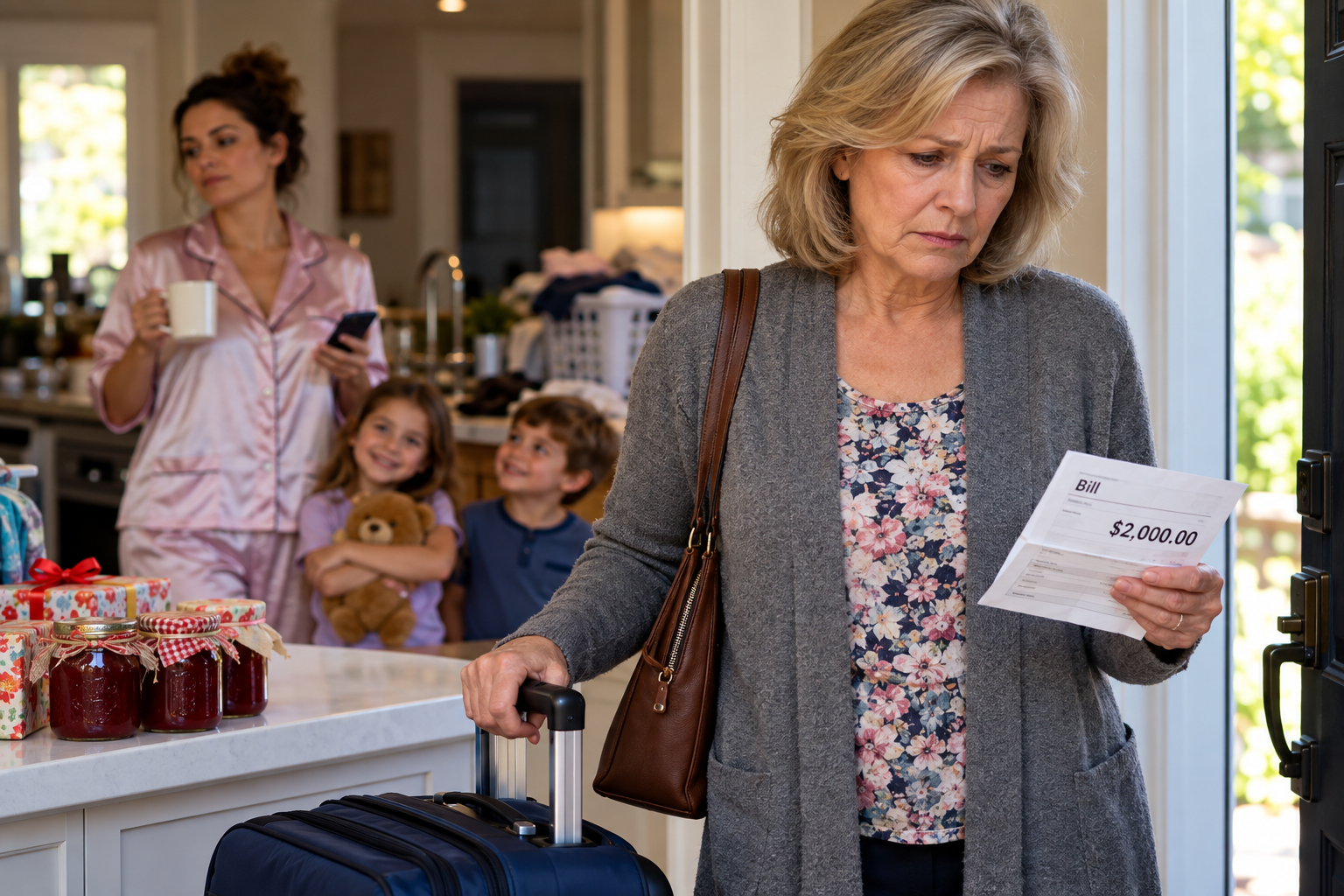
I did not expect Bianca to hand me a bill.
But that was what happened.
We were at the table when she put the paper in front of me.
There was no shouting.
No argument.
No long explanation that gave me time to understand what was happening.
Just a sheet of paper.
And an amount.
$2,000.
I looked at the number.
Then I looked at Bianca.
For a moment, I thought I must have misunderstood.
Two thousand dollars was not a small amount.
It was not the kind of sum I could mistake for a few groceries or an ordinary household expense.
I looked down again.
The paper was still there.
The amount hadn't changed.
I had spent a full week helping my son's family.
And now my daughter-in-law was presenting me with a charge.
I tried to make sense of it.
Had I heard the invitation incorrectly?
Had there been some condition she thought she had explained?
Had I agreed to something without realizing it?
I went back over the Sunday phone call in my head.
Graham was leaving for work.
Bianca was worried about managing alone.
Maisie and Oliver wanted their grandmother.
That was what I remembered.
I remembered the sound of her voice.
I remembered the relief when I agreed.
I remembered how quickly I started getting ready.
I did not remember being told there would be a bill.
Not once.
I had driven to their home because I was invited.
I had brought food and gifts because I wanted to.
I had helped around the house because I believed I was needed.
Now I was being asked for money.
The two things would not fit together in my mind.
I stared at the paper.
My first feeling wasn't anger.
It was confusion.
A deep, unpleasant confusion that made it difficult to speak.
I knew what a bill was.
I knew what it meant when someone handed you one.
But I couldn't understand why this one belonged to me.
I looked at Bianca again.
She was my son's wife.
The mother of my grandchildren.
Someone I had just spent seven days trying to help.
I wanted her to tell me I had misunderstood.
I wanted her to say there had been some mistake.
I wanted the paper to mean something other than what it appeared to mean.
But it remained on the table between us.
I could feel myself getting very still.
That happens to me when I'm upset.
Some people raise their voices.
Some people start asking questions all at once.
I become quiet.
I look at the thing in front of me.
I try to understand it before I react.
That habit probably saved me from saying something I would have regretted.
Because there were plenty of things I could have said.
I could have reminded Bianca that I had come at her request.
I could have asked how she expected me to pay for the privilege of helping her.
I could have listed every meal I cooked.
Every load of laundry.
Every hour I spent caring for Maisie and Oliver.
I could have mentioned the shopping.
I could have mentioned the long drive.
I could have asked whether she thought my time was worth nothing.
And I could have asked why a grandmother who came because the children missed her was now being treated as if she had purchased something.
All those questions passed through my mind.
None of them came out.
I was too hurt to trust my voice.
I had spent the week telling myself I was family.
That was the word I had used whenever the work became difficult.
Family.
It meant I didn't mind helping.
It meant I didn't keep score.
It meant I didn't expect to be paid for my time.
But I had never imagined that family would mean I was the one expected to pay.
That was the part I couldn't get past.
I wasn't looking for wages.
I wasn't looking for praise.
I had wanted to spend time with my grandchildren and make things easier for my son and daughter-in-law.
I had done those things.
I thought that was the end of it.
Apparently, Bianca thought otherwise.
I looked at the number again.
Two thousand dollars.
It seemed larger each time I read it.
Not because the digits changed.
Because the meaning did.
The first time, it had been a surprise.
The second time, an insult.
By the third time, it felt like a warning about how differently Bianca and I understood my place in the family.
I didn't want to believe that.
Even then, I didn't want to think badly of her.
I wanted there to be a reasonable explanation.
I wanted the whole thing to be something we could laugh about later.
But I couldn't make myself laugh.
I thought of the kitchen on the day I arrived.
The dishes stacked in the sink.
The laundry across the living room.
Bianca standing in silk pajamas with her phone.
I had looked at all that work and decided she needed help.
I hadn't complained.
I had unpacked my things.
I had stayed.
I thought of the four jars of strawberry jam.
I had wrapped them so carefully.
I had been pleased with the way they turned out.
I had carried them all the way from home because I knew the children would enjoy them.
There was no calculation behind those jars.
No expectation that anyone would pay me for making them.
They were a gift.
Just like my time.
At least, that was how I understood it.
Now I wondered whether Bianca understood gifts at all in the same way I did.
I couldn't answer that question.
I knew only what had happened.
She had asked me to come.
I had come.
I had worked for seven days.
And she had handed me a bill.
I thought about asking Graham what he knew.
He was my son.
It was his home, too.
But I didn't know whether he had any idea what was on that paper.
I wasn't going to assume he did.
That wouldn't have been fair.
And I didn't want to bring him into an argument before I understood it myself.
So I stayed quiet.
I could hear ordinary household sounds around me.
Nothing had changed outside that table.
The house was still the same house.
The children were still my grandchildren.
Bianca was still my daughter-in-law.
But something inside me had shifted.
I no longer felt like the woman who had walked through the door a week earlier.
That woman had arrived smiling.
She had been carrying presents.
She had believed she was wanted.
I was still the same person in many ways.
I still loved the children.
I still wanted the family to be happy.
But I could no longer pretend that the invitation and the bill belonged naturally together.
I placed my hand on the paper.
I didn't push it back.
I didn't tear it.
I didn't throw it across the table.
I picked it up.
The action felt strangely ordinary.
As if I were taking a receipt after buying groceries.
That made me feel worse.
I had no idea why I should be the one behaving as though this were an ordinary transaction.
But I kept my hands steady.
I folded the paper.
Once.
Then again.
I made it small enough to fit inside my purse.
I remember how careful I was.
I didn't want to crumple it.
I didn't want to lose it.
I wanted to keep exactly what Bianca had given me.
Not because I accepted it.
Because I needed time to think.
I opened my purse.
I put the folded bill inside.
Then I closed it.
Bianca was still there.
I looked at her.
I could have made the moment ugly.
I knew that.
I could have demanded an answer.
I could have let every bit of disappointment from the week come pouring out at once.
But there were two children in that house whom I loved.
And there was a relationship with my son that mattered to me.
I didn't want my first response to make a painful situation worse.
So I chose to leave the argument where it was.
Unspoken.
For the moment.
“I'll take care of this tomorrow morning,” I told her.
My voice was calm.
That surprised me.
Inside, I felt anything but calm.
I was embarrassed.
I was hurt.
And beneath both feelings, I could sense anger beginning to form.
I wasn't accustomed to feeling that way toward my own family.
Especially not after doing something I believed was kind.
But I couldn't deny it.
I was angry.
Not because anyone had asked for help.
Not because I had worked hard.
I would have done the work again if I had known it was truly needed.
What hurt was the feeling that my willingness to help had been treated as something owed.
And now the person I had helped was asking something more from me.
Money.
Two thousand dollars.
The amount stayed in my thoughts even after I put the paper away.
I knew I needed to go home.
I needed distance from the kitchen.
Distance from that table.
Distance from the sight of the folded bill.
I had already spent seven days responding to whatever needed doing.
I didn't want to respond to this in the same way.
Not automatically.
Not out of habit.
Not because I was afraid of disappointing someone.
That had been my mistake throughout the week.
I had never paused long enough to ask what I was agreeing to.
I had seen work and accepted it.
I had seen a need and tried to fill it.
I had assumed kindness would be understood as kindness.
Now I had a piece of paper in my purse that made me question every one of those assumptions.
I thought about the drive home.
Nearly three hours.
The same roads.
The same distance.
But I knew it wouldn't feel like the journey I had made on Monday morning.
On the way there, I had been thinking about the children.
About the jam.
About how nice it would be to spend a whole week together.
On the way back, I knew I would be thinking about the bill.
I could already feel its weight, even though it was only paper.
That was what shocked me most.
A small folded sheet could change how I remembered an entire week.
I didn't want it to spoil my memories of Maisie and Oliver.
They had done nothing wrong.
They hadn't asked for a bill to be written.
They hadn't invited me under any terms I didn't understand.
They were children who loved their grandmother.
I wouldn't hold any of this against them.
But I also couldn't pretend the charge meant nothing.
It meant something.
I just wasn't ready to decide exactly what.
I had spent the week trying not to cause trouble.
Trying to be helpful.
Trying to make everyone else's days easier.
For the first time since Bianca called, I stopped thinking about what she needed.
I thought about what I needed.
I needed to understand why that paper had been handed to me.
I needed to decide what I was willing to accept.
And I needed to do it without letting my feelings turn into words I could never take back.
The bill remained in my purse.
I didn't take it out again at the table.
I had already looked at it enough.
I had already understood that it said two thousand dollars.
What I hadn't understood was why Bianca believed I should pay it.
There was no point pretending I had that answer.
Not yet.
So I let the matter rest for the night.
I would deal with it the next morning, just as I had said.
That was the decision I made.
No shouting.
No accusations.
No promise to pay.
I had taken the paper, but I had not agreed that the charge was fair.
There was a difference.
A very important difference.
And for once, I was determined not to rush past it simply because someone in my family expected me to be agreeable.
Click here to continue reading: PART 5: I Slept With Bianca’s Two-Thousand-Dollar Bill in My Purse and Woke Up Knowing I Could Not Ignore What She Had Done
I Thought My Grandchildren Needed Me for One Week, but I Had No Idea What Was Waiting Inside That House
Part 4 of 20