For a moment, I considered paying.
I don't like admitting that.
After everything I had thought about during the night, after all the effort it took to question Bianca's charge, a part of me still wanted the easiest way out.
I imagined handing over the money.
Not arguing.
Not explaining.
Not upsetting anyone.
Just making the problem disappear.
It was tempting.
I was tired.
My suitcase was packed.
I wanted to go home.
I wanted the matter settled before another uncomfortable conversation began.
And paying seemed, for one brief moment, like a way to buy peace.
Then I imagined what would happen afterward.
I would drive home.
I would sit in my quiet house.
I would think about the money.
I would remember the week.
And I would feel worse than I did now.
Because I would know I had accepted a charge I didn't believe was fair.
I would have paid not because I owed it, but because I was afraid of disappointing someone.
That wasn't peace.
That was surrender.
I had spent too many years confusing the two.
I didn't want to make that mistake again.
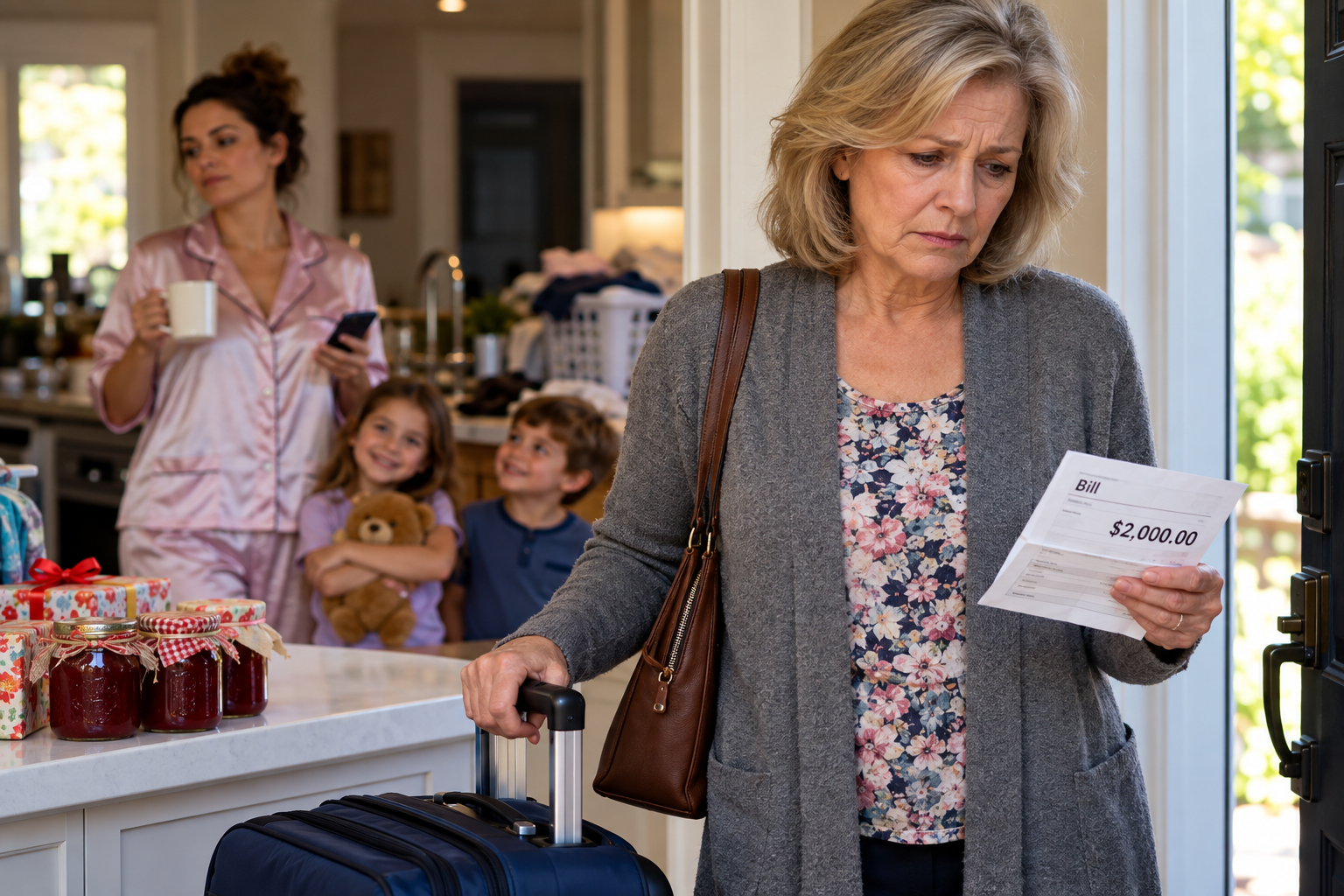
I looked at the folded bill.
Two thousand dollars.
I could not make the amount seem reasonable simply by deciding I didn't want an argument.
The charge remained unexpected.
It remained unexplained.
And it remained something I had never agreed to.
Paying wouldn't change those facts.
It would only make them harder to discuss later.
I thought about Bianca.
I wondered whether she understood how much the bill had affected me.
Maybe she had expected an ordinary response.
Maybe she believed the charge was reasonable.
Maybe she hadn't considered how I would feel.
I didn't know.
I kept reminding myself of that.
I wasn't going to invent her motives.
But I was responsible for my own decision.
And I no longer wanted that decision to come from fear.
I sat down.
I was more tired than I wanted to admit.
The week had caught up with me.
Seven days of household work.
Seven days of helping with the children.
Seven days away from my own routine.
Then a night spent thinking about the bill.
I wanted rest.
I wanted quiet.
I wanted something ordinary.
But first, I needed to be honest with myself.
I wasn't willing to pay.
That was the truth.
I wasn't willing to pay a charge that hadn't been discussed before the visit.
I wasn't willing to accept the idea that a grandmother owed money simply because she had come when asked.
And I wasn't willing to pretend that the bill was harmless.
I had tried to be understanding.
I had given Bianca the benefit of the doubt.
I had considered whether there might be an explanation I hadn't heard.
I was still prepared to listen.
But listening didn't mean agreeing.
That was a distinction I needed to keep.
I thought about how often I had said yes during the week.
Yes, I could cook.
Yes, I could clean.
Yes, I could help with shopping.
Yes, I could watch the children.
Those decisions had been made because I wanted to help.
They hadn't been made because I expected to receive a charge afterward.
I had never treated the week as a purchase.
I wasn't going to start now.
I remembered the drive to Bianca's house.
Nearly three hours.
I had spent much of it thinking about Maisie and Oliver.
I had looked forward to hearing their voices.
I had imagined the week as a chance to be close to them.
I hadn't worried about money.
I hadn't thought about contracts.
I hadn't asked for a list of household expenses.
I had been a grandmother responding to an invitation.
That was the beginning.
I wanted the ending to respect it.
I didn't expect everyone to be perfect.
Families made mistakes.
People misunderstood one another.
Sometimes someone acted without thinking.
I knew that.
I had made mistakes myself.
But mistakes needed to be acknowledged if relationships were going to recover.
I couldn't simply absorb this one and hope the problem would disappear.
That would leave the misunderstanding intact.
And it would leave me afraid of the next invitation.
I thought about what paying might teach Bianca.
I couldn't know how she would interpret it.
But she might believe I accepted the charge.
She might think the arrangement had been fair.
She might assume that another unexpected bill would be acceptable in the future.
I didn't want that.
Not because I intended to be difficult.
Because I wanted clear expectations.
If someone needed help, we could discuss it.
If someone expected money, that needed to be explained beforehand.
If I agreed to something, I would honor my word.
But I couldn't honor an agreement that had never been made.
I felt certain about that.
I thought about the four jars of jam.
Again.
They seemed to return to my mind whenever I felt most disappointed.
Perhaps because they represented the kind of giving I understood.
I had made them.
I had wrapped them.
I had brought them because I loved the children.
Nobody asked me to calculate their value.
Nobody needed a receipt.
I simply wanted to share something.
That was what I believed family should allow.
People giving what they could.
People appreciating the effort.
People understanding that generosity didn't create an unlimited obligation.
I wanted to keep believing in that.
I didn't want the bill to make me suspicious of kindness.
But I knew I had to become more careful.
Next time, I would ask questions.
I would make sure everyone understood what the visit involved.
I would talk about how much help I could provide.
And I would not agree to something simply because I feared that saying no might make me less welcome.
That last part would be difficult.
I knew myself.
I liked being needed.
I liked knowing the children wanted me.
I liked feeling that Graham's family could count on me.
Those feelings were not wrong.
But I couldn't allow them to determine every decision.
My worth as a grandmother didn't depend on how many chores I completed.
My place in the family shouldn't depend on how much inconvenience I accepted.
And my love for Maisie and Oliver didn't need to be proven with money.
Those truths felt stronger now.
I was beginning to believe them.
I thought about Graham.
I still wanted to tell him what had happened.
I wanted him to understand that the issue wasn't a desire for attention or praise.
I wasn't asking him to thank me for every dish I washed.
I wasn't demanding reimbursement for every hour I spent with his children.
I wanted him to know that his mother had been given a substantial bill after coming to help at his wife's request.
And that no such charge had been mentioned beforehand.
I wanted him to hear that without immediately feeling he had to choose sides.
Perhaps that was asking a lot.
I didn't know.
But it was what I hoped for.
I looked at my suitcase.
I was ready to leave.
My body wanted to rest.
My mind wanted the problem settled.
But I no longer believed the quickest solution was necessarily the right one.
Paying would have been quick.
Silence would have been easy.
Neither would have addressed what hurt me.
I had spent the week being agreeable.
I had spent the night questioning myself.
Now I needed to make a decision that reflected what I actually believed.
I wouldn't pay simply to avoid discomfort.
I wouldn't punish Bianca.
I wouldn't involve the children.
And I wouldn't pretend I knew more than I did about why she presented the charge.
I would continue asking for an explanation.
If she provided one, I would consider it.
If the charge remained unjustified, I would say so.
And whatever happened, I would be honest about my limits in the future.
That was the decision.
It wasn't dramatic.
There was no shouting.
No triumphant speech.
Just a tired grandmother finally recognizing that she could say no.
I took the bill out.
I read the amount.
Then I folded it again.
The paper had become worn from handling.
I had looked at it often enough.
I no longer needed to search the number for an answer.
The answer had to come from the people involved.
And my decision had to come from me.
I returned the bill to my purse.
I closed it.
I didn't feel victorious.
I felt sad that such a conversation had become necessary.
But I also felt relieved.
For the first time since Bianca slid the paper across the table, I wasn't asking myself how to make everyone else comfortable.
I was asking what was fair.
And I knew that paying an unexpected charge merely to keep the peace would not be fair to me.
Click here to continue reading: PART 20: I Left With the Two-Thousand-Dollar Bill Still Unpaid, but I Finally Understood What My Week With Bianca Had Cost Me
I Thought My Grandchildren Needed Me for One Week, but I Had No Idea What Was Waiting Inside That House
Part 19 of 20