I never learned every private detail of what happened after that evening.
I couldn't tell you what Alexander said to Noah over breakfast.
I couldn't tell you what Anna thought when she returned to work.
And I couldn't tell you whether the three women spoke to one another after leaving the ballroom.
I would be making things up if I claimed otherwise.
What I did know was enough.
The gathering had ended without the decision everyone expected.
Alexander had not forced Noah to return to the altar.
The three women had not received the answer they came for.
And Anna had been allowed to stand beside the child who had noticed her tears.
Those facts stayed with me.
For a long time, I had thought of the Sterling family as people who could arrange their lives however they pleased.
They had wealth.
They had influence.
They had access to opportunities most people would never see.
If something needed to be organized, they could organize it.
If something needed to be provided, they could provide it.
But the evening had shown the limits of that power.
Alexander could arrange a gathering for his son's future.
He could invite three women he considered possible partners.
He could ask Noah to take part.
What he could not do was determine what his son would feel.
And that was probably the most important truth of the night.
Noah was not a problem to solve.
He was a child.
He had lost his mother three years earlier, and nothing about that loss could be undone by finding another woman to stand beside his father.
A new relationship might someday bring happiness to the household.
It might give Alexander companionship and offer Noah another caring adult.
But it could not erase the mother he had lost.
Nor should it have to.
Love was not a competition in which one person had to replace another.
A family could grow without forgetting who had been there before.
I hoped Alexander would carry that understanding into whatever decisions he made afterward.
He did not have to abandon the idea of marrying again.
He did not have to spend the rest of his life alone.
He only had to remember that his son deserved time and honesty.
The women who had waited beside the altar deserved those things too.
They had arrived with hopes of becoming part of the Sterling family.
They had presented themselves with care and had tried to make Noah feel welcome.
But they could not be promised a place simply because the family had arranged an occasion for them.
Their feelings mattered.
Their disappointment mattered.
Still, neither could determine what Noah was ready to accept.
They were adults.
They could understand that an evening had not gone as planned.
Noah was five.
He deserved the chance to learn what he felt without being made responsible for the consequences of his father's romantic choices.
And Anna deserved something that had been easy to overlook in the ballroom.
She deserved to remain herself.
I didn't know whether she wanted a different position in life.
I didn't know what had caused her tears.
I didn't know whether she had ever imagined speaking privately with a member of the Sterling family.
There was no reason to assume she had.
She had arrived to do her job.
She had carried a silver tray.
And she had tried to hide her sadness.
The fact that Noah noticed her did not mean she owed him anything beyond the ordinary kindness one person might offer another.
It certainly did not mean she owed Alexander a future.
That distinction mattered to me.
A person could be kind without becoming responsible for someone else's happiness.
A child could care about someone without needing to make them part of his family.
And a wealthy man could admire an act of kindness without turning it into an arrangement.
I hoped Alexander understood that.
Perhaps he had already begun to understand it when he told Anna she had not interrupted anything.
Those words had seemed small at the time.
But they had changed the way the moment unfolded.
Anna had expected to be blamed.
Alexander had told her she was not at fault.
Noah had wanted her to stay.
And for a while, the three of them had stepped outside the expectations of the ballroom.
There had been no formal announcement.
No promise of a new family.
No sudden solution to grief.
Just a father, a son, and a woman who had been allowed to stop working long enough to be seen.
That was what I remembered.
I also remembered the silver tray.
It had been such an ordinary object.
It had belonged to the evening's routine, no more important than the glasses arranged across its surface.
Yet it had marked the moment when Anna was doing her job and the moment when she was no longer expected to continue it.
When the tray was taken away, she could stand still.
When she stood still, Noah could stay beside her.
And when Noah stayed, Alexander had to decide whether the plans of the adults mattered more than his son's feelings.
He had allowed the boy to remain.
That choice did not settle the family's future.
It did not tell us whether Alexander would marry again.
It did not reveal what Anna wanted from her own life.
It did not tell us what the three women would decide to do next.
But it showed that Alexander was capable of stopping.
For a man accustomed to control, that was not a small thing.
Sometimes a parent has to stop long enough to hear what a child is trying to say.
Sometimes a person has to accept that a carefully planned future needs more time.
And sometimes the most useful thing a family can do is admit that it does not have all the answers.
The Sterling family had gathered in a ballroom full of beautiful things.
There had been crystal lights, golden roses, polished marble, and expensive gowns.
Every detail had been selected to make the evening feel important.
But the moment I remembered most clearly was not one of those things.
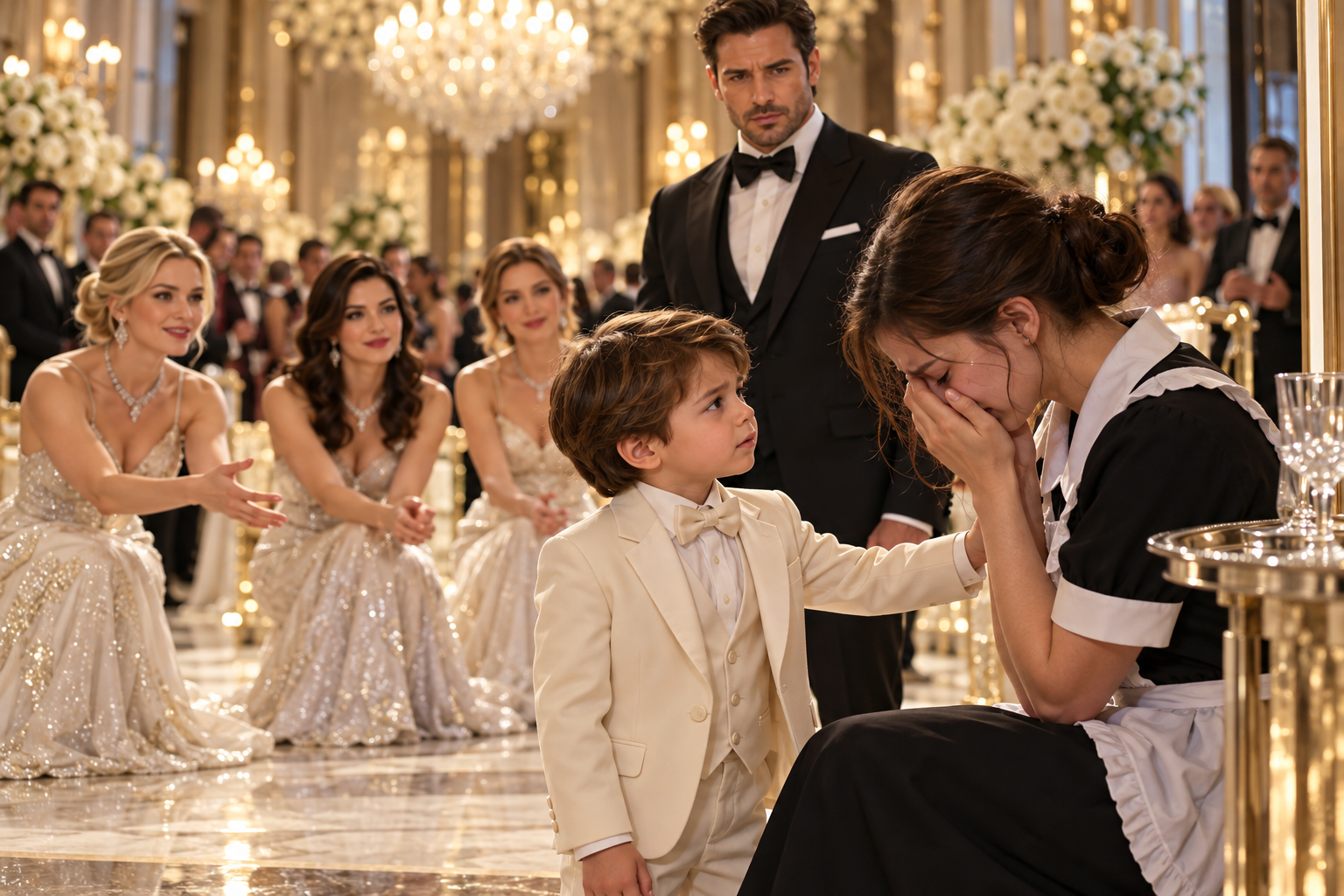
It was Noah looking up at Anna and asking whether she was all right.
He had not asked what she could offer him.
He had not asked whether she belonged in his father's world.
He had not asked what the other guests would think.
He had seen someone who was sad.
He had cared.
And when she tried to send him away, he had asked to stay.
Perhaps that was why the evening had felt so different from what everyone expected.
The adults had been thinking about the future.
Noah had been thinking about a person standing in front of him.
The adults had been weighing possibilities.
Noah had been responding to what he could see.
The adults had been waiting for him to make a choice.
He had made one, but it was not the choice they had imagined.
He chose kindness.
That did not make him responsible for deciding who should become his future mother.
It did not mean Anna should be asked to fill that role.
It did not mean the family had found an answer to every question.
It meant that, for one moment, a child had done something simple and honest while the grown people around him struggled with their expectations.
I had spent the evening watching a billionaire family wait for a boy to choose.
By the end, I understood that the boy had never needed to make the kind of choice they were waiting for.
He needed to be heard.
He needed to be allowed to care.
And he needed adults who could understand the difference between a child's affection and an adult's decision about the future.
I still remember the maid near the doors.
I remember the tray in her hands.
I remember the way she tried to hide her tears before anyone noticed.
And I remember the boy who noticed anyway.
The Sterling family had entered that ballroom expecting a decision about marriage.
They left with a harder question to consider.
What did it mean to build a family when the child at its center was still learning how to live with loss?
There was no answer that could be bought.
No ceremony could guarantee it.
No stranger could decide it on his behalf.
Alexander would have to find his own way forward as a father and as a man.
Noah would have to grow up, carrying the memory of his mother while learning to trust the people who remained.
Anna would have to continue living her own life, without being made into a symbol of anyone else's hopes.
And the three women would have to accept that the evening had not given them the future they had imagined.
Those were the consequences of what had happened.
Not a perfect ending.
Not a magical solution.
Just a family forced to look more honestly at what it needed.
I used to believe money could solve almost anything.
I don't believe that anymore.
Money could fill a ballroom with flowers.
It could bring the most influential people into one room.
It could provide a child with comfort and security.
But it could not tell Noah whom he should love.
It could not make Anna stop crying.
And it could not decide what Alexander's future should look like.
For that, they needed something less impressive and much harder to arrange.
Patience.
Honesty.
And the willingness to notice another person's pain.
The evening began with three women waiting for a little boy to choose.
It ended with that boy showing everyone something they had forgotten.
Before asking someone to become part of a family, it helps to understand what the people already in that family need.
And sometimes, before anything else can change, someone simply has to ask whether the person beside them is all right.
The End
Read more original stories on Feel Every Story.
Everyone Expected the Billionaire Heir to Choose a Beautiful Bride, Until He Looked Past Them All
Part 10 of 10