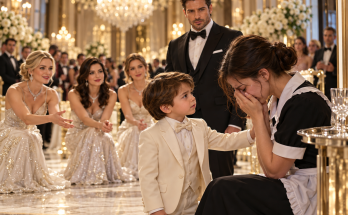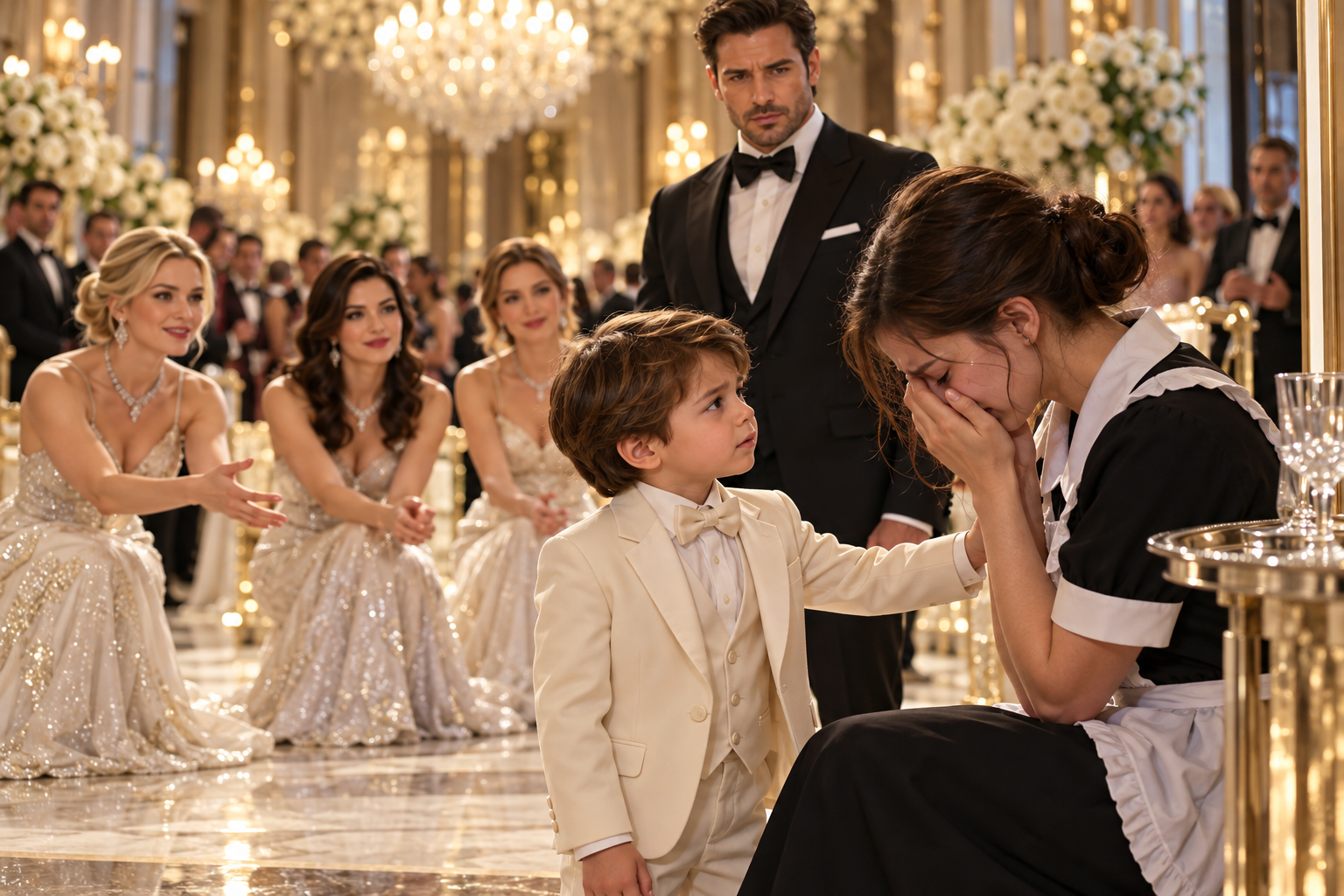
The next morning, I found myself thinking about the ballroom again.
I remembered the white gowns.
The golden roses.
The silver tray near the doors.
Most of all, I remembered Noah asking Anna whether she was all right.
It had been such a small question.
Yet it had changed the direction of the entire evening.
I wondered what the Sterling household felt like after the guests had gone home.
There would be no orchestra that morning.
No rows of chairs.
No strangers waiting to see what a five-year-old boy would do.
There would only be the family and the decisions that remained.
Alexander still had to face the fact that his wife was gone.
Noah still had to grow up without his mother.
And Anna still had to return to a life in which she had not expected to become the subject of anyone's attention.
The evening had not solved any of those problems.
It had only made them harder to ignore.
I used to think that a person with Alexander's resources could make almost any difficult situation easier.
He could hire the best people.
He could provide the safest home.
He could make sure his son never wanted for anything material.
But grief did not care about a person's bank balance.
A child could have every comfort available and still miss the one person he wanted most.
That was the part I had failed to consider.
Perhaps Alexander had failed to consider it too.
I couldn't say that with certainty.
I had never sat down with him to discuss his private thoughts.
I had seen him only as the powerful man everyone recognized.
But that evening, when Noah refused to return to the altar, I saw a father who had to decide whether to insist on his plans or listen to his child.
He had listened.
It wasn't a complete answer.
It was a beginning.
I imagined the breakfast table at the Sterling home.
Perhaps Noah would sit in his usual chair.
Perhaps Alexander would look across at him and remember the way the boy had stood beside Anna.
The child might not bring up the gathering at all.
Children sometimes move on from an event while adults continue examining it.
Or perhaps Noah would ask another question.
Something ordinary.
Something that would reveal what he had been thinking.
I hoped Alexander would listen as carefully as he had the previous evening.
A child should not have to make a public scene before an adult takes his feelings seriously.
I also hoped Alexander would remember the women who had come to the ballroom.
Their hopes had been disappointed.
Whatever he decided about his future, they deserved honesty.
A difficult conversation would have been better than leaving them to guess what the evening meant.
But their disappointment did not make Noah responsible for giving them the answer they wanted.
That responsibility belonged to the adults.
The same was true of Anna.
She had not volunteered to become the center of the family's attention.
She had not asked to be included in a private decision about Alexander's future.
And she had not encouraged Noah to ignore the other women.
She had tried to send him back to his father.
She had apologized for crying.
She had offered to return to work.
Every action I had witnessed suggested that she wanted the situation to settle down.
I hoped Alexander would respect that.
There was a danger in allowing one moving moment to become more than it was.
People could take Noah's kindness and turn it into a story about destiny.
They could decide that Anna must be special because the boy had approached her.
They could treat her as the answer to a question she had never been asked.
But that would be another way of ignoring the person she actually was.
Anna was not a solution to Alexander's loneliness.
She was not a replacement for Noah's mother.
She was not a reward for the family's generosity.
She was a woman who had been crying at work.
Noah had noticed.
That was enough to explain why he approached her.
It did not explain everything about Anna, and it did not need to.
I had to remind myself of that because it was tempting to make the evening sound like a fairy tale.
A billionaire's son ignored three beautiful women and walked toward a maid.
It was the sort of story people would repeat because it sounded extraordinary.
But the truth was more ordinary.
A little boy saw someone who looked unhappy.
He asked a question.
When she tried to send him away, he stayed.
The adults around him were the ones who turned that moment into a question about the future.
Perhaps that was why it mattered so much.
Noah had not been trying to change his family.
He had not been trying to make a statement.
He had simply acted on what he saw.
Alexander had the harder task.
He had to decide what to do with what his son had shown him.
Would he continue trying to arrange a future that looked right from the outside?
Or would he slow down long enough to understand what his child needed?
I hoped he chose the second path.
Not because it would make a better story.
Because it would be better for Noah.
A child who had lost his mother needed time.
He needed reassurance that loving someone new would not mean forgetting the person who was gone.
He needed adults who could speak honestly about the past without making every conversation about the future.
And he needed the freedom to care about people without being told that his kindness had decided something permanent.
Alexander could give him that freedom.
He could tell his son that Anna's tears had mattered because people mattered.
He could explain that caring about someone did not mean that person had to become a member of the family.
He could let Noah be five years old.
Perhaps that was the most important thing the evening had taught him.
The boy did not need to choose his father's next wife.
He needed a father who would listen.
And Alexander had already taken the first step by allowing him to walk away from the altar.
I hoped he understood that stopping the ceremony had not been a failure.
It had been an opportunity to reconsider what the family was asking of a child.
The ballroom had been prepared for a decision.
But the decision that mattered most had nothing to do with the gowns or the flowers.
It was whether Alexander would let his son be honest about what he felt.
That was the decision no guest could make for him.
No amount of money could make it easier.
And no beautiful ceremony could make it unnecessary.
Click here to continue reading: PART 10: The Sterling Family Learned That a Future Could Not Be Chosen in One Evening, and Noah’s Small Act of Kindness Became the Lesson They Needed Most
Everyone Expected the Billionaire Heir to Choose a Beautiful Bride, Until He Looked Past Them All
Part 9 of 10