That afternoon, Ethan came home from school with a folded sheet of paper in his backpack.
He placed it on the kitchen table while my mother finished making sandwiches.
“Our teacher asked us to write about a memory,” he said.
I washed my hands and sat beside him.
“What kind of memory?”
“Any memory. Something we did with our family.”
He unfolded the paper.
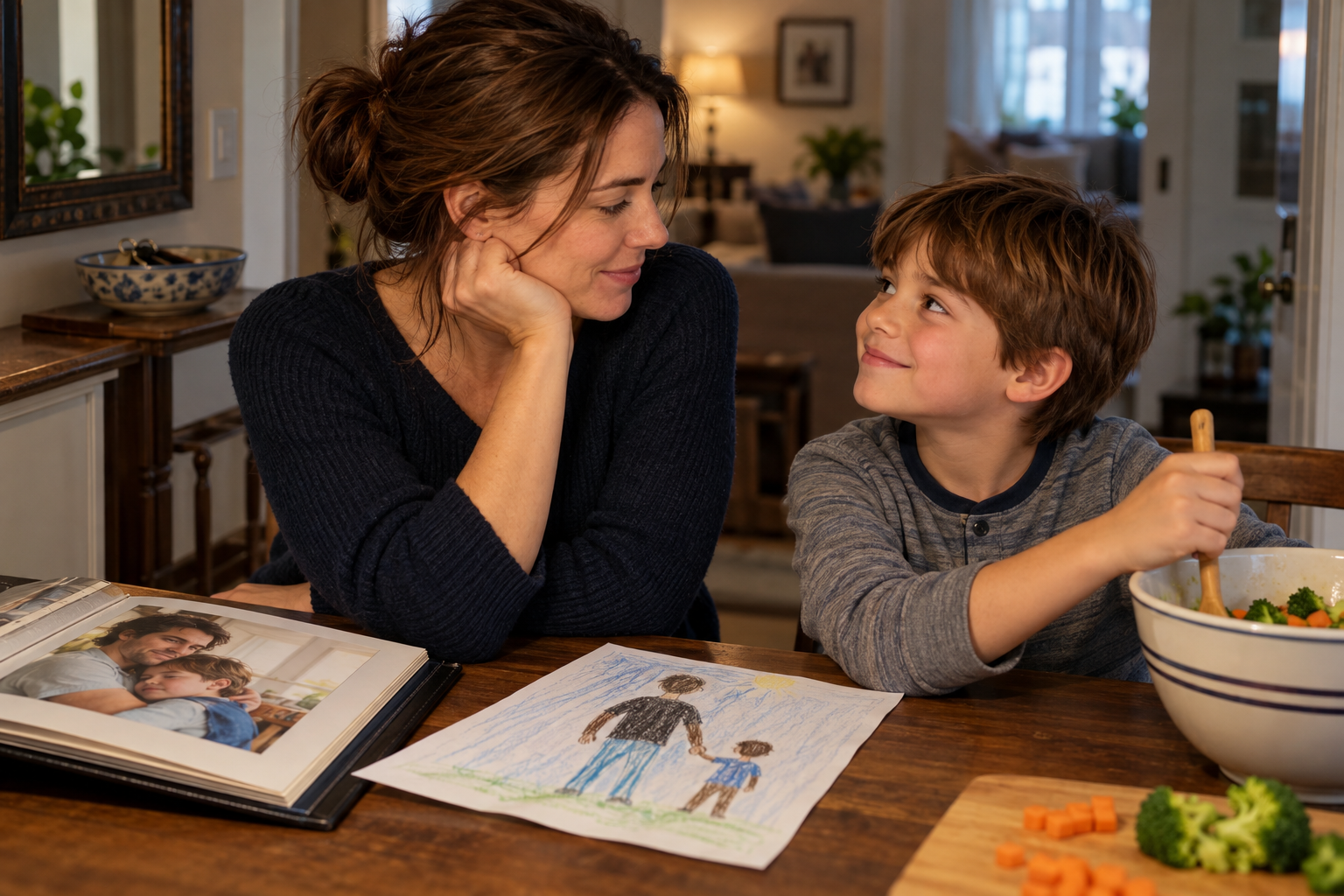
At the top, he had written his name in careful letters. Beneath it were three lines and a drawing of a man standing beside a small boy.
The man had long arms and dark hair.
The boy was holding his hand.
I recognized his father immediately.
Ethan had drawn the two of them beneath a large square light.
I kept my expression calm.
“Would you like to tell me about it?”
He nodded.
“I think this is the room.”
He pointed to the square above the figures.
I looked at the drawing without leaning closer.
“What made you choose that light?”
“I remember it being bright.”
“Is that the part you remember most clearly?”
He thought about it.
“Maybe.”
I waited.
He traced one of the lines with his finger.
“I don't know what the room looked like. I just remember the light and Dad's hand.”
I felt a question rise in my throat.
I wanted to ask whether his father had been taking him somewhere, whether they had been leaving or arriving, and whether the light had been above a door.
I let the questions pass.
“What do you want to write about the memory?” I asked.
Ethan looked at the paper.
“I don't know if I should write it if I'm not sure.”
“You can write what you remember and be honest about the parts you aren't sure of.”
He frowned.
“What if my teacher asks me where it was?”
“You can tell her you don't know.”
“What if she thinks I made it up?”
“Then you can explain that it's a memory you're trying to understand. You don't have to pretend to know more than you do.”
He looked relieved, although not completely.
“Can I write that Dad was holding my hand?”
“If that's what you remember.”
He nodded and picked up his pencil.
I went back to the counter to give him room.
My mother watched me from the other side of the kitchen.
She did not speak until Ethan began writing.
“You didn't ask him anything else,” she said quietly.
“He told me what he wanted to tell me.”
“And you listened.”
I looked down at the sandwiches.
It seemed such a small thing.
But I knew how much effort it had taken not to turn the drawing into a list of questions.
Ethan worked on the paper for nearly twenty minutes.
Sometimes he erased a word.
Sometimes he stared at the drawing as if he expected it to become clearer.
When he finished, he slid the sheet toward me.
He had written that he remembered standing with his father beneath a bright light. He did not know the name of the place or what they had been doing.
At the end, he had added that he liked remembering his father's hand because it made him feel safe.
I read the paragraph twice.
“Is this okay?” he asked.
“Yes,” I said. “It's honest, and it tells your teacher what the memory means to you.”
He folded the paper.
“I'm going to put it in my backpack.”
He carried it into the living room.
I stayed at the table, looking at the place where the drawing had been.
The room still had no name.
The light still had no explanation.
But Ethan had found a way to talk about what he remembered without having to turn it into a complete story.
That mattered.
Later that evening, my mother helped him with his schoolwork while I prepared dinner.
He seemed more settled than he had the previous night.
He asked for another piece of toast and complained that his pencil had broken just when he needed it.
My mother sharpened it for him.
They argued playfully about whether the pencil was too short to use.
For a while, the house sounded like our house again.
After dinner, Ethan brought the photograph of his father into the kitchen.
He placed it beside his plate.
“Mom?”
“Yes?”
“Do you think Dad remembers me?”
The question stopped me.
I dried my hands and sat down.
I had expected questions about the room, the drawing, or the envelope.
I had not expected this.
“I don't know what happens after someone dies,” I said carefully. “But I know your dad loved you when he was here.”
Ethan looked at the photograph.
“Even when I was too little to remember everything?”
“Yes. Even then.”
“How do you know?”
“Because I saw how he treated you. I remember the way he carried you, the way he talked to you, and how he looked at you when you fell asleep in his arms.”
He touched the edge of the photograph.
“Sometimes I feel like I should remember more.”
I moved my chair closer to his.
“You were very young. It's normal not to remember every day from when you were little.”
“But what if I forgot something important?”
I took a breath.
“Then we can talk about it if you remember more. But you don't have to search for something just because you're worried you might have forgotten it.”
He looked at me for a long moment.
“Are you worried too?”
I could have told him no.
I could have tried to make the room feel safer by pretending I had no fear of my own.
Instead, I chose the truth.
“Yes,” I said. “I'm worried because there are things I don't understand. But I'm not asking you to fix them.”
His shoulders relaxed a little.
“You aren't?”
“No. That's my job, not yours.”
He leaned against me.
I put my arm around him and let him sit there.
Neither of us spoke for a while.
Then he asked whether we could make pancakes on Saturday.
I laughed softly.
“Yes. We can make pancakes on Saturday.”
“Chocolate chips?”
“If you help clean up afterward.”
He grinned.
“That's fair.”
The conversation moved on.
I did not drag it back.
After he went upstairs, I found my mother standing near the living room window.
“He needed that,” she said.
“So did I.”
She turned toward me.
“You told him the truth without giving him something you couldn't promise.”
I thought about what she meant.
I had not told Ethan that everything would be explained.
I had not promised that the envelope would contain nothing frightening.
I had not told him that his memory was correct or incorrect.
I had told him what I knew.
His father had loved him.
He had been very young.
He did not have to recover every memory to prove that love had existed.
It was enough for that evening.
Before bed, I checked the front hall.
The envelope remained in the ceramic bowl.
I still did not know why it had been left there, and the police had not yet given me permission to open it.
I did not touch it.
Instead, I picked up my keys and placed them on the small shelf beside the bowl, leaving the envelope where it was.
Then I turned off the hallway light.
The house went quiet.
Upstairs, Ethan was reading beneath his bedside lamp, and my mother was preparing for bed in the guest room.
For the first time, I could think about the envelope without immediately connecting it to every uncertain detail of Ethan's memory.
I was still afraid of what it might mean.
I was still waiting for answers.
But I was no longer asking my son to carry the weight of my questions.
That was the one thing I could change before I knew anything else.
Click here to continue reading: PART 13: The Officer Called With an Update, but It Did Not Tell Me Who Had Left the Envelope
The Barber Said Something About My Nine-Year-Old Son That I Could Not Explain, and Then a Familiar Name Changed Everything
Part 12 of 20