The next morning, I woke before Ethan.
I went downstairs and made coffee.
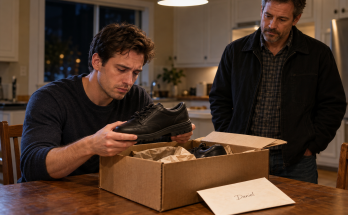
The house was quiet, and the envelope remained on the table beside the door.
I had grown used to seeing it there.
That worried me.
A few days earlier, I would have considered an unexplained envelope inside my home an emergency.
Now I found myself stepping around it while I made breakfast.
Fear had not disappeared.
It had simply become part of the routine.
I poured coffee into a mug and stood near the kitchen window.
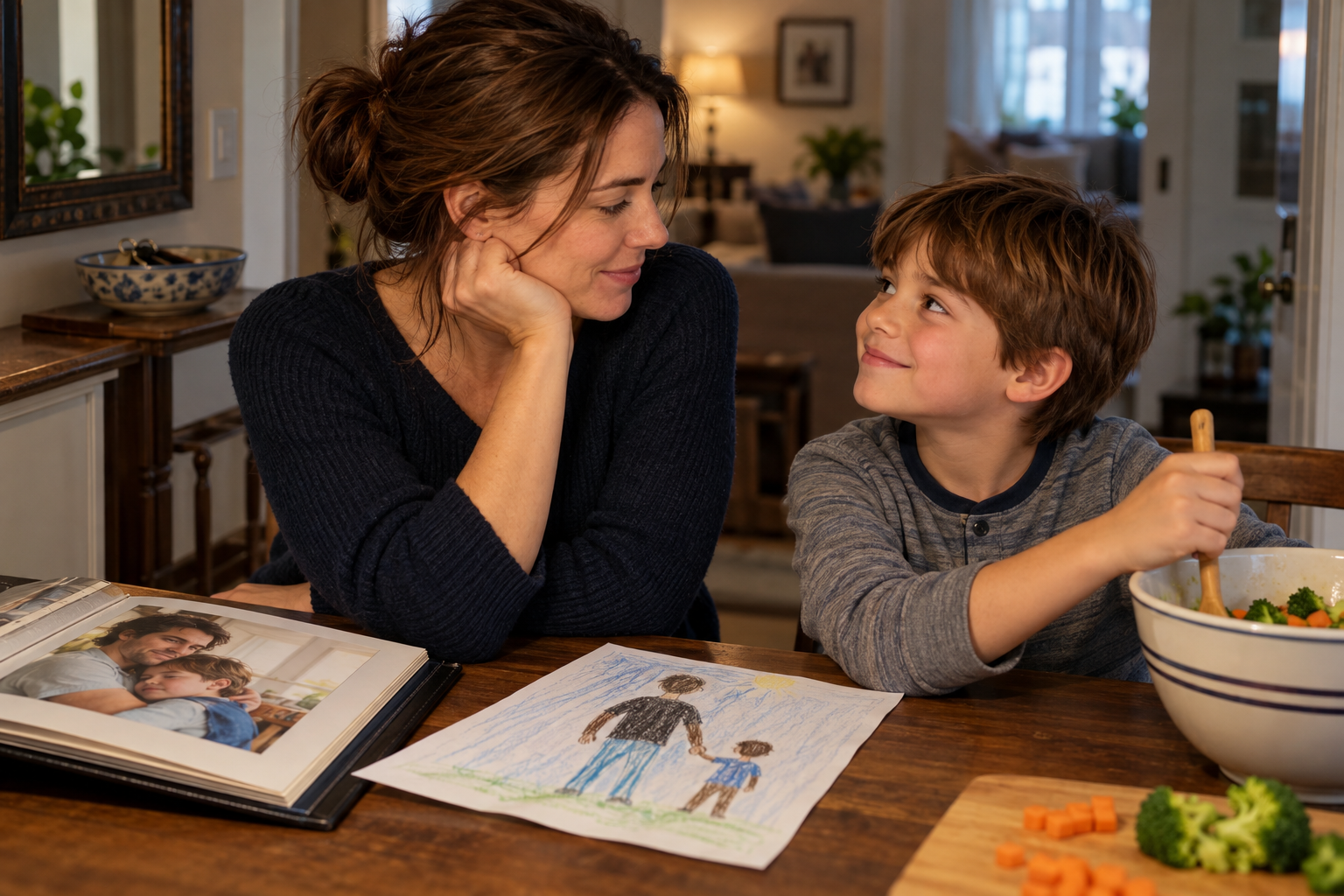
I thought about the drawing Ethan had shown me.
I could still picture the small square near the ceiling.
The two figures.
The door.
It was tempting to treat the drawing as a clue that would eventually lead me to an answer.
But the barber had been right about one thing.
I had to be careful not to turn an uncertain memory into a story of my own making.
I couldn't tell Ethan what he remembered.
I couldn't decide what his father had done based on a picture drawn by a nine-year-old who wasn't sure where the room had been.
I could only listen.
When Ethan came downstairs, he found me at the table.
He was carrying his notebook.
"Did you sleep with that?" I asked.
He nodded.
"I wanted to look at it again."
He sat across from me and opened the page.
I set a plate of toast in front of him.
He ate while studying his drawing.
After a while, he asked whether I thought the room had been real.
I took a breath.
"I think you remember something that feels real to you."
He looked up.
"That's not the same as saying it happened?"
"No. Not exactly."
He considered that.
I continued before he could mistake my uncertainty for disbelief.
"It means we can take your memory seriously without pretending we know every detail."
He seemed to understand.
He returned to his toast.
I was relieved that he hadn't shut down.
I had been afraid that telling him the truth about uncertainty would make him feel that I didn't believe him.
Instead, he seemed calmer.
He didn't have to prove anything.
Neither did I.
After breakfast, I called my mother again.
She asked whether the police had discovered anything about the envelope.
I told her I hadn't received an explanation.
She offered to return home sooner than planned.
This time, I accepted the offer.
I didn't tell her that I was frightened of being alone.
I said it would help to have her nearby while we figured out what to do.
That was true.
It was also easier to say.
She promised to arrange her return and call me with the details.
When we hung up, I checked the front door lock.
Then I checked the back door.
I inspected the windows.
Everything appeared secure.
I didn't find any sign that someone had entered the house.
I wasn't sure whether that should comfort me.
At least, I had done what I could.
I went upstairs and found Ethan arranging his pencils in a row on his desk.
He looked at me when I entered.
"Are we going anywhere today?"
"Not unless you want to."
He shrugged.
"Can we stay home?"
"Of course."
We spent the afternoon doing ordinary things.
He built a small tower from blocks.
I folded laundry in the next room.
He asked for a snack.
I gave him one.
He complained that I had bought the wrong kind of crackers.
I told him he could eat those or wait until dinner.
He ate them.
For a while, I almost forgot about the envelope.
Then I walked past the front door and saw my name again.
The white paper caught my eye.
I stopped.
I couldn't explain why someone would leave it there.
I couldn't explain why it had appeared on the same day the barber had spoken to me about my son.
But I could choose not to let those unknowns control every moment of our lives.
I went back to the kitchen.
That evening, Ethan asked whether I could read to him before bed.
He hadn't asked me to do that in months.
I agreed.
He chose a book we had read when he was younger.
The cover was worn at the corners, and the spine had begun to split.
He settled beside me while I read.
Every few pages, he interrupted to correct me about a character or tell me what he thought would happen next.
His voice sounded more like itself.
I felt a small wave of gratitude.
When we reached the end, he closed the book and rested his head against my shoulder.
"Mom?"
"Yes?"
"Can I tell you something without you asking lots of questions?"
I looked down at him.
"Yes."
He took a moment.
"I think I've remembered that room before."
I kept my voice steady.
"When?"
"I don't know. Sometimes when I'm falling asleep."
I waited.
He rubbed the corner of the book with his thumb.
"I see the light, and then it goes away."
I nodded.
"Does it scare you?"
"Not exactly."
"What does it feel like?"
He thought about that.
"Like I forgot something important."
I felt a painful recognition.
I knew what it was like to believe that an answer existed somewhere just beyond reach.
But I didn't tell him that.
I didn't want my experience to become another part of his memory.
Instead, I said, "You don't have to remember everything tonight."
He looked at me.
"What if I never remember?"
"Then we'll still be okay."
I meant it.
I hoped it was true.
He leaned against me again.
For a while, we sat quietly.
Then he asked whether we could leave the notebook beside his bed.
I said yes.
I tucked the blanket around him and turned off the light.
When I reached the doorway, he called my name.
"Mom?"
I turned.
"Thank you for listening."
I couldn't answer right away.
Those words stayed with me as I walked downstairs.
I had spent years thinking that being a good mother meant knowing what my child needed before he had to ask.
I had treated silence as a sign that nothing was wrong.
I had assumed that if Ethan couldn't explain something, I should help him find the explanation.
Now I understood how easily help could become pressure.
I couldn't make the envelope disappear.
I couldn't force the barber to know more than he did.
I couldn't recover a memory that Ethan himself couldn't fully describe.
But I could stop treating uncertainty as something he needed to solve for me.
I returned to the living room.
The little ceramic dish sat on the narrow table.
My keys rested beside it.
The envelope remained untouched.
I stood there for a moment, looking at my name.
Then I turned off the light and went upstairs.
I was still afraid.
I still wanted answers.
But I was no longer going to let the need for those answers become another burden my son had to carry.
Click here to continue reading: PART 9: My Mother Returned Home With a Question She Had Been Afraid to Ask Me
The Barber Said Something About My Nine-Year-Old Son That I Could Not Explain, and Then a Familiar Name Changed Everything
Part 8 of 20