The call came the following morning while I was clearing breakfast from the table.
My mother was helping Ethan find a missing worksheet, and I had just put his lunch container beside his schoolbag when my phone began to ring.
I recognized the officer's number.
For a moment, I stood still with a plate in my hand.
Then I set it down and answered.
“Hello?”
“Claire, it's the officer who spoke with you about the envelope.”
“Yes.”
“I wanted to check in and give you an update on the information we've collected.”
I looked toward the front hall.
The envelope was still in the ceramic bowl.
“Have you found out who left it?”
“Not at this point.”
I felt my shoulders tighten.
He continued before I could ask another question.
“We're still reviewing what was reported. I don't want you to take the absence of an answer as confirmation of any particular explanation.”
“I understand.”
I did understand what he meant.
I also understood that I had been hoping he would say something different.
I wanted him to tell me that the envelope had been traced to someone, that the way it appeared in the bowl had an ordinary explanation, and that I could stop wondering whether someone had entered the house.
Instead, I had another unanswered question.
“Should I continue leaving it where it is?” I asked.
“Yes. For now, don't open it or move it. We'll contact you if that changes.”
“All right.”
He asked whether anyone had approached me or whether I had noticed anything else unusual.
I told him there had been no new contact and no further incident.
I did not mention every thought I had entertained in the middle of the night.
Those thoughts were not events.
I was learning to keep that distinction clear.
When the call ended, I put my phone on the counter.
My mother had stopped searching through the papers on the kitchen table.
She looked at me.
“Anything?”
“They still don't know who left it.”
She lowered the worksheet she was holding.
“Did they tell you to do anything different?”
“No. Leave it alone and wait.”
“Then that's what we'll do.”
Her calmness irritated me for a second.
I wanted someone to be as impatient as I was.
Then I remembered that she had driven home early because I was frightened, and that she had been helping me keep the house steady without pretending to have answers.
I had no right to expect her to make uncertainty disappear.
I picked up Ethan's lunch container.
“Have you seen his blue water bottle?”
My mother pointed toward the refrigerator.
“Behind the milk.”
It was there.
I washed it, filled it, and placed it in his schoolbag.
The morning continued.
Ethan found his worksheet beneath the couch cushion. My mother reminded him to bring his reading book. He complained that his shoes felt too tight, although they fit yesterday.
I checked the time and told him we needed to leave.
At the door, he glanced at the ceramic bowl.
He did not say anything.
I noticed the glance, but I did not ask what he was thinking.
After I dropped him at school, I drove to work.
For the first hour, I managed to concentrate.
Then I found myself reading the same message three times without understanding it.
I closed the screen and went to get a glass of water.
I was not only worried about the envelope.
I was frustrated by how little control I had over what happened next.
I could make calls, answer questions, and follow instructions. I could check the locks and keep the house occupied.
None of those things could tell me what was inside the envelope.
And none could tell me whether it had anything to do with the barber's concern or Ethan's memory.
By lunchtime, I had decided to call the barbershop again.
I waited until I was away from other people before dialing.
The barber answered after several rings.
“Hello?”
“It's Claire. Ethan's mother.”
“I remember.”
“I wanted to ask whether you've thought of anything else about what happened when Ethan was there.”
There was a short pause.
“Has he said anything new?”
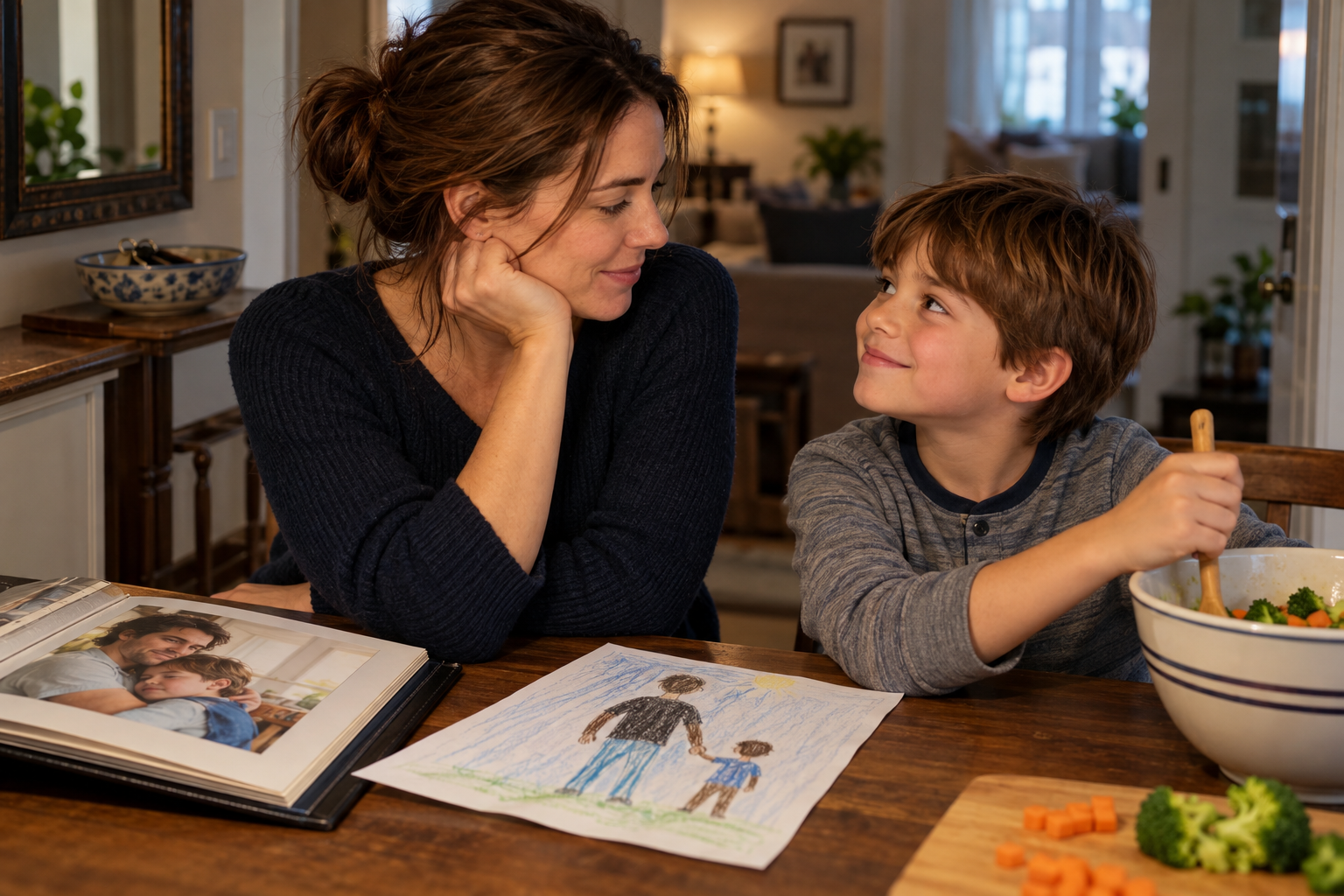
“He drew the room he thinks he remembers. He still doesn't know where it was.”
“Did he tell you more about what happened there?”
“No. He remembers a bright light and his father's hand. That's all he has been able to explain.”
The barber did not immediately respond.
I waited.
“Claire, I don't want to turn something uncertain into a fact,” he said.
“I don't want that either.”
“Then I think you should keep doing what you've been doing. Let him speak when he wants to speak. Don't try to fill in the parts he can't remember.”
I rested my hand against the wall.
“I know you've told me that before.”
“I'm telling you again because it's important.”
His voice was serious, but not threatening.
I tried another question.
“Is there something you haven't told me?”
He took a breath.
“I've told you what I remember from that conversation. I noticed that Ethan seemed unsettled, and I thought it was worth speaking to you privately. I don't have proof of anything else.”
“Then why did you ask me to come back?”
“Because I didn't think it was appropriate to discuss a child's private comments while other customers were sitting nearby. I also wanted to be careful about how I explained what I'd heard.”
That answer made sense.
It was also the closest thing to a clear explanation I had received from him.
“Did you know about the envelope?”
“No.”
“Has anyone contacted you about it?”
“No.”
I believed he was answering honestly, although I could not prove that.
I had to accept that not every question could be settled by how an answer sounded.
“Thank you for answering me,” I said.
“Of course. I hope Ethan is doing all right.”
“He's getting on with things.”
“That's good.”
We ended the call.
I remained where I was for a moment, looking through the window at the parking lot.
I had not discovered anything new.
But I had asked direct questions and received direct answers.
The barber had no information about the envelope, and he had not claimed to know what Ethan remembered.
For now, those were the facts.
When I returned home that evening, Ethan was sitting with my mother at the kitchen table.
His schoolbag was open beside him, and his worksheet lay between them.
He looked up.
“Mom, I got a good mark on my reading.”
“That's wonderful.”
He showed me the page.
I praised the work he had done, and he explained which words he had found difficult.
He did not mention his father.
He did not mention the room.
We spent the evening making dinner and watching a television program he liked.
My mother laughed at one of the jokes before Ethan did, which made him accuse her of ruining it.
She insisted that she had simply understood it faster.
Their argument lasted longer than the joke deserved.
I sat on the couch and listened.
The envelope remained in the front hall, but it did not occupy every moment.
That night, when I checked the door locks, I did it once.
I went upstairs without returning to the ceramic bowl.
For the first time in days, I slept for several hours without waking.
I still wanted answers.
I simply no longer believed that worrying harder would make them arrive sooner.
Click here to continue reading: PART 14: I Found Myself Reaching for the Envelope, Then Remembered Why I Had Promised to Wait
The Barber Said Something About My Nine-Year-Old Son That I Could Not Explain, and Then a Familiar Name Changed Everything
Part 13 of 20