By the end of the week, my mother had settled into a routine at our house.
She made coffee before I came downstairs, helped Ethan organize his schoolwork, and reminded me to buy milk whenever she noticed the carton was getting low.
She did not ask me every morning whether the police had called.
I think she understood that I would tell her if something changed.
The envelope remained in the ceramic bowl.
I still noticed it when I entered the house.
But I had stopped walking toward it every time I passed the front hall.
The difference was small enough that another person might not have noticed.
I noticed.
One morning, I left the house in a hurry because Ethan had misplaced his reading book.
We found it under the couch, where it had slipped behind a cushion.
I put it in his bag, grabbed my keys, and headed for the door.
I did not look at the envelope until I was already outside.
By then, I had other things to do.
I drove Ethan to school and continued to work.
The day was busy.
I answered calls, completed tasks, and had lunch at the time I was supposed to have lunch.
I did not spend the entire afternoon checking my phone.
When I returned home, my mother was helping Ethan with a school assignment.
He was writing about a book he had read, and she was asking him to explain why he liked the main character.
I sat nearby and listened.
He described the character as someone who made mistakes but kept trying.
My mother asked whether that was enough to make someone a good person.
Ethan thought about it.
“I think it matters what they do after they make a mistake.”
My mother smiled.
“That sounds reasonable.”
I looked at him.
He was serious about his answer.
I wondered whether he was thinking about his father's memory, but I did not ask.
The conversation belonged to his schoolwork.
It did not need to become something else.
After he finished, we ate dinner together.
My mother told us about an elderly man she had seen at the grocery store who had insisted on carrying his own bags even though the cashier offered to help.
Ethan said he hoped he would be strong enough to carry his own bags when he was old.
My mother told him that by then, he might be more interested in having someone else carry them.
He laughed.
Later, while Ethan brushed his teeth, I stood with my mother in the kitchen.
“I think I'm getting better at this,” I said.
She looked at me.
“At what?”
“Not trying to make everything connect.”
She nodded.
“That's good.”
“I still want to know who left the envelope.”
“Of course.”
“And I still wonder what Ethan remembers.”
“Of course.”
I leaned against the counter.
“But I don't think I have to answer both questions tonight.”
My mother smiled faintly.
“No. You don't.”
She took her cup to the sink.
“You can care about something without giving it every minute of your day.”
I thought about that long after she went upstairs.
For several days, I had acted as though attention were a kind of protection.
If I watched the envelope closely enough, perhaps I would notice something important.
If I listened carefully enough to every word Ethan said, perhaps I would discover what his memory meant.
If I called the barber again, perhaps he would remember a detail that explained why he had been concerned.
But none of those things could guarantee an answer.
Attention had its place.
So did rest.
I was allowed to make dinner without thinking about the envelope.
I was allowed to laugh with my son without wondering whether his laughter hid a memory he could not explain.
I was allowed to sleep.
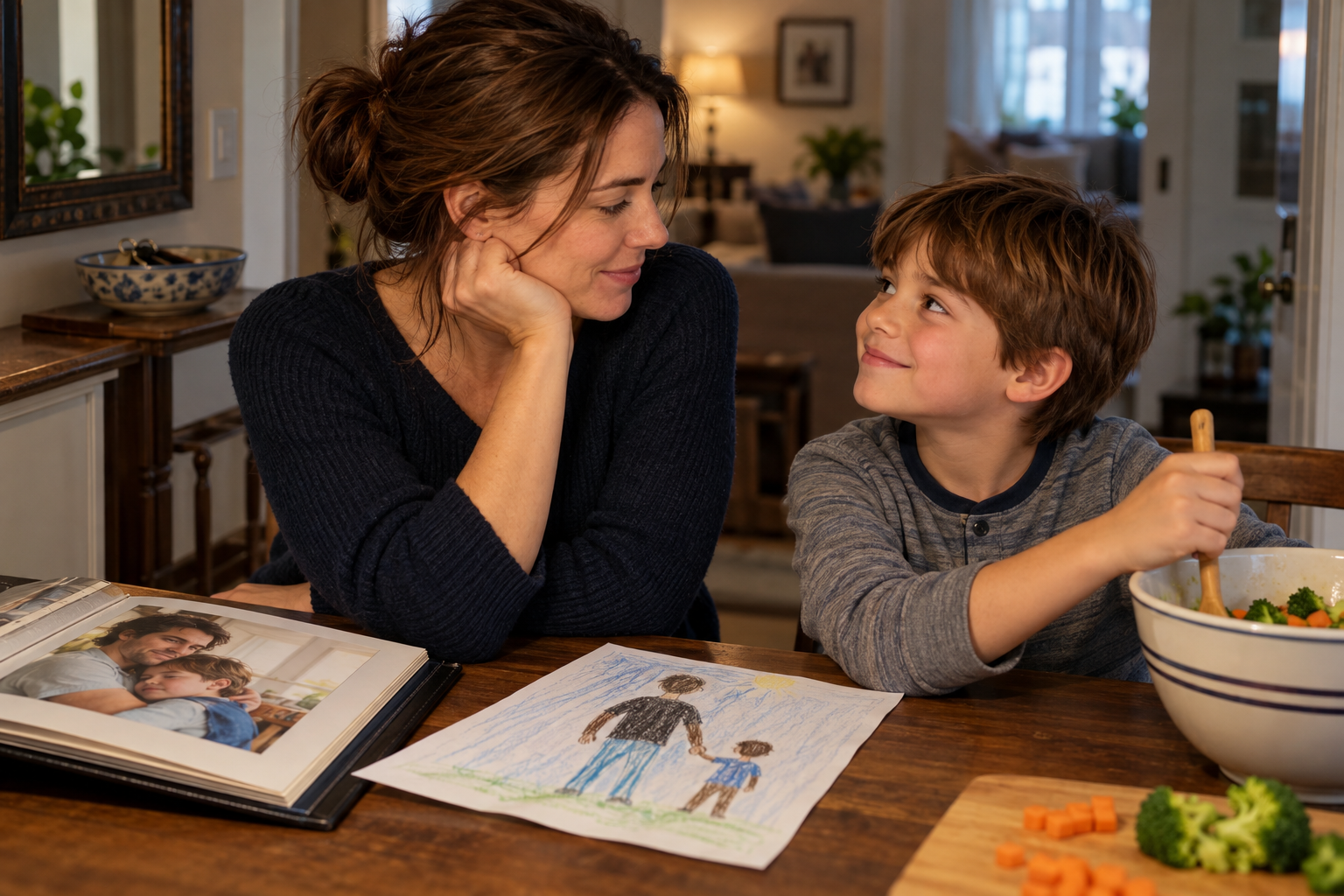
The next morning, Ethan came into the kitchen carrying his drawing from the school assignment.
He had made a small change.
The figure representing his father now had a hand extended toward the smaller figure.
“Why did you change it?” I asked before I could stop myself.
He looked at the paper.
“Because I remembered his hand better than his face.”
I felt the old urge to ask what he meant.
Instead, I waited.
He continued on his own.
“I can't remember what he was saying. I just remember holding his hand.”
I nodded.
“Thank you for telling me.”
He folded the paper and put it in his schoolbag.
Then he asked whether we had any more chocolate chips for Saturday's pancakes.
I told him I would check.
He went to find his shoes.
I stood at the counter with one hand resting on the edge.
His words had not explained the room.
They had not told me where it was or why he remembered the light.
They had not connected the memory to the envelope.
But they had given me a clearer understanding of what he was actually describing.
He remembered a feeling of safety.
He remembered his father's hand.
The rest was uncertain.
I could honor the part he remembered without insisting that he produce the part he did not.
That afternoon, the officer called again.
I was at home, and my mother was in the next room.
He asked whether anything had changed.
I said it had not.
He confirmed that we should continue to leave the envelope alone until further instructions.
I asked whether there was anything else I needed to know.
“Not at the moment,” he said.
I thanked him.
After the call, I put my phone on the table.
My mother came into the kitchen.
“Still waiting?”
“Yes.”
She pulled out a chair.
“Then we'll keep waiting.”
I sat opposite her.
“I used to think waiting meant I wasn't doing anything.”
“And now?”
“Now I think sometimes it means not doing the wrong thing just because I can't stand not knowing.”
She smiled.
“That sounds like progress.”
I laughed quietly.
“It doesn't feel like much.”
“Most progress doesn't announce itself.”
We sat together for a few minutes.
Then my mother stood up and asked whether I wanted help preparing dinner.
I said yes.
We chopped vegetables, washed a pan, and argued about whether we had enough potatoes.
It was an ordinary evening.
I did not need to pretend that the envelope had stopped worrying me.
I only needed to remember that worry was one part of my life, not the whole of it.
After dinner, Ethan brought his block room into the kitchen.
He wanted to show my mother how he had reinforced the floor.
She leaned down to inspect it.
“That's stronger than before.”
“I made it wider.”
“Good thinking.”
He looked at me.
“Can we keep it here overnight?”
“Of course.”
He placed it on the far end of the table, away from the dishes.
The small figure stood inside the room.
The doorway remained open.
I looked at the structure, then at Ethan.
He was pleased with what he had made.
He was not asking me to explain it.
I did not ask him to explain it either.
That night, I checked the doors and turned off the lights.
When I passed the front hall, I glanced at the envelope.
It was still there.
I no longer felt compelled to stand beside it.
I went upstairs and checked on Ethan.
He was asleep with the photograph of his father beside his pillow.
I adjusted the blanket around his shoulders and left the door slightly open.
Then I went to my own room.
I still did not know who had left the envelope.
I still did not know whether Ethan would remember anything else about the room.
And I still did not know why the barber had felt compelled to speak to me privately.
Those questions remained.
But they no longer seemed to require me to spend every waking hour trying to solve them.
I could wait for information without treating every quiet moment as a warning.
I could listen to Ethan without making him responsible for my fear.
I could remember his father without assuming that every incomplete memory concealed something terrible.
For that night, I let those truths be enough.
Click here to continue reading: PART 17: The Police Finally Gave Me Permission to Open the Envelope, and I Had to Decide What I Was Ready to Learn
The Barber Said Something About My Nine-Year-Old Son That I Could Not Explain, and Then a Familiar Name Changed Everything
Part 16 of 20