I had always known the trust was important.
My grandfather had explained it carefully when I was younger.
He wanted me to understand that receiving money was not the same as earning it, and inheriting something did not mean I could afford to stop thinking.
He had worked for what he owned.
He had made decisions, taken risks, and spent years building an estate he hoped would provide security for the people he loved.
He didn't want me to waste that work.
But he also didn't want me to live in fear of losing it.
That was why the trust existed.
Margaret had helped him establish it, and she had remained involved in managing the legal arrangements.
She knew what the documents said.
She knew which decisions belonged to me and which matters required careful review.
Most importantly, she knew that the money was not something I should use to solve an emotional problem.
I thought about that while sitting beside the window.
Fifteen million dollars was a large amount of money.
People could look at a figure like that and imagine it changed everything.
Sometimes it did.
It could provide choices that other people didn't have.
It could offer security, create opportunities, and make certain emergencies easier to survive.
But it couldn't make someone honest.
It couldn't make a person love you.
And it couldn't protect you from the pain of discovering that someone you trusted might not be who you thought.
I had learned that much before breakfast.
I called Margaret again because I wanted to make sure I understood the trust's position.
She answered without sounding impatient.
"Did something else happen?"
"No. I just want to be certain about a few things."
"All right."
I explained that I didn't want to make any changes to the arrangements.
I wasn't interested in transferring money, moving assets, or making a financial decision because I was angry with Carter.
I wanted everything to remain as it was while I worked out what I intended to do about the wedding.
Margaret agreed that this was sensible.
She reminded me that any future decision would need to be considered within the trust's actual terms.
There was no need to rush.
That was all I wanted to hear.
I didn't need a complicated strategy.
I needed to know that I wasn't required to make a decision about my inheritance simply because my personal life had become uncertain.
I thanked her.
Then I asked a question I had been avoiding.
"Did my grandfather ever tell you why he was so concerned about Carter?"
Margaret paused.
"He discussed his concerns with me, yes."
"What did he say?"
"He wanted you to be certain that Carter respected you as a person, independent of your inheritance."
I closed my eyes.
That sounded exactly like my grandfather.
He had never accused Carter of anything he couldn't prove.
He had never told me that I was forbidden to marry him.
He had simply wanted me to examine the relationship honestly.
"Did he think Carter was after the money?"
"I think he worried about the possibility. But I would be careful about turning his concern into a conclusion."
I nodded.
Again, she was right.
My grandfather's doubts were part of the history between us.
They were not proof of what Carter had done that morning.
I needed to remember that.
Still, hearing that my grandfather had shared those concerns with Margaret made the memory feel more serious.
I had thought his questions were personal opinions.
I had assumed they came from his instinct to protect me.
Perhaps they had.
But he had also been a man who understood business and the motives that could influence financial decisions.
He knew how to recognize when someone was asking questions for reasons that might not be obvious.
I had wanted to believe that Carter's interest in my inheritance was harmless.
I had wanted to believe that our future mattered more to him than any money I might receive.
Now I wasn't sure what to believe.
Margaret told me that I didn't have to settle the matter on the basis of old conversations.
I could consider what Carter had actually said and done.
I could ask questions when I was ready.
And I could make decisions based on what I learned.
That was the sensible approach.
I had not always been sensible where Carter was concerned.
I could admit that now.
I had defended him because I loved him.
I had dismissed concerns because I didn't want to imagine the possibility that our relationship was built on different expectations.
I had mistaken my willingness to trust him for proof that he deserved my trust.
Those were my mistakes.
They did not make me responsible for what had happened to my hair.
I wanted to be clear about that.
Trusting someone did not give that person permission to hurt me.
Loving someone did not make me responsible for their choices.
And agreeing to marry someone did not mean I had agreed to surrender my judgment.
I thanked Margaret and ended the call.
For several minutes, I sat without moving.
Then I noticed that I had been pressing my fingertips into my palm.
I released them.
My hands were still tense.
I took a slow breath and looked toward the dress.
It seemed strange that an object could carry so much expectation.
The dress itself had done nothing wrong.
Neither had the invitations, the arrangements, or the people who had planned to attend.
But I had begun to treat the wedding as though it were a promise I was obligated to keep regardless of what happened.
It wasn't.
A wedding was supposed to mark a decision two people made freely.
If I no longer felt able to make that decision, continuing simply because the plans were complete would have been dishonest.
I didn't yet know whether I would cancel.
I wasn't ready to make that declaration.
But I was ready to stop treating cancellation as an unthinkable failure.
That was progress.
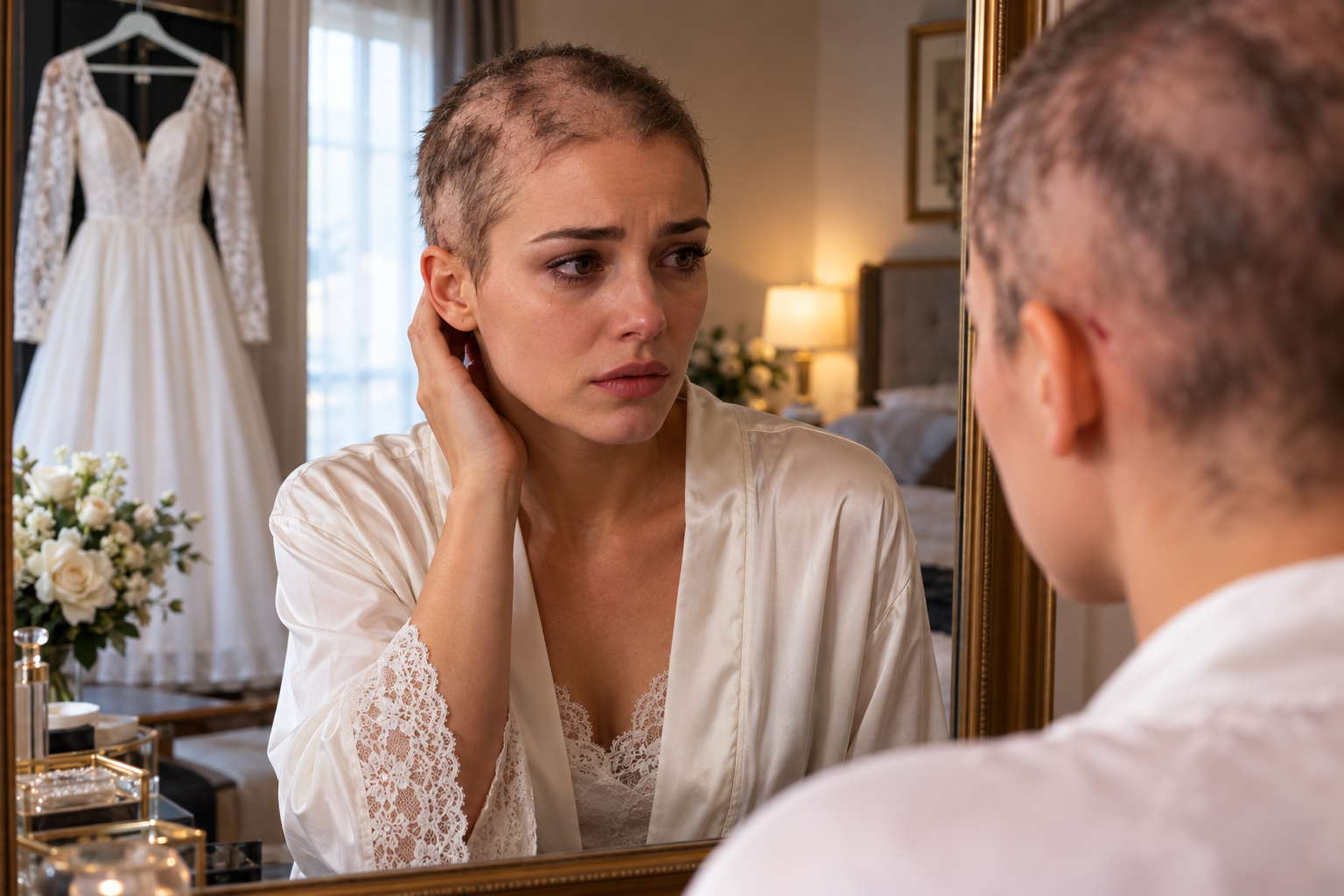
I stood up and went to the mirror.
My reflection looked back at me without offering any answers.
I almost laughed at the absurdity of expecting it to.
A mirror could show me what I looked like.
It could not tell me who had done this.
It could not explain Carter's motives.
And it could not decide whether I should marry him.
Those questions belonged to me.
I ran my fingers lightly over my scalp.
The stubble felt rough.
I remembered how Carter used to say he loved my hair.
I had once taken those words as a compliment.
Now they reminded me that a person's affection could become confusing when it seemed tied to a particular version of you.
I didn't know whether Carter had any part in what happened.
I refused to pretend I did.
But I also refused to ignore the possibility simply because it was painful.
I stepped away from the mirror.
My grandfather's advice returned to me once more.
He had wanted me to distinguish between love and the desire to benefit from someone else's life.
At the time, I had assumed that warning applied mainly to money.
Now I understood that it applied to choices, too.
Someone who truly respected me would not need me to abandon my judgment to prove my affection.
Someone who cared about my future would not expect me to risk my security merely to preserve his comfort.
And someone who wanted a marriage built on trust would have to accept that trust was something we both needed to protect.
I wasn't going to decide Carter's character based on a single suspicion.
But I was going to stop ignoring the questions that suspicion had raised.
I returned to my phone.
There was still no conversation that settled anything.
I placed it beside me and looked out the window.
The morning continued.
The world outside did not know that I was questioning my engagement.
It did not know that my hair had been removed while I slept.
It did not know that the fifteen million dollars my grandfather had left me had suddenly become part of a much larger question about trust.
But I knew.
And I was finally willing to face what I knew without rushing to protect the future I had imagined.
The trust would remain untouched.
My decisions would remain my own.
And the next step would be taken because I believed it was right, not because I was afraid of what other people might think.
Click here to continue reading: PART 7: I Had Spent Months Preparing to Become Carter’s Wife, but Sitting Alone With My Grandfather’s Advice Made Me Question What I Was Really Promising
I Opened My Eyes on the Morning of My Wedding and Discovered That Someone Had Taken Away the One Thing My Fiancé Loved Most About Me
Part 6 of 20