I called Rosella's older son on Monday afternoon.
I had thought about the conversation for two days.
I did not want to sound as though I were announcing a victory.
There had been no victory.
There was only more information.
When he answered, I asked whether he had a few minutes to talk.
"Yes. What's happened?"
"I received the additional filing from the courthouse and reviewed it with the attorney."
He became quiet.
"What did it say?"
I took a breath.
"It confirmed that the older records are connected and that my name was included deliberately. But the attorney has not said that I own the property."
He did not speak for several seconds.
Then he asked, "What does included deliberately mean?"
"It means the name appears to be part of the recorded arrangement, not just a mistake in copying the entry. The legal effect still needs to be established."
"So you still don't know what you have."
"That's correct."
He let out a long breath.
"I don't understand why Mother would do something like that without telling us."
"I don't understand it either."
"Did she tell you anything about it?"
"No. She asked me about my living situation years ago, but she never explained why."
I told him about the conversation I remembered, when Rosella had asked whether I wanted a home of my own.
I also told him that he had recently remembered her asking him about my living situation.
"I thought she was making conversation," he said.
"So did I."
"Did the attorney say you might own the house?"
"He said we need to review the remaining records before reaching a conclusion."
The silence that followed was not angry.
It was heavy.
I could imagine him sitting at a table somewhere, trying to fit the new information into what he had believed about his mother's plans.
I understood the difficulty.
He had grown up knowing the farmhouse as his family's property.
I had known it as the place where I worked.
Neither of us had expected to see my name in the deed book.
"What happens now?" he asked.
"The attorney is checking the remaining property records and the estate documents."
"Will you send us copies?"
I thought carefully before answering.
"I can discuss that with the attorney. I want to make sure I understand what each document means before I describe it to anyone."
He seemed dissatisfied.
"You're making this sound very complicated."
"I know it is complicated."
"Mother never said anything about giving you land."
"I have not said she gave me land."
He fell silent.
I continued gently.
"I don't want to take something that belongs to you or your brother. But I also can't pretend the records don't exist. I need to understand why my name is there."
He did not answer right away.
When he finally spoke, his voice had softened.
"I suppose I can understand that."
I had not expected him to agree so quickly.
I did not assume the conversation had settled our differences.
But I was grateful that we could speak without accusing each other.
He told me he and his brother had found a few more papers while sorting through the cabinet.
They had not yet checked every reference.
He offered to send me a list of the dates and numbers they had found.
I told him that would be helpful.
"If any match the records I've already requested, I'll let you know," I said.
"All right."
Before we hung up, he asked whether I remembered Rosella speaking about the creek fields.
I thought for a moment.
"She sometimes talked about keeping the land together. She didn't like the idea of people cutting up the property without thinking about what would happen afterward."
"She said that to us, too."
"Did she explain why?"
"Not really. She said the land had been in the family a long time."
I wrote that down after the call.
The memory did not explain my name in the deed book.
It did, however, show that Rosella had thought about the future of the land.
I wondered whether her arrangement had been intended to protect the property in some way.
I also reminded myself that this was only a possibility.
I could not use one remembered conversation to fill in the missing terms of a legal document.
That evening, Rosella's friend came by for tea.
I had invited her because I wanted to talk without using the telephone.
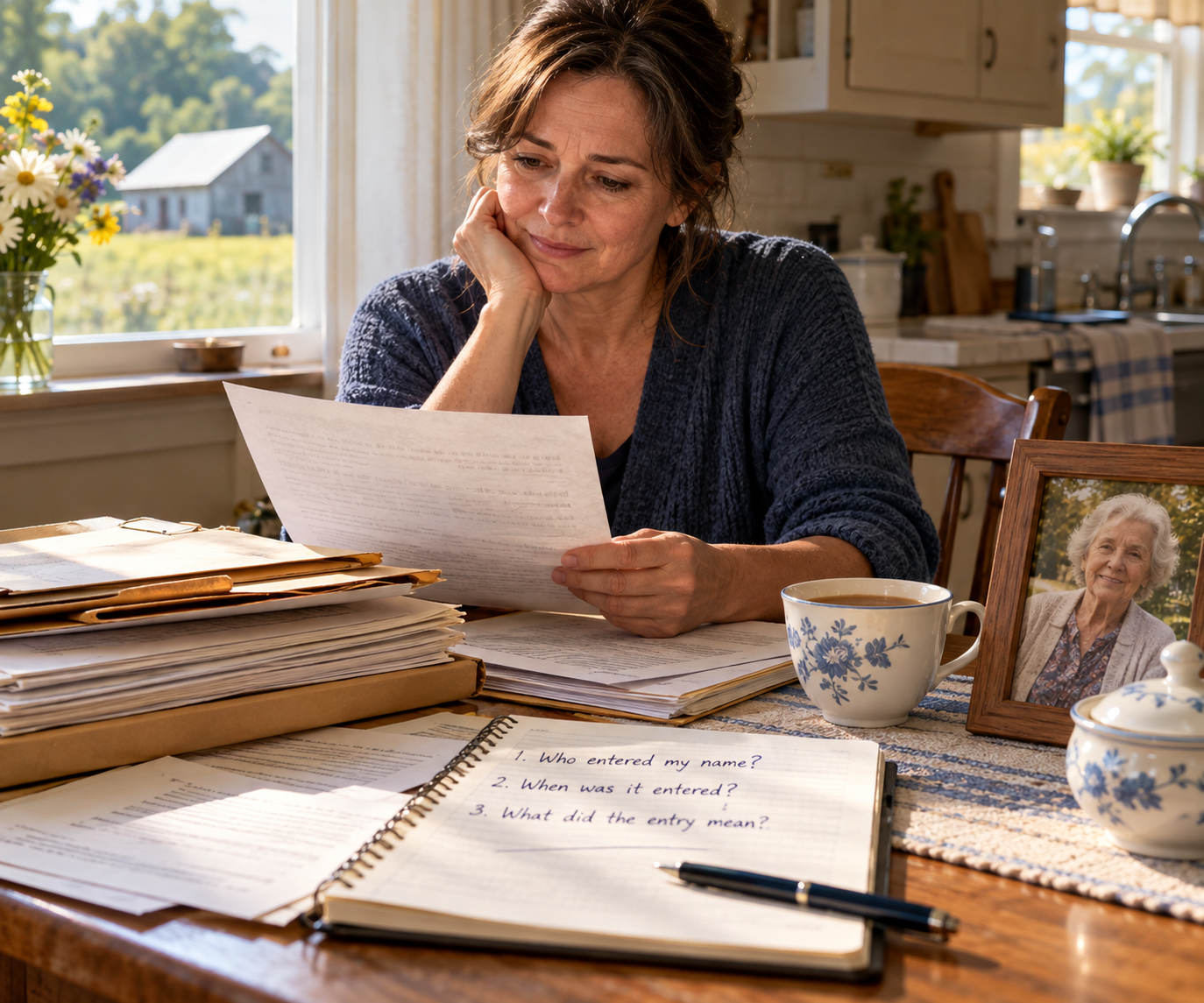
She sat at the kitchen table and looked at the folder beside my notebook.
"Has anything changed?" she asked.
"I understand more than I did, but I still don't know what the final answer will be."
I told her about the call with Rosella's son.
She listened while I described his questions and my answers.
"That sounds better than the last conversation you had," she said.
"It was."
"Did you feel you had to defend yourself?"
"Not as much."
I stirred my tea.
"I think he is frightened that his mother did something he doesn't understand. I feel the same way."
She nodded.
"People can be afraid for different reasons and still need the same facts."
I looked at her.
"Do you think Rosella meant to give me the house?"
She set down her cup.
"I don't know."
I waited, hoping she might add something.
She did not.
Instead, she asked me what the attorney had actually said.
I repeated the explanation.
She listened carefully, then nodded.
"Then that's what you should hold on to for now."
I felt disappointed, though I knew she was right.
I had spent weeks looking for an answer that would make the uncertainty stop.
But the answer could not be forced.
We talked about Rosella for a while.
Her friend remembered the way Rosella used to keep the porch swept even when nobody was expected to visit.
She remembered how Rosella would send food home with someone who had mentioned being short on groceries.
She also remembered how stubborn Rosella could be when she had made up her mind.
I laughed at that.
"She could be very stubborn."
"You know she once refused to replace a kitchen chair because she said the old one still had years left in it?"
I smiled.
"I remember that chair. I had to tighten one of the screws every few months."
"She said it was perfectly good."
"It was perfectly good after I fixed it."
We both laughed.
For a moment, I felt as if Rosella were still part of an ordinary conversation rather than the center of a legal question.
That helped.
When my friend left, I cleared the cups and washed them.
Then I sat at the table with my notebook.
I wrote down the new memory about Rosella wanting to keep the land together.
I marked it as a recollection, not a fact about the legal arrangement.
I was learning to separate what I remembered from what the records established.
The distinction was not always easy.
Memories came with feelings attached.
A sentence spoken years earlier could sound more important after a person died.
I did not want to turn every ordinary moment into a secret message.
Rosella had been a private woman.
She might have been planning something.
She might have been asking questions without any specific plan.
I needed to let the records tell me what they could.
The following day, Mr. Harris called to confirm that the remaining requests were still in progress.
He had received the photograph and copies of the documents.
He told me that the next review would focus on whether later filings affected the arrangement.
He also reminded me not to describe the property as mine until we had a clear legal basis for doing so.
I agreed.
After the call, I wrote the reminder in my notebook.
Then I added another sentence.
I can be honest about uncertainty.
That was something I had not understood when I first found my name in the book.
I had thought I needed an answer before I could speak to Rosella's family.
Now I knew I could tell them exactly what I knew and exactly what I did not.
I could say that my name had been included deliberately.
I could say the records were connected.
I could say the legal effect remained under review.
Those statements were not dramatic.
They were true.
That evening, I placed the notebook in the drawer with the documents.
I did not feel certain about the future.
But I no longer felt that I had to choose between protecting Rosella's memory and asking what she had done.
If she had made an arrangement involving me, understanding it properly was not an insult to her.
If the records turned out to give me no rights to the property, I would accept that too.
I wanted the truth more than I wanted a particular answer.
It was the first time I could say that without feeling as though I were trying to convince myself.
Click here to continue reading: PART 20: The Final Records Changed What I Thought Rosella Had Left Me, and I Learned That Her Gift Was More Complicated Than a House
I Spent Twenty-Six Years Cleaning a Wealthy Woman’s Home Without Knowing Why She Never Let Me Leave It Behind
Part 19 of 20