The following morning, I returned to the farmhouse in my memory before I even left my bed.
I could picture the kitchen.
The long counter.
The sink beneath the window.
The sugar jar beside the stove.
I could see Rosella standing near the doorway, watching me straighten something that did not need straightening.
I had dismissed that moment as ordinary.
Now it seemed to belong to a conversation we had never finished.
I got dressed and made myself breakfast.
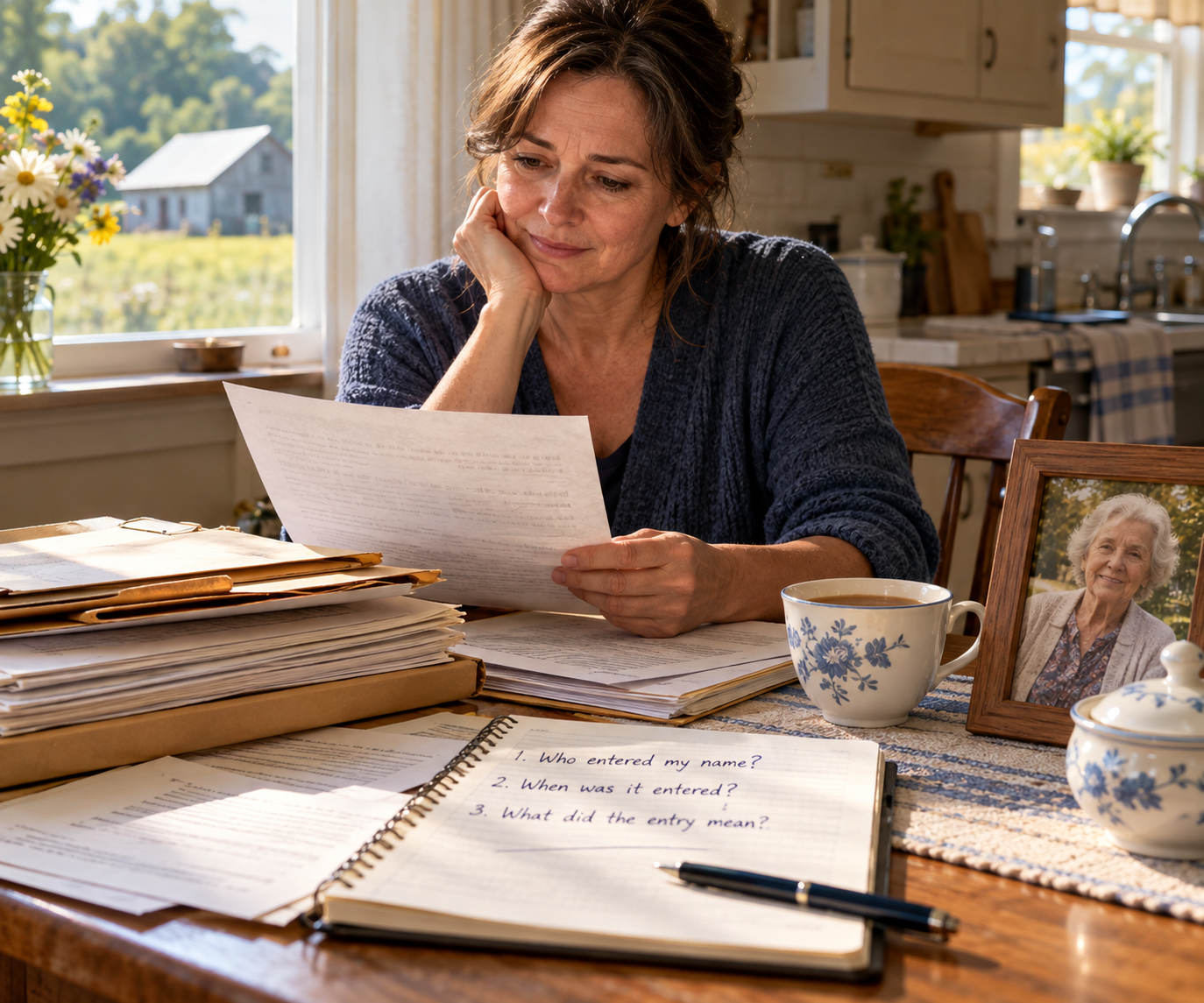
Then I took out the notebook I had started the day before.
I read through my notes slowly.
The questions Rosella had asked me stood out.
Had I ever found a place that felt permanent?
Had I lived anywhere long enough to call it home?
At the time, I had answered honestly.
I had moved through life trying to keep a roof over my head.
I had never expected a wealthy woman to care whether I felt settled.
But Rosella had asked more than once.
She had listened closely.
And she had sometimes looked at me as though my answers meant something beyond the conversation.
I could not tell whether those memories were helping me or making me imagine connections that were not there.
I wrote another note.
Then I stopped.
There was only so much I could learn by replaying conversations in my head.
If I wanted answers, I needed to keep working from what I actually knew.
The courthouse record was real.
The land description was clear.
Rosella had spoken about explaining something important.
Her sons had reacted strangely when I mentioned the courthouse.
Those were the facts.
Everything else was a question.
I reminded myself of that whenever my thoughts began running ahead.
Later that day, I met Rosella's friend again.
She asked whether I had remembered anything new.
I told her about the sitting room and the folder.
I also told her about the way Rosella's sons had behaved when they discussed the land.
She listened carefully.
"Did Rosella ever tell you what she wanted done with the property?"
"She said she wasn't ready to sell it."
"Did she explain why?"
"No."
I paused.
"She never really explained anything about the land. Not to me."
Her friend nodded.
We sat quietly for a moment.
Then she asked whether I remembered Rosella speaking about the future.
I thought about it.
She had talked about the house needing repairs.
She had worried about the fields.
She had mentioned the pecan trees and the old pike.
But she had never told me what she expected to happen after her death.
I said so.
Her friend closed the notebook.
"We should not assume that the record tells the whole story."
"I know."
"And we should not assume it tells us nothing."
I looked at her.
That was the first thing anyone had said that made the situation feel manageable.
We did not have to choose between believing the record explained everything and pretending it meant nothing.
We could keep looking.
That evening, I found myself thinking about the years I had worked for Rosella.
There had been difficult days.
There had been mornings when I arrived tired and left more tired.
There had been times when her expectations seemed unreasonable.
I was not going to pretend that every day had been pleasant simply because she was gone.
But she had paid me fairly.
She had treated me with more respect than some people had.
And when she asked me personal questions, she did not make me feel ashamed of my answers.
I owed her honesty.
That included admitting that I had sometimes resented her.
I had envied the ease with which she could afford things I had to save for.
I had watched her sons arrive in expensive cars while I calculated whether I could afford a repair at home.
I had wondered what it would be like to live without worrying about every bill.
That was human.
But I had never believed her money belonged to me.
I had never looked at the farmhouse and thought of it as something I should receive.
That was why the record frightened me.
It threatened to change how I understood the years behind me.
If Rosella had intended to leave me something, why had she waited?
If the entry had another explanation, why had she never mentioned it?
And if she had known that her sons would react badly, had she been trying to protect me by staying silent?
I had no answers.
I could only keep asking the questions.
A few days later, I passed the farmhouse again.
This time, I saw one of Rosella's sons near the drive.
He was standing beside a vehicle, looking toward the house.
I considered driving on without stopping.
Then he noticed me.
He raised a hand, not quite a greeting and not quite a warning.
I slowed down.
He approached the roadside.
"Have you been talking to someone about the property?"
His question was direct.
I felt my stomach tighten.
"I've been trying to understand a record."
"What record?"
"The one at the courthouse."
His face changed.
Only slightly.
But I saw it.
He looked toward the house before returning his attention to me.
"There's no reason for you to get involved in family matters."
I kept my hands on the steering wheel.
"I'm not trying to interfere."
"Then don't."
I could have argued.
I could have told him that I had spent twenty-six years working for his mother and deserved at least the courtesy of a proper answer.
But I knew that anger would not help me understand anything.
So I said nothing.
He stepped back.
I drove away.
For several minutes, I could not think about anything except his expression.
He had not asked what I had seen.
He had not asked whether the record was clear.
He had simply told me to stop looking.
I could not know why.
Maybe he believed I was misunderstanding something harmless.
Maybe he was tired of dealing with his mother's affairs.
Maybe he was worried that I would make a claim against the estate.
I did not know.
I had to be honest about that.
Still, his reaction left me more certain that I needed to understand the record properly.
When I reached home, I called Rosella's friend.
I told her what had happened.
She did not sound surprised.
She asked whether I had made any accusations.
I said I had not.
"Good," she replied. "Keep it that way until we know what we're dealing with."
I promised I would.
That night, I put my notebook beside the sugar bowl on my own kitchen table.
I looked at the two objects for a long time.
The sugar bowl belonged to me.
The notebook held my questions.
Neither could give me the answer I wanted.
But I was beginning to understand something about myself.
For years, I had confused silence with safety.
I had believed that if I stayed out of the way, no one could accuse me of asking for too much.
Now I was learning that silence could leave a person trapped inside someone else's version of events.
I did not want to make that mistake again.
Click here to continue reading: PART 7: I Had Never Asked Rosella for a Single Thing Beyond My Wages, Yet Her Son’s Warning Made Me Wonder What He Feared I Might Find
I Spent Twenty-Six Years Cleaning a Wealthy Woman’s Home Without Knowing Why She Never Let Me Leave It Behind
Part 6 of 20