Mr. Harris returned my call the following morning.
I had left the photograph of Rosella's handwritten reference open on my phone so I could read the numbers without making a mistake.
When he asked me to describe the page, I read the date and reference number aloud.
He asked me to repeat them.
I did.
"That gives us another place to look," he said.
"Do you think it is connected to the other documents?"
"It appears worth investigating. I wouldn't want to tell you more until we locate the filing."
I wrote that down.
I was beginning to appreciate the difference between a promising lead and an answer.
For weeks, I had wanted someone to tell me what Rosella had intended.
Now I understood that no one could do that responsibly without examining the records.
Mr. Harris told me which office to contact and what information to provide.
He also asked me to send him the photograph so he could compare the reference with the documents already in his file.
I sent it after we ended the call.
Then I checked the image to make sure the writing was clear.
Rosella's handwriting had always been easy for me to recognize.
She wrote her grocery lists in small letters, with the items arranged in a straight column.
When she left instructions for me, she rarely used more words than necessary.
The note in the folder had that same neat appearance.
It was not addressed to me.
It did not explain anything about the deed.
Still, it had helped us identify another record.
I called the courthouse and gave the clerk the reference number.
She searched the index while I waited.
I could hear her typing through the telephone.
After a few minutes, she asked me to confirm the date again.
I checked my notebook.
"Yes, that's correct."
She told me the filing appeared in the older records but would need to be retrieved before a copy could be issued.
I asked how long that might take.
She gave me an estimate and explained that the original was not kept in the same office as the more recent records.
I thanked her and wrote down the expected time.
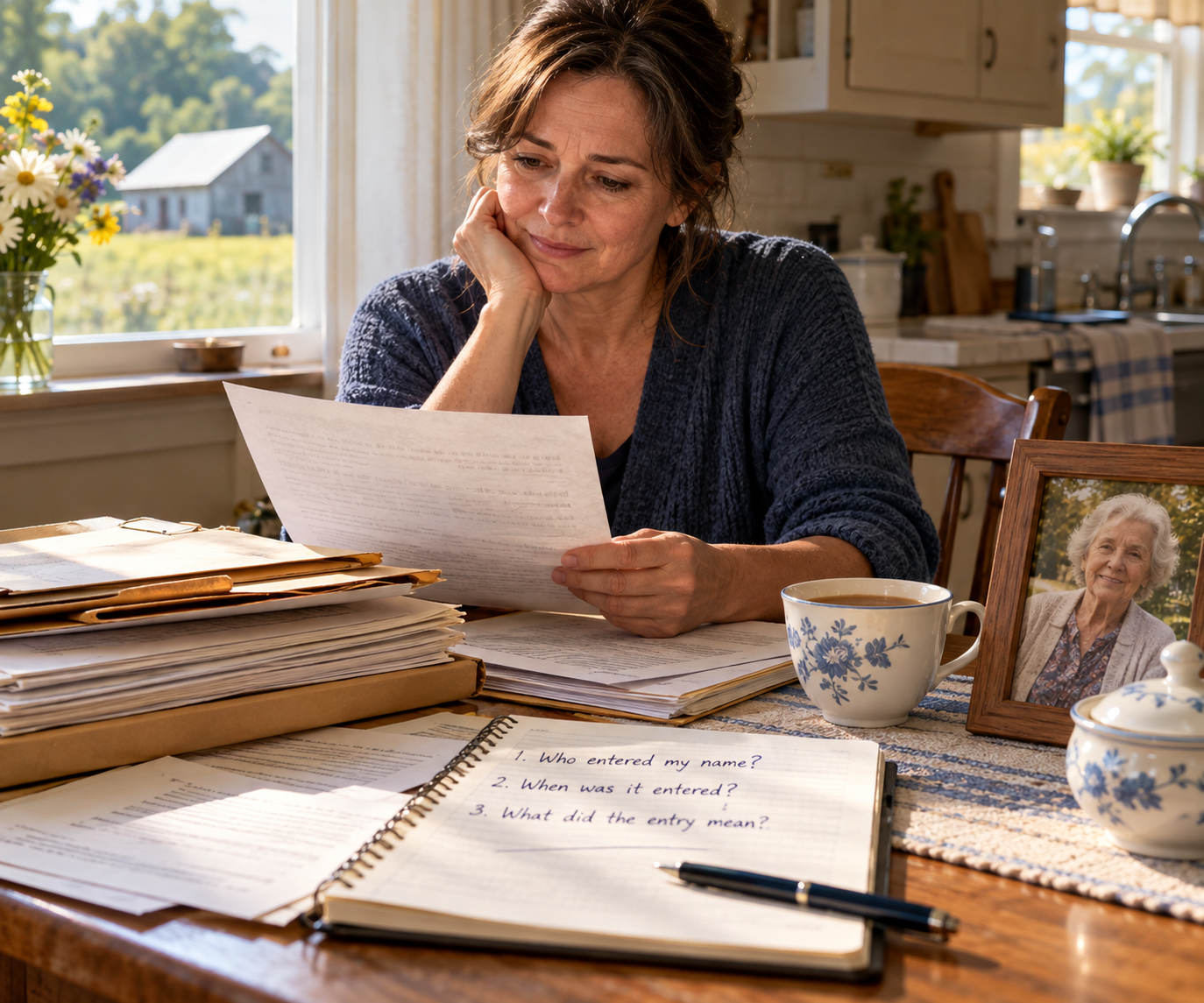
After hanging up, I sat at the kitchen table and looked at the three questions I had written at the beginning of this process.
Who entered my name?
When was it entered?
What did the entry mean?
The first question remained unanswered.
The second had become clearer.
The third still sat between me and everything else.
I did not cross any of them off.
Instead, I added the new reference number beneath them.
For the rest of the morning, I tried to concentrate on ordinary work.
I washed the kitchen floor.
I changed the towel in the bathroom.
I carried a bag of rubbish to the bin outside.
When I returned, I noticed that the sugar bowl had been left near the edge of the table.
I moved it to the counter.
The small movement brought back the kitchen at Rosella's farmhouse.
I could see her standing beside the stove, one hand resting on the counter while she looked through a stack of papers.
She had sometimes stopped when I entered the room.
Then she would fold the paper she was reading and put it away.
I had assumed she simply wanted privacy.
I had never asked what she was reading.
There was nothing wrong with that.
I had been there to work, not to examine her personal affairs.
But I wondered whether the papers I remembered had included the same references we were now trying to locate.
I wrote the memory down without giving it a meaning.
That afternoon, Rosella's older son called.
He said he had spoken with his brother about the folder we had examined.
They had agreed to look through the remaining boxes and identify any other property references.
"Have you found anything else?" I asked.
"Not yet. There are more papers in the cabinet."
"Are you comfortable with me helping again if you find something connected to the records?"
He took a moment to answer.
"I think so. We'll need to talk about it first."
"Of course."
He said he had also written down the reference number I had given him during our earlier call.
He intended to ask the courthouse whether it appeared in the records connected to their mother's estate.
I told him that sounded reasonable.
We did not discuss ownership.
Neither of us knew enough to do that.
Before we ended the call, he said something that stayed with me.
"Mother could be difficult to understand when she wanted to keep something private."
I smiled sadly.
"She could."
"Did she ever tell you why she kept asking whether you wanted a home of your own?"
The question caught me off guard.
"No," I said. "She asked me about it more than once, but she never explained why."
"She asked me about your living situation, too."
I sat still.
"When?"
"I don't remember the exact year. It was a long time ago. She asked whether you still rented that place near town."
"What did you tell her?"
"That I thought you did."
I looked toward the window.
Rosella had asked me about my home years before I saw my name in the deed book.
Now her son remembered her asking him about the same subject.
It was not proof of an arrangement.
But it was another memory that could be checked against the timeline.
"Did she say why she was asking?" I asked.
"No. I thought she was just making conversation."
I understood that.
I had thought the same thing.
"Thank you for telling me," I said.
He sounded tired when he answered.
"I wish I knew what she was planning."
"So do I."
After we hung up, I wrote down his recollection.
I marked it as something he remembered, not as proof of what Rosella intended.
I wanted to be fair to him and to myself.
A memory could be sincere and still be incomplete.
The following day, I received a message from Mr. Harris.
He had reviewed the photograph and confirmed that the reference was consistent with an older filing.
He said we should wait for the official copy before drawing conclusions.
I read the message twice.
Then I put my phone down.
The words were not exciting.
They were useful.
That evening, I went for a short walk around the neighborhood.
The air was cool, and the streets were quiet.
I passed the small houses with their porch lights coming on one by one.
For years, I had believed that owning a home was something I might never manage.
I had not needed a large house.
I had wanted a place where I could paint a room when I pleased, plant flowers beside the steps, and know that I would not have to move because a landlord changed his plans.
Rosella had known that.
She had seen how carefully I counted my money.
She had heard me talk about repairs I could not afford.
She had watched me work for years without taking a day off unless I truly needed one.
Perhaps she had wanted to help.
Perhaps she had simply been concerned.
I could not decide.
When I returned home, I warmed a bowl of soup and ate at the kitchen table.
Then I opened my notebook and read the latest entries.
I noticed that the pages no longer contained only questions.
They contained dates, references, and names of offices.
They contained things I could verify.
That mattered more than I had realized.
I had started this process frightened that I might be doing something wrong.
Now I understood that asking for public records and seeking professional advice were ordinary ways to find out what had happened.
I was not accusing anyone.
I was not promising myself a house.
I was trying to understand a document that carried my name.
Before bed, I placed the notebook beside the folder.
The next step was clear.
Wait for the filing.
Read it with Mr. Harris.
Then decide what needed to happen.
I could not make the answer come sooner by worrying about it.
So I turned off the light and let the day end.
Click here to continue reading: PART 18: The Missing Filing Explained the Shape of Rosella’s Arrangement, but I Still Needed to Know What It Meant for Me
I Spent Twenty-Six Years Cleaning a Wealthy Woman’s Home Without Knowing Why She Never Let Me Leave It Behind
Part 17 of 20