I used to think the past was settled.
You remembered what happened.
You learned what you could from it.
Then you moved on.
That belief had helped me through years when I did not have the time or money to sit around wondering what might have been different.
But Rosella's death had left me with a question that would not stay in the past.
I had tried to put it aside.
I had tried to focus on ordinary responsibilities.
I had even told myself that the safest thing would be to accept that the record was beyond my understanding.
None of it worked.
Every time I thought about the farmhouse, I remembered the courthouse.
Every time I remembered Rosella, I wondered what she had wanted to explain.
I began to understand that I was not only looking for information about the land.
I was trying to make sense of twenty-six years of my life.
Had I been trusted with something I never knew existed?
Had Rosella planned to tell me and simply run out of time?
Or had I misunderstood the importance of her words because I had never imagined that they might concern me?
I could not answer any of those questions.
Still, I found myself remembering details I had once considered unimportant.
The way Rosella checked the front windows.
The way she kept her papers in a folder.
The way she stopped speaking when one of her sons entered the kitchen.
The way she asked whether I had ever found a place that felt permanent.
Perhaps those were ordinary habits.
Perhaps they meant nothing beyond what they appeared to mean.
I did not want to turn every memory into a clue simply because I was searching for an explanation.
But I could no longer ignore the possibility that Rosella had been trying to tell me something.
I called her friend and asked whether she would meet me again.
She agreed.
We sat together for a long time, talking through the facts.
I told her that I had never expected to receive anything from Rosella.
I said it plainly because I wanted her to understand.
"I worked for my wages. That's all I ever asked for."
She nodded.
"I believe you."
"I don't want her sons thinking I'm trying to take something from them."
"Then don't let their assumptions decide what you do."
I looked down at my hands.
I had spent years worrying about how other people might judge me.
It was a habit I had mistaken for good manners.
Rosella's friend reminded me that asking a question was not the same as making a claim.
That distinction gave me some peace.
We decided to keep the courthouse record at the center of our attention.
We would not invent an explanation.
We would not assume that Rosella's sons were hiding something simply because they seemed uncomfortable.
We would also not ignore the fact that the record existed.
I felt better having a plan, even if it was only a small one.
After the meeting, I drove home by a different route.
I passed shops I had visited for years.
I passed a grocery store where I knew the price of almost everything.
I passed a stretch of road where I had once stopped to change a flat tire after leaving Rosella's house late in the evening.
The memories came without effort.
Twenty-six years was a long time.
The farmhouse had been part of my life through sickness, financial trouble, lonely holidays, and ordinary days when nothing happened at all.
I had watched the seasons change from its kitchen windows.
I had heard Rosella complain about the cold.
I had watched her sons come and go.
I had worked through days when I wanted to quit and others when I felt grateful to have a place where my work mattered.
The house was not mine.
I had never believed it was.
But my life had been tied to it in ways I had not understood until it was too late to ask Rosella directly.
When I arrived home, I put the kettle on.
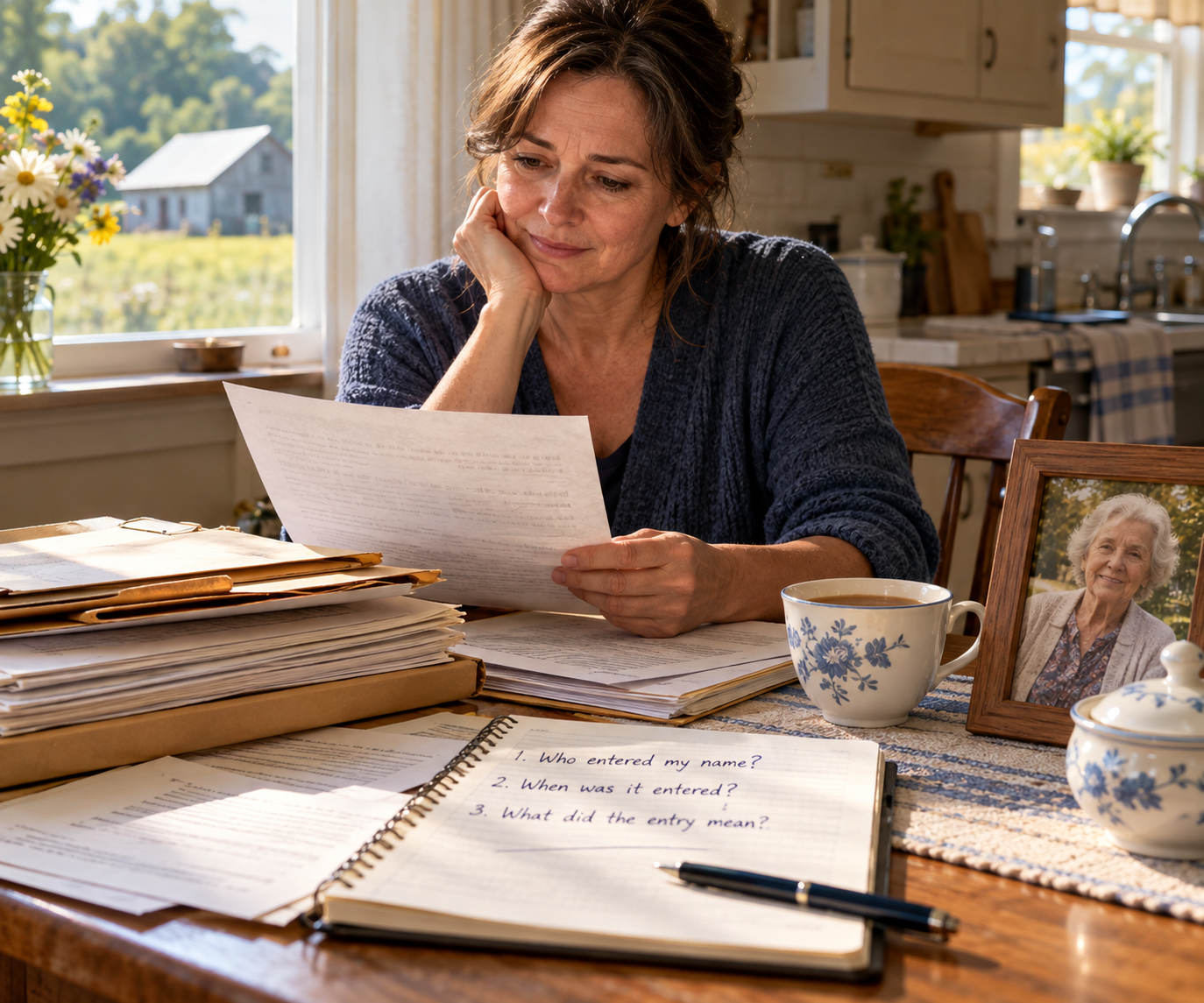
I took out the notebook.
Then I wrote a sentence I had been avoiding.
I wished I had asked Rosella what she meant.
I stared at it until the words blurred.
There was no point pretending otherwise.
I had been afraid of losing my job.
I had been afraid of appearing nosy.
I had been afraid that asking a personal question would make Rosella think I had forgotten my place.
Those fears had kept me quiet.
Now I was left to wonder whether one honest conversation might have spared me weeks of uncertainty.
I could not change that.
I could only decide what to do now.
The next day, I called Rosella's friend and told her I wanted to continue examining the record.
She agreed.
I did not feel brave.
I felt tired and uncertain.
But I was no longer willing to let fear make the decision for me.
Before we ended the call, she reminded me that we still did not know what the record meant.
I told her I understood.
That evening, I sat at my kitchen table with my notebook open and the sugar bowl beside it.
I thought of Rosella's kitchen and the jar that had stood near her stove for so many years.
I remembered straightening it while she watched.
At the time, I had believed she was simply checking my work.
Now I wondered whether she had been thinking about something else entirely.
I would never know what had passed through her mind that day.
But I could honor the trust she had shown me by being careful with what I discovered.
I would not claim more than I knew.
I would not let anyone frighten me away from asking reasonable questions.
And I would not pretend that the woman I had worked for all those years had left no unfinished business behind.
The record remained where we had found it.
My name remained on the page.
Whatever it meant, I could not make it disappear by looking away.
For twenty-six years, I had believed my connection to Rosella's house began and ended with the work I did there.
Now I understood that the story was not finished.
I just did not yet know what the next page would say.
Click here to continue reading: PART 9: I Returned to the Courthouse With My Questions Written Down, Determined to Learn Why Rosella Had Put My Name Beside Her Land
I Spent Twenty-Six Years Cleaning a Wealthy Woman’s Home Without Knowing Why She Never Let Me Leave It Behind
Part 8 of 20