I spent the next several days trying not to think about Rosella's son.
That was easier said than done.
His warning had been brief.
He had not shouted.
He had not threatened me directly.
But he had made it clear that he did not want me asking questions about the property.
I could not pretend I had misunderstood him.
I also could not pretend I knew why he had reacted that way.
I kept returning to the same question.
What did he think I was going to find?
I had no intention of fighting with Rosella's family.
I did not want their money.
I did not want to create trouble.
I wanted to know why my name appeared in the courthouse record.
That seemed like a reasonable request.
Still, I worried that even asking it might make me look greedy.
I had spent my whole life trying not to be mistaken for someone who wanted more than she had earned.
The thought made me angry with myself.
I had not created the record.
I had not placed my name in the book.
And I had not asked Rosella to leave me anything.
I was simply trying to understand what had happened.
One morning, Rosella's friend called to ask whether I was all right.
I told her I was.
She paused.
"You don't sound all right."
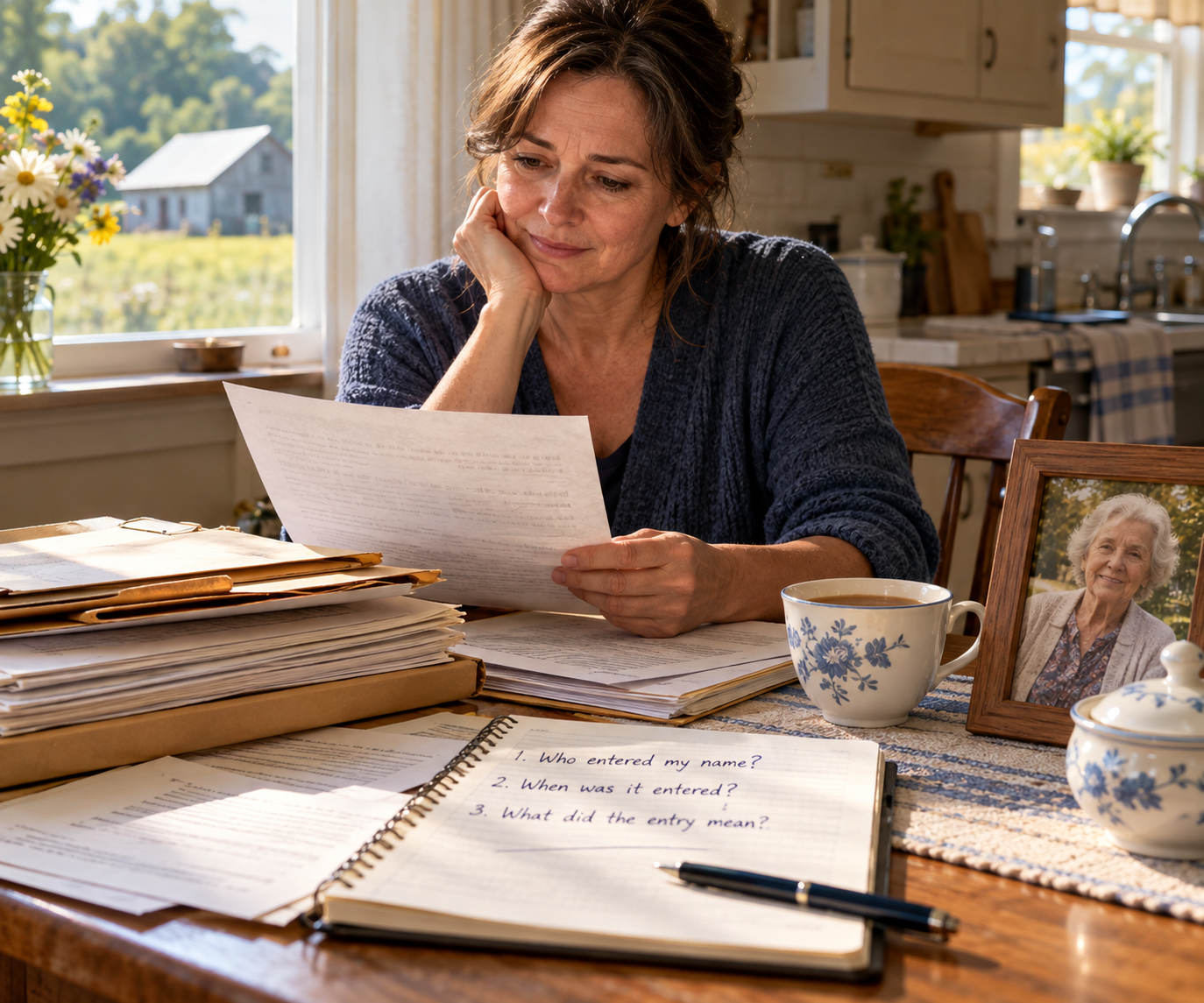
I looked down at the notebook beside my coffee.
"I don't know what I'm supposed to do with all this."
"You don't have to decide what it means before we know what it means."
I had heard those words before, but I needed to hear them again.
We agreed to meet.
When I arrived, she had written down the details we already knew.
The property description.
My full name.
The courthouse where we had found the entry.
She had also written down the questions we still could not answer.
I sat beside her and read the list.
It looked so small on paper.
My name.
A farmhouse.
A piece of land.
Yet those few details had turned my life upside down.
I asked whether Rosella had ever told her why she wanted me to remain at the farmhouse for so many years.
Her friend considered the question.
"Rosella trusted you."
"I know that."
"She trusted you with her home. She knew you would do what you said you would do."
I nodded.
That part was not difficult to believe.
But trust alone did not explain the record.
I asked whether Rosella had spoken about me in connection with the property.
Her friend looked down at the notebook.
"She spoke about you with care."
I waited for her to say more.
She did not.
I wanted to press her, but I could see she was choosing her words carefully.
Perhaps she knew more than she was ready to tell me.
Perhaps she was simply trying not to suggest something she could not prove.
I decided not to force the issue.
I had spent too many years listening to people talk around difficult matters.
I knew how little good it did to demand an answer before someone was ready to give one.
Instead, I asked what we should do next.
She said we needed to keep the facts separate from our suspicions.
I agreed.
We reviewed what we knew.
The record identified me by my full name.
The description matched Rosella's property.
Rosella had mentioned that there were things she needed to explain.
Her son had warned me to stay away from the matter.
None of those facts told us exactly what the record meant.
But together, they gave me enough reason not to dismiss it.
After our meeting, I went home and tried to return to ordinary routines.
I cleaned my kitchen.
I washed my clothes.
I paid a bill.
I called someone I had been meaning to call for weeks.
The ordinary tasks helped.
They reminded me that my life was still mine, even if I had stumbled into a question I did not know how to answer.
That afternoon, I found an old envelope in a drawer.
It contained a few notes from the years I had worked for Rosella.
Nothing important.
A reminder about a repair.
A list of supplies.
A date when she had asked me to come in early.
I sat on the floor and looked through them.
I had kept them because I was the kind of person who saved papers in case they became useful later.
Most of them had never been needed.
But seeing Rosella's handwriting brought back the sound of her voice.
She had been strict about some things.
She had also been fair.
I remembered how she thanked me when I stayed late.
I remembered how she sometimes asked me to sit down when I looked exhausted.
I remembered the folder in the sitting room.
That memory would not leave me alone.
I wondered whether it had contained the same information as the courthouse record.
I wondered whether her sons had seen it.
I wondered whether Rosella had intended to give it to me.
I stopped myself.
Those were questions, not facts.
I wrote them down anyway.
A few days later, I met Rosella's friend again.
She asked whether I had heard anything more from the family.
I told her I had not.
She said that might be for the best.
I looked at her.
"Do you think I should stop asking?"
She took a moment before answering.
"I think you should stop guessing. I don't think you should ignore what you saw."
That answer stayed with me.
I could not control what Rosella's sons thought of me.
I could control whether I acted carefully.
I could refuse to accuse anyone without evidence.
I could also refuse to pretend that the courthouse entry had never existed.
For the first time, those choices felt like two parts of the same decision rather than opposing ones.
I would keep looking.
I would not turn the search into a fight.
And I would not let embarrassment convince me that I had no right to understand a document bearing my own name.
That evening, I opened my notebook and read the first line I had written.
Elnora Ruthanne Whitsett.
I traced the letters with my eyes.
It was my name.
I had carried it all my life.
I had never imagined that seeing it in a book could make me feel so uncertain about who I was.
Click here to continue reading: PART 8: Rosella Had Given Me Twenty-Six Years of Work and Kindness, but the Question She Left Behind Was Beginning to Change Everything I Remembered
I Spent Twenty-Six Years Cleaning a Wealthy Woman’s Home Without Knowing Why She Never Let Me Leave It Behind
Part 7 of 20