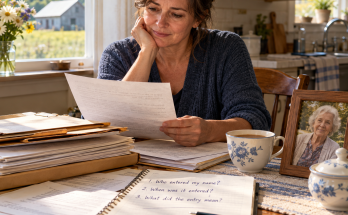
I returned home and placed my notebook beside the yellow folder.
I did not open the papers immediately.
Instead, I read through the notes from my meeting with Frank.
I wanted to separate what he had actually said from what I had thought he meant.
He had worked with my grandfather.
He had handled business matters.
He had access to some records.
He had seen my grandfather on the day he died.
He had discussed business with him.
And he had admitted that some transactions were difficult to explain.
Those statements were worth recording.
But they did not tell me what happened to my grandfather.
They did not prove Raymond's innocence.
They did not prove my father's guilt.
I wrote those limits at the bottom of the page.
Then I opened the folder.
I placed the property records on the left side of the table.
The handwritten notes went in the middle.
The remaining business documents went on the right.
I took the list of dates and names I had prepared earlier and began checking each entry.
The work was slow.
I found several references that appeared more than once.
Some related to transactions involving property.
Others concerned money moving between companies.
I marked the repeated names without drawing conclusions about them.
Frank had said that a name could appear for different reasons.
I needed to find out which reason applied to each entry.
I began with my father's name.
It appeared in records connected to the business, but none of the documents I had could establish exactly what he had approved or what he had known.
I wrote a question beside each reference.
What was his role?
What document explains this transaction?
Who else was involved?
I did the same with Frank's name.
Then I moved to my grandfather's entries.
His name appeared throughout the records.
That was hardly surprising.
He had owned or controlled the business, and he had made many of its decisions.
But some entries were accompanied by notes that referred to discussions or changes in arrangements.
Without the documents those notes referred to, I couldn't establish what had happened.
I began to see why Raymond had kept the papers.
They were not a complete explanation.
They were a collection of things that might lead to one.
I took out the folded handwritten note and placed it beside the records that carried similar dates.
The writing remained difficult to read.
I examined the page under the kitchen light.
There were no initials I could confidently identify.
No signature.
No clear statement of who had written it.
I turned it over.
The back was blank.
I had hoped that studying it more carefully would reveal something obvious.
It didn't.
I returned it to its place.
Then I checked the list of questions I had written after speaking to Frank.
One stood out.
Where were the original business records kept after my grandfather died?
Frank had said that some were kept at the factory.
He had also said that records could be moved, copied, or discarded.
He had not said that the original documents had been destroyed.
That distinction mattered.
I wrote down the exact question I wanted answered.
Were the original records from the factory preserved, transferred, or discarded after my grandfather's death?
I read it twice.
Then I called Raymond.
He answered quickly.
“How did it go with Frank?”
“He answered some questions.”
“Did he explain the transactions?”
“No.”
“Did he admit anything?”
“Not beyond what he told me about the business.”
Raymond was quiet.
“He admitted that he had seen Grandpa on the day he died,” I added.
“I knew he had seen him that day.”
“You knew?”
“I knew they had spoken. I didn't know exactly what they discussed.”
“Did you tell the police?”
“Yes.”
“What happened?”
“They asked me about the argument I had with your grandfather. They asked about the business. I told them what I remembered.”
“Did they ask about Frank?”
“They asked whether he had been involved in the business. I told them he was.”
“Did you tell them he had spoken to Grandpa that day?”
“Yes.”
I looked at my notes.
“Did they ask what he said?”
“They asked what I knew. I couldn't tell them what I hadn't heard.”
That answer made sense.
I had to keep reminding myself that knowing someone had spoken to my grandfather did not mean knowing what they had discussed.
“Raymond, did you ever see the original business records after the case?”
“Some.”
“Where?”
“In copies and documents that were available to me. I didn't have the whole set.”
“Did you see them at the factory?”
“I saw records there before the case.”
“Were they kept in an office?”
“Yes.”
“Do you remember where?”
“In the business office. There were cabinets and boxes of paperwork.”
“Do you know what happened to them?”
“No.”
I wrote down his answers.
Then I asked about the missing document.
“The record you thought might explain the transaction. Do you remember anything about it besides the date?”
Raymond thought for a moment.
“I remember that I believed it would help connect two entries.”
“What did it contain?”
“I can't remember enough to describe it accurately.”
“Could it have been a copy of another document?”
“Possibly.”
“Could it have been a note?”
“Possibly.”
I sighed.
“I'm sorry. I keep asking you to remember things you may not remember.”
“You don't need to apologize for asking.”
“But I want to be careful.”
“You should be.”
He paused.
“Just don't let the need to be careful stop you from asking the next question.”
I looked at the folder.
“I won't.”
After we hung up, I wrote down everything he had told me.
I did not write that he had proved anything.
I wrote that he remembered business records being kept at the factory and did not know what had happened to the complete set after the case.
It was not a dramatic discovery.
It was another piece of information that could be checked.
I began to understand how the past had become so difficult to examine.
Each person remembered a different part.
Each person had a different reason for not knowing the rest.
And the documents that might have connected those memories were incomplete.
The gaps did not automatically mean someone had deliberately removed information.
But they could not be ignored, either.
I went back to the property records.
One of the company names appeared beside an entry I had already marked.
I checked the date against the handwritten note.
They were close enough to deserve attention, but not close enough to establish a connection.
I wrote both dates in my notebook and added a question mark.
I wanted to compare them with the original records if I could find them.
That became the next task on my list.
I also wrote down the names of the people who had handled the business records.
My grandfather.
Frank.
My father.
Raymond.
I did not know whether anyone else had been involved in keeping them.
I left space beneath the list.
The more I examined the papers, the more I understood why a single person's memory could not settle the matter.
Raymond remembered what he had seen.
Frank remembered what he had discussed.
My father remembered whatever he had been willing to tell me.
The records contained information that none of them had fully explained.
I needed to keep all three sources separate until I could compare them.
Later that evening, my father called again.
I considered ignoring the call.
Then I answered.
“David.”
“Dad.”
“Have you spoken to Frank?”
I looked at my notebook.
“Yes.”
He was silent for a moment.
“What did he tell you?”
“That he worked with Grandpa, handled business matters, and saw him on the day he died.”
My father breathed out.
“Frank has been involved in this family for a long time.”
“I know.”
“He understands things you don't.”
“Then why won't he explain them?”
“Because you're asking questions about a time you weren't there to witness.”
“I understand that. But he was there.”
My father said nothing.
I continued.
“He told me that some transactions were difficult to explain.”
“That doesn't mean anything was wrong.”
“I didn't say it did.”
“You're treating every uncertainty as if it proves something.”
“No. I'm writing down the uncertainties so I can find out what they mean.”
He was quiet again.
For once, I felt no need to fill the silence.
Finally, he said, “You should leave this alone.”
“I can't do that.”
“You don't know what you're getting into.”
“Then tell me what I need to know.”
He ended the call.
I sat very still.
The conversation had not given me new information about the records.
It had given me another example of my father refusing to discuss them.
I wrote that down, too.
Then I stopped.
I had enough notes for one evening.
I placed the pages in the notebook and returned the papers to the folder.
Before closing the cover, I checked the handwritten list of questions one more time.
There were still more questions than answers.
But they were no longer all tangled together.
I knew which dates needed checking.
I knew which transactions required explanation.
I knew that Frank had seen my grandfather on the day he died.
I knew Raymond remembered the business records being kept at the factory.
And I knew that my father had admitted being involved in some of the business while refusing to explain the nature of that involvement.
None of those facts told me who was responsible for my grandfather's death.
They did tell me what I needed to investigate next.
I closed the folder.
I had spent most of my life treating the past as something other people had already explained.
Now I understood that the explanations themselves had to be examined.
And the more I did that, the less willing I became to accept a simple answer merely because it came from someone I loved.
Click here to continue reading: PART 20: I Finally Stopped Asking Which Person Deserved My Trust and Started Asking What the Evidence Could Actually Establish
I Thought My Father Was Just Another Man With a Temper Until I Saw the Gun in His Hand and Realized What My Uncle Had Been Protecting
Part 19 of 20