The following morning, I found a voicemail from Chloe.
I listened to it while standing beside the kitchen sink.
“Mrs. Bennett, it's Chloe. Liam told me you spoke yesterday. I think we should talk directly, rather than keep passing things through him. Let me know when you're available.”
Her voice was calm.
She didn't sound angry.
She also didn't sound especially warm.
I listened to the message a second time, wondering whether there was something I had missed.
There wasn't.
She had asked to talk.
I decided that was enough for now.
I called her back after breakfast.
“Hello, Chloe.”
“Hi.”
“Liam said the two of you had been discussing what happened.”
“We have.”
“I think it would be better if we spoke honestly about it.”
“That's what I want.”
I pulled out a chair and sat down.
“Would you like to come over tomorrow afternoon?”
There was a pause.
“Would that be all right?”
“Yes,” I said. “But I want us to be clear about one thing before you come.”
“What?”
“I don't want the conversation to turn into another discussion about how to save the mortgage application.”
Chloe exhaled.
“I wasn't planning to do that.”
“Good.”
“I do think we need to discuss the situation eventually.”
“You and Liam can discuss your options with Aaron. I don't want to be in the middle of that process.”
“All right.”
Her answer came quickly enough that I wondered whether she truly accepted it.
Still, I wasn't going to argue with an agreement before it had been tested.
We settled on two o'clock.
After the call, I wrote the appointment on the calendar.
Then I looked at the kitchen.
I considered cleaning the entire room before Chloe arrived.
I considered moving the chair that had been near the cabinets, even though there was nothing wrong with where it stood.
I considered preparing a meal so that the conversation would feel less uncomfortable.
I caught myself halfway through making a list.
I was already trying to manage her feelings before she had even arrived.
I put the pen down.
I would make tea.
That was enough.
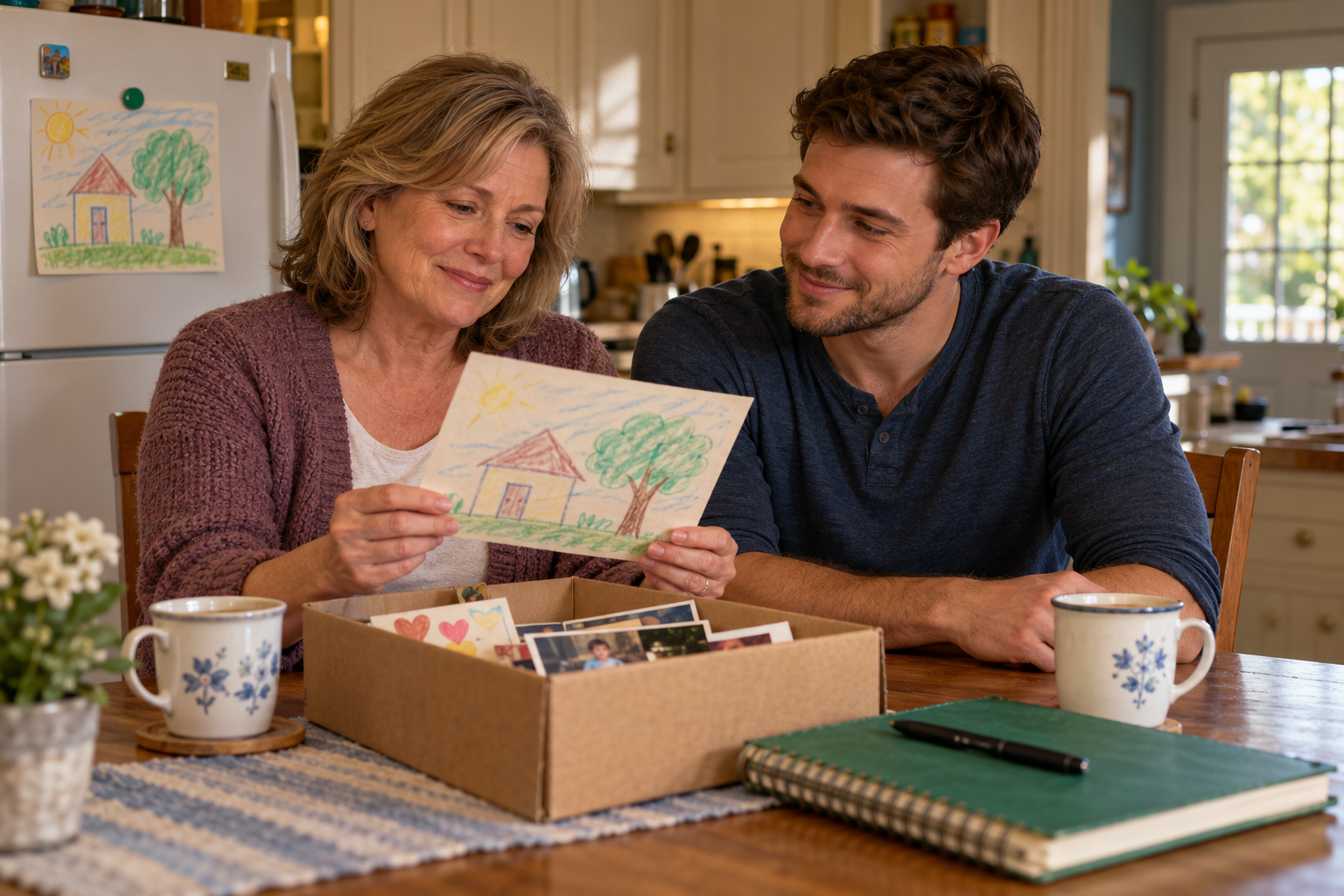
The next afternoon, I changed the tablecloth and put two clean cups on the kitchen table.
The blue-rimmed glasses remained in the cupboard.
I chose the cups because they were easy to lift with my wrist brace.
At two minutes past two, the doorbell rang.
I opened the door.
Chloe stood on the porch holding her handbag in front of her.
“Hello,” she said.
“Hello, Chloe.”
She glanced at my wrist.
“How is it?”
“Still sore, but improving.”
“I'm glad.”
I stepped aside and let her enter.
For a moment, neither of us knew what to do.
Then I led her to the kitchen.
She sat in the chair opposite mine.
I brought the tea and placed it between us.
We both reached for our cups, then stopped when we realized we were moving at the same time.
Chloe gave a small, nervous laugh.
I smiled politely.
It was the kind of awkward moment that might have seemed funny under different circumstances.
I sat down.
“Thank you for coming,” I said.
“I wasn't sure whether you wanted me here.”
“I wouldn't have invited you if I didn't.”
She nodded.
I waited for her to begin.
She looked down at her cup.
“I know things have been bad between us.”
“Yes.”
“And I know the mortgage situation has made everything worse.”
I kept my expression neutral.
“It's certainly added pressure.”
She took a breath.
“I want you to know that I didn't intend for you to get hurt.”
I looked at her.
It was not the same as saying she was sorry for what had happened.
But it was an opening.
“I appreciate you telling me that,” I said. “I need you to understand that the argument was frightening for me.”
Chloe looked up.
“I didn't think you were frightened.”
“I was.”
“I thought you were just angry.”
“I was angry, too.”
I rested my good hand on the table.
“But when I fell, I was hurt. I needed help. And the way things continued afterward made me feel as though my injury was less important than the argument.”
She looked away.
“I didn't know what to say.”
“You could have asked if I was all right.”
“I suppose I could have.”
The answer was hesitant.
I tried to remain patient.
“I wasn't expecting you to agree with everything I said that day,” I told her. “I was expecting us to speak to each other without things getting out of control.”
She rubbed the side of her cup with her thumb.
“I was under a lot of stress.”
“I understand that.”
“The move has been complicated. We were trying to get everything arranged, and I felt like every time we made progress, something else went wrong.”
I listened.
I could understand how stress had affected her.
I could understand how the mortgage, the apartment, and the planned move had all become important to her.
But I also knew that stress did not explain everything.
“I'm sorry things have been difficult,” I said. “I never wanted the house purchase to become a source of conflict.”
She nodded.
“That's why I think you should reconsider the mortgage.”
I felt my shoulders stiffen.
The conversation had returned to the same place.
I took a breath before answering.
“Chloe, I invited you here to talk about what happened between us.”
“I know.”
“But you're asking me to reconsider the financial arrangement.”
“Because the two things are connected.”
“They are connected in your plans. They are not the same decision for me.”
She frowned.
“I don't understand how you can separate them.”
“I can love you and Liam while deciding not to take on a financial commitment.”
“But you agreed to help us.”
“I did.”
“So we made plans.”
“I understand that.”
Her voice grew more urgent.
“We gave notice on the apartment. We arranged the furniture delivery. My parents are coming next month. We can't simply pretend none of that matters.”
“I am not pretending it doesn't matter.”
“Then what are we supposed to do?”
I held her gaze.
“You and Liam need to work with Aaron to find out what options are available.”
She shook her head.
“You keep saying that as if it's easy.”
“I know it isn't easy.”
“Then why won't you help us?”
I felt the old instinct rise again.
I wanted to explain every reason.
I wanted to remind her that I had not withdrawn my support to make her life difficult.
I wanted to tell her how much I had worried about the decision.
Instead, I answered simply.
“Because I am not comfortable continuing with the arrangement after what happened.”
Chloe stared at me.
“So this is punishment.”
“No.”
“It certainly feels like it.”
“I can't control how it feels to you. I can only tell you why I made the decision.”
She looked down at her cup again.
I continued.
“I don't want to control where you and Liam live. I don't want to decide how you spend your money. I don't want to interfere in your marriage. But I also don't want to be financially responsible for a mortgage while feeling that my place in this family depends on whether I agree to help.”
Her eyes lifted.
“That's not how we see you.”
“Then I hope we can find a way to make that clear through our actions.”
She sat very still.
For several seconds, I thought she might say something honest.
Something about the argument.
Something about the way she had spoken to me.
Instead, she said, “I think we both made mistakes.”
I nodded.
“We may have.”
“I don't want to be the only person blamed.”
“I am not asking you to accept all the blame.”
She seemed to relax slightly.
Then I added, “But I need us to talk about what actually happened, not only about how upset everyone became afterward.”
The tension returned to her face.
“I don't know what you expect me to say.”
“You can start by telling me whether you understand why I was hurt.”
She was quiet for a long time.
Then she said, “I understand that you felt hurt.”
I looked at her.
It was a careful sentence.
She had acknowledged my feeling without acknowledging her part in the event.
I decided not to force the words out of her.
“You don't have to say anything you don't mean,” I told her. “But I can't pretend that this conversation has resolved everything.”
She nodded, though she looked disappointed.
We drank the rest of our tea.
We talked about the appointment I had attended and how long the doctor expected my wrist to take to heal.
Chloe asked whether I needed anything from the store.
I thanked her and said I was managing.
It was a small, ordinary exchange.
I tried to appreciate it for what it was without turning it into proof that our relationship had been repaired.
When she stood to leave, I walked her to the door.
“Thank you for coming,” I said.
“I hope things get better.”
“So do I.”
She paused on the porch.
“Are you sure you won't reconsider?”
I felt a wave of sadness.
Even at the end, she could not leave the question alone.
“I'm sure about the current application,” I said.
She nodded and walked to her car.
I closed the door gently.
Then I returned to the kitchen and gathered the cups.
The tea had gone cold.
I poured it down the sink and rinsed the cups.
I had wanted the conversation to end with an apology.
It hadn't.
I had wanted Chloe to understand my decision without seeing it as a punishment.
She wasn't there yet.
But I had spoken honestly.
I had not shouted.
I had not insulted her.
I had not offered money simply to make the tension disappear.
For me, that was progress.
Not the kind that made everything better in one afternoon.
The kind that allowed me to leave a difficult conversation without abandoning myself.
Click here to continue reading: PART 15: The Plans They Had to Change
My Son Asked Me to Stay Out of His Life, but by the Next Morning, His First Concern Was the House He Could No Longer Afford
Part 14 of 20