
Liam called on Tuesday evening to ask whether he could come by on Saturday.
I was watering the plants beside the living room window when the phone rang.
I turned off the tap and dried my hand before answering.
“Hello, Liam.”
“Hi, Mom. Are you busy?”
“Not particularly.”
“I was wondering if I could come over this weekend.”
I looked at the row of plant pots he had helped me move the previous Saturday.
The smallest one sat slightly crooked, its leaves reaching toward the afternoon light.
“Of course,” I said. “Is everything all right?”
“Yeah. I just thought we could spend some time together.”
I waited for him to mention the mortgage.
He didn't.
“What day were you thinking?”
“Saturday, if that works for you.”
“It does.”
“Would you like me to bring anything?”
I smiled.
“You don't have to bring anything.”
“I know. I was asking.”
That small distinction stayed with me after we hung up.
For months, I had become accustomed to hearing Liam's questions as the beginning of a request.
Now I was learning that sometimes a question could simply be a question.
On Saturday morning, I made coffee and put the cinnamon rolls I had bought the previous day on a plate.
I didn't prepare a large meal.
I didn't clean rooms nobody would enter.
I didn't rearrange my day around the possibility that Liam might arrive in a particular mood.
I opened the curtains, straightened the cushions, and sat down with my book.
He arrived just before ten.
When I opened the door, he was holding a cardboard box.
“What's that?” I asked.
“Something I found while cleaning out a cupboard.”
He carried it into the living room and placed it on the coffee table.
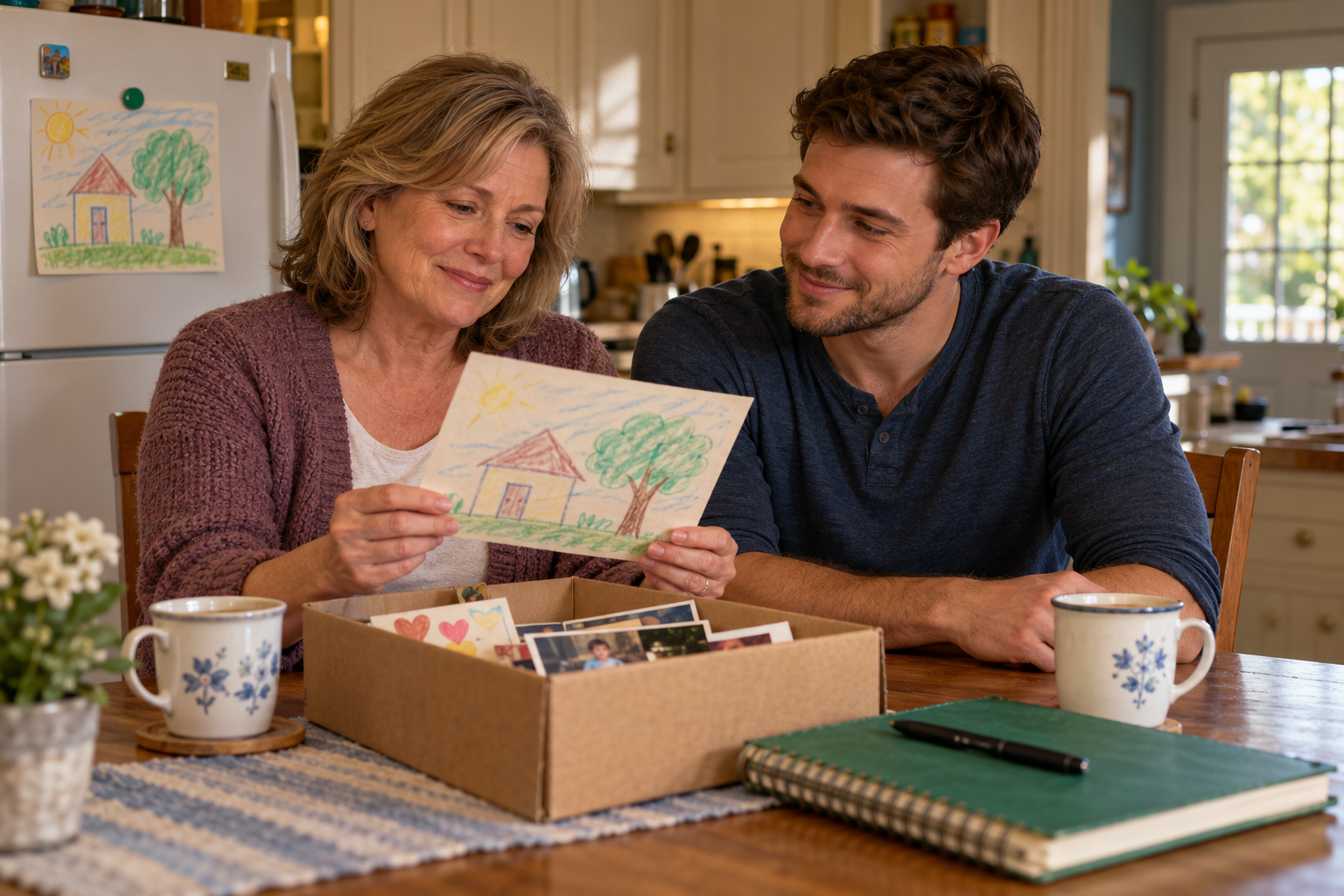
The box contained old photographs, birthday cards, and a few school projects he had kept from childhood.
“I thought you might like to look through these,” he said.
I sat beside him.
For a moment, I could only stare at the box.
“You kept all this?”
“Some of it.”
He lifted a folded piece of construction paper.
It was a drawing of a house with a crooked roof and a tree that looked more like a green cloud.
I recognized it immediately.
“You drew this in second grade.”
“I think so.”
“You were very proud of that tree.”
He laughed.
“I remember you putting it on the refrigerator.”
“I kept it there for years.”
He looked at the drawing again.
“I didn't know you remembered that.”
“Of course I remember.”
We spent the next hour sorting through the box.
There were photographs from school plays, pictures from family holidays, and a card he had made for my birthday when he was little.
The letters were large and uneven.
Inside, he had written that I was the best mother in the world.
I ran my finger over the paper.
“You must have spent a long time making this.”
“I probably wanted something from you.”
I laughed.
“You probably did.”
He smiled, then grew quiet.
“I meant it, though.”
I looked at him.
“What?”
“That card. I probably wanted something when I gave it to you, but I meant what I wrote.”
I felt my throat tighten.
“I know you did.”
He leaned back on the sofa.
“I think sometimes I forget how much you've done for me.”
I didn't answer immediately.
I wanted to hear what he meant without rushing to reassure him.
“I know you've helped me financially,” he continued. “But it wasn't just that.”
He picked up a photograph of himself standing beside his father at the county fair.
“I remember when Dad was sick and you were trying to keep everything together. You still made it to my school events.”
I looked at the photograph.
There were years of memories inside that small frame.
“I wanted you to have as much of a normal childhood as possible.”
“You did a lot more than that.”
I placed the photograph back in the box.
“I did what I thought was right.”
He nodded.
For a while, we looked through the remaining pictures.
Then Liam asked, “Do you think I've taken you for granted?”
The question caught me off guard.
I looked at him carefully.
“I think there have been times when you've expected me to help without considering what it costs me.”
He lowered his eyes.
“I can see that.”
“I don't think you set out to hurt me every time you asked for something.”
“I didn't.”
“But I think we both got used to a pattern.”
He looked up.
“What kind of pattern?”
“I would help. You would feel relieved. And then we would move on without talking about whether the arrangement was working for me.”
He thought about that.
“I guess I didn't ask very often.”
“No,” I said gently. “You didn't.”
He rubbed his hands together.
“I don't want to keep doing that.”
“Then we can start by talking before either of us makes assumptions.”
He nodded.
It wasn't a grand promise.
It was a practical one.
And practical promises were easier to keep than emotional ones made in the middle of a difficult conversation.
After a while, Liam stood and carried the empty coffee cups into the kitchen.
I followed him.
He placed them beside the sink, then glanced toward the drawer where I kept the green notebook.
“Are you writing things down now?”
“Sometimes.”
“Like what?”
“Things I don't want to forget.”
He looked uncomfortable.
“About me?”
“Some of them are about you. Some are about me.”
He nodded slowly.
I could see him trying to decide whether he should ask more.
He didn't.
Instead, he opened the cupboard and reached for another cup.
“Do you have any more coffee?”
“I do.”
I made a fresh pot.
We sat at the kitchen table, and he told me that he and Chloe had been reviewing their finances.
They had looked at several alternatives.
They were considering whether to postpone buying a house until they had saved more money.
He spoke carefully, as if he wasn't sure how much of the subject I could hear without becoming uncomfortable.
I listened.
“That sounds sensible,” I said when he finished.
“We're disappointed.”
“I understand.”
“But we're working through it.”
“I'm glad to hear that.”
He looked at me.
“I want you to know I'm not telling you this because I'm expecting you to offer anything.”
I felt a quiet relief.
“Thank you for saying that.”
“I don't want every conversation to turn into the mortgage.”
“Neither do I.”
He stirred his coffee.
“I still wish things had gone differently.”
“So do I.”
“Sometimes I think about how easily we could have avoided all this.”
I looked down at my hands.
“We could have avoided some of it if we'd handled the argument differently. But we can't change what happened now.”
“I know.”
“What we can change is what we do next.”
He nodded.
The words sounded familiar, but they felt different coming from him.
We finished our coffee and returned to the living room.
Liam placed the photographs back in the box.
He left the drawing of the house on the coffee table.
“Can I take a picture of that?” he asked.
“Of course.”
He held up his phone and photographed the drawing.
Then he stood in the doorway for a moment.
“Would you mind if I came by next weekend, too?”
I smiled.
“I'd like that.”
He hugged me before leaving.
This time, neither of us seemed uncertain about the gesture.
After he drove away, I returned to the living room.
The cardboard box sat on the coffee table.
I picked up the drawing and carried it into the kitchen.
I found a clean magnet and placed the picture on the refrigerator.
The tree still looked like a green cloud.
The roof was still crooked.
The little house still had a door much too large for the rest of it.
I stood there smiling at the drawing.
I didn't take it as proof that everything between Liam and me had been repaired.
I didn't need to.
It was simply a reminder that our relationship contained more than the worst days we had shared.
It contained years of ordinary moments, too.
And if we wanted to build something better, we would have to start with the ordinary moments we still had left.
Click here to continue reading: PART 18: Learning to Help Without Taking Over
My Son Asked Me to Stay Out of His Life, but by the Next Morning, His First Concern Was the House He Could No Longer Afford
Part 17 of 20


One Comment on “PART 17 – The Visit That Meant More Than Money”