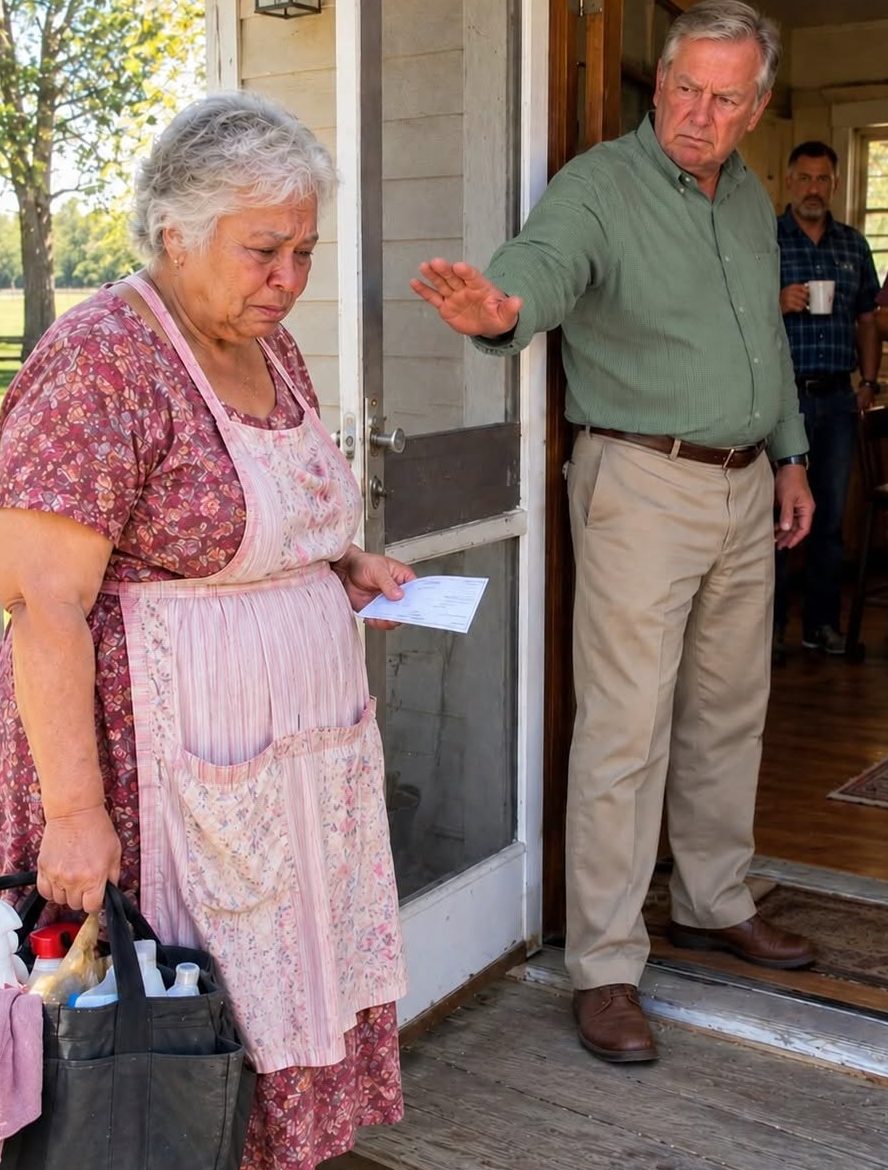
My name is Elnora Whitsett. I’m seventy-two years old.
For twenty-six years, I cleaned Mrs. Henrietta Lockridge’s old farmhouse out by the highway.
On Mondays, I scrubbed the kitchen and bathrooms.
Thursdays were for washing the floors.
And on Fridays, Mrs. Lockridge insisted we share coffee and biscuits before I started working.
“Elnora, those floors aren’t going anywhere,” she’d tell me. “But I won’t be here forever.”
She was ninety-four when she passed away, and her mind stayed clear almost until the end.
Truthfully, I’d known that farmhouse nearly my entire life.
My mother worked for the Lockridge family before I was even born.
We lived in a little white house at the end of their driveway, with a porch swing out front and pecan trees behind it.
I took my first steps on that porch.
After Mama passed, I eventually returned to work for the family myself.
Mrs. Lockridge had three sons, none living closer than Nashville.
Carlton, the oldest, telephoned every Sunday.
Thurston and Bertram, his younger brothers, usually visited only when they needed something.
Last Christmas, Thurston told me I ought to clean his house in town as well.
“Mother’s already paying you,” he said. “Why should it matter?”
Mrs. Lockridge heard him from the adjoining room.
She didn’t confront him.
But that Friday, while we were drinking coffee, she asked me an unusual question.
“Elnora, remind me of your middle name. I want to spell it correctly.”
“Ruthanne,” I answered. “What for?”
“Oh, nothing important, sweetheart.”
She wrote it on a paper napkin.
Mrs. Lockridge died peacefully in her sleep that September.
Following her funeral, I helped the neighborhood women arrange the food.
I personally washed every plate afterward.
The next morning, I drove to the farmhouse to begin sorting her belongings, just as I’d promised Carlton.
He was waiting at the back entrance.
He didn’t even unlatch the screen door.
Through it, I could see his brothers in the kitchen, leaning against their mother’s counter and drinking her coffee.
Carlton slipped a check through the narrow opening.
Three hundred dollars.
“Mother has passed,” he told me. “Your services won’t be needed anymore.”
Nothing else.
After twenty-six years of caring for that home, he wouldn’t even invite me inside.
I’d always believed Carlton was different from his brothers.
He was the one who remembered to call his mother every Sunday.
Apparently, I’d misjudged him.
I accepted the check.
“Yes, sir,” I whispered.
I still don’t know why I called him sir.
I cried throughout the drive home, with that check lying on the passenger seat.
At seventy-two, cleaning Mrs. Lockridge’s home had been my only income besides Social Security.
My monthly payment arrived on the third, and it barely covered necessities.
That evening, I called my daughter, Alfreda.
“Mama, you shouldn’t still be cleaning houses at your age,” she said.
“What else am I supposed to do?”
She went quiet.
“We can’t have you move in with us right now, Mama. We just can’t.”
I told her I understood.
Then I sat alone at my kitchen table, staring at the three-hundred-dollar check until nightfall.
Seven days later, the telephone rang.
“Am I speaking with Elnora Ruthanne Whitsett?” a woman asked.
Hardly anyone ever used all three of my names except the doctor’s office.
“I’m Rosella, calling from the county register of deeds,” she explained. “Could you come down to the courthouse? Please bring identification.”
My heart began racing.
I worried someone had used my identity, or that I owed money I couldn’t possibly repay.
I called Alfreda again.
“Mama, whatever you do, don’t start trouble with those Lockridge sons,” she warned. “If this involves their property, they’ll make your life miserable.”
She wasn’t wrong.
Those men had wealth and connections throughout the county.
All I had was an old Buick I’d been driving for twelve years.
I stayed home the entire next day.
I convinced myself it would be wiser not to get involved.
When you’re elderly and living alone, sometimes avoiding trouble feels like your safest choice.
But Thursday morning arrived.
It was the day I’d always cleaned Mrs. Lockridge’s floors.
I woke early, dressed in my best Sunday clothes, and drove to the courthouse.
Rosella was waiting behind the counter.
She looked close to my age and wore glasses attached to a beaded chain.
“Henrietta and I played bridge together every Tuesday for forty years,” she told me. “Before she passed, she made me promise I’d contact you personally.”
She stepped around the counter and gently took my arm.
Then she guided me to a long table.
Resting on it was an enormous, heavy volume, nearly as thick as the family Bible I’d kept since childhood.
Gold lettering along its spine read: Deed Book.
Rosella opened it to a page marked with a narrow strip of paper.
She rotated the book so I could see it.
Then she placed her finger beneath a particular line.
“Go ahead, sweetheart,” she said softly. “Read what it says. See for yourself.”
I leaned closer.
The first thing I recognized was my own name, written in black ink beside a date from nine years earlier.
Elnora Ruthanne Whitsett.
I read it once, then again, moving my lips over every syllable as though the letters might rearrange themselves if I looked away.
Beneath my name was a description of a property I knew as well as I knew my own kitchen: the Lockridge farmhouse, the old barn, the pecan orchard, and twenty-three acres of land stretching from the highway to the creek.
I lifted my head.
“Rosella, I think there’s been a mistake.”
She pulled out a chair for me.
“Take your time, Elnora.”
“But this is Mrs. Lockridge’s property.”
“Yes, sweetheart. It was.”
My hands had begun to tremble. I pressed them against my knees, embarrassed by how quickly my body seemed to be giving way beneath me.
Rosella turned the heavy book slightly and pointed to another line.
“Look at the date. Then look at the name beneath it.”
The name was Henrietta Lockridge.
The entry identified her as the person who had transferred the property to me. The document was a recorded deed, signed and notarized, with a legal description that matched the farmhouse and its surrounding acreage.
I couldn’t make sense of it.
“She never told me.”
“No,” Rosella said quietly. “She didn’t.”
“Why would she give me her home?”
Rosella removed her glasses and folded them carefully.
“I can explain what the record says, but I don’t want to put words in Henrietta’s mouth. She asked me to show you this after she was gone. She said you’d need to see the truth for yourself.”
I stared at the date.
Nine years earlier, I’d been sixty-three years old. I remembered that year clearly because my Buick had needed a new transmission, and I’d spent six months putting aside a little money every week to pay for it. I’d been working at the farmhouse then, just as I had for years before and would continue to do for years afterward.
Nothing had changed in my life that I could remember. I’d gone to work, made my coffee, paid my bills, and called my daughter on Sundays.
All that time, this document had existed.
“Does this mean I own the house?” I asked.
Rosella placed a finger on a paragraph farther down the page.
“It means Henrietta conveyed the property to you while reserving the right to live there for the rest of her life. That right ended when she passed away.”
I felt as though the room had tilted.
“But her sons—”
“Her sons may have questions. They may even disagree with what their mother decided. That doesn’t change what the recorded deed says, though any legal dispute would have to be handled properly.”
I looked again at the acreage.
Twenty-three acres.
A farmhouse with a deep front porch, a kitchen where I’d spent thousands of mornings, a barn with a sagging roof, and pecan trees that had been dropping nuts into the grass since before I was born.
I remembered Henrietta telling me that the floors weren’t going anywhere.
I remembered her asking for my middle name.
And suddenly, I remembered something else: nine years earlier, on a Friday morning, she’d asked me to stay a little longer after our coffee. She’d been sitting at the kitchen table with a stack of papers, and when I’d offered to help sort them, she’d closed the folder and smiled.
“Not today, Elnora. Some things have to be done in their proper time.”
I’d thought she was talking about her taxes.
I swallowed hard.
“Why would she keep this from me?”
Rosella reached into her handbag and took out a sealed envelope.
“Because she wanted you to see the deed first,” she said. “And because she left instructions about what I was to give you next.”
She placed the envelope on the table, but kept one hand resting over it.
“Before you open this, Elnora, there’s something you need to understand. Henrietta knew exactly what might happen when her sons learned what she’d done.”
I stared at the envelope.
“What might happen?”
Rosella looked directly at me.
“She believed that when the time came, they would try to take the property from you.”
Part 2 – The House That Was Never Mine to Lose
For several seconds, I could hear nothing but the courthouse clock ticking above the doorway. I had spent so many years thinking of myself as a woman who worked in other people’s houses that the notion of owning one seemed almost indecent, like wearing somebody else’s Sunday dress without permission.
Rosella moved her hand away from the envelope.
“Henrietta didn’t want you frightened,” she said. “She wanted you prepared.”
“Prepared for what? I’ve never taken anything from those boys.”
“I know that. She knew it, too.”
I touched the envelope but didn’t open it. My name was written across the front in Henrietta’s careful handwriting, the same rounded script she’d used on birthday cards and the labels she put on jars of peach preserves.
For a moment, I could almost hear her telling me not to let the coffee boil over.
“Did she make this decision because she thought I was poor?” I asked.
Rosella’s expression softened.
“She made it because she wanted to.”
“That’s not an answer.”
“No,” she admitted. “It isn’t. But I’m not going to pretend I know every reason she had. I can tell you what I saw, and I can tell you what she asked me to do.”
She opened the deed book to a second page, where a small reference number connected the recorded deed to another document. The signatures were clear, and the notary’s seal had been entered into the county record. It wasn’t a penciled promise or a note Henrietta had tucked into a drawer. It was an official instrument that had been filed years before her death.
“She asked me to make sure you understood that the deed wasn’t part of her will,” Rosella explained. “She transferred the property during her lifetime and retained the right to live there until she died. That’s why the house doesn’t simply become an asset her sons can distribute through her estate.”
I tried to take that in.
“So they can’t just decide to sell it?”
“They can’t sell what they don’t own. But don’t make any decisions based on my explanation alone. You need an independent attorney to review the deed and tell you exactly where you stand.”
I looked at her, then at the envelope.
“Can you recommend someone?”
“I can give you a list of attorneys who don’t represent the Lockridge family. You should choose one yourself.”
She wrote down the names and telephone numbers of three local lawyers on a piece of paper. Then she made a photocopy of the deed’s first page and the legal description, stamped each copy as a record from the county books, and placed them in a folder.
Before I left, she gave me the envelope.
“Henrietta told me to say something to you when you finally read the deed,” Rosella added.
“What was that?”
“She said, ‘Tell Elnora that a gift is not a debt. She doesn’t owe me the rest of her life for it.'”
I felt tears gathering behind my eyes.
“I wish she’d told me herself.”
“So do I,” Rosella said. “But she had her reasons.”
I tucked the folder and envelope into my handbag, thanked her, and walked out into the bright October morning. The courthouse steps seemed steeper than they had when I’d climbed them, and I sat on the lowest one for a few minutes before going to my car.
I didn’t call Alfreda immediately. I wasn’t ready to hear her tell me I’d misunderstood the whole thing, and I wasn’t ready to explain something I barely understood myself.
Instead, I drove to the farmhouse.
I had told myself that I would never go there again after Carlton dismissed me at the back door. Yet the road seemed to lead me there of its own accord, past the feed store, the old church, and the field where a white horse stood beneath a shade tree.
When I reached the entrance, I slowed down.
The iron gate was open.
The house sat beyond the driveway, its white paint dulled by years of weather. The front porch needed sweeping, and the shutters on the east side were hanging crooked. Smoke rose from the kitchen chimney, and a dark sedan I recognized as Carlton’s was parked beside the barn.
I almost turned around.
Then I remembered that I was no longer merely the woman who had been dismissed from the back door.
I parked behind Carlton’s car and walked to the front entrance. The brass knocker had been polished recently, and I could see movement through the narrow window beside the door.
When I knocked, Bertram opened it.
He was wearing the same expensive watch he’d worn to the funeral. His expression changed when he saw me, first to surprise and then to irritation.
“What are you doing here?”
“I need to speak with Carlton.”
“He’s busy.”
“I won’t take long.”
He looked at the handbag hanging from my arm.
“Is this about the check?”
“No.”
“Then what is it about?”
Before I could answer, Thurston appeared behind him, holding a mug of coffee. He glanced at me and laughed without humor.
“Well, look who’s come back. I thought Mother had finally taught you when it was time to leave.”
Bertram stepped aside, perhaps because he realized the conversation could be heard from the road. I entered the hall, the first time I’d crossed the farmhouse threshold since Carlton had refused to open the screen door.
The familiar smell of furniture polish, coffee, and the lavender sachets Henrietta kept in her linen cupboard surrounded me. Her walking shoes were still beneath the little bench by the stairs. A cardigan hung over the banister, as though she’d stepped upstairs to fetch something and would be back any moment.
I had to steady myself against the wall.
“Don’t start crying,” Thurston said. “We have enough to deal with.”
I looked at him.
“I’m not crying for you.”
That surprised him enough to make him silent.
Carlton emerged from the kitchen, holding a thick folder. When he saw me, his face tightened.
“Elnora. I thought we made ourselves clear.”
“You made yourself clear about my services. You didn’t say I couldn’t come into the house.”
“This is a family matter.”
I took the photocopy from my handbag and placed it on the hall table.
“Then perhaps you’d better look at this.”
Carlton glanced down. For the first time since I’d known him, I saw him lose his composure without trying to hide it. His eyes moved across the page, stopping at the recording number and the date.
Thurston took the paper from him.
“What is this?”
Carlton reached for it, but his brother had already begun reading aloud. When he came to my name, he stopped.
“That’s impossible.”
“It’s in the county records,” I said.
Bertram stepped closer. “What exactly are you claiming?”
“I’m not claiming anything. I’m asking you to explain why your mother deeded this property to me.”
The silence that followed was so complete I could hear the refrigerator humming in the kitchen.
Carlton folded the copy once, then unfolded it.
“Where did you get this?”
“At the courthouse.”
“Who showed you?”
“Rosella.”
He closed his eyes briefly.
Thurston turned on him. “You knew about this?”
“No,” Carlton said sharply. “I didn’t.”
“Then why are you looking like that?”
“Because I know what a deed is, you fool.”
Bertram took the paper from Thurston and examined it more carefully. He seemed less angry than bewildered, as though the document had introduced a problem that couldn’t be solved by making somebody leave the room.
“Mother wouldn’t have given away the farmhouse,” he said. “Not without telling us.”
I thought of all the Fridays I’d sat across from Henrietta, listening to her talk about the garden, the weather, and the books she was reading. I remembered the way she’d looked at me when Thurston told me to clean his house for free.
“Perhaps she didn’t tell you because she knew you wouldn’t agree,” I said.
Thurston’s face reddened.
“You’ve been working here for twenty-six years. You were paid every week. Are you honestly telling us that you deserve our inheritance?”
“I didn’t say I deserved anything. I said your mother made a decision.”
Carlton set the photocopy on the table.
“We’ll have this reviewed,” he said. “Until then, I don’t want you moving anything or interfering with the estate.”
“I haven’t moved anything.”
“Good. Then we understand one another.”
I picked up the paper.
“No, Carlton. I don’t think we do.”
I walked toward the front door, but before I reached it, I noticed the little table beside the staircase. Henrietta had kept a blue ceramic bowl on it for years, where she dropped her keys and the folded shopping lists she always forgot to take to town.
The bowl was gone.
In its place lay a brass key attached to a faded paper tag.
I recognized the handwriting on the tag immediately.
Elnora — desk drawer.
I turned back.
“Whose key is this?”
Carlton stared at it, and the color drained from his face.
“Where did you find that?”
“It was on the table.”
He crossed the hall and snatched it up.
“That belongs to Mother.”
“Then why does it have my name on it?”
For the first time, none of the brothers had an answer.
I left the farmhouse with my photocopy in my handbag and a strange, heavy feeling in my chest. The deed had been a surprise, but the key felt like something else entirely. Henrietta had not simply signed a document and hoped I would someday discover it. She had left a trail, and her sons had just revealed that they knew there was more to find.
That evening, I called the first attorney on Rosella’s list.
His office was closed, so I left a message and tried the second number. A receptionist arranged an appointment for the following morning and told me to bring every document I had.
I slept badly that night.
At half past six, my telephone rang. Carlton’s name appeared on the screen.
I nearly let it go to voicemail, but I answered.
“Elnora,” he said, his voice low and strained. “I’ve been thinking about what happened yesterday.”
I waited.
“Mother kept a locked drawer in her desk. She told us never to open it without her permission. We assumed it held personal papers.”
I sat up in bed.
“All right.”
“Bertram found an envelope in it this morning. Your name is on the front.”
My fingers tightened around the telephone.
“What does it say?”
Carlton took a breath.
“It says that if you ever learn about the deed, the three of us are supposed to give you whatever is inside.”
“And have you opened it?”
“No,” he replied. “But there’s something else you need to know.”
His voice faltered.
“The envelope is addressed to you and to your mother.”
My mother had been dead for more than thirty years.
Part 3 – The Letter My Mother Left Behind
I didn’t answer Carlton immediately. I stared at the telephone in my hand, trying to understand how my mother’s name could be on an envelope inside a desk she’d never owned and in a house where she’d last worked decades before.
“What do you mean, addressed to my mother?” I finally asked.
“Exactly what I said. It has both your names on it.”
“Then bring it to me.”
“Mother’s instructions were specific. She wrote that the envelope should be opened with you present, and that all three of us should hear what it says.”
I let out a small, disbelieving laugh.
“Yesterday, you wouldn’t even let me through the back door.”
“I know.”
“Today, you want me to come over and listen to a letter?”
“I know how it sounds, Elnora.”
“No, Carlton. I don’t think you do.”
He went quiet. I could hear faint voices in the background, one of his brothers speaking impatiently and another voice telling him to stop pacing.
“Come at ten,” he said. “We’ll meet in the sitting room.”
I agreed, but only after telling him that I would not sign anything, hand over my deed, or make any promises. He said he understood, and for once, I believed that he was trying to be honest.
Before I left home, I placed the deed photocopy in my handbag alongside my Social Security card and driver’s license. I also took the three-hundred-dollar check Carlton had given me, although I hadn’t yet decided why. It seemed important to remember how the whole business had begun: with a dismissal delivered through a screen door and a payment that had made twenty-six years feel as small as a line on a receipt.
The farmhouse looked different in daylight. The front curtains had been drawn back, and the porch had been swept. Someone had placed Henrietta’s favorite potted fern beside the door, where it caught the morning sun.
Carlton opened the door himself.
“Thank you for coming.”
I nodded and stepped inside.
The brothers were waiting in the sitting room, a place I’d dusted every Thursday for years. The floral armchairs had been arranged around the coffee table, and Henrietta’s Bible sat beside her reading glasses. Bertram stood by the window with his arms folded, while Thurston occupied the chair closest to the fireplace.
Between them sat a small wooden box.
I recognized it immediately. Henrietta used to keep sewing supplies in it, although she hadn’t sewn anything in years. The brass key from the hall table lay on the lid.
Carlton motioned toward a chair.
“Before we begin, I want to say something.”
Thurston groaned.
“Must we have a speech?”
“Yes,” Carlton said. “We must.”
He looked at me, and I saw something in his expression that hadn’t been there when he’d handed me the check. He looked tired, and older than his sixty-eight years.
“I treated you badly the morning after Mother’s funeral. I was upset, and I handled things in a way I shouldn’t have. You deserved more respect than I gave you.”
The apology was awkward, almost painfully so, but it was the first one he’d offered.
I didn’t rush to comfort him.
“Yes,” I said. “I did.”
He nodded, accepting the answer.
Thurston looked away. Bertram rubbed his thumb along the edge of his watchband.
Carlton unlocked the box and removed a cream-colored envelope. My name was written across the front, followed by the name of my mother. Below them, in smaller letters, Henrietta had written: To be opened only when Elnora knows about the deed.
He held it out to me.
I took the envelope carefully. The paper had yellowed around the edges, and the flap was sealed with a strip of clear tape. Inside, I found a folded letter and a smaller photograph, its corners softened from handling.
The photograph showed two young women standing beneath a pecan tree. One was Henrietta, perhaps twenty-five, with her dark hair pinned back and a smile that seemed almost shy. The other was my mother, wearing a plain cotton dress and holding a baby wrapped in a white blanket.
Me.
I recognized the porch behind them, though the house had been freshly painted then. My mother’s face was bright with the sort of happiness I’d seen only in the few photographs she had kept from before I was old enough to remember.
On the back, Henrietta had written a date and a sentence.
The day Ruthanne came home.
I pressed the photograph against my chest.
“She kept this all these years?”
Carlton nodded.
“Apparently.”
I unfolded the letter.
The handwriting was Henrietta’s, but the words were addressed to my mother. She had written that she hoped Elnora would someday understand what the house meant to both families, and that the gift of the property was not intended to settle a debt or purchase loyalty. It was intended to put right something that had remained unsettled for far too long.
I read the first paragraph twice before I could continue.
Dear Ruthanne and Elnora,
If you are reading this together, then I have finally done what I should have done years ago: made certain that the home where you began your life will not be lost simply because the people who inherited my name believe they are entitled to every part of my history.
I stopped.
Thurston shifted in his chair.
“Keep reading.”
I looked at him.
“Don’t tell me what to do.”
He opened his mouth, then closed it again.
I continued.
Your mother, Elnora, came to this farm as a young woman. She was employed to help with the house, but she became my closest companion during a difficult season of my life. When my husband died, the house was full of people offering advice about money and land, yet very few stayed to help me through the long nights when grief made it difficult to breathe.
Your mother stayed.
I looked at the photograph again. My mother had never spoken much about her years with the Lockridges. She told me what she thought a child needed to know: how to sew a button, how to stretch a meal, how to recognize the sound of rain coming through a damaged roof. She rarely spoke of her own disappointments.
The letter continued.
There was a time when the farm was in danger of being divided and sold. Your mother helped me keep it together, not by doing anything grand, but by standing beside me while I learned how to manage what I had left. She worked extra hours when I could afford them, and when I could not, she never made me feel ashamed of needing time.
I wanted to give her the little white house at the end of the driveway. I offered it to her more than once, but she refused. She said she had earned a living there, not a fortune, and she would not take what she had not been promised.
My throat tightened.
That little white house had been the center of my childhood. I remembered its narrow kitchen, the porch swing, and the way Mama used to sit beside me on summer evenings, fanning us both with an old magazine. I had believed the house belonged to the Lockridges because the land belonged to them, and because Mama had never suggested otherwise.
I turned the page.
I thought her refusal meant I had done enough. I was wrong. When she died, I realized I had let pride disguise itself as fairness. I had been so determined not to make her feel like a charity case that I had failed to give her the one thing she had always wanted for her daughter: a place where she would never have to ask permission to stay.
I lowered the letter.
“She wanted me to have the house where I grew up.”
“That appears to be what she meant,” Carlton said.
“But the deed is for the farmhouse and twenty-three acres.”
He nodded slowly.
“That’s what we need to understand.”
I looked back at the letter. It described how Henrietta had spent years watching the little white house fall into disrepair after our family moved away. She had considered selling it, then decided to keep the parcel intact until she knew what she wanted to do. Eventually, she chose to include the farmhouse and the surrounding acreage, because she believed the two buildings belonged to one another in the history of the property.
There was no accusation in the letter, no attempt to humiliate her sons. She simply explained that the land was the one thing she could give that would not be spent, misplaced, or divided among people who might never understand its value.
Then I reached the final paragraph.
I have made this decision freely, with a clear mind and proper legal advice. The deed is recorded, and my sons have no reason to believe that I have been confused about what I am doing. I have not taken away their future. They will have what remains of the estate, and they will have the opportunity to decide what sort of men they wish to be when they learn that not every inheritance is measured in acres.
I read the sentence again.
The letter ended with a final line.
Elnora, if you are frightened, remember that you have spent your life believing you were only a visitor in a house that was already part of your story. You are not required to be grateful for the rest of your life. You are allowed to belong somewhere.
I couldn’t see the page through my tears.
For a long time, no one spoke. Even Thurston had stopped fidgeting, and Bertram had lowered his arms from his chest. Carlton sat with his hands clasped between his knees, staring at the rug.
Finally, I folded the letter.
“Why didn’t she tell me?”
Carlton looked up.
“She believed you would refuse it.”
I shook my head.
“She didn’t know me very well, then.”
“She knew you better than you think,” he said. “She also knew you’d spend the next nine years trying to prove you hadn’t done anything to deserve it.”
I wanted to disagree, but the words wouldn’t come. I had spent much of my life refusing help, even when I needed it, because accepting anything I couldn’t repay had always made me feel vulnerable. My mother had been the same way, and perhaps Henrietta had understood that more clearly than either of us.
Thurston stood and walked to the window.
“There’s still a question of whether the deed is valid.”
I folded the letter and placed it back in the envelope.
“Then we’ll have it reviewed.”
“You’re going to hire a lawyer?”
“Yes.”
He gave a short laugh.
“With what money?”
I looked at him steadily.
“That’s no longer your concern.”
Carlton rose.
“Thurston, stop.”
“No, Carlton. We have a right to know what’s going on. Mother has left us with a mess, and now Elnora thinks she’s entitled to—”
“She is entitled to have the deed examined without being insulted,” Carlton interrupted. “And we’re entitled to know whether Mother understood what she signed. Those are two different things.”
For the first time, I saw the brothers look at one another not as a united family, but as three men who had inherited the same upbringing and arrived at very different ideas about what it meant.
I took the photograph and letter with me. Carlton offered to make copies, but I told him I’d rather keep the originals until I met with the attorney.
At the door, he stopped me.
“Elnora, there’s something else in Mother’s desk.”
I turned.
“What?”
“A folder of financial papers. Bertram found it beside the box. There’s a document from the year she signed the deed, and I think it may explain why she made the transfer when she did.”
“What kind of document?”
He hesitated.
“A letter from a lawyer, confirming that Mother had asked for an appraisal of the farm. And a handwritten note attached to it.”
He reached into his pocket and took out a folded sheet of paper.
The handwriting was Henrietta’s.
If my sons ever challenge the deed, show them the appraisal. It will explain why I could not wait any longer.
I stared at the note.
“What did the appraisal say?”
Carlton looked toward his brothers, then back at me.
“We haven’t read it yet.”
Part 4 – The Price of a Piece of Home
I met the attorney the following morning in a narrow office above the pharmacy on Main Street. His name was Mr. Bell, and he was a careful, soft-spoken man who listened without interrupting while I explained the deed, the letter, and the way Carlton had dismissed me at the farmhouse.
When I finished, he folded his hands on the desk.
“First, Mrs. Whitsett, I want you to understand something. You do not have to apologize for asking whether a legal document is valid. You do not have to justify accepting a gift that was properly made. And you do not have to decide today what you intend to do with the property.”
I had expected him to speak in the language of courts and contracts. Instead, he spoke as though he were trying to help me find my footing after stepping onto an unfamiliar road.
He examined the photocopy from the courthouse, then asked permission to contact the register of deeds for a certified copy and the associated records. I signed the authorization, and he explained that the deed appeared, on its face, to be a completed transfer with a reserved life estate, but that he would need to inspect the full instrument and verify the legal description before giving me a firm opinion.
“Could the sons take it away from me?” I asked.
“Anyone can bring a legal challenge. That doesn’t mean the challenge will succeed. What matters is whether the deed was properly executed, whether your benefactor had the legal capacity to make it, and whether there is evidence of coercion, fraud, or some other basis for setting it aside.”
I thought of Henrietta sitting at her kitchen table, writing my middle name on a napkin.
“She was clear-minded until the end,” I said. “She remembered everything. She did the crossword puzzle every morning, and she could tell you what she’d paid for a jar of jam in 1978.”
Mr. Bell smiled faintly.
“Those are useful details, but we’ll rely on the records and evidence, not just recollections. Did she ever ask you to sign anything?”
“No.”
“Did you ever ask her to leave you the property?”
“Never.”
“Did you know about the deed before the courthouse called?”
“No.”
He made a note.
“That may become important if anyone alleges that you influenced her decision. Do you have any other documents from her?”
I showed him the letter addressed to my mother and me. He read it slowly, his expression becoming more serious as he reached the final paragraph.
“This helps explain her intentions,” he said. “It isn’t a substitute for the deed, but it may help establish the context in which she made the transfer.”
He asked whether I had the original envelope and photograph. I told him I did, but that I wanted to keep them safe. He suggested making copies and storing the originals somewhere secure, and I agreed.
Before I left, he gave me a short list of things to do: keep the documents together, don’t sign anything presented by the Lockridge family without having it reviewed, and don’t enter into any agreement about the property until we knew exactly what the deed covered.
“And one more thing,” he said as I stood. “Don’t spend money you don’t have trying to prove something that the public records may already establish. Let us take this one step at a time.”
I thanked him and walked down to the street.
For the first time in days, I felt that the world had become a little less confusing. I still didn’t know why Henrietta had kept the deed secret, but I knew that I had the right to ask questions without being made to feel foolish for asking them.
That afternoon, Mr. Bell telephoned me.
“The certified copy confirms the recording information,” he said. “I’m also requesting the related survey and the appraisal your benefactor apparently commissioned. There are some details in the property description that we need to verify, but nothing I’ve seen so far suggests the deed is merely a promise or an informal arrangement.”
I sat down at the kitchen table.
“What about the appraisal?”
“I haven’t received it yet. But if you can obtain a copy from the Lockridge family, that would be useful.”
I told him Carlton had said he would show it to me.
“Then ask him to provide a copy. Don’t take the original from the house, and don’t allow anyone to pressure you into making a decision while the review is underway.”
After we hung up, I called Carlton.
He answered on the second ring.
“I was going to call you,” he said. “Mr. Bell has already contacted us.”
I was surprised.
“You know him?”
“He sent a letter requesting the appraisal and the supporting documents. Mother had kept everything in a folder marked with the year of the deed.”
“Can I see it?”
“Yes. Come tomorrow morning.”
This time, when I arrived at the farmhouse, Carlton opened the front door and invited me into the sitting room. He had made coffee, and a plate of biscuits sat on the table, arranged in a neat circle. The sight of them almost undid me, because it was exactly how Henrietta had always served them on Fridays.
“I thought we might as well do this properly,” Carlton said.
Thurston and Bertram were already seated. Between them lay a folder containing copies of the appraisal, the survey, and a letter from the attorney who had prepared the deed. A separate sheet of paper contained Henrietta’s handwritten instructions.
Carlton passed me the appraisal first.
The report had been prepared nine years earlier by a licensed local appraiser. It listed the farmhouse, barn, orchard, and twenty-three acres as a single parcel. The estimated market value was substantial, though nowhere near the sort of fortune the brothers might have imagined when they spoke of the land as their inheritance.
The report also noted that the farmhouse needed repairs, the barn required structural work, and several acres near the creek were subject to seasonal flooding. The property was valuable, but it wasn’t an untouched estate waiting for someone to collect a check.
“Why did she have it appraised?” I asked.
Carlton turned to the attorney’s letter.
“She was considering transferring it. The letter says she wanted independent advice about how to do that without affecting the rest of her estate.”
Thurston leaned forward.
“She told us she was reviewing her finances. She never said she was giving the house away.”
“She wasn’t required to discuss every decision with you,” I said.
“Don’t turn this into a fight, Elnora.”
“I’m not. I’m reading the documents you put in front of me.”
Bertram tapped the appraisal.
“There’s another page.”
He slid it across the table. It was a summary of the property boundaries, including a map showing the twenty-three acres outlined in red. The farmhouse stood near the center, the barn to the west, and the old white house at the end of the driveway.
I leaned closer.
“The little white house is included?”
Carlton nodded.
“Yes.”
I looked at the map until the lines blurred. The house where I’d taken my first steps, where my mother had taught me to braid my hair and mend my clothes, was part of the same property Henrietta had given me. I had imagined owning the farmhouse, but I hadn’t understood that she had included the small house as well.
“What happened to it?” I asked. “I haven’t been inside for years.”
“Mother had it maintained,” Carlton said. “The roof was repaired, and the plumbing was checked. She didn’t want it to fall apart.”
I remembered the way the house had looked when I’d last seen it, its windows dark and its porch swing gone. I had assumed it had been left empty because no one cared enough to fix it.
“Why didn’t she tell me?”
Carlton shook his head.
“I don’t know.”
Thurston pushed his chair back.
“I think we know enough. Mother signed a deed, and we’re supposed to accept it because she wrote a letter explaining her feelings. But there’s still the question of whether she was in her right mind.”
“She was,” I said.
“How do you know?”
“Because I spent time with her every week. Because I knew her habits, her opinions, and the things that made her laugh. Because she could remember a conversation from six months earlier better than I could remember what I’d eaten for breakfast.”
“That doesn’t prove she understood the financial consequences.”
“No,” I replied. “But neither does your disbelief prove that she didn’t.”
Carlton held up a hand.
“Enough. We can have the records reviewed, and if there’s a genuine legal question, we’ll deal with it. But we’re not going to sit here and pretend Mother was incapable just because she made a decision we didn’t expect.”
Thurston looked at him sharply.
“You’ve changed your tune.”
“I’ve had time to think.”
Bertram turned to the handwritten instructions. They were brief, but one sentence had been underlined twice.
The appraisal is not meant to measure what the property is worth to my family. It is meant to establish that I knew what I was giving away.
Mr. Bell had asked for that very document, and now I understood why. Henrietta had anticipated that someone might question her judgment, and she had taken steps to show that she’d considered the value of the property before transferring it.
But the appraisal contained another page, tucked behind the summary. It was a statement from the appraiser confirming that Henrietta had met with him alone, answered his questions clearly, and discussed the property’s condition without assistance from any member of her family.
At the bottom, she’d signed an acknowledgment that she had received the report and understood the estimate.
I turned the page over.
There was a handwritten note in Henrietta’s familiar script.
I have no wish to deprive my sons of their inheritance. I wish only to keep one part of my life from being divided among people who do not love it.
I looked at Carlton.
“Did you know she felt this way?”
He shook his head.
“I knew she was worried about the farm. I didn’t know how much.”
“Why was she worried?”
He hesitated.
Thurston answered for him.
“Because we wanted to sell the land.”
The words settled over the room.
I looked from one brother to the next.
“Sell it to whom?”
Bertram glanced at Carlton, who seemed to be deciding how much to tell me.
“There’s been interest in the property for some time,” he said. “The land along the highway is worth more than it used to be. We discussed selling the entire farm after Mother passed.”
“Did she know?”
“She knew we’d talked about it. We told her it would make things easier for everyone.”
“Everyone except the people who love that place.”
Thurston stood.
“We’re businessmen, Elnora. We don’t make decisions based on memories of porch swings.”
“No,” I said. “I suppose you don’t.”
I gathered my copies and returned them to the folder. I was beginning to understand that Henrietta’s gift was not simply about giving me a house. She had given me a choice about what happened to a place that had shaped two generations of my family, and she’d done it knowing her sons might see the choice as an obstacle.
Carlton walked me to the front door.
“I want you to know that I haven’t decided what I think about all this,” he said. “But I don’t believe Mother was confused, and I don’t believe you did anything wrong.”
I thanked him.
He looked as though he wanted to say something else, but I stepped outside before he could find the words.
The following morning, Mr. Bell called again.
“I’ve received the survey and reviewed the recorded deed against the property description,” he said. “The boundaries match. The instrument is more complete than I initially expected, and the evidence of your benefactor’s intent is stronger than I anticipated.”
I gripped the telephone.
“So I own it?”
“Based on what I’ve reviewed, you have a strong claim to the property. We’ll need to address any challenge that may arise, but the deed appears to be valid and properly recorded.”
I let out a breath I hadn’t realized I was holding.
“Then what happens now?”
“That depends on what you want. You can keep the property, sell it, or make arrangements to live there. But before you decide, I recommend visiting the house, taking an inventory of its condition, and considering what it would mean for your finances.”
I told him I would think about it.
After we hung up, I sat for a long time at the kitchen table, listening to the refrigerator hum. I had spent decades believing that my future depended on finding another house to clean, another family willing to hire me, another small check that would help me get through the month.
Now I had a farmhouse, a barn, an orchard, and a little white house that had once been my whole world.
I could hardly imagine living there again.
That afternoon, Alfreda came to see me. She had heard from one of the neighbors that something was happening with the Lockridge property, and she arrived with a bag of groceries and the determined expression she wore whenever she thought I was about to make a mistake.
“Mama, please tell me you haven’t signed anything.”
“I haven’t.”
“And you’re not planning to fight those men in court?”
“I’m not looking for a fight, Alfreda.”
She sat down across from me.
“Then what are you going to do?”
I looked at the deed on the table.
“I don’t know yet.”
She glanced at the property description and shook her head.
“I still think this is a terrible idea. You don’t have the money to maintain a place like that, and those men have lawyers. They could drag this out for years.”
“Mr. Bell says the deed appears valid.”
“Lawyers say all sorts of things.”
I felt a familiar weariness rise in me. I loved my daughter, but I was tired of being told that the safest thing I could do was to make myself smaller.
“Alfreda, I know you’re worried about me. But I need you to let me decide what kind of life I want.”
She looked down at her hands.
“I don’t want you hurt.”
“Neither do I.”
For a moment, I thought she might apologize. Instead, she asked whether I had enough money for my next electricity bill, and I told her I did. She offered to help with groceries, but I refused gently, not because I didn’t need help, but because I wanted our next conversation to be about something other than what I couldn’t afford.
When she left, I took the Buick keys from their hook and drove to the farmhouse.
I didn’t go to the front door. I drove past the barn and followed the narrow lane toward the little white house at the end of the driveway.
The house stood beneath the pecan trees, its white paint weathered but intact. The porch had been repaired, and a new screen door hung squarely in its frame. I could see curtains in the windows, and the grass had been cut recently.
I climbed the steps slowly and reached for the doorknob.
It turned.
The door opened onto a small sitting room, clean and empty except for a wooden chair and a lamp on the windowsill. The kitchen had been repaired, and the old fireplace had been swept. Someone had left a folded quilt on the bed in the back room, the same pattern my mother used to sew from scraps of fabric.
I walked from room to room, touching the doorframes and looking at the places where I’d once measured my height with a pencil mark. I could almost see my mother standing at the stove, telling me to stop running through the house with muddy feet.
Then I noticed a narrow envelope on the mantel.
It had been placed there recently, and my name was written across the front.
I opened it with trembling fingers.
Inside was a short note from Henrietta.
Elnora, if you have come this far, then you have seen the deed and the letter. There is one more thing you must know before you decide what to do with this property.
I read the next line.
The sons have already signed an agreement to sell the entire farm, and the deadline for that agreement is approaching.
My heart began to pound.
I looked out the window toward the farmhouse, where the three brothers had spent the last week trying to understand their mother’s decision.
Henrietta had not merely given me a home.
She had placed me directly between her sons and the future they had already promised someone else.
Part 5 – The Promise They Had Already Sold
I read Henrietta’s note until I knew every word by heart, then sat on the edge of the little white house’s front porch and watched the pecan leaves move in the afternoon breeze.
The sons have already signed an agreement to sell the entire farm.
I couldn’t stop thinking about that sentence. The deed had been recorded nine years earlier, yet the brothers had apparently made plans to sell land that no longer belonged to them. Perhaps they hadn’t known about the transfer. Perhaps they’d assumed their mother’s property would pass to them automatically. Or perhaps, as Henrietta seemed to fear, they had believed that whatever they wanted would eventually become theirs.
I folded the note and placed it inside my handbag.
The house around me was quiet. I could hear a lawn mower somewhere beyond the trees, and from the highway came the occasional rumble of a passing truck. I remembered sitting on those same porch steps with my mother, watching the evening settle over the fields while she told me stories about the people who had lived on the farm before I was born.
She had never spoken bitterly about the Lockridges. Even when money was tight, she had said that a person could work for someone without surrendering her dignity, and that kindness was not a debt to be collected later.
I had spent much of my life trying to live by those words.
Now I wondered whether my habit of avoiding trouble had allowed me to mistake silence for peace.
I drove home and called Mr. Bell.
He listened without interrupting while I read Henrietta’s note aloud. When I finished, he asked me to bring it to his office the next morning.
“Do you know who the buyer is?” he asked.
“No. Henrietta didn’t say.”
“Did she leave any other papers at the white house?”
“Nothing that I could find.”
“All right. Don’t contact the buyer, and don’t confront the sons until I’ve reviewed the agreement. If there is a signed contract, we need to know precisely what they promised and whether the agreement contains conditions concerning ownership and title.”
I agreed, though the instruction to avoid confrontation was harder to follow than he might have imagined. I had spent the day walking through the house where I’d grown up, only to discover that the place I had just inherited was already at the center of a business arrangement made without my knowledge.
That night, I placed Henrietta’s note beside the deed photocopy on my kitchen table. The two documents seemed to belong to different worlds: one written in the careful language of a legal instrument, the other in the familiar handwriting of a woman who had once insisted that I take the larger biscuit because I was the one doing the work.
I wondered what she had known about her sons. I wondered whether she’d anticipated their reaction. Most of all, I wondered why she had chosen to leave me with a problem she could have explained while she was alive.
I knew the answer, at least in part. Henrietta had believed I would refuse the gift if she offered it directly. But I couldn’t help wishing she’d trusted me enough to let me be part of the decision.
The next morning, I arrived at Mr. Bell’s office shortly after nine.
He read the note twice, then placed it beside the certified deed he had obtained from the county. He asked me to describe exactly where I’d found it and whether anyone else had been in the white house recently.
“I don’t know,” I said. “The grass was cut, the porch had been repaired, and the rooms were clean. Someone has been taking care of it.”
He made a note.
“That may simply mean Mrs. Lockridge arranged for maintenance. But we should establish when the note was placed there and whether she left other instructions.”
“Can we find out about the sale agreement?”
“We can ask the sons for a copy. If they refuse, there may be other ways to establish what has been signed, but let’s begin with a written request.”
He prepared a letter explaining that I was the recorded grantee of the property and requesting any proposed sale agreement affecting the land. He also advised that no one should enter into a new agreement or attempt to transfer the property until the ownership question had been resolved.
I signed the authorization and watched him place the letter in an envelope.
“Mr. Bell, could the sale go through without my permission?”
“Not if the recorded deed is valid and the property description covers the land they intend to sell. But the practical details matter. A buyer may have a contract with the estate, and the estate may have made promises about a closing date. That could create disputes even if the buyer cannot obtain the title they expected.”
“So I could own the land and still be dragged into a fight?”
“Possibly. That’s why we’re going to be careful.”
I thought about my small Social Security check, the roof on the farmhouse, and the barn that looked as though it had been leaning against the wind for twenty years. I had never wanted to spend my old age in a courtroom. I had wanted enough money to buy groceries, a comfortable chair by a window, and a little peace.
Instead, I was learning how to protect a home I hadn’t known was mine.
Mr. Bell gave me a copy of the letter and told me to go home. He would contact me when he received a response.
I was halfway down the stairs when my telephone rang.
It was Carlton.
“Have you been to see Mr. Bell?” he asked.
“Yes.”
“Then you know about the agreement.”
“I know that you and your brothers have signed something to sell the farm.”
He sighed.
“We were discussing the sale for months. Mother knew there was interest in the land. We thought we had time to sort out the details after she passed.”
“You didn’t know about the deed?”
“No. None of us did.”
“Why didn’t you check the records before signing?”
“We thought the property belonged to Mother’s estate. She had told us years ago that we’d eventually need to decide what to do with it, and we took that to mean the land would pass to us.”
I leaned against the railing.
“Did you ever ask her?”
“Not directly.”
“Then you assumed.”
“Yes,” he said. “We assumed.”
His answer surprised me. I had expected another argument, another attempt to make me feel as though I’d stepped into a place that didn’t belong to me. Instead, Carlton sounded like a man who had discovered that his certainty had been built on something less solid than he believed.
“What happens now?” I asked.
“The buyer expects to close in a few weeks. There’s a deadline in the agreement, and if we can’t deliver the property, there may be financial consequences.”
“That’s unfortunate.”
“Elnora, I’m not asking you to give up your rights. I’m asking you to understand what this means for everyone.”
“I understand that you made a promise about property your mother had already given away.”
He was silent.
“I know how that sounds,” he said finally. “But we weren’t trying to take anything from you. We didn’t know you had it.”
“I believe you didn’t know about the deed. I don’t know what you intended to do once you found out.”
“That’s fair.”
The admission softened something in me, though it did not erase the memory of the back door or the check.
“What are you going to do?” I asked.
“We’ll speak with our attorney. And we’ll cooperate with Mr. Bell.”
“Good.”
After we hung up, I drove to the grocery store. I bought milk, bread, eggs, and a small packet of biscuits. When I returned home, I made coffee and sat at the kitchen table, trying to imagine what it would mean to own the farmhouse outright.
The deed didn’t put money in my bank account. It didn’t repair the roof, replace the old wiring, or make the property taxes disappear. I could own twenty-three acres and still struggle to pay the electric bill.
That fact frightened me almost as much as the prospect of losing the property.
In the afternoon, Alfreda called.
“Somebody told me Carlton’s been talking to Mr. Bell,” she said. “Mama, please tell me you haven’t agreed to anything.”
“I haven’t.”
“Are you going to sell the farm?”
“I don’t know.”
“Then you need to be careful. A property that large could cost you more than it’s worth to keep.”
“I know.”
“And you can’t expect to live there alone. The farmhouse is old, and you haven’t lived there for years.”
I looked toward the window.
“Alfreda, I haven’t decided anything yet.”
She paused.
“I could help you find someone to buy it.”
The suggestion stung more than I expected.
“I’ve had the deed for less than a week. Can we wait until I’ve had time to understand what it means?”
“I’m trying to help.”
“I know you are. But help doesn’t always mean deciding for me.”
She went quiet.
Then she said, “I’m sorry, Mama. I’m worried about you.”
“I understand.”
We ended the call more gently than we had begun it, but I was left with the uneasy feeling that even the people who loved me saw the property as a burden to be disposed of rather than a choice I had the right to make.
The next morning, Mr. Bell called with an update.
“The brothers’ attorney has responded. They have provided a copy of the sale agreement, and I’ve reviewed it. The proposed sale covers the entire parcel described in the deed, including both houses, the barn, and the acreage.”
“Can they cancel it?”
“That depends on the agreement’s provisions. There is a title condition, which means the buyer expects the sellers to establish that they can legally convey the property. The estate cannot simply deliver a title it doesn’t possess.”
I felt a small measure of relief.
“Then the sale won’t happen.”
“Not so quickly. The buyer may seek to negotiate a different arrangement, and the estate may have obligations under the contract. We also need to confirm the status of the deposit and the deadline.”
“How much money is involved?”
“The agreement lists a deposit large enough that the estate will be concerned about returning it. I don’t want to speculate about the outcome until we’ve examined the relevant terms.”
He explained that the buyer had been given a period to review the title, and that the deadline was approaching. If the title couldn’t be delivered, the parties would have to address the contract according to its terms.
I thanked him and hung up.
For the first time, I understood why Henrietta had left the note at the white house. She had known that the land might become the subject of a sale after her death, and she had wanted me to discover the truth before the deadline passed.
But there was another question I couldn’t ignore.
Why had she been so certain her sons would try to take the property from me?
I found myself thinking about the last Christmas I’d spent at the farmhouse, when Thurston had suggested I clean his house for free. Henrietta had heard him, then asked me about my middle name the following Friday. Perhaps that had been the moment she decided to make sure her intentions were recorded beyond anyone’s ability to dismiss them.
Or perhaps she’d been preparing for this long before that.
That afternoon, Carlton called again.
“I want to meet with you,” he said. “All three of us do. We think there’s a way to handle this without turning it into a legal battle.”
I hesitated.
“What kind of way?”
“We’d like to explain the agreement, and we’d like to hear what you want to do with the property. We don’t want to pressure you. We just need to know whether there’s any possibility of a compromise.”
I thought of the letter Henrietta had written, and of the line telling me that I was allowed to belong somewhere.
“I’ll meet with you,” I said. “But Mr. Bell will be there, too.”
“Of course.”
We arranged to meet at the farmhouse the following afternoon.
Before we hung up, Carlton added, “There’s something else. The buyer has asked to inspect the property before the deadline. Our attorney says the inspection may still be allowed, depending on the agreement. We don’t want anyone entering without your knowledge.”
I gripped the telephone.
“Then nobody enters without my permission.”
“I’ll make sure they understand.”
When the call ended, I sat quietly for several minutes. I had spent years entering the farmhouse with a bucket, a mop, and a key that Henrietta had given me. Now the same front door represented a boundary I would have to defend, not because I wanted to keep anyone out, but because I had finally learned that I was allowed to decide who came in.
The following afternoon, I arrived with Mr. Bell and found the three brothers waiting in the sitting room. Carlton stood when we entered. Bertram offered us coffee, and Thurston remained seated, his expression guarded.
Mr. Bell explained that he was there to advise me, not to negotiate on my behalf without my approval. He also made it clear that the deed and the sale agreement were separate documents, and that any resolution would need to respect the recorded transfer.
Carlton listened carefully.
“We understand that,” he said. “We want to know what Elnora intends to do.”
Mr. Bell turned to me.
“You don’t have to answer that today.”
I looked around the room, at the furniture I had dusted for twenty-six years, at the windows Henrietta used to open every morning, and at the empty space where her favorite reading chair had stood.
“I want time to decide,” I said. “I want to understand what the property needs, what I can afford, and whether I can keep it without putting myself in financial trouble. I’m not going to promise to sell it just because you’ve already made plans.”
Thurston shifted in his chair.
“And if the buyer won’t wait?”
“Then you’ll have to deal with the agreement you signed.”
Carlton looked down at his hands.
Mr. Bell asked for the deadline and the conditions to be put in writing. The brothers agreed, though Thurston made it clear he was unhappy.
When we were leaving, Bertram followed us to the front porch.
“Elnora,” he said, “there’s something I think you should know. The buyer isn’t interested only in the farmhouse. They’ve been asking about the entire stretch of land along the highway, including the area near the creek.”
“Why?”
He glanced back toward the sitting room.
“They want to develop it. I don’t know all the details, but the proposal is bigger than we first understood.”
I looked out across the acres, where the pecan trees cast long shadows over the grass.
The land had been part of my family’s life for generations, and now I was beginning to see why Henrietta had been so determined to keep it intact.
Bertram lowered his voice.
“There’s one more thing. The buyer’s representative is coming tomorrow, and they’ve asked for access to the old white house.”
I felt the blood drain from my face.
“Why that house?”
“Because the agreement includes the entire parcel. And because, according to the information they were given, the house is vacant.”
I thought of the quilt on the bed, the repaired porch, and the note on the mantel.
The house wasn’t vacant to me.
It was the place where my mother had raised me, the place where I’d learned that belonging wasn’t something a person had to earn every morning.
And tomorrow, someone who had already planned to buy it was coming to look at it as if it were nothing more than a structure on a map.
Part 6 – The Room Where I Finally Spoke
I woke before sunrise, as I had for most of my working life, and made coffee in the kitchen. The house was quiet, but my thoughts were already at the farmhouse, where a stranger would soon be walking through rooms my mother had once filled with laughter.
For years, I had entered other people’s homes with the understanding that my presence was temporary. I could scrub the floors, polish the silver, and fold the towels, but I never forgot that the keys belonged to someone else. Even after twenty-six years with Henrietta, I had never imagined that I might have a right to decide what happened to the place.
Now that right was written in a deed, and I was learning that having a right and feeling entitled to exercise it were two different things.
I called Mr. Bell and told him about the proposed inspection.
“Has the buyer confirmed the time?” he asked.
“Not to me. Bertram said they wanted to come today.”
“Then I will contact the brothers’ attorney. Until the title issue is resolved, no one should assume that the estate can authorize access to the entire property. We’ll ask that any inspection be postponed until we know precisely what the contract permits.”
“Will that make things worse?”
“It may inconvenience the buyer. But it is better to establish the boundaries now than to allow everyone to proceed on the assumption that the deed doesn’t exist.”
I thanked him and hung up.
At ten o’clock, I drove to the farmhouse. Carlton met me at the front door, looking as though he’d spent the night worrying.
“The inspection has been postponed,” he said. “Our attorney told the buyer’s representative that we couldn’t authorize it until the title question was settled.”
I let out a breath.
“Thank you.”
He nodded.
“I know you don’t owe me gratitude for doing what I should have done in the first place.”
The words were simple, but I heard the effort behind them. I had spent so many years watching Carlton move through the world with the confidence of a man accustomed to being obeyed that seeing him admit a mistake felt almost unfamiliar.
Inside, Bertram had laid out a stack of papers on the dining table. Thurston was pacing beside the window, and Mr. Bell arrived a few minutes later with his briefcase.
We began by reviewing the sale agreement.
The buyer had offered a substantial sum for the entire parcel, with a deposit paid to the estate and a closing date set for the following month. The agreement required the sellers to provide marketable title, and it contained provisions addressing what would happen if they could not do so. It did not, however, give the buyer the right to acquire property owned by someone outside the agreement simply because the sellers had promised to convey it.
Mr. Bell explained the distinction carefully.
“The estate may have contractual obligations to the buyer,” he said. “But those obligations do not automatically transfer ownership from Elnora to the estate. We need to determine whether the contract can be amended, terminated, or otherwise resolved without creating unnecessary expense for anyone.”
Thurston folded his arms.
“So we’re supposed to lose the sale because Mother changed her mind nine years ago?”
“She didn’t change her mind after the sale agreement,” Mr. Bell replied. “She executed the deed nine years ago. The agreement was signed recently.”
“She never told us.”
“That may be true, but it doesn’t alter the recorded document.”
Thurston turned toward me.
“You understand what this means, don’t you? We may have to return the deposit, and there could be other costs. The estate was counting on the proceeds.”
I looked at him.
“I understand that you made plans before checking what you owned.”
His face tightened.
“We had no reason to suspect this.”
“Then you should have checked.”
Carlton intervened before Thurston could answer.
“She’s right about that. We should have had the title examined before we signed anything.”
Bertram sat down.
“What happens if the buyer decides to sue?”
Mr. Bell explained that the buyer’s rights would depend on the terms of the agreement and the facts surrounding the transaction. There might be a way to negotiate a release, or the buyer might insist on recovering expenses allowed by the contract. But there was no reason to assume that the estate would lose everything, and no reason for anyone to make promises before the attorneys had spoken.
I listened closely, though some of the legal details were difficult to follow. I understood the central point: the brothers had made a promise they might not be able to keep, and they were frightened of what that failure could cost them.
For the first time, I saw something beneath their irritation. They had expected the land to be theirs, and they had built their plans around that expectation. Now they were confronting the possibility that their mother’s decision had changed their future without their permission.
I knew what it felt like to have the ground shift beneath your feet. I had felt it when Carlton handed me the check through the screen door, and again when Rosella showed me the deed.
But there was a difference between being surprised by a truth and refusing to accept it.
Mr. Bell finished reviewing the contract and gathered the papers.
“We have enough information to begin discussions with the buyer’s attorney. In the meantime, Elnora needs to consider what she wants. If she wishes to retain the property, we will defend her ownership. If she wants to explore a sale or another arrangement, that decision must be hers.”
Thurston looked at me as though I had been handed a weapon.
“Do you intend to keep the farm?”
“I intend to decide after I’ve had time to understand it.”
“You can’t keep us waiting forever.”
“I’m not asking you to wait forever. I’m asking you to stop treating my decision as though it belongs to you.”
The room fell silent.
I had never spoken to the brothers that way. I had always been careful, not because I was afraid of them, but because I believed that courtesy was a kind of protection. If I kept my voice low, if I did my work well, if I never asked for more than I was offered, I thought people would have no reason to treat me badly.
I was beginning to understand that courtesy did not require me to disappear.
Carlton walked me to the kitchen after the meeting. He made coffee, and we sat at the table where Henrietta had spent so many Fridays listening to me talk about my daughter, my bills, and the small troubles of ordinary life.
“Mother used to tell me that you were the most dependable person she knew,” he said.
I stirred my coffee.
“She was kind to me.”
“She also said you were stubborn.”
That made me smile despite myself.
“She wasn’t wrong.”
Carlton looked toward the window.
“I think I resented how much she trusted you. Not because you did anything wrong, but because she talked to you about things she never discussed with us. I thought being her son meant I should be the person she trusted most.”
I had not expected that admission.
“She loved you.”
“I know. But I wanted her to need me.”
He stared into his cup.
“After Father died, she learned to manage the farm herself. She didn’t ask us for much. We visited, called, sent cards. I thought I was being a good son because I called every Sunday. I didn’t realize how much of her life was happening in the hours between those calls.”
I thought of the Fridays we had spent over coffee and biscuits, when Henrietta told me about the books she was reading, the memories that had come back to her, and the things she worried about but didn’t want to burden her sons with.
“She didn’t need you to be perfect,” I said. “She needed you to listen.”
He nodded slowly.
“I wish I’d understood that sooner.”
For a while, we sat in silence. The coffee was warm, and the kitchen smelled faintly of cinnamon from a jar of biscuits Henrietta had kept in the cupboard. I had expected the house to feel empty after her death, but now I realized it was full of the things she’d taught me without ever calling them lessons.
Before I left, Carlton gave me a copy of the appraisal and the survey, along with a list of the repairs the property would need over the coming year. The farmhouse required work on the roof and electrical system. The barn needed attention before it could be used safely, and the old white house would need a proper inspection before anyone moved in.
“I thought you might want to know what you’re facing,” he said.
“Thank you.”
He hesitated.
“I know this doesn’t make up for the way I treated you.”
“No,” I said. “It doesn’t.”
He looked down.
“But it’s a start,” I added.
He nodded, and for the first time, the silence between us didn’t feel like a punishment.
That afternoon, I drove to the little white house and spent an hour going through the rooms. I opened the windows, letting in the smell of damp earth and fallen leaves. In the bedroom, I folded the quilt neatly and placed it on the bed. In the kitchen, I found a small shelf where my mother used to keep her jars of flour and sugar.
I could still see her there, humming as she worked.
I had not realized how much I’d missed the house until I stood inside it again. For years, I had thought of my childhood as something I carried in my memory, a place that could never be visited again. Now I understood that a building could hold more than old furniture and worn floorboards. It could hold the shape of a life, the habits of a family, and the quiet evidence of people who had loved one another.
I wanted to keep it.
That thought came so clearly that I stopped what I was doing.
I wanted to keep the little white house, not because it was valuable or because the deed said I could, but because I wanted to live somewhere that didn’t make me feel like a guest. I wanted a kitchen where I could make coffee without asking permission, a porch where I could sit in the evening, and a garden where I could plant the flowers my mother used to grow.
The farmhouse was more complicated. It was large, expensive to maintain, and full of memories that belonged to Henrietta as much as they belonged to me. I wasn’t sure I could live there alone, and I wasn’t sure I wanted to.
But I didn’t have to decide everything at once.
When I returned home, Alfreda was waiting on my porch. She had brought a casserole and a folder of papers, and her expression was so serious that I knew she had been thinking about our conversation.
“Mama, I owe you an apology,” she said before I could speak.
I set my handbag down.
“For what?”
“For treating you like you couldn’t make decisions for yourself. I was worried about the money, and I let that worry turn into telling you what to do.”
I sat beside her.
“I know you’re trying to protect me.”
“I am. But I think I was also afraid that if you had the farm, you’d need me less.”
I looked at her in surprise.
“Alfreda, you’re my daughter. I’ll always need you in some way.”
She smiled sadly.
“I know. I just didn’t know where I fit into all this.”
I took her hand.
“You don’t have to fix everything for me. You can just be here.”
She squeezed my fingers, and we sat quietly for a while.
Then she opened the folder she had brought.
“I called the county office and asked what information was available about property taxes and basic maintenance costs. I didn’t give them your name or ask anyone to do anything on your behalf. I just wanted to understand what you might be facing.”
I looked through the papers. She had gathered estimates for insurance, property taxes, and some of the repairs Carlton had mentioned. The numbers were sobering, but they were useful. For the first time, I could see the difference between the farmhouse as a symbol of my past and the property as a practical responsibility.
“Thank you,” I said.
Alfreda nodded.
“I also thought we could visit the house together. Not to decide anything today. Just to see it.”
I felt a warmth in my chest that had nothing to do with the casserole on the table.
“I’d like that.”
The next morning, we drove to the farmhouse. We walked through the kitchen, the sitting room, and the upstairs bedrooms, making a list of what needed repair. Alfreda asked questions about the plumbing and the roof, while I pointed out the little things Henrietta had loved: the window where she watched the birds, the cupboard where she kept her tea, the place beside the fireplace where she’d sat with her books.
When we reached the old white house, Alfreda paused on the porch.
“I remember this place,” she said. “You brought me here when I was little.”
“You were six. You chased a chicken into the garden and cried when it ran away.”
She laughed.
“I thought it was going to live with us.”
We entered the house together. Alfreda walked slowly from room to room, touching the doorframes and looking at the small kitchen.
“Mama,” she said, “I think you could be happy here.”
I looked around the room, imagining a small table by the window, my favorite chair beside the lamp, and the porch swing replaced with a new one. I could see myself waking in the morning, making coffee, and opening the curtains to the pecan trees.
For the first time, the future didn’t feel like a problem waiting to be solved.
It felt like a place I might choose.
Then my telephone rang.
It was Mr. Bell.
“The buyer’s attorney has responded,” he said. “They want to discuss a possible resolution. But there’s a complication: the buyer is willing to withdraw from the agreement only if the estate can return the deposit and settle certain expenses. The brothers are concerned about the cost.”
I looked at Alfreda, who was watching my face.
“What does that mean for me?”
“It means the estate may ask whether you would consider selling part of the land or entering into another arrangement. You are not obligated to agree, but we should be prepared for the conversation.”
I thanked him and ended the call.
Alfreda took my hand.
“Whatever you decide, Mama, we can work through it.”
I believed her.
But as I looked out at the acres stretching beyond the white house, I knew the next decision would not be simple. Keeping the land might mean giving up the chance to have an easy retirement. Selling it might mean surrendering the one place that had finally made me feel as though I belonged.
And for the first time in my life, I had to decide what I was willing to give up—and what I was no longer willing to lose.
Part 7 – What a Home Is Worth
The meeting with the buyer’s attorney took place three days later in Mr. Bell’s office. I arrived with Alfreda beside me, carrying a notebook in which she’d written down the questions we needed answered. I had insisted that she come, not because I needed someone to speak for me, but because I wanted my daughter to see that I was capable of making a difficult decision with the right information and a little support.
Carlton, Thurston, and Bertram arrived together. They looked more subdued than they had at the farmhouse, and the folder containing the sale agreement was tucked under Carlton’s arm.
Mr. Bell began by explaining the purpose of the meeting. The buyer’s side wanted to know whether the property could be conveyed as expected, while the estate wanted to understand its options if the agreement could not be completed. I had no obligation to sell the property, he reminded everyone, and any discussion about a possible arrangement had to begin with that fact.
The buyer’s attorney was not present in person, but had sent written terms through the brothers’ attorney. The proposal was straightforward: if the estate could not provide the promised title, the parties would negotiate a release and settle the deposit and any expenses recoverable under the contract. The buyer was also willing to consider a smaller transaction if I chose to sell a portion of the land independently, though no price had been agreed.
I listened carefully.
“What portion of the land are they interested in?” I asked.
Carlton opened the survey.
“The stretch along the highway,” he said. “It’s the easiest area to access, and the buyer believes it could be developed without using the farmhouse itself.”
“Would that include the pecan orchard?”
“Some of it, depending on the boundaries.”
I studied the map. The orchard was one of the oldest parts of the property, with trees that had been planted long before I was born. My mother used to gather the nuts in the autumn and store them in a tin on the kitchen shelf. Henrietta had often said that the trees were the only part of the farm that seemed to grow more generous with age.
“How much land would they need?”
“We don’t know yet,” Mr. Bell said. “Any proposal would have to be reviewed for access, utilities, drainage, and the effect on the remaining parcel. We shouldn’t agree to a division until we understand those details.”
Thurston leaned forward.
“There’s a lot of money involved. We can’t simply ignore the offer because the land has sentimental value.”
I looked at him.
“I haven’t said I’m ignoring it. I’ve said I want to understand what it would mean.”
He rubbed his forehead.
“Then what would you accept?”
“I don’t know yet.”
He looked exasperated, but Carlton spoke before he could respond.
“She’s entitled to take her time. We signed the agreement without checking the title. We can’t make that her problem.”
The words surprised me, though perhaps they shouldn’t have. Carlton had begun to understand that the deed was not an obstacle his mother had placed in his way. It was a decision she had made about her own property, and he was responsible for how he responded to it.
Mr. Bell suggested that we obtain a professional estimate of the costs required to maintain the property and a separate assessment of any proposed subdivision. He also recommended that the estate negotiate directly with the buyer about the existing agreement, rather than expecting me to solve a problem I had not created.
The meeting ended without a final decision, but I left with a clearer understanding of the choices before me.
I could keep the property intact and take on the cost of maintaining it. I could sell the entire parcel and use the proceeds to secure a comfortable retirement, though I would lose the chance to preserve the houses and land. Or I could consider a carefully planned division that might provide income while allowing me to retain the farmhouse, the white house, and the most meaningful parts of the property.
The third option appealed to me, but I knew it would require patience and professional advice.
That evening, Alfreda came over for supper. We ate at my kitchen table, and afterward she washed the dishes while I dried them. It was an old routine from her childhood, one we had rarely followed since she moved away.
“Do you think Grandma would have wanted you to keep the whole farm?” she asked.
I set a plate in the cupboard.
“I think she wanted me to have the choice.”
“That’s not quite the same thing.”
“No,” I said. “It isn’t.”
I sat down beside her.
“Henrietta loved that place, but she also knew it was expensive to maintain. She didn’t leave me a pile of money to go with it. I don’t think she expected me to spend my last years worrying about the roof.”
Alfreda smiled faintly.
“Then perhaps she wanted you to make the kind of decision she couldn’t make for herself.”
I thought about that.
“What do you mean?”
“She spent years keeping the property together because she believed it was her responsibility. You don’t have to prove your love for the place by keeping every acre. You can honor what it means to you without sacrificing everything else.”
Her words stayed with me long after she left.
The next morning, I drove to the farmhouse and walked the land with Carlton. He had brought a copy of the survey and a list of the repairs that would be needed over the next several years. We started at the barn, where several boards had begun to rot, then followed the fence line toward the creek.
The air was cool, and the grass was damp beneath our shoes. The pecan trees stood in uneven rows, their branches spreading over the field. Carlton pointed out the places where the ground became soft after heavy rain and showed me the old drainage ditch that ran toward the highway.
“Mother used to walk this path every morning,” he said. “Even when she got older, she insisted on coming out here if the weather was good.”
“I remember.”
“She said the land helped her think.”
I looked toward the creek.
“It helps me think, too.”
We walked in silence for a while. Carlton seemed less like the man who had handed me a check and more like the son who had grown up in the same house where his mother had raised him. He told me about the summers he and his brothers had spent climbing the trees, the time Bertram fell into the creek trying to catch a fish, and the winter when the pipes froze and their mother made them sleep in the sitting room beside the fireplace.
I listened, surprised by how much I enjoyed hearing the stories. The farmhouse had belonged to my childhood as well, but I had never been part of the family memories that had shaped the boys. We had shared a place without sharing the same history.
“I was jealous of you,” Carlton said suddenly.
I stopped walking.
“Of me?”
“Mother trusted you with things she didn’t tell us. She talked to you about her worries, her memories, even her fears about getting older. I thought she was keeping us at a distance because she didn’t love us enough.”
I shook my head.
“She loved you. She just didn’t always know how to ask you for what she needed.”
He nodded.
“I understand that now. Or I’m trying to.”
We reached the pecan orchard and sat on a low stone wall. The trees cast long shadows over the grass, and the wind moved softly through their leaves.
“Do you remember the little white house?” I asked.
“Of course. I used to visit your mother when she made preserves. She always gave us a jar to take home.”
“She liked making people feel welcome.”
Carlton smiled.
“She did.”
For a moment, I could see the two of them as they must have been years ago, my mother standing in the kitchen with a spoon in her hand, Henrietta sitting at the table with a cup of tea. They had shared a friendship that had outlasted their differences in age, money, and social position.
“I don’t want to lose the house,” I said.
“Then don’t.”
“It’s not that simple. The property costs money. If I keep everything, I might spend the rest of my life worrying about repairs and taxes.”
Carlton looked toward the farmhouse.
“Mother wouldn’t have wanted that.”
“How do you know?”
“Because she told me once that the point of owning a house was to make life easier, not harder. She said a person could become so busy preserving a place that she forgot to live in it.”
I smiled.
“That sounds like her.”
We returned to the house, and Carlton showed me the records he had gathered about maintenance costs. I made notes, asked questions, and began to see the property not as an impossible burden but as something I could manage if I made sensible decisions.
That afternoon, Mr. Bell called with an update. The buyer had agreed to consider a smaller parcel, provided that the remaining property could retain legal access to the highway and that the boundaries were professionally surveyed. The estate’s attorney was also negotiating the terms for resolving the original agreement.
“Would you like us to explore that option?” he asked.
I looked around my kitchen, at the unpaid utility bill beside the telephone and the photograph of my mother on the shelf.
“Yes,” I said. “But I want the farmhouse, the white house, the barn, and the pecan orchard to remain together. If any land is sold, it must be land that can be separated without damaging the rest of the property.”
“That’s a reasonable starting point. We’ll need a surveyor and a valuation before we can know whether it’s practical.”
I agreed.
Over the following days, the work moved forward. Mr. Bell arranged for an updated survey, and the brothers provided the records they had about the property’s condition. Alfreda helped me organize the documents, while I made a list of the things I would need if I moved into the white house.
I wanted a comfortable bed, a sturdy kitchen table, and a chair by the window. I wanted to plant flowers along the porch and put a swing beneath the pecan trees. I wanted to keep the farmhouse in good condition, even if I didn’t live in it, because it had been Henrietta’s home and because I couldn’t imagine letting it fall into disrepair.
The more I thought about it, the more I realized that my decision wasn’t simply about money. It was about how I wanted to spend the years I had left.
I had spent decades cleaning other people’s homes, making their lives easier while putting off my own comforts. I had accepted small wages because I believed steady work was more valuable than asking for something better. I had told myself that I was content, even when I felt lonely.
Now I wanted something different.
I wanted to wake up in a house where I could leave a book on the table without worrying that someone would tell me to put it away. I wanted to make coffee on Friday mornings and sit on the porch without needing to earn the right to be there. I wanted my daughter to visit because she wanted to spend time with me, not because she felt responsible for rescuing me.
A week later, Mr. Bell called to say the survey was complete.
“The proposed division appears feasible,” he said. “The buyer is willing to consider purchasing a limited strip along the highway, subject to the final terms and the required approvals. If the transaction goes ahead, the proceeds could provide a reserve for repairs and taxes, though we need to calculate the exact amount.”
I felt my shoulders relax.
“Would I still own the houses and orchard?”
“Under the current proposal, yes. The survey would need to protect access and ensure that the remaining parcel functions independently. Nothing should be signed until all the terms are settled.”
I thanked him.
Then he added, “There’s one more issue. The estate needs to decide how it will handle the deposit and expenses under the original agreement. The brothers may need to contribute from their own funds if the estate cannot cover everything.”
I thought of the men who had once stood in the kitchen drinking their mother’s coffee while I waited outside the back door.
I didn’t wish them hardship, but I wasn’t going to surrender my property to spare them the consequences of their own assumptions.
“What do they intend to do?” I asked.
“They’re discussing it. Carlton believes they should accept responsibility for the agreement they signed, but his brothers disagree about how the costs should be divided.”
I thanked him and hung up.
That evening, I sat on my porch with a cup of coffee and watched the sky turn pink above the rooftops. I thought about the little white house, the farmhouse, the pecan orchard, and the woman who had quietly arranged for me to inherit them.
I had spent so long believing that my life was defined by the work I did for other people that I had forgotten I was allowed to want something for myself.
Now I had a choice, and I was going to make it.
The next morning, I called Mr. Bell and told him I wanted to proceed with the proposed division, provided the survey and legal terms protected the homes, barn, orchard, and access to the remaining land. I also told him I wanted to move into the white house as soon as the repairs and inspections were complete.
He said he would prepare the necessary documents and arrange a meeting with the brothers.
Before I hung up, I asked one final question.
“Will the sale be enough to make the property manageable?”
“If the final price and costs are as expected, it should provide a useful reserve. But I want you to see the full financial picture before you commit. There will still be taxes, insurance, and maintenance expenses.”
“I understand.”
“And Elnora?”
“Yes?”
“You have every right to choose a life that suits you. You don’t have to keep the entire farm to prove that Henrietta’s gift mattered.”
I looked out toward the road, where the morning sun was shining through the trees.
“I know,” I said. “But I want to keep the parts that matter most.”
For the first time, I felt certain about what I wanted.
I wanted to live in the little white house where my mother had raised me. I wanted to preserve the farmhouse where Henrietta had spent her final years. I wanted to keep the pecan orchard, the barn, and enough land to walk beneath the trees whenever I pleased.
And I wanted to do it without spending the rest of my life afraid of the next bill.
The decision was made.
All that remained was to see whether the brothers could accept it—and whether I could finally accept that I deserved the life I had chosen.
Part 8 – The Friday Morning That Belonged to Me
The final meeting took place on a bright Tuesday morning in Mr. Bell’s office. I arrived early, carrying Henrietta’s letter in my handbag and the photograph of my mother beneath the pecan tree tucked safely inside a small envelope. Alfreda came with me, and together we sat by the window while Mr. Bell arranged the documents across his desk.
For once, I wasn’t frightened by the sight of legal papers. I had learned enough to understand what they meant, and I knew I could ask questions whenever something wasn’t clear.
Carlton arrived first, followed by Bertram and Thurston. They greeted us quietly and took their seats. The tension between the brothers was still there, but it had changed. They no longer looked at me as though I had appeared out of nowhere to claim something that belonged to them. They looked at me as a person whose decision they would have to respect, even if they did not entirely agree with it.
Mr. Bell began by reviewing the proposed division. The updated survey showed that a limited strip of land along the highway could be separated from the remaining property without cutting off access to either house, the barn, or the pecan orchard. The buyer had agreed to consider the revised parcel at a negotiated price, subject to the necessary approvals and final legal documents.
The sale would not make me wealthy, but after the transaction costs and a reserve for taxes, insurance, and repairs, it would provide enough money to maintain the property without relying entirely on my monthly Social Security payment. The farmhouse would remain mine, as would the little white house where I had grown up.
I would not have to sell the place where my mother had raised me.
I would not have to surrender the home Henrietta had given me.
And I would not have to spend every remaining year worrying that one broken pipe or damaged roof would leave me unable to pay my bills.
Mr. Bell explained the agreement carefully, then asked whether I understood the terms.
“I do,” I said.
“Do you wish to proceed?”
I looked at the survey, at the boundaries that preserved the houses and orchard, and at the signature line waiting at the bottom of the page.
“Yes.”
He handed me the pen.
I signed my name slowly, making sure every letter was clear.
Elnora Ruthanne Whitsett.
For most of my life, those three names had appeared on paychecks, doctor’s forms, and envelopes containing bills. Now they appeared on a document that recorded a decision I had made for myself.
The brothers signed the necessary acknowledgments, and their attorney would handle the estate’s remaining obligations under the original sale agreement. The deposit and expenses would be resolved according to the contract, with any costs properly attributable to the estate handled through the estate’s funds and the brothers’ agreed contributions where necessary.
Thurston was still unhappy about the lost opportunity to sell the entire farm, but he no longer argued that the property belonged to him. Bertram asked a few questions about the survey, and Carlton listened as Mr. Bell explained the final steps.
When the meeting ended, Carlton waited until his brothers had left the room.
“Elnora, may I speak with you for a moment?”
I nodded.
He stood beside the desk, looking uncomfortable.
“I want to apologize again for the morning after Mother died. I keep thinking about how you must have felt, standing outside that door after everything you’d done for her.”
I didn’t answer immediately.
“I was angry and grieving,” he continued, “but those aren’t excuses. I treated you as though your only value was the work you did for Mother. I forgot that you were a person who loved her, too.”
His eyes were wet, though he seemed determined not to let the tears fall.
“I can’t undo it. But I want you to know that I’m sorry.”
I looked at the man who had once slipped a three-hundred-dollar check through a narrow opening in a screen door and told me my services were no longer needed.
I remembered the humiliation, the drive home, and the long hours I’d spent wondering how I would manage without the income I’d depended on for so many years. Those memories had not disappeared simply because he had apologized.
But I could also see that he had begun to understand something about his mother’s life that he had missed while she was alive.
“Thank you for saying that,” I replied. “I forgive you, Carlton. But I hope you’ll remember what happened here.”
“I will.”
“And I hope you’ll remember that your mother loved you. She wasn’t trying to punish you by giving me the property.”
He nodded.
“I understand that now.”
I picked up my handbag and stood.
“I think she wanted us all to learn something about what it means to belong to a place. She wanted me to have a home, and she wanted you to understand that loving someone doesn’t mean you own everything they leave behind.”
Carlton looked toward the window.
“She would have liked hearing you say that.”
I smiled.
“She probably would have told me I was making too much of it and asked whether I’d finished cleaning the kitchen.”
He laughed, and the sound surprised us both.
For the first time since Henrietta’s death, I felt that I could remember her without feeling the weight of everything that had happened afterward. The deed had been important, but it was not the whole story. What mattered was that I had been given the chance to choose my future, and I had finally learned how to accept that chance without apologizing for it.
The legal work took several more weeks. The survey was finalized, the necessary approvals were obtained, and the limited sale along the highway was completed under the terms we had negotiated. Mr. Bell reviewed the closing documents with me, made sure the proceeds were properly accounted for, and helped me establish a reserve for taxes, insurance, and maintenance.
The farmhouse and the little white house remained in my name.
I paid for the repairs that mattered most. The roof on the white house was inspected and secured, the plumbing was checked, and an electrician replaced the unsafe wiring in the kitchen. The farmhouse needed more work, so I arranged for the repairs to be done in stages rather than trying to fix everything at once.
I moved into the little white house on a cool Saturday in November.
Alfreda came early with boxes, blankets, and a pot of soup. She carried the kitchen things while I arranged my books and photographs. We placed my mother’s picture on the mantel, beside the photograph Henrietta had kept for so many years.
When we finished, I stood in the doorway and looked around.
The house was small, but it was comfortable. Sunlight fell across the kitchen floor, and the windows looked out toward the pecan trees. The bedroom was quiet, the porch had been repaired, and the old wooden chair I’d brought from my own house fit perfectly beside the window.
Alfreda stood behind me.
“What do you think, Mama?”
I smiled.
“I think I’m home.”
She hugged me, and I held her close. We had both been frightened by the changes that followed Henrietta’s death, but we were learning that love did not require one of us to surrender every decision to the other.
Before she left that evening, Alfreda helped me hang the porch swing. We sat on it together, watching the light fade across the fields. She asked me about the years when I had worked for the Lockridges, and for the first time in a long while, I told her stories without worrying that I was dwelling too much on the past.
I told her about Henrietta’s habit of putting too much sugar in her coffee, about the time she tried to bake a cake without measuring the flour, and about the way she used to read aloud from her favorite novels while I folded laundry. I told her how my mother had taught me to make biscuits and how she’d insisted that no visitor should ever leave our house hungry.
Alfreda listened without interrupting.
“I wish I’d known all this when I was younger,” she said.
“You knew more than you think.”
“I knew you worked hard. I didn’t understand what it meant to you.”
I reached for her hand.
“Work was how I made a living. It wasn’t all of who I was.”
She nodded.
“I understand that now.”
After she left, I walked through the house once more, checking the doors and turning off the lights. I put the kettle on the stove, made a cup of tea, and sat beside the window with Henrietta’s letter in my lap.
I had read it so many times that I knew most of it by heart, but there was one sentence I returned to whenever doubt crept in.
You are allowed to belong somewhere.
For years, I had thought belonging was something a person earned by being useful. I believed that if I worked hard enough, stayed quiet enough, and never asked for too much, I could make myself indispensable to the people who employed me. I had confused being needed with being valued, and I had allowed my fear of losing work to keep me from asking for the respect I deserved.
Henrietta had seen that in me.
Perhaps she had recognized it because she had spent years trying to prove her own worth through the care she gave her family. Perhaps she had simply understood that a woman who had spent her life making other people’s homes comfortable deserved the chance to make her own home comfortable, too.
I would never know every thought that had led her to sign the deed. But I knew what she had wanted me to understand: that her gift was not a payment for my labor, and it was not a demand that I spend the rest of my life preserving every board and acre.
It was an opportunity.
And I had used it to build a life I could afford, a life that honored the people who had come before me without making me a prisoner of their memories.
The following Friday, I woke early and made coffee. I took a small plate of biscuits to the porch and sat in the morning light, listening to the birds in the pecan trees.
For twenty-six years, Fridays had belonged to Henrietta and me. We had shared coffee before I began cleaning, talking about the weather, our families, and the little events that made up our days. I had never thought of those mornings as anything extraordinary. They had simply been part of my work, a kindness tucked into the routine.
Now I understood that they had been something more.
They had been friendship.
I looked toward the farmhouse, its windows bright in the morning sun. I would keep it in good repair, preserve the orchard, and make sure the property remained a place where family memories could live without becoming a burden. I would not pretend that the land was priceless or that its history made the bills disappear. I would manage it carefully, ask for help when I needed it, and make decisions based on the life I wanted to live.
I would also keep the little white house.
Not because I had to prove anything to the Lockridges, and not because I owed Henrietta a lifetime of gratitude, but because it was where my story had begun. It was where my mother had taught me to be kind without becoming small, to work hard without surrendering my dignity, and to offer people a place at the table without making them earn every moment of comfort.
That morning, I poured a second cup of coffee and placed it on the little table beside me.
For a moment, I imagined Henrietta sitting in the chair across from mine, smiling at the sunlight on the porch and telling me that the floors could wait another hour.
I smiled back at the empty chair.
Then I took a biscuit, settled into the swing, and let the morning unfold at its own pace.
There would be repairs to arrange, bills to pay, and decisions to make. There would be days when I missed Henrietta so much that the farmhouse seemed too quiet, and days when I wondered how my mother would have felt knowing that the place she had loved was still standing.
But I would no longer face those days believing that my life had become too small to change.
I was seventy-two years old. I had spent twenty-six years cleaning another woman’s home, and I had spent far longer than that believing that a person like me should be grateful for whatever place she was given.
Now I had my own front door, my own porch, and my own name on the deed.
The three-hundred-dollar check had once seemed like the final measure of what my work had meant. I had cried over it because I thought that was all I had been worth to the family I’d served for so long.
But Henrietta’s gift had shown me something I had struggled to believe: the years I’d spent caring for that home were part of my life, not the sum of my life. I could be grateful for the friendship we’d shared without accepting humiliation from her sons. I could forgive Carlton without pretending his actions hadn’t hurt me. And I could honor Henrietta’s wishes without giving up my right to choose what happened next.
The coffee cooled beside me as the sun rose above the trees.
I didn’t hurry to drink it.
For the first time in my life, nobody was waiting for me to finish before I could begin something else.
I was already where I belonged.