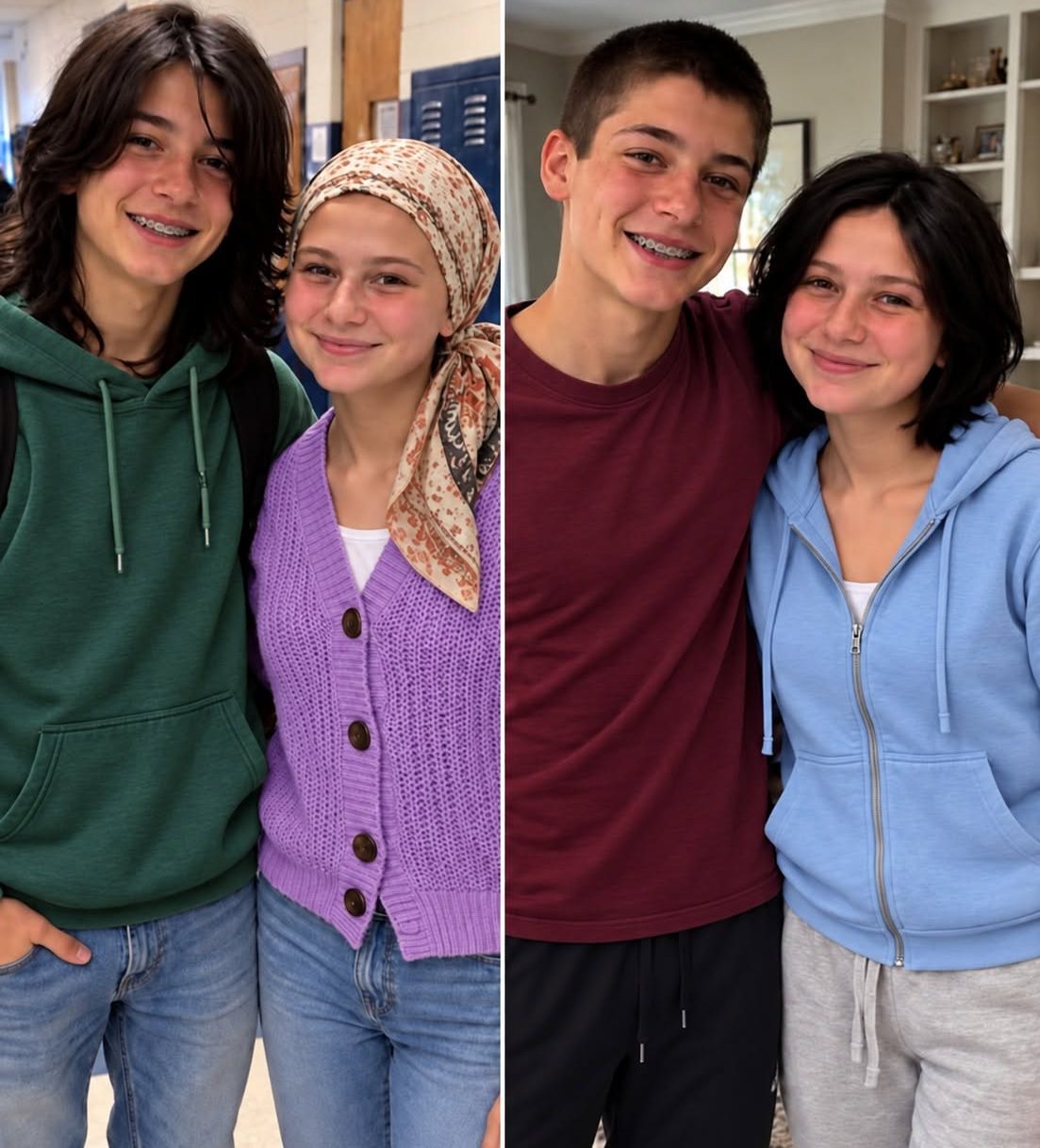
Part 3 – The Plan Nobody Approved
Mr. Harrison lowered the packet onto his desk as if it had suddenly become heavier than paper. The colored tabs fanned out beneath his hand, each one labeled in Ethan’s blocky handwriting, and I could see where he had pressed too hard with the pen and left grooves in the cardstock. Across the top of the cover page, centered beneath the school’s name, he had written MILES FOR LILY in letters large enough to belong on a banner. Underneath, in smaller type, was a sentence that made something cold slide through my stomach: A student-led community fundraiser to help the Bennett family continue Lily’s medical care.
Daniel reached for the packet before Mr. Harrison could say anything else. “Give me that.”
Mr. Harrison kept one hand on it. “Daniel, I think we should go through this carefully.”
“I said give it to me.” Daniel’s voice stayed low, but his face had changed. The anger I had seen when he showed me the pawn-shop receipt had been sharp and controlled; this was different. This was fear trying to disguise itself as authority. “My daughter’s name is on that page.”
Ethan looked up at last. “Mr. Bennett, I wasn’t going to—”
“No.” Daniel turned so quickly his chair scraped against the floor. “You don’t get to tell me what you were going to do. Apparently none of us get told what you’re going to do until after you’ve done half of it.”
The fluorescent lights hummed overhead. Outside the office, somewhere beyond the closed door, the school kept moving through its ordinary morning: lockers slamming, shoes squeaking on tile, a burst of laughter that cut off when a bell rang. It felt obscene that any of it could still be ordinary. I looked at Ethan and saw his hands clenched so tightly in his lap that the knuckles had gone pale.
Mr. Harrison removed his hand from the packet. Daniel snatched it up, scanned the first page, then flipped to the second hard enough to bend the corner. His eyes moved rapidly, stopping on lines I couldn’t yet see. With each page, his mouth tightened. By the time he reached the first colored divider, his breathing had become audible.
“What is this?” he demanded.
Ethan swallowed. “A proposal.”
“I can read the word proposal.”
“It’s for a fundraiser.”
“I can read that too.”
Mr. Harrison shifted in his chair. “Ethan brought me the sealed envelope several weeks ago. He told me it was an idea he wanted me to consider only if a private solution didn’t work.”
Daniel let out a sound with no humor in it. “A private solution. Is that what we’re calling selling stolen property now?”
“Daniel,” I said.
His gaze snapped to me. “Am I wrong?”
I couldn’t answer him. Not because he was being cruel, but because he wasn’t. My husband’s guitar had been stolen from my house by my son and sold without my knowledge. Whatever Ethan had intended, no amount of tenderness could change the shape of that fact.
Ethan stared at the carpet. “I thought the guitar would cover it.”
Daniel slapped one page flat against the desk. “Cover what?”
“The trip.”
“What trip?”
Ethan finally looked at him. “The specialist.”
Daniel’s expression became perfectly still.
I felt the room contract around us.
Mr. Harrison glanced between them. “I think this is the part we need to understand.”
Daniel didn’t move. “No. What we need is for him to stop saying things that aren’t his to say.”
Ethan’s chin lifted a fraction. “Lily told me.”
“I know Lily told you something. That doesn’t mean you understood it.”
“She said you might have to cancel.”
Daniel’s fingers curled around the packet. “She should not have told you that.”
“She was scared.”
“She is fourteen.”
“So am I.”
“That is exactly my point.”
Ethan flinched, and for a second I saw how young he actually was. Not the boy who had planned budgets, not the boy who had walked into a pawn shop carrying his dead father’s guitar, not the boy who had sat across from adults and tried to solve what they had failed to solve. Just fourteen. Fourteen and stubborn and frightened and carrying too much.
I reached for the packet. “Let me see.”
Daniel hesitated, then pushed it toward me with two fingers. “Please. Read what your son was planning to tell hundreds of people.”
The cover page blurred for a moment before my eyes adjusted. Ethan had typed most of it. The formatting was uneven, some margins slightly off, and one heading used a different font from the rest, but it was organized with a seriousness that hurt to look at. There was a mission statement, a proposed date, a list of activities, projected participation fees, donation tiers, and a section marked FINANCIAL TRANSPARENCY.
I flipped to that section.
A paragraph had been highlighted in yellow.
All donations will be administered through the school or an approved charitable partner. Ethan Carter will not collect or personally control donated funds.
My eyes moved lower.
The Bennett family will not be described as requesting assistance. All public materials must state that this fundraiser is being proposed independently by students who wish to support a classmate facing extraordinary treatment-related expenses.
Then I saw the handwritten note in the margin.
Make sure Mr. Bennett can’t say no just because he thinks it’s charity.
I closed my eyes.
“Ethan.”
“I know that sounds bad.”
I looked at him over the packet. “It sounds like you anticipated he might refuse.”
He rubbed his palms against his jeans. “He would’ve.”
Daniel gave a short, disbelieving laugh. “You’re damn right I would have.”
“That’s why it had to be through the school.”
“No,” Daniel said. “That’s why it wasn’t supposed to happen at all.”
Ethan’s voice sharpened. “Then what was supposed to happen?”
Daniel rose halfway from his chair. Mr. Harrison immediately said his name, not loudly, but with enough weight that Daniel stopped. He remained standing for another second, then sat again, shoulders rigid.
“What was supposed to happen,” Daniel said, each word carefully controlled, “was that my wife and I were supposed to make decisions for our daughter.”
“You were going to cancel.”
“You don’t know what we were going to do.”
“Lily did.”
Daniel’s jaw flexed.
I turned another page before the argument could ignite again. The next section was labeled EVENT STRUCTURE. Ethan had built the whole thing around laps on the school track. Students could pledge to walk or run, families could sponsor miles, local businesses could contribute flat donations, teachers could form teams. There were notes beside each idea, some crossed out and rewritten.
No cancer costumes. No shaving heads. Lily hates pity stuff.
I stopped.
The words were so unmistakably Ethan that I could hear him saying them.
Another note read: Don’t put her picture everywhere unless she says yes.
Another: Call it helping with expenses, not saving Lily. She’s not a project.
My throat tightened despite myself.
Daniel leaned across the desk. “Keep reading.”
I did.
There was a section for publicity, but it was full of restrictions. No medical details beyond what Lily approved. No photographs taken from social media. No interviews without family consent. No estimates of prognosis. No mention of the Bennett family’s income, employment, debt, insurance, or private medical records. He had written the word NEVER beside that last sentence three times.
It should have made me feel better.
Instead, it made me feel worse.
Because it meant he knew exactly where the boundaries were.
And he had still decided he was entitled to approach them.
“You knew this was private,” I said.
Ethan’s eyes flicked toward me. “Yes.”
“You knew Lily didn’t want people talking about her.”
“Yes.”
“You knew her parents hadn’t asked for help.”
“Yes.”
“And you made a fourteen-page proposal.”
“Sixteen,” Mr. Harrison murmured.
I looked at him.
He grimaced. “Including appendices.”
Daniel pushed back from the desk again. “Of course there are appendices.”
Ethan’s cheeks reddened. “I was trying to do it right.”
Daniel stared at him. “There was no right way to do this without asking us.”
“I was going to ask before anything started.”
“You had flyers.”
“Drafts.”
“You had a budget.”
“A draft.”
“You had a schedule.”
“It was just—”
“A draft,” Daniel finished bitterly. “Yes, Ethan. I understand what the word means.”
Mr. Harrison reached for the packet. “There are also permission forms.”
Daniel looked at him as if this were somehow worse.
Mr. Harrison turned several pages and held one up. “Ethan prepared draft parental consent language for student participants, a facility-use request for the track, a request for a faculty sponsor, and a preliminary outline for handling funds through an approved account.”
I stared at my son.
“You did all that?”
Ethan shrugged once, an embarrassed twitch of one shoulder. “Most of it is based on the forms from the spring charity run.”
“How did you get those?”
“They’re on the school website.”
Mr. Harrison looked personally offended by the efficiency of that answer. “They are.”
Daniel pressed two fingers against his forehead. “Unbelievable.”
Ethan’s eyes went to the packet again. “I wasn’t trying to embarrass Lily.”
Daniel dropped his hand. “You were planning an event with her name in the title.”
“That was just the working name.”
“You put her name on every page.”
“Because people had to know who it was for.”
“That is the problem.”
The last word cracked through the office. Daniel stopped, closed his eyes, and pressed his lips together until the color drained from them. When he spoke again, his voice had lowered.
“My daughter spends every day having strangers know things about her body she doesn’t want them to know. Nurses know what she weighs. Doctors know when she vomits. Insurance people know which drugs she’s taking. People who barely know us ask me about her blood counts in grocery stores because somebody’s cousin told somebody’s aunt.” He looked directly at Ethan. “When she goes to school, she wants to be Lily. Not the sick girl. Not the brave girl. Not the fundraiser.”
Ethan’s face crumpled slightly before he pulled it back into control. “I know.”
“No, you don’t.”
“I do.”
“You grew your hair for her. Do you understand why she could accept that?”
Ethan didn’t answer.
Daniel pointed toward him. “Because it was yours to give.”
The sentence landed harder than shouting would have.
I looked down at the pages in my hands and saw the line beneath the title: Proposed by Ethan Carter, Grade 9. The name felt absurdly small compared with the machinery he had tried to set in motion. Sixteen pages. Permissions, money, publicity, adults, students, businesses. An entire system built by one child around the private terror of another.
Ethan’s voice had gone rough. “The specialist wasn’t going to wait for everybody to feel comfortable.”
Daniel’s chair creaked as he leaned forward. “Do not talk to me about waiting.”
“I heard her crying.”
“And that gave you permission?”
“She said you might cancel the trip because you couldn’t afford the hotel and the flights and your time off and whatever insurance wasn’t—”
“Stop.”
Ethan stopped.
Daniel’s face had gone gray.
Mr. Harrison folded his hands. “Ethan, where exactly did you hear this conversation?”
Ethan glanced at me, then away. “It wasn’t a conversation.”
Daniel’s expression changed.
“What do you mean?”
Ethan took a breath. “Lily told me.”
“When?”
He looked at the clock on the wall as if the answer might be written there. “Two weeks ago. At lunch.”
Daniel’s brow furrowed. “She told you all of that at lunch?”
“Not all of it.”
“What did she say?”
Ethan picked at the seam of his jeans. “She said she heard you and Mrs. Bennett talking. She said you thought maybe there wasn’t enough money to make the trip happen. She said the appointment was still scheduled but you were talking about calling and giving it up.”
Daniel closed his eyes.
For several seconds, the only sound was the faint rattle of the air vent.
Then Daniel said, “She wasn’t supposed to hear that.”
Ethan looked at him. “But she did.”
“You think I don’t know that now?”
“She thought it was because she was too expensive.”
Daniel recoiled as though Ethan had struck him.
I put the packet down.
Even Mr. Harrison went still.
Ethan’s eyes filled, but he kept going. “She said maybe it would be easier if she told you she didn’t want to go. She said she could pretend she was tired of doctors so you wouldn’t feel bad.”
Daniel’s mouth opened, then closed again.
“She said that?” he asked.
Ethan nodded.
Something in Daniel’s face broke. Not dramatically. There was no sob, no collapse, no sudden softness. It was smaller than that and somehow worse: his eyes lost focus, and his hands fell open on his knees as if he had forgotten what he was holding them for.
“She said she was too expensive?”
“Yes.”
Daniel looked at the floor.
I watched him struggle not to let us see the effect of those words. He drew one breath, then another, each measured and deliberate. When he finally lifted his head, his eyes were wet, but his voice was steady.
“That was not her burden.”
Ethan whispered, “I know.”
“No, apparently none of you know.” Daniel scrubbed a hand across his face. “Her mother and I were discussing options. That is what parents do. We discuss ugly possibilities where our children can’t hear us, or where we think they can’t hear us. We weren’t telling her she was too expensive. We were trying to figure out whether we could put another ten thousand dollars on cards we’re already struggling to pay.”
Mr. Harrison leaned back slowly. “Daniel.”
Daniel shook his head. “No. I’m not giving numbers. I’m not doing this.”
“You don’t have to.”
“I already did.”
The room seemed suddenly too bright.
I thought of all the times I had shut a door before talking about money after my husband died. Bills at the kitchen table after Ethan went upstairs. Insurance paperwork turned facedown when he entered the room. The guitar moved from one closet to another because selling it would have helped, because keeping it hurt, because some things become more precious when they are useless.
I looked at my son and wondered how many closed doors he had been listening through in his life.
“What happened after Lily told you?” I asked.
Ethan hesitated.
Daniel’s gaze sharpened. “Answer her.”
“She got upset.”
“That’s not what your mother asked.”
Ethan swallowed. “She said she shouldn’t have told me.”
“And?”
“She told me to forget it.”
Daniel’s face went blank.
I felt the answer before Ethan finished.
“She asked you to forget?”
“Yes.”
“Exactly like that?”
“Pretty much.”
Daniel leaned forward. “Did she ask you not to tell anyone?”
Ethan’s shoulders tightened.
“Ethan,” I said.
“Yes.”
Daniel stood.
This time Mr. Harrison didn’t tell him to sit.
Daniel walked to the window, which looked out over a rectangle of brown autumn grass and the edge of the parking lot. He placed both hands on the sill and bowed his head. In the glass, I could see his reflection: a man trying to keep his anger from turning toward a child because he knew the child had acted out of love and because love, in that moment, did not make anything easier.
“You promised her,” he said.
Ethan’s eyes closed.
“Yes.”
“You promised my daughter you would keep something private.”
“I didn’t tell anybody what she said.”
Daniel turned from the window. “You wrote a fundraising proposal.”
“I didn’t include what she said.”
“You included enough.”
“I didn’t use numbers.”
“You included a specialist trip.”
“That’s the reason for the fundraiser.”
“You included treatment expenses.”
“That’s true.”
“You used her name.”
“It was a draft.”
Daniel pointed toward the packet. “Stop hiding behind that word.”
Ethan’s face flushed. “I wasn’t going to publish anything without permission.”
“You had already decided what permission was acceptable.”
“That’s not fair.”
For the first time, anger flashed fully across Ethan’s face. It startled me because until then he had mostly looked ashamed. Now he looked cornered.
Daniel saw it too. “Not fair?”
Ethan stood so suddenly his knees bumped the underside of the desk. “You were going to let her miss it.”
“Sit down.”
“You were.”
“I said sit down.”
“You keep saying it was your decision, but Lily’s the one who has cancer.”
Daniel went white.
Mr. Harrison rose. “Ethan.”
But Ethan couldn’t stop now. The words had been waiting behind his teeth for weeks.
“She was scared you were going to cancel because of money. She thought it was her fault. She cried in the cafeteria and then made me promise not to say anything because she didn’t want you mad at her. So I tried to fix it. Maybe I did it wrong, okay? Fine. I did it wrong. But everyone keeps acting like I did this because I wanted attention.”
“No one said that,” I told him.
“You’re all looking at me like I’m some thief who wanted to make a big show out of her being sick.”
“You did steal,” I said quietly.
His eyes met mine, and I watched the anger collapse.
“I know.”
The words came out small.
I stood and moved toward him, but stopped before I touched him. I wanted to pull him against me. I wanted to shake him. I wanted to go back three days and lock the guitar in my bedroom, go back two weeks and somehow be in the cafeteria, go back a year and make cancer happen to nobody.
“Ethan,” I said, “there is a difference between why you did something and whether you had the right to do it.”
His mouth trembled. He nodded once.
Mr. Harrison gathered the scattered pages into a neat stack. “There is another page everyone should see.”
Daniel looked exhausted already. “What now?”
“The statement Ethan intended to make.”
Ethan’s head snapped toward him. “You don’t have to read that.”
“I think we do.”
“No.”
Mr. Harrison regarded him carefully. “Why?”
Ethan looked at me.
That was when I understood.
Whatever was on that page was not about Lily.
It was about him.
Mr. Harrison found the section near the back and held it out to me. The title was PUBLIC STATEMENT — ETHAN CARTER. Beneath it, Ethan had typed several paragraphs, then edited them by hand. Whole lines were crossed out. Words had arrows connecting them. The paper looked more personal than anything else in the packet because he had clearly fought with every sentence.
I began reading silently.
Then my heart lurched.
“No.”
Ethan looked down.
Daniel said, “What?”
I stared at my son. “Absolutely not.”
“What does it say?” Daniel asked.
I slid the page onto the desk, unable to keep holding it.
Mr. Harrison read the first lines. His voice was gentle but formal, as if the distance of reading might make the words safer.
“If people are wondering why I care so much about this fundraiser, I want to explain something before anyone says Lily or her family asked me to do it. They didn’t. Lily never asked me for money.”
Daniel’s expression didn’t change, but his arms folded tighter across his chest.
Mr. Harrison continued. “I sold something that belonged to my family because I thought I could cover the expenses privately. The thing I sold was a vintage guitar that belonged to my father before he died.”
He stopped.
My vision narrowed around the edges.
Ethan’s voice was barely audible. “Mom.”
I shook my head. “You were going to tell the whole school?”
“Only if the fundraiser happened.”
“That is not an answer.”
“I didn’t want people blaming Lily.”
“So you were going to announce that you stole from me?”
Ethan winced. “I was going to say I sold it.”
“You did not own it.”
“I know.”
“Then the word is stole.”
“I know.”
The fury came up so fast it surprised me. I had spent so long since arriving at the school trying to understand him that anger had kept slipping behind shock. Now it found me. I could feel it in my face, my hands, the tightness of my jaw.
“That guitar was your father’s.”
“I know.”
“It was one of the only things I kept exactly the way he left it.”
“I know.”
“You knew I wouldn’t even let your uncle borrow it.”
“I know.”
“You knew I had turned down offers for it.”
His eyes filled again. “Yes.”
“And you were prepared to stand in front of the entire school and tell them you sold it, like that was your sacrifice to explain?”
“No.”
“What else would you call it?”
Ethan shook his head hard. “I was going to say I was wrong to take it.”
I looked at the page.
Mr. Harrison silently passed it back.
I read further.
I made a choice without asking my mother because I was afraid she would say no. She would have had the right to say no. The guitar belonged to my dad and then to our family, not just to me. I am not asking anyone to think what I did was okay. I am explaining it because Lily did not ask me to do it and because nobody should think her family took something from mine.
I had to stop.
My husband’s hands flashed through my mind. His thumb rubbing the worn edge of the guitar pick. Ethan at six sitting cross-legged on the carpet, staring up at him. The sound of an E chord vibrating through our old living room. Then the same guitar silent in its case for years after the funeral.
I hated that Ethan had taken it.
I hated that he understood exactly why telling people about it might protect Lily.
I hated most of all that both things could be true at once.
Daniel took the page from me. He read quickly, then slowed near the bottom.
His eyes shifted to Ethan.
“You were going to tell people not to donate if they felt sorry for you.”
Ethan shrugged. “Yeah.”
“Why?”
“Because that’s not the point.”
Daniel read aloud, “‘If you give, give because a family should not have to decide whether they can reach a doctor because of airfare and hotel bills. Do not give because you think I am a good person for selling a guitar. I did something wrong and I will deal with that at home.’”
Ethan looked miserable. “That part needed work.”
Daniel stared at him for a long time.
Then he put the page down.
“I don’t know whether to admire you or ground you myself.”
“I’ve got the grounding covered,” I said.
For the first time since I entered the office, Daniel almost smiled. It appeared for less than a second, a twitch at one corner of his mouth, then vanished under exhaustion.
Mr. Harrison sat again. “There’s something else Ethan did correctly, even if the premise itself was not approved.”
Daniel sighed. “I’m afraid to ask.”
“He did not submit the plan publicly.”
Ethan glanced at him.
Mr. Harrison continued. “He brought me a sealed envelope and told me to review it only if he came back and said his private attempt had failed. I placed it in my locked office cabinet. As far as I knew, no one else had seen it.”
“As far as you knew?” Daniel repeated.
The principal paused.
I caught it.
“So someone did?”
“I didn’t say that.”
“You almost did.”
Mr. Harrison adjusted his glasses. “I am saying I want us to distinguish between what Ethan planned and what he actually initiated. At this moment, I have no reason to believe he launched any fundraiser.”
Daniel pointed at the packet. “He drafted one.”
“Yes.”
“He planned to use the school.”
“Yes.”
“He planned to use my daughter’s name.”
“With permission, according to the proposal.”
Daniel’s face hardened again. “You keep adding that as if it fixes the problem.”
“It does not fix it.” Mr. Harrison’s voice became firmer. “But it matters.”
“Why?”
“Because intent matters when I decide whether a student violated school policy.”
Daniel blinked at him.
Mr. Harrison turned toward Ethan. “And boundaries matter when I decide whether a student requires consequences.”
Ethan sank lower in his chair.
“This is not a clever project, Ethan. You did not have authority to solicit on behalf of another family. You did not have approval to use school facilities, our name, our accounts, or our student body. Preparing drafts is not itself a disciplinary violation, but had you circulated any of this as official, we would be having a different conversation.”
“I know.”
“I’m not convinced you do.”
Ethan looked at him.
Mr. Harrison tapped the packet. “You built this as though permission were a final administrative box to check.”
Ethan frowned slightly. “Isn’t it?”
“No.”
Mr. Harrison leaned forward. “Permission is where the process starts.”
The words seemed to reach him in a way some of ours hadn’t. Ethan stared at the colored tabs, his brow furrowed. I could almost see him rearranging the logic in his head.
Daniel noticed too.
“That,” he said quietly, “is what I’ve been trying to tell you.”
Ethan looked at him. “I thought if I had everything ready, people would be more likely to say yes.”
“Exactly.”
Ethan hesitated.
Daniel spread his hands. “You weren’t asking. You were presenting us with a machine already built and making us the people who had to unplug it.”
Ethan’s shoulders dropped.
“Oh.”
The sound was small enough that none of us spoke for a moment.
I wanted to hold onto that moment because it felt like the first time he truly saw the shape of what he had done. Not the guitar. Not the money. Not even the secrecy. The pressure.
Mr. Harrison closed the folder. “I think Lily needs to be part of this conversation.”
Daniel immediately shook his head. “No.”
“She is already part of it.”
“She is in class.”
“So is Ethan.”
“She is undergoing chemotherapy.”
“And she is fourteen,” Mr. Harrison said. “Which means people keep making decisions around her while also saying they’re protecting her.”
Daniel stared at him.
Mr. Harrison’s tone softened. “I am not suggesting we interrogate her. I am suggesting that if this discussion is about what she told Ethan and what she wants kept private, we should hear what she actually wants.”
Daniel’s mouth tightened.
I watched him fight the instinct to refuse.
Finally he looked toward the office door. “She’s going to hate this.”
Ethan gave a miserable laugh. “Yeah.”
Daniel’s eyes cut toward him. “You don’t get to sound amused.”
“I’m not.”
Mr. Harrison reached for his phone. “I’ll have her sent down discreetly.”
Daniel held up a hand. “Tell them I’m here.”
Mr. Harrison nodded. “Of course.”
The call lasted less than a minute. Afterward, nobody seemed to know what to do with the silence. Ethan sat with his elbows on his knees. Daniel remained by the window. I picked up the public statement again and reread the line about my right to say no until the words stopped looking like language.
When the knock finally came, Ethan went rigid.
Mr. Harrison opened the door himself.
Lily stood in the hallway wearing a soft gray knit cap and a dark green sweatshirt two sizes too large. Her backpack hung from one shoulder. She looked tired in the specific way I had learned not to comment on—skin a little too pale, shadows under her eyes, posture held upright through intention rather than energy. Her gaze moved from Mr. Harrison to her father, then me, then Ethan.
She stopped.
“What happened?”
Daniel crossed the room at once. “Nothing happened to you.”
“That is a weird answer.”
“Lily—”
“Dad, why are you here?”
Her eyes moved to the papers on the desk.
Then to Ethan.
His face told her before anyone else could.
“Oh no.”
Ethan stood. “Lily.”
“What did you do?”
He opened his mouth.
She dropped her backpack beside the door. “What did you do?”
Daniel stepped between them slightly, not blocking her but making the distance clear. “We found out Ethan sold something valuable to give us money.”
Lily’s eyes widened.
Ethan said quickly, “It wasn’t—”
She pointed at him. “Be quiet.”
He closed his mouth.
I had never heard Lily speak to him like that.
She looked at her father. “What did he sell?”
Daniel glanced at me.
Lily followed his eyes and understood the answer involved me too.
“What?”
I said, “His father’s guitar.”
The color drained from her face.
She stared at Ethan. “Your dad’s guitar?”
He nodded.
“The brown one?”
Another nod.
“The one nobody’s allowed to touch?”
Ethan looked at the floor. “Yeah.”
Lily made a strangled noise and pressed both hands to her face. For a second, I thought she might cry. Instead she dragged her hands downward and glared at him with an intensity that made him take half a step back.
“Are you insane?”
“Maybe.”
“Don’t joke.”
“I’m not.”
She walked toward him, stopped two feet away, and whispered, “I told you to forget it.”
Ethan’s face tightened.
Daniel looked at his daughter. “So you did tell him.”
Lily closed her eyes.
“Dad.”
“I’m not angry at you.”
“You sound angry.”
“I’m angry at several things. You are not currently one of them.”
She gave him a look that said she did not entirely believe him, but she turned back to Ethan.
“I told you one thing because I was freaking out.”
“I know.”
“You said you wouldn’t tell anybody.”
“I didn’t.”
Her eyes flicked to the papers. “What is that?”
Ethan said nothing.
Lily stepped toward the desk and picked up the cover page.
I watched her read the title.
Her expression went utterly still.
“Miles for Lily.”
Ethan winced.
She looked at him over the page. “Seriously?”
“It was a working title.”
Daniel muttered, “He likes that phrase.”
Lily flipped to the next page.
Then the next.
Her movements grew faster.
“What is this?”
“A fundraiser idea,” Ethan said.
“I can see that.”
Daniel looked briefly at the ceiling.
Ethan noticed and muttered, “Okay, apparently everybody says that.”
Lily ignored him. She found the publicity section. I watched her eyes move down the bullet points. Her finger stopped beside No photographs unless Lily approves.
“You wrote rules about pictures of me?”
“I thought you’d want rules.”
“I don’t want a fundraiser.”
“I know that now.”
“You knew that then.”
“I knew you didn’t want people making a huge deal out of you being sick.”
“That is the same thing.”
“I didn’t think it had to be.”
Her eyes flashed. “Of course you didn’t.”
Ethan recoiled.
Lily’s voice stayed quiet, which made it worse. “You get to go home after school and stop being the kid with cancer.”
“I never said—”
“You get to grow your hair and people think you’re weird for a while, and then you cut it and everybody thinks you’re amazing. I go to math class and someone asks if I’m dying because they heard their mom talking about me at dinner.”
Ethan’s face crumpled. “Lily.”
“No. You don’t get to ‘Lily’ me right now.”
She held up the packet. Her hand was shaking.
“You were going to put my name on a track event.”
“I was going to ask.”
“After writing sixteen pages?”
He blinked. “How do you know it’s sixteen?”
She looked down at the packet, then back at him. “There are page numbers, genius.”
Despite everything, Mr. Harrison coughed into his fist.
Ethan almost smiled, then remembered he had no right to.
Lily sank into the empty chair beside her father. The burst of anger seemed to have cost her. She leaned back and closed her eyes for a moment.
Daniel crouched beside her. “You okay?”
“I’m fine.”
“You look tired.”
“Please don’t.”
He stopped.
That tiny exchange told me more than any speech could have. Lily wanted exactly what Daniel had said she wanted: the right to define herself from minute to minute. Not brave unless she chose brave. Not tired unless she admitted tired. Not fragile because someone else was frightened.
She opened her eyes and looked at Ethan again.
“How much?”
He hesitated.
“How much did you sell the guitar for?”
“Thirty-two hundred.”
Lily stared at him.
Then she looked at her father.
“Did you take it?”
Daniel’s jaw tightened. “I have the money.”
“That’s not what I asked.”
He looked at her.
“Did you use it?”
“No.”
Some tension left her face.
Ethan noticed. “Why does that make you feel better?”
She looked at him as though he had asked something astonishingly stupid. “Because it was stolen.”
He looked away.
“I thought it would help.”
“I know.”
“You said the trip might not happen.”
“I was scared.”
“You were crying.”
“I was having a bad day.”
“You said—”
“I know what I said.”
Her voice cracked.
Everyone stopped.
Lily gripped the edge of the chair. “I know exactly what I said, Ethan. I said maybe they couldn’t afford it. I said maybe I should tell them I didn’t want to go. I said maybe all of this was costing too much.” She swallowed hard. “And then I went home and felt horrible because I knew I wasn’t supposed to hear them talking about it in the first place.”
Daniel’s face tightened. “Lily.”
She looked at him. “You were in the kitchen. You thought I was asleep.”
He nodded once.
“I heard Mom say we couldn’t keep doing this forever.”
Daniel closed his eyes.
“I know she meant the money,” Lily said. “I know she didn’t mean me. I know that now.”
His voice was hoarse. “She never meant you.”
“I know.”
“No. I need you to hear me. There is no amount of money that makes you too expensive.”
Lily’s eyes filled.
She looked away fast. “Can we not do this in the principal’s office?”
Daniel stood, helpless anger crossing his face because he had a thousand things to tell his daughter and she was asking him not to tell them here.
“Fine,” he said softly.
Lily rubbed her thumb against the edge of the fundraiser packet. “I told Ethan because I was panicking. Then I told him to forget it because it wasn’t his problem.”
Ethan spoke before he could stop himself. “You’re my best friend.”
She turned toward him.
“I know,” she said. “That still doesn’t make everything my problem your problem.”
He stared at her.
She gave a tired little shake of her head. “You always do this.”
“What?”
“You decide something matters, and then you go completely insane.”
“I don’t.”
“You built a solar-powered phone charger in seventh grade because Mr. Harrison said students were wasting electricity.”
Mr. Harrison blinked. “That was you?”
Lily ignored him. “You spent three months teaching yourself how to replace my bike chain because I said the repair shop charged too much. You once stayed up until four in the morning making thirty cupcakes because I forgot I volunteered us for the bake sale.”
“That was your fault.”
“Yes. And you still made thirty cupcakes.”
“Twenty-eight.”
“You ate two.”
“That doesn’t change how many I made.”
For the first time, Lily’s mouth twitched.
Then she looked down at the cover page again and the almost-smile disappeared.
“This isn’t cupcakes.”
“No.”
“This isn’t a bike.”
“I know.”
“You don’t get to fix everything.”
Ethan swallowed.
“I know.”
She studied him. “Do you?”
He took longer to answer this time.
“I think I’m starting to.”
Lily placed the packet on the desk.
“Good.”
Daniel straightened. “Then we agree this fundraiser is not happening.”
Ethan’s head lifted.
Lily looked at her father.
Mr. Harrison folded his hands.
I said, “Yes.”
Ethan turned to me. “Mom.”
“No.”
“But—”
“No, Ethan.”
He looked stunned by the finality of it.
I stepped closer to him. “The guitar is gone because you made a decision that wasn’t yours to make. We are going to try to get it back.”
His face changed. “How?”
“I don’t know yet.”
“They might have sold it.”
“I know.”
“If they did, the money—”
“Is not yours to give away.”
He opened his mouth.
I raised a hand. “Listen to me. You are going to hear this all the way through.”
He closed his mouth.
“I love that you wanted to help Lily. I love that you were willing to give something up. I even understand why, in your head, the guitar became something you could trade for a chance she might otherwise lose.” My voice shook despite my effort to steady it. “But you did not give up something that belonged only to you. You gave up something that belonged to our family. And then you tried to solve another family’s private crisis without their permission.”
Ethan stared at the floor.
“The fundraiser is over,” I said. “We will contact the pawn shop. We will find out whether the guitar can be recovered. Mr. Bennett will keep the money untouched until we know what is possible. And you are not making any more plans about Lily’s treatment, her family’s finances, or school fundraising.”
His jaw clenched.
I waited.
Finally he nodded.
“Okay.”
Daniel exhaled slowly.
Lily looked at Ethan. “Thank you.”
He looked at her sharply.
She shrugged. “For not arguing more.”
“I could.”
“I know.”
That faint almost-smile appeared again.
Mr. Harrison began gathering the pages into order. “For what it’s worth, the plan will remain with me. It won’t be copied or circulated.”
Daniel nodded. “I appreciate that.”
“I’ll also speak with the relevant staff and make certain no one discusses today’s meeting.”
“Thank you.”
Mr. Harrison stacked the pages against the desk twice to square them. One sheet slipped out and fluttered to the floor near his chair. He bent to retrieve it, frowned, and turned it over.
“What?”
He looked at Ethan. “This has a student council filing mark.”
Ethan frowned. “What does that mean?”
Mr. Harrison held up the bottom corner. There was a tiny blue stamp I hadn’t noticed before.
“Why is this stamped?”
“I don’t know.”
“Did you submit any portion of this to student council?”
“No.”
“Did you show it to anyone on student council?”
Ethan shook his head. “No.”
Lily sat up straighter. “Then why does it have a stamp?”
Mr. Harrison’s frown deepened. He pulled more pages from the packet and checked the corners. The first three had nothing. The fourth bore the same tiny blue mark.
Then the sixth.
Then the budget sheet.
Daniel’s voice changed. “Mr. Harrison.”
“I see it.”
“What does the stamp mean?”
Mr. Harrison looked toward his computer.
“It means these pages passed through the student council workroom.”
Ethan stood. “That’s impossible.”
Mr. Harrison was already moving behind his desk. He woke the computer and typed his password, faster than I had seen him move all morning.
“How?” I asked.
“The student council office has a shared printer and document scanner. Draft event proposals are often marked when volunteers sort them.”
“I never sent it there,” Ethan said.
“Could someone have copied it?”
“I gave the envelope to you.”
“I know.”
Daniel came around the desk. “Who had access?”
Mr. Harrison’s face tightened. “My administrative assistant. Me. Custodial staff have keys for cleaning. But the envelope was in my cabinet.”
“Locked?”
“Yes.”
Lily looked at Ethan. “Did you make another copy?”
“No.”
“Are you sure?”
“Yes.”
Mr. Harrison clicked through something on his screen.
Then his office phone rang.
All five of us froze.
The sound was painfully ordinary.
One ring.
Two.
Mr. Harrison picked it up. “Harrison.”
He listened.
His expression changed.
“Yes.”
Another pause.
“No, I did not authorize that.”
He looked at Ethan.
“What account?”
Ethan’s face went pale.
Mr. Harrison turned slightly away from us. “Who created it?”
Daniel stepped closer.
Mr. Harrison held up one finger, asking for silence.
“No. Do not send me a link over the school messaging system. Email it directly to my administrative account.” He listened again, eyes narrowing. “How many?”
I felt Ethan move beside me.
Mr. Harrison stared at the blank wall.
“When?”
Another pause.
“No. Do not respond to anyone. Do not post anything else. Lock comments if you can do so without deleting the page. I’m coming to you in a moment.”
He hung up.
Nobody spoke.
Daniel broke first. “What happened?”
Mr. Harrison didn’t answer immediately. He sat down and opened his email.
“Mr. Harrison.”
“I’m checking something.”
“What happened?”
A new message appeared.
He clicked it.
I couldn’t see the screen from where I stood, but I saw the light from it change across his face.
His mouth opened slightly.
Ethan whispered, “What?”
Mr. Harrison scrolled.
Then scrolled again.
“Oh, God.”
Daniel came around the desk so fast his hip struck the corner. “Show me.”
Mr. Harrison turned the monitor halfway.
A webpage filled the screen.
At the top was a photograph.
Not of Lily.
Of the fundraiser proposal.
The cover page.
MILES FOR LILY.
Below it was another photograph showing the event outline, slightly crooked, as though someone had taken it quickly with a phone.
A bright donation button sat beneath the images.
Lily stood.
“No.”
Ethan moved toward the desk. “I didn’t make that.”
Daniel’s face had gone dark with fury. “Take it down.”
“I don’t control it.”
“Then call whoever does.”
“I’m going to.”
“Now.”
Mr. Harrison clicked through the page.
Comments streamed beneath the post.
Praying for Lily.
What an incredible friend.
This young man sold his late father’s guitar to help her.
Our family donated. Stay strong, Lily!
Someone had written the guitar part in capital letters.
I looked at Ethan.
He looked sick.
“I never posted my statement.”
Mr. Harrison clicked another image.
It was Ethan’s public statement.
The whole page.
My stomach dropped.
“No.”
Lily whispered, “Everybody knows.”
Daniel put an arm around her shoulders. She didn’t shrug it off this time.
Mr. Harrison’s phone began ringing again.
Then his computer chimed with a new email.
Then another.
He muted the phone.
“Someone photographed the packet.”
Daniel’s eyes burned. “Who?”
“I don’t know yet.”
“Find out.”
“I will.”
Lily stared at the screen as if it had betrayed her personally. “How many people saw it?”
Mr. Harrison scanned the page.
“It’s been shared locally.”
“How many?”
He didn’t answer.
“Mr. Harrison.”
His eyes moved to the fundraising total.
He went completely still.
Ethan looked over his shoulder.
“What?”
Mr. Harrison reached out and turned the computer toward us.
At the center of the page, beneath a progress bar that had already raced far past its first marked goal, glowing numbers showed the amount collected.
$18,437.
The total changed while we watched.
$18,512.
A new donation notification slid onto the screen.
Lily made a choking sound.
Daniel gripped the back of the chair.
Ethan stared at the numbers in horror.
Mr. Harrison looked from the screen to him.
“The unfinished fundraiser has already collected more than eighteen thousand dollars from strangers who believe you launched it.”
Part 4 – When a Secret Becomes Everyone’s Business
Daniel’s voice was low enough that, for one strange second, it frightened me more than if he had shouted. He stood behind Lily’s chair with both hands pressed against its wooden back, his knuckles pale, while the number on Mr. Harrison’s computer kept changing as if none of us were in the room at all. $18,512 became $18,587. Then $18,612. Every small electronic chime sounded obscenely cheerful.
Mr. Harrison was already reaching for his phone. “I understand what you’re asking me to do, Mr. Bennett. I’m trying to determine who created the page first. The school did not authorize this. Ethan did not authorize this. If it’s attached to a private account—”
“I didn’t ask who authorized it.” Daniel leaned closer, and I saw the tendons stand out in his wrists. “I said take it down.”
Lily sat very still beneath his shadow. She had pulled the sleeves of her sweatshirt over her hands, and only the pale tips of her fingers showed as she stared at the screen. The fluorescent lights turned her skin almost translucent. Ethan was two chairs away from her, equally pale, his fresh haircut still strange to me after months of seeing his hair fall into his eyes and brush his shoulders.
Mr. Harrison dialed a number from the fundraising page. “I am calling the organizer.”
Ethan found his voice first. “It says who made it?”
Mr. Harrison looked at him, then at me. “It lists a parent organizer, but the account appears to have been created this morning.”
Daniel let out a humorless breath. “A parent. Of course.”
Lily looked up at him. “Dad.”
“No.” He didn’t look down. “No, Lily. You do not have to comfort me because other people decided your life belonged to them.”
The words hit harder than he intended. I saw Ethan flinch as if Daniel had turned and struck him.
Daniel saw it too.
His jaw tightened, but he did not take the words back.
Mr. Harrison lifted one finger as someone answered. “Hello. This is James Harrison, principal at Westbridge Middle School. I’m calling about a fundraising page created under the title ‘Miles for Lily.’ Yes. Yes, that one.” His face changed while he listened. “I understand you were trying to help. What I need to know is where you obtained the proposal documents.”
The office seemed to shrink around his voice. Somewhere outside, a bell rang for the end of a class period. Almost immediately, footsteps flooded the hallway, lockers clanged, voices rose, and then, as if someone had turned down a dial, the noise passed us by.
Mr. Harrison’s eyes moved toward the student council folder still open on his desk.
“I see,” he said.
Daniel’s grip on the chair tightened. “Who?”
Mr. Harrison held up a hand, listening. “No, please don’t delete anything yet. I know that sounds counterintuitive, but there are donations involved now. We have to preserve the record and make sure the money is handled correctly. Yes. I understand. Please do not transfer funds anywhere.”
Daniel stepped away from Lily’s chair so abruptly that one leg scraped across the floor. “Handled correctly? There is no correctly. There is return it.”
Mr. Harrison covered the phone. “That may be possible.”
“May?”
“Eighteen thousand dollars from dozens of donors is not cash in an envelope. We need to know what platform rules apply and whether each donor must be refunded individually.”
Daniel stared at him for a moment, then turned toward the window. The blinds were half open, and through them I could see students crossing the courtyard in small groups. Two girls stood near the bike rack with their heads bent over one phone. One of them looked toward the administrative wing.
I wondered if they were looking at us.
Then I knew they were.
The girl holding the phone whispered something, and both of them turned.
Mr. Harrison ended the call and set his phone down carefully. “The parent says she created the page after her daughter sent her photographs of Ethan’s proposal. She believed the proposal had already been approved and that the school was waiting for someone to build the online donation page.”
“Her daughter.” Daniel turned back. “Which daughter?”
Mr. Harrison hesitated.
“You know.”
“Yes.”
“Say it.”
“I am not going to identify another minor in this room while I am still determining exactly what happened.”
Daniel laughed once, without amusement. “You’re worried about her privacy?”
Lily closed her eyes.
Mr. Harrison’s expression tightened. “Yes. I am. Because the answer to one privacy violation is not another.”
That stopped Daniel, though only barely. He walked to the corner of the office and back again, the way a man might pace beside a hospital bed when standing still became impossible. His face had lost some of its anger and gained something worse: fear. I recognized it because I had worn it myself after Ethan’s father died, during those first terrible weeks when every decision felt like it might destroy whatever remained.
Ethan stared at the carpet. “It was probably someone from student council.”
Mr. Harrison looked at him. “Why do you say that?”
“Because that’s where you left the folder.”
“I did not leave it there unattended.”
“You left it with the council packet.”
“For one meeting.”
“That’s enough.”
“Ethan.” I heard the warning in my own voice, sharp and automatic. He looked at me at last, and I hated how quickly shame entered his face.
Mr. Harrison did not seem offended. “He’s right. One meeting was enough.”
Daniel stopped pacing. “So a student photographed private medical information from a document your office allowed into a student council meeting, sent it around, and then a parent turned it into a fundraiser.”
“The proposal did not include Lily’s detailed medical records.”
“It had her name.”
“Yes.”
“It had cancer.”
“Yes.”
“It said we couldn’t afford the trip.”
Mr. Harrison’s mouth tightened. “Yes.”
Daniel spread his hands. “Then spare me the distinction.”
No one answered.
Lily looked at the computer again. The total had climbed past nineteen thousand dollars.
“Can you make it stop moving?” she asked.
Her voice was so quiet Mr. Harrison almost missed it.
He reached across the desk and turned the monitor away from her.
That simple motion broke something.
Lily pressed the covered heels of her hands against her eyes. Her shoulders shook once, then went rigid as she fought whatever was trying to come out. Daniel moved toward her, but she lowered her hands immediately.
“I’m fine.”
“Lil—”
“I said I’m fine.”
He stopped.
I knew that tone. Not because Lily sounded like Ethan. She didn’t. Ethan’s anger came hot and clumsy, all force and no shield. Lily’s was thinner, colder, built for surviving questions she was tired of answering.
Mr. Harrison’s phone buzzed again.
Then mine did.
I pulled it from my bag and saw three messages from numbers I knew only vaguely from school events.
Rachel, is this Ethan???
I just saw the post. Your boy is incredible.
Please tell me where we can donate directly.
I turned the screen facedown.
Ethan had seen enough to understand.
“People are texting you.”
“Yes.”
“I’m sorry.”
I almost said, You should be.
The words rose fast, fueled by the image of that empty wall in my house where his father’s guitar had hung for years. By the pawn receipt. By Ethan standing in this same office telling me he would rather lose the guitar than let Lily lose a chance. I was still furious. I still had no idea whether the guitar was even recoverable.
But when I looked at him, I saw a fourteen-year-old boy staring at a disaster that had outgrown every choice he had made.
“Sorry doesn’t fix this,” I said instead.
“I know.”
Daniel turned toward him. “Do you?”
Ethan lifted his head.
Daniel came closer, not threateningly, but with an intensity that made Ethan sit straighter. “Do you understand what it feels like for my daughter to walk through school today knowing that every person who looks at her might know we are broke?”
Lily’s eyes opened. “Dad.”
He kept looking at Ethan. “Do you understand what it feels like for her to wonder whether every smile is pity now? Whether every person who says hello is thinking about chemo? About money? About whether she’s going to die?”
“Daniel,” I said.
“No. He needs to hear it.”
Ethan swallowed. “I do hear it.”
“You didn’t before.”
“No.”
Daniel waited.
Ethan’s hands had closed around the edge of his chair. “I thought if people knew it was my idea, they wouldn’t blame Lily.”
Daniel stared at him. “That was the problem. You thought you could control what hundreds of people would think.”
“I know.”
“You thought you could hand them the right paragraph and make them behave.”
“I know.”
“You thought because you meant to protect her, you were allowed to decide for her.”
Ethan’s face tightened. “I know.”
Lily finally looked at him. For a second, I expected anger. Instead there was exhaustion.
“No, you didn’t,” she said.
Ethan went still.
Lily pulled her sleeves back from her hands and folded them in her lap. “You know now. You didn’t know then.”
He looked at her as if the distinction hurt worse.
“I’m sorry.”
“I know.”
“I should’ve listened when you told me to forget it.”
“Yes.”
“I just—”
“Don’t.”
He stopped.
Lily took a breath, and her mouth trembled. “Please don’t explain it again. I know why you did it. That’s what makes it harder.”
The room went silent except for the muffled pulse of voices outside the door.
Then someone knocked.
Mr. Harrison stood immediately and opened the door only a few inches. A secretary’s voice came through too softly for me to make out every word, but I heard local station, voicemail, and reporters.
Mr. Harrison closed the door again.
Daniel saw his face. “What?”
“We’ve had calls.”
“From?”
“Two local news stations. One newspaper.”
Lily made a small sound of disbelief.
Ethan whispered, “Already?”
Mr. Harrison nodded. “The post was shared into several community groups. One of the captions includes the school name.”
Daniel stepped back as if the air itself had pushed him. “No interviews.”
“Agreed.”
“No photographs.”
“Agreed.”
“No one talks to my daughter.”
“I will instruct the front office immediately.”
Lily looked at her father. “They’re going to anyway.”
Daniel turned. “No, they’re not.”
She gave him a look that would have been ordinary on any other fourteen-year-old girl: annoyed, impatient, faintly embarrassed by a parent’s certainty. That ordinary expression nearly undid me.
“They have my name, Dad.”
“We’ll deal with it.”
“How?”
“I said we’ll deal with it.”
“You keep saying that.”
Daniel’s face changed.
Lily’s voice rose, not loudly, but enough that every adult in the room straightened. “You said we’d deal with the bills. You said we’d deal with the travel. You said we’d deal with missing work. You said we’d figure it out if the specialist wanted to see me. Then I heard you and Mom talking in the kitchen about cancelling it.”
Daniel closed his eyes.
She kept going. “And now everybody knows anyway.”
“Lily.”
“No. You’re mad at Ethan because he took something that wasn’t his to give.” Her eyes flicked toward me. “And he did. He was wrong. But everybody in this room keeps making decisions for me because I’m sick.”
Nobody moved.
Lily stood.
The sweatshirt hung loosely from her shoulders, and for the first time I noticed how much weight she had lost. I had known, of course. I had seen her throughout treatment. But sitting there with her chin lifted, furious at the five of us for circling her life like it was a problem on a whiteboard, she suddenly looked both younger and older than fourteen.
“If people are going to talk about me,” she said, “then I get to talk too.”
Daniel shook his head immediately. “Absolutely not.”
Lily stared at him. “That is exactly what I mean.”
“You are not going in front of cameras.”
“I didn’t say cameras.”
“You are not making some statement because people online decided they are entitled to one.”
“I’m making a statement because if I don’t, they’ll keep using Ethan’s.”
Ethan looked at her.
Lily pointed at Mr. Harrison’s turned monitor. “His statement says I never asked for money, which is true. But it still makes me sound like some sad girl in a hospital bed he had to rescue.”
“I didn’t mean—”
“I know what you meant.”
Ethan’s mouth closed.
Lily looked at Mr. Harrison. “Can you post something official?”
Mr. Harrison did not answer immediately. I could see him calculating risk, permission, school policy, whatever invisible maze principals carried around in their heads.
“A school statement is possible,” he said finally. “But anything attributed to you would require your parents’ consent.”
She turned to Daniel.
He looked away.
“Dad.”
“No.”
“Why?”
“Because you are not content.”
“I didn’t say I was.”
“You are not a story people get to feel good about themselves for sharing.”
“I know.”
“Then why help them?”
“Because they’re already telling the story.”
Daniel opened his mouth, but nothing came out.
Lily stepped closer to him. “I want to say one thing. That’s it. I want to say Ethan messed up, I didn’t ask him to do any of this, and I don’t want people treating me differently. And if money exists now, then adults can decide what happens to it. But I want my name back.”
The last four words altered the room.
Even Daniel’s anger seemed to lose its direction.
He reached toward her, then let his hand fall before touching her shoulder. “You shouldn’t have to do this.”
“I know.”
“That matters.”
“I know.”
“I’m trying to protect you.”
“I know that too.”
He looked at her for a long time.
Then he nodded once.
Not agreement exactly. Surrender, maybe.
“One statement,” he said. “Written here. No interviews. No reporters. No names of doctors, no treatment details, no money amounts from our family.”
Lily’s shoulders lowered half an inch. “Fine.”
“And I read it before it goes anywhere.”
She almost rolled her eyes, caught herself, and said, “Fine.”
Mr. Harrison moved around his desk. “Then we do this carefully.”
For the next twenty minutes, the office became something between a crisis room and a classroom assignment no one wanted to complete. Mr. Harrison opened a blank document. Lily refused the chair and stood beside his desk, reading each line as it appeared. Daniel hovered close enough to object to almost every third sentence.
Mr. Harrison typed, “A private student matter was shared without authorization—”
“No,” Lily said.
He stopped. “What would you prefer?”
“Say my name.”
Daniel immediately said, “Lily.”
She looked at him. “Everybody already knows it.”
“That doesn’t mean we confirm—”
“If we don’t, it sounds like I’m hiding.”
“You have every right to hide.”
“I don’t want to.”
That ended it.
Mr. Harrison deleted private student matter.
Ethan sat beside me with his elbows on his knees. He had not spoken in several minutes. Every so often his eyes moved to Lily, then away again, as if he had finally understood that watching too closely could also feel like pressure.
Lily dictated slowly.
“My name is Lily Bennett. Ethan Carter is my friend. I never asked Ethan to sell anything or raise money for me, and my family did not know he was planning to do either.”
Mr. Harrison typed.
Lily paused.
Daniel said quietly, “That’s enough.”
“No.”
“Lily.”
“I’m not done.”
He exhaled through his nose but stayed silent.
She continued. “Some information about my medical treatment and my family’s finances was shared without my permission. I am angry about that.”
Ethan’s face tightened.
Lily saw him.
She did not soften the sentence.
“And I don’t want anyone blaming Ethan for the fundraiser page because he did not create it and did not post his proposal online.”
Ethan looked up sharply. “You don’t have to defend me.”
“I’m not defending you.”
The corner of Daniel’s mouth moved, almost despite himself.
Lily added, “I’m saying what’s true.”
Mr. Harrison waited.
She stared at the blank space beneath the last line. “Put this: I have cancer. That is something happening to me. It is not the only thing about me.”
Daniel looked down.
Mr. Harrison’s fingers rested on the keyboard.
Then he typed it exactly.
Lily read the whole statement twice. Daniel changed one phrase from fundraising money to donations because he said the first sounded as though they had approved a fundraiser. Lily made him put back the sentence about being angry when he suggested removing it.
When they were finished, Mr. Harrison printed one copy.
The printer sounded absurdly loud.
Daniel read the page standing by the window. Lily watched his face, waiting. He got to the bottom, went back to the top, and read it again.
Finally he handed it to her.
“You mean all of this?”
“Yes.”
“You’re sure?”
“Yes.”
He nodded.
Mr. Harrison looked at me. “Rachel?”
It took me a second to realize why.
Ethan was a minor too.
I looked at him. “Do you want your name in this?”
He gave a small, miserable laugh. “My name is already everywhere.”
“That wasn’t my question.”
He thought about it.
“Yes.”
“Why?”
“Because if she says I didn’t make the page and my name’s not there, people will think the school forced her to protect some anonymous student.” He rubbed both hands over his face. “And because I did make the proposal. I shouldn’t get to disappear from the part I actually did.”
I nodded toward Mr. Harrison. “Leave his name.”
Mr. Harrison posted the statement to the school’s official website and sent it to the district communications office. He did not post it to the fundraiser page.
Daniel noticed.
“Why not there?”
“Because we still do not control that page.”
“Then get control.”
“I’m working on it.”
The phone rang again.
This time Mr. Harrison answered immediately.
As he listened, his expression shifted from impatience to concentration.
“Yes,” he said. “That is correct. No, the school did not solicit those funds. The page was created by a parent based on leaked photographs of a student draft proposal.” He glanced at Daniel. “No, we have not accepted the donations.”
A pause.
Then, “What are the available options?”
We all watched him.
He reached for a pen and started writing.
“Hold the funds pending verification,” he repeated. “Transfer administration of the campaign to an eligible organization with the current organizer’s consent. Or refund donors.”
Daniel said, “Refund.”
Mr. Harrison raised one finger.
“Yes,” he told the person on the phone. “If transferred, can the purpose be narrowed and expenses documented? Travel, lodging, treatment-related costs not reimbursed by insurance, lost wages connected to medical travel?”
Daniel took a step forward. “I said refund.”
Mr. Harrison turned slightly away.
“Thank you. And how quickly could that transfer occur?”
He wrote something else.
When he hung up, Daniel was waiting.
“I heard you,” Mr. Harrison said.
“Then act like it.”
“I also heard Lily.”
Daniel’s face hardened. “Do not use my daughter against me.”
“I’m not.”
“Then why are we discussing how to keep money we never asked for?”
“Because twenty thousand dollars has now been given by people who believe they are helping, and the situation has changed.”
Daniel gave him a look of pure disbelief. “That is exactly the logic that created this mess. Something happened without permission, therefore we must accept it because undoing it is inconvenient.”
“No.” Mr. Harrison stayed calm. “Something happened without permission. We determine whether it can be corrected without making the damage worse.”
“Returning the money makes it worse?”
“Possibly.”
Daniel laughed again. “Amazing.”
Mr. Harrison leaned both hands on his desk. “If every donor is refunded, nothing prevents the parent organizers from creating a second page tomorrow. Or another person from creating one tonight. The story is public now. We cannot make it private again by pretending the fundraising impulse will vanish.”
Daniel’s eyes flashed. “So your solution is to reward it.”
“My solution is to contain it.”
“That’s a bureaucrat’s word for surrender.”
“It’s a principal’s word for keeping adults from turning your daughter into fifty different unauthorized campaigns by dinner.”
That landed.
Daniel’s mouth closed.
Mr. Harrison continued, quieter. “If the existing page is transferred into an official assistance fund, the school can require verification. We can remove speculative language. We can stop people from inventing medical details. We can state clearly that Lily’s family did not request the campaign. We can restrict the use of funds to documented expenses. We can close donations when the approved need is met.”
Daniel looked at Lily.
She was reading her own printed statement again.
“I don’t want money because people feel sorry for me,” she said without looking up.
Mr. Harrison nodded. “Then that is not how it will be presented.”
“How will it be presented?”
“As assistance for a student family facing extraordinary treatment-related expenses.”
“That sounds like the same thing with nicer words.”
“It may feel that way.”
“It does.”
Ethan spoke from beside me. “Use my proposal.”
Every head turned.
He straightened slowly.
Daniel’s expression darkened. “No.”
“Not the fundraiser part.”
“There is no part of your plan I am interested in hearing more about.”
“Daniel,” I said.
He looked at me.
I surprised myself by continuing. “Let him finish.”
Ethan swallowed. “The proposal says why I started planning before anyone knew about the guitar. It has dates. It says I wanted to raise money because of the specialist trip, not because people were talking about Lily.”
Daniel’s jaw tightened.
Ethan kept going. “If the school puts out the original proposal with the private parts removed, people can see this wasn’t Lily asking. And they can see the page online isn’t the one I made.”
Lily looked at him. “You want to put more of it online?”
“No.” His answer came fast. “I want Mr. Harrison to use it to prove what happened. Not post all of it.”
Mr. Harrison sat down.
“The original packet is dated,” he said.
I looked at him. “Does that matter?”
“It may matter considerably.”
He pulled open a drawer and took out the sealed envelope Ethan had given him weeks earlier. The paper was no longer sealed, of course. He had opened it in front of us earlier that morning. Now he removed the proposal again and spread its pages across his desk.
Dates.
Budget estimates.
Permission drafts.
A route map for a school walkathon.
A statement Ethan had written before he ever sold his father’s guitar.
Mr. Harrison pointed to the first page. “This was submitted to me before any public fundraiser existed.”
Daniel folded his arms.
“So?”
“So if we issue a timeline, it establishes that Ethan’s intent existed before the leak, and before anyone had the opportunity to praise him for it. It also establishes that your family did not organize the fundraiser.”
Daniel’s eyes moved toward Ethan.
Ethan did not look away.
Mr. Harrison continued. “And Rachel has the pawn receipt.”
The words pulled my attention like a hand around my wrist.
I reached into my purse.
I had carried that receipt since Daniel gave it to me, folded in half and then folded again until the crease had gone soft. The pawn shop’s logo sat at the top in red ink. Beneath it was the guitar description, the date, Ethan’s name in the notes field despite the fact that a minor should never have been able to complete the transaction alone without an adult intermediary. That was another problem we still had to untangle.
And at the bottom: $3,200.
I laid it beside the proposal.
Ethan stared at it.
Daniel did too.
Mr. Harrison pointed to the date. “The guitar was sold three days before the proposal leaked.”
Daniel’s face tightened. “You think that makes it better?”
“No. I think it proves Ethan did not sell the guitar because he expected attention.”
Ethan looked at the floor.
Mr. Harrison tapped the proposal. “And this proves he approached the school before the story was public. Together, they establish intent and sequence.”
Daniel’s eyes sharpened. “Sequence does not erase what he did.”
“I didn’t say it did.”
“Then stop using words like prove.”
“I am using them because the public story is already changing by the hour.”
Mr. Harrison turned the computer monitor back toward himself and opened a local community page. He scrolled once.
Then stopped.
His face went grim.
“What now?” I asked.
He hesitated.
“Show us.”
He rotated the screen.
Someone had posted a photograph of Ethan walking into the pawn shop.
My breath left me.
The image was grainy and taken from across a parking lot, but there was no mistaking him. His hair was still long then, tied at the back of his neck. The guitar case was in his hand.
The caption read: THIS KID REALLY DID IT.
Below it were hundreds of reactions.
I gripped the edge of the desk.
“Who took that?”
Ethan leaned forward. “I don’t know.”
“Were you followed?”
“No.”
“Did you tell anyone where you were going?”
“No.”
Daniel stepped closer to the screen, anger returning in a new form. “This is exactly what I was talking about.”
Mr. Harrison scrolled.
Someone had found an old photograph from a school concert where Ethan’s father stood behind him holding the same guitar.
My chest went cold.
For a moment, I couldn’t hear anyone.
There he was.
My husband.
Alive in a rectangle on a computer screen.
Smiling.
His hair was windblown because that concert had been outside. I remembered it suddenly with painful clarity: folding chairs on wet grass, paper cups of lemonade, Ethan at eight years old insisting his father play louder because the speakers were bad. I remembered taking that photograph.
I had posted it years ago.
Someone had dug it up and placed it beside the pawn-shop image like evidence.
“Close it,” I said.
Mr. Harrison did.
“Rachel—”
“Close everything with his face.”
He turned the monitor off.
I sat back.
Ethan was looking at me.
“Mom.”
I couldn’t answer him yet.
He shifted closer. “I’m sorry.”
My throat tightened. “You already said that.”
“I know.”
“Then stop saying it like the words are supposed to do something.”
His face crumpled for half a second before he forced it still.
I hated myself for that.
I also meant it.
The room stayed quiet until Lily walked over and put the printed statement facedown on the desk.
“This is getting worse.”
Daniel rubbed a hand over his mouth. “Which is why we shut it down.”
“No,” she said.
He looked at her.
Lily’s eyes were tired, but her voice had changed. There was steadiness in it now. “If we shut down the page without saying anything else, people will make up a reason.”
“They already have.”
“Then we give them fewer blanks.”
Mr. Harrison nodded once.
Daniel noticed. “Do not encourage her.”
“I’m listening to her.”
“So am I.”
“Then listen.”
Daniel stared at the principal.
Lily crossed her arms. “I want the statement posted. I want the fundraiser taken away from whoever has it. If the money can be handled without people calling me brave every five seconds, fine. If it can’t, refund it.”
Daniel looked at her. “You would accept it?”
She hesitated.
That hesitation hurt him. I saw it.
“I want to go to the specialist,” she said.
His eyes closed.
Lily’s voice softened, just slightly. “Dad.”
“I know.”
“I know you tried.”
“I know.”
“No, I mean it.” She took one step toward him. “I know.”
Daniel’s face folded inward in a way I had never seen before. Not crying. He seemed like a man who had spent months refusing himself that luxury.
“I was supposed to take care of it,” he said.
Lily looked almost angry again. “You are.”
He shook his head.
“You are.”
He turned away.
Ethan stared at them, and something moved across his face. I knew my son well enough to recognize it.
He was learning that adults could fail without being careless.
Maybe that was what he had never understood.
Maybe he had imagined Daniel refusing help out of pride because pride was easier to understand than a father standing in his kitchen at midnight, choosing which bill could wait and which trip might save his daughter.
Mr. Harrison broke the silence gently.
“I can ask the district to administer the fund.”
Daniel did not turn around. “What does that mean?”
“It means no parent organizer controls it. No student controls it. No Bennett family member controls it. No Carter controls it. Expenses are verified before reimbursement. The purpose is limited.”
“And when the need is met?”
“Donations close.”
“What happens to extra money?”
“We set the terms before transfer. Ideally, no excess is collected. If there is any, donors are informed in advance of the approved disposition.”
Daniel finally turned. “No broad cancer charity language buried in fine print.”
“No.”
“No using Lily’s face.”
“No.”
“No public updates about her treatment.”
“Agreed.”
“No running total with fireworks every time someone gives twenty dollars.”
Mr. Harrison almost smiled. “I will specifically request no fireworks.”
Lily’s mouth twitched.
Daniel saw it and, for the first time that day, some of the violence left his posture.
Mr. Harrison picked up the phone again.
What followed took more than an hour.
The parent who had created the page agreed to transfer control almost immediately. She cried on speakerphone when Mr. Harrison told her how much distress the leak had caused. Daniel stood at the far side of the room with his arms folded and said nothing while she apologized.
“I really thought it had been approved,” the woman said through the speaker. “My daughter said it was going before the council. She sent me pictures. I should have checked. I know I should have checked.”
Mr. Harrison’s voice remained formal. “At this point, the most helpful thing you can do is authorize the transfer and remove the photographs from any accounts you control.”
“I already deleted the post from my page.”
“Deleting the original post will not remove copies.”
“I know. I’m so sorry.”
Lily stared at the floor.
The woman’s voice broke. “Lily, if you’re there, I am so sorry.”
Daniel moved toward the phone.
Lily raised one hand.
He stopped.
She leaned toward the speaker. “I hear you.”
The woman went silent.
Lily did not say it was okay.
I was proud of her for that.
By early afternoon, the district had an administrator on the phone, the donation platform had temporarily frozen withdrawals, and Mr. Harrison had sent Ethan’s original proposal and the pawn receipt as part of a documented timeline. Personal sections were redacted. Lily’s statement went live on the school website exactly as she had approved it.
Within minutes, people began sharing that instead.
I knew because my phone would not stop vibrating.
I finally turned it off.
Ethan had already turned his off before I told him to.
Daniel watched the two of us, then took his own phone out, stared at the flood of notifications, and shut it down too.
Lily gave him a faint smile. “Look at us. A family activity.”
He almost laughed.
Almost.
Mr. Harrison’s computer chimed.
He looked at the new message.
“The transfer is approved.”
Daniel stiffened.
Mr. Harrison read further. “The campaign will be converted into a school-supported assistance fund. The existing donations remain on hold until the terms are accepted. The public page will be revised to include Lily’s statement and a notice that the original campaign was created without family or school authorization.”
“How much?” Lily asked.
Mr. Harrison glanced at the monitor.
Daniel immediately said, “She doesn’t need to know.”
Lily looked at him.
He sighed. “Right. Sorry.”
Mr. Harrison answered. “Twenty-six thousand, eight hundred and forty dollars.”
No one spoke.
Ethan’s eyes widened.
I thought about three thousand two hundred dollars.
The guitar.
His father’s guitar.
The number that had seemed enormous when I first saw it on the pawn receipt now sat beside this new amount like a match beside a bonfire.
Ethan whispered, “That’s enough for the trip.”
Daniel looked at him.
Ethan corrected himself quickly. “Maybe. I don’t know. I shouldn’t say that.”
“No,” Daniel said. “You shouldn’t.”
But there was less bite in it now.
Mr. Harrison checked the terms again. “The fund can cover verified travel, lodging, uncovered treatment-related costs connected to the specialist evaluation, and documented lost wages for a parent accompanying Lily.”
Daniel sat down slowly.
Lily watched him.
He rubbed both palms over his knees.
“That last part,” he said.
Mr. Harrison waited.
Daniel’s voice had gone rough. “That was going to be the part that killed it.”
Lily frowned. “What?”
Daniel looked at her, and I saw him deciding whether to tell her.
Then he did.
“The hotel wasn’t the biggest problem. The flights weren’t even the biggest problem.” He rubbed his thumb against the seam of his jeans. “If I missed more work, I wasn’t sure we could cover the mortgage and everything else that month.”
Lily stared at him.
“You told me it was the travel.”
“It was all of it.”
“You said—”
“I know what I said.”
Her eyes filled.
Daniel leaned forward. “I was trying not to make you carry that.”
A tear slipped down her cheek. She wiped it away angrily.
“And Ethan heard me carrying it anyway.”
Daniel looked toward him.
Ethan did not move.
“No,” Daniel said quietly. “Ethan heard one piece.”
The boy’s shoulders tightened.
Daniel continued, “Then he tried to carry the rest without telling anyone.”
Ethan swallowed.
Daniel’s gaze dropped to the floor. “And I was furious because I recognized it.”
That surprised all of us.
Even Mr. Harrison looked up.
Daniel gave a tired shake of his head. “Different scale. Same stupidity.”
Lily wiped another tear. “Dad.”
He looked at her.
“You’re not allowed to call him stupid when you’re admitting you did the same thing.”
“I said the behavior was stupid.”
“Convenient.”
A tiny laugh escaped Mr. Harrison before he could stop it.
Daniel stared at him.
Mr. Harrison cleared his throat. “My apologies.”
“No, you’re not.”
“No.”
For the first time since I entered the office that morning, something close to human warmth moved through the room.
It did not erase anything.
That mattered too.
By three o’clock, the fund had been formally transferred.
Mr. Harrison capped donations at an amount approved by the district based on the initial documentation Daniel provided. He removed the dramatic headline written by the parent organizer. He removed the photograph of Ethan with the guitar. He removed phrases like heroic sacrifice and desperate family.
In their place was a plain notice.
A school-supported assistance fund had been established for verified treatment-related expenses.
No one was asked to admire anyone.
No one was asked to pity anyone.
It was not perfect.
But when Lily read it, she said, “I can live with that.”
Daniel stood behind her.
“Can you?”
She looked over her shoulder. “Can you?”
He took longer to answer.
“Yes.”
Then he added, “I still hate all of this.”
“So do I.”
“Good.”
Lily almost smiled.
Ethan stayed quiet.
She noticed.
“What?”
He looked at her. “Nothing.”
“That means something.”
“I just…” He rubbed the back of his newly bare neck, still unused to not having hair there. “I thought you were never going to talk to me again.”
Lily studied him.
“I might not tomorrow.”
His face fell.
She sighed. “Ethan.”
“What?”
“That was a joke.”
“Oh.”
“You’re terrible.”
“I’m having a bad day.”
“So am I.”
“I noticed.”
Her expression shifted.
Not forgiveness.
Not yet.
But something less closed.
“You don’t get to do this again,” she said.
“I know.”
“No secret plans.”
“I know.”
“No deciding what I need.”
“I know.”
“No selling your stuff.”
From beside me, I said, “Especially things that are not his stuff.”
Ethan winced. “Right.”
Lily looked at me. “Sorry, Mrs. Carter.”
“You don’t owe me an apology.”
She glanced at Ethan. “He does.”
“Yes, he does.”
Ethan sank lower in his chair. “This is going great.”
Daniel gave him a look. “You want sympathy?”
“No, sir.”
“Smart answer.”
Mr. Harrison was about to say something when the office phone rang again.
He checked the extension.
“Front desk.”
Daniel’s body tensed automatically.
Mr. Harrison answered. “Yes?”
He listened.
Then looked at me.
“What?” I asked.
He covered the receiver. “Someone is asking for you.”
“Who?”
“The pawn shop.”
Every sound in the room seemed to disappear.
Ethan sat upright.
Daniel’s face changed.
I stood so quickly my chair bumped the wall. “Why are they calling here?”
Mr. Harrison spoke into the phone. “Put them through.”
The line clicked.
He handed me the receiver.
My palm was damp against the plastic.
“Hello?”
A man’s voice came through. “Is this Rachel Carter?”
“Yes.”
“This is regarding the guitar sold to our shop earlier this week.”
My free hand closed around the edge of the desk. Ethan was watching me without blinking.
“Do you still have it?”
A pause.
“Yes, ma’am.”
My knees weakened.
I lowered myself into the chair.
“You haven’t sold it?”
“No. It was placed on hold after we received an inquiry about the transaction.”
I looked at Ethan.
He looked terrified to hope.
“I want it back.”
“Yes, ma’am. I understand.”
“I’ll pay whatever I have to pay. The full amount, fees, anything. Just don’t sell it.”
“That’s actually why I’m calling.”
My grip tightened on the receiver. “What happened?”
“The redemption amount has already been paid.”
I thought I had misheard him.
“What?”
“The guitar has been released from the loan inventory.”
Ethan stood.
Daniel turned away slightly.
Mr. Harrison watched both of us.
“Who paid it?” I asked.
“I’m not able to give you the purchaser’s information over the phone.”
“Purchaser?”
“Technically the person paid the release amount before any retail sale occurred. The instrument never went onto the sales floor.”
“I don’t understand.”
“The guitar is no longer ours to sell.”
My heart began pounding.
“Then whose is it?”
“There are instructions attached to the release.”
I stood again.
“What instructions?”
The man paused, as though checking something.
“It is to be returned to Ethan Carter.”
Nobody in the office moved.
I looked at my son.
His mouth had fallen open.
“I didn’t—” he whispered.
I lifted one finger, barely aware I was doing it.
“To Ethan?”
“Yes, ma’am.”
“From who?”
“As I said, I can’t disclose customer information by phone.”
“Then tell me what I’m supposed to do.”
“You can come collect the instrument with identification. The release document is already completed.”
“When?”
“Any time before closing.”
I looked at the wall clock.
“I’m coming now.”
I hung up.
Ethan stepped toward me. “Mom, I swear I didn’t ask anyone.”
“I know.”
“How do you know?”
“Because you look like you’re about to throw up.”
“That’s fair.”
Daniel cleared his throat. “Rachel.”
I turned.
He had both hands in his coat pockets now. His anger was gone. In its place was an unreadable heaviness.
“What?”
He shook his head once. “Nothing.”
I stared at him.
Something about the way he said it bothered me.
Before I could ask, Lily moved toward Ethan.
“Go.”
He looked at her. “What?”
“Get the guitar.”
“I shouldn’t leave you here with—”
She raised her eyebrows.
He stopped himself.
“Right. Not deciding what you need.”
“Learning already.”
A faint smile appeared on his face.
Then it vanished as he looked at Daniel.
“Mr. Bennett.”
Daniel waited.
Ethan took a breath. “I know saying sorry isn’t enough.”
“No.”
“I know I made everything worse.”
“Yes.”
“I still don’t regret wanting to help her.”
Daniel’s gaze hardened slightly.
Ethan held it.
“But I regret thinking wanting to help meant I got to choose how.”
Daniel studied him for a long moment.
“That,” he said finally, “is the first thing you’ve said today that sounds older than fourteen.”
Ethan didn’t know what to do with that.
Neither did I.
So I picked up my bag.
“We’re going.”
Mr. Harrison nodded. “I’ll remain here with the Bennetts until the district confirms the final public notice. Rachel, I’ll call you if anything changes.”
“Thank you.”
I meant it.
Even though part of me still wanted to blame every adult in the building.
Even though part of me still blamed Ethan.
Even though the day had become too large for blame to fit neatly anywhere.
The drive to the pawn shop took twelve minutes.
Neither Ethan nor I spoke for the first five.
The sky had turned gray, and a cold drizzle dotted the windshield. Wipers squeaked across the glass. My phone, switched back on only because I needed navigation, kept lighting up with messages I refused to read.
Ethan sat with both hands between his knees.
At a red light, he said, “Are you going to punish me?”
“Yes.”
He nodded.
“You sound relieved.”
“A little.”
I looked at him.
He stared through the windshield. “Not knowing is worse.”
“You stole something from me.”
“I know.”
“It was your father’s.”
“I know.”
“It was one of the last things I had that still felt…” My voice stopped.
He turned toward me.
I gripped the steering wheel tighter. “You didn’t just take a guitar.”
“I know.”
“No. I don’t think you did.”
He looked down.
The light turned green.
I drove.
After a while, he said, “I thought Dad would’ve done it.”
That cut through me so quickly I almost missed the next turn.
“You don’t get to use him that way.”
“I’m not.”
“You are.”
“I just meant—”
“I know exactly what you meant.” I turned into the next lane harder than necessary. “You imagined what your father would have done and then used that imaginary answer to give yourself permission.”
Ethan stared at me.
“He is not here to answer you,” I said. “He is not here to tell you whether he would have sold that guitar. He is not here to tell me either. That is part of why it mattered.”
His eyes filled.
I kept mine on the road.
“I’m sorry,” he whispered.
This time I let him say it.
A minute later, I said, “Your father probably would have wanted to help Lily.”
Ethan looked up.
“That does not mean he would have wanted you to steal from me to do it.”
“I know.”
“And if we get the guitar back, that doesn’t erase what happened.”
“I know.”
“You’re going to earn back every dollar we lose because of this.”
His eyes widened.
“Every fee,” I continued. “Every cent. Weekend work. Chores beyond what you already do. Whatever is appropriate and legal and miserable enough to stay in your memory.”
A tiny, nervous sound escaped him. “Okay.”
“And you are never again going to decide that being scared for someone gives you permission to take control of their life.”
“I know.”
“You keep saying that.”
“I mean it more now.”
I glanced at him.
He was crying silently.
I looked back at the road.
“I believe you,” I said.
The pawn shop sat in a strip mall between a dry cleaner and a phone repair store. I had driven past it dozens of times without seeing it. Now the red letters above the door seemed offensively large.
Inside, the air smelled like old carpet, metal, and dust.
Glass cases reflected rows of watches, tools, game consoles, rings, and things that had once mattered enough to someone to buy and later mattered less than cash.
I hated the place instantly.
Not because it was a pawn shop.
Because I could see our guitar in every object.
A man behind the counter recognized us before I spoke.
“Rachel Carter?”
“Yes.”
He reached under the counter.
Ethan stopped breathing beside me.
The black guitar case rose into view.
I knew every scratch on it.
A silver nick near the bottom latch.
A strip of faded tape on the handle where my husband had wrapped it after the original leather tore.
One corner dented from the time Ethan, at six years old, ran into it with a toy truck and then cried harder than his father did.
My hand went over my mouth.
Ethan whispered, “Mom.”
The man placed the case on the counter.
“It’s been fully released.”
I touched the handle.
For one second, I couldn’t pick it up.
“What did they pay?”
“I’m not authorized to discuss the other party’s payment details.”
“Was it thirty-two hundred?”
He hesitated. “The redemption amount included applicable fees.”
“I want to reimburse them.”
“You’ll have to discuss that with them.”
“You said you couldn’t tell me who they are.”
“I can’t.”
I stared at him.
He shifted, uncomfortable. “There is something inside the case.”
Ethan looked at me.
“What?”
“A note.”
“From the buyer?”
The man gave a careful shrug. “I was instructed not to remove it.”
My skin prickled.
I lifted the case from the counter.
It was heavier than I remembered.
Or maybe I was.
We carried it to the car without opening it.
Rain tapped softly on the roof. Ethan climbed into the passenger seat, but neither of us closed our doors immediately. The guitar case lay across the back seat, black and solid and impossible.
Finally, I shut my door.
Ethan did the same.
We sat listening to the rain.
“Open it,” he said.
I turned.
He swallowed. “Please.”
I got out again.
He followed.
We opened the rear door and stood beneath the shallow overhang of the strip mall while traffic hissed across the wet pavement behind us.
My fingers found the latches.
The first clicked open.
Then the second.
Then the third.
I lifted the lid.
There it was.
His father’s guitar.
The amber wood glowed even under the flat gray light. One tiny scratch near the bridge. The worn patch where his father’s forearm had rested. The old strap curled beneath the neck.
For a moment, Ethan and I simply stared.
Then I saw the envelope.
It was tucked beneath the strings.
My name was written on the front.
Rachel.
No last name.
I knew the handwriting.
Not well.
But I had seen it that morning on forms Mr. Harrison handed across the desk.
Ethan saw my face.
“What?”
I pulled the envelope free.
It wasn’t sealed.
Inside was a single folded sheet of paper.
I opened it.
The first line made my hands go cold.
I skipped to the bottom.
The signature was written in dark blue ink.
Daniel Bennett.
Part 5 – What Was Worth Saving
I read the first sentence again because my mind refused to accept it the first time.
Rachel, I bought back the guitar because I could not let your son lose his father twice.
Rain ticked against the open rear door above my shoulder, gathering along the rubber seal before dropping onto the pavement beside my shoes. Ethan stood close enough that I could feel the heat of him, but he did not try to look over my arm. He kept his eyes on the guitar instead, on the amber curve of the body and the small crescent scratch near the bridge that his father had once blamed on a belt buckle and I had always blamed on carelessness.
I forced myself to keep reading.
I did not use Ethan’s money. Not one dollar. I still have all $3,200. I was angry because he stole from you, frightened because a fourteen-year-old boy thought he had to solve what I could not solve, and ashamed because part of me wanted to take the money anyway.
My throat tightened.
Ethan whispered, “Mom?”
I held up one hand. Not to silence him forever. Just long enough to survive the next line.
Once the school fund became legitimate and Lily’s expenses were covered, I went back to the pawn shop. I paid the amount needed to release the guitar with my own emergency savings. I know what that money means to my family. I also know what this guitar means to yours.
I stopped.
The paper trembled between my fingers.
There were another few lines beneath that, but the words had blurred. I blinked hard until Daniel’s handwriting sharpened again.
I am not returning the guitar because I approve of what Ethan did. I do not. I am returning it because his mistake should have consequences, but the consequence should not be that he loses the last thing his father left him. Please come to our house tonight. I still have his money. We need to decide what happens next together.
Daniel.
Ethan stared at me as I folded the note. His face had gone pale in the gray light, and without the long hair that had framed it for months, he suddenly looked younger than fourteen. His hands disappeared into the sleeves of his sweatshirt. “He bought it back?”
“Yes.”
“With his own money?”
“That’s what he says.”
Ethan’s mouth opened, then closed. His eyes dropped to the guitar. “Why?”
The question came out so quietly that it hurt more than if he had shouted it.
I tucked the note back into the envelope. “Because apparently he understands something you didn’t.”
Ethan flinched. I saw it immediately, and part of me wanted to soften the sentence, but another part of me had spent four days moving through shock after shock caused by my son deciding what everyone else was allowed to know, what they were allowed to give, what they were allowed to lose. I shut the guitar case carefully and clicked each latch down. The sounds were small and hard.
He stared at the wet pavement. “I knew what the guitar was.”
“No, Ethan.” I lifted the case by the handle. “You knew what it could be sold for.”
His head came up.
“That’s not the same thing.”
The drive to the Bennett house took eleven minutes. I knew because the dashboard clock changed from 5:42 to 5:53 while Ethan sat beside me without speaking. The heater pushed warm air that smelled faintly of dust through the vents. Every red light painted his shaved-down hair copper at the edges, and every time I glanced at him, he seemed to be watching his own reflection in the dark passenger window.
At one point he said, “If you want to keep the money, I understand.”
I tightened my hands on the steering wheel. “I don’t even know what that means.”
“The money Daniel has. The thirty-two hundred.” He rubbed both palms against his jeans. “You can keep it. I mean, obviously. It was yours because the guitar was yours.”
“The guitar was ours.”
He swallowed. “Dad’s.”
“Yes.”
The light changed. I accelerated.
Ethan leaned his forehead against the cool glass. “I thought if Dad were here, he’d tell me to sell it.”
I almost missed the turn.
I pulled over so abruptly the tires bumped the curb. The windshield wipers kept moving, clearing a view we were no longer using. Ethan straightened in alarm, but I stared forward at the wet row of mailboxes and the bare maple branches dripping under the streetlights.
“You do not get to make your father say things because he’s dead.”
The words came out low enough that he froze.
I turned toward him. “Do you understand me?”
His face crumpled for half a second before he got control of it. “I wasn’t trying to—”
“I know what you were trying to do. That is part of the problem. You keep deciding that what you mean is more important than what you actually do.” I pressed my fingers against my temple and felt my pulse there. “Your father might have sold that guitar himself. He might have emptied our savings. He might have stood in the street with a cardboard sign if he thought it could help Lily. But he would have made that choice. You stole the choice from him by putting words in his mouth, and you stole it from me by taking the guitar.”
Ethan looked down. His breathing changed, shallow and uneven.
I wanted him to understand. I did not want to crush him. The line between those two things felt as thin as the rainwater racing down the side window.
After a moment I said, “You did something loving in a way that hurt people.”
He nodded once.
“That means the loving part doesn’t erase the hurt.”
Another nod.
“And the hurt doesn’t erase the loving part either.”
His eyes lifted then. They were wet, but he blinked before anything fell. “So what am I supposed to do?”
“For once?” I put the car back in gear. “You’re going to let the adults in the room help answer that.”
Daniel opened the Bennett front door before we knocked.
He had changed out of the button-down shirt he wore at school and into an old gray sweatshirt with a frayed cuff. The difference startled me. At the principal’s office he had seemed carved out of anger and exhaustion; here, standing under the yellow porch light, he looked like a man who had been awake too many nights in a row.
His gaze dropped immediately to the guitar case in my hand.
“You got it.”
“I got it.”
He stepped back. “Come in.”
The Bennett house was warm enough to fog my glasses. I removed them and wiped them on my sleeve while Ethan stood rigidly beside the entryway rug. The living room carried all the evidence of interrupted life: a stack of hospital paperwork on the coffee table, a pink blanket twisted on one end of the couch, two mugs with tea gone cold, and a pair of Lily’s sneakers kicked halfway under a chair. There was no tragic music, no solemn shrine to illness, just a house trying to remain a house.
Lily sat curled in the corner of the couch wearing Ethan’s wig.
That stopped me.
Not because I had not seen it before, but because this was the first time I had seen her wearing it casually. At school she had worn a knit cap. During the statement with Mr. Harrison, she had worn nothing on her head at all, standing in front of the cameras with her chin raised in a way that made several adults look embarrassed for having spoken about her as though she were absent.
Now the brown hair Ethan had grown moved when she turned her head.
“You look weird,” Ethan said.
Lily’s mouth twitched. “You look bald.”
“I’m not bald.”
“You’re aerodynamic.”
He almost smiled.
Daniel closed the front door behind us. “Lily, can you give us a minute?”
“No.”
He exhaled through his nose. “I wasn’t asking because I think you’re six.”
“You were using the parent voice, so yes, you were.”
“Lily.”
She shifted her legs off the couch, wincing slightly as she did. The wig slipped forward, and she pushed it back with two fingers. “This is about me too. Literally all of this is because everyone keeps deciding things because of me.”
Daniel looked at her for several seconds.
Then he said, “Fine. Stay.”
Lily settled back, victorious but tired.
I put the guitar case on the rug between the coffee table and the couch. Daniel’s eyes followed it as if it were something alive.
“The note said you still have the money.”
“I do.”
He walked to the narrow desk near the dining room doorway and opened the bottom drawer. When he returned, he carried a thick white bank envelope. He held it toward Ethan, then seemed to reconsider and handed it to me instead.
I did not take it immediately.
Daniel kept his arm extended. “It’s all there.”
“You really didn’t spend any?”
His jaw tightened. “No.”
“Not the motel deposit? Gas? Anything?”
“No.”
Ethan spoke before I could. “But you told me you needed it.”
Daniel turned on him so quickly that Lily sat straighter.
“I told you nothing of the sort.”
“I heard Lily.”
“You overheard my daughter talking to her friend in a hallway and decided that made you the chief financial officer of my household.”
Ethan reddened. “I wasn’t trying to control your money.”
“No, you were only trying to obtain it through felony-level decision-making.”
“Dad,” Lily said.
Daniel dragged a hand across his face. “I know. I know.”
Ethan stared at the carpet. “I’m sorry.”
Daniel was quiet.
Ethan tried again. “I’m sorry I put Lily’s stuff out there. And the fundraiser. And the guitar.”
Daniel’s expression changed on the last word. The anger did not disappear, but something underneath it became visible.
He sat in the chair opposite Lily. “Do you know why I was so angry when I found out where that money came from?”
Ethan nodded cautiously. “Because I stole it.”
“Yes. But that wasn’t all of it.” Daniel rested his elbows on his knees and clasped his hands. “I had spent months telling Lily we were handling things. Every bill, every form, every call, every stupid insurance code that gets read to you by somebody who sounds like they’re ordering lunch. I told her it was our job to worry about that, not hers.”
Lily looked toward the dark television screen.
Daniel’s voice grew rougher. “Then one night I sat in the garage with a calculator and realized I could not make the numbers work. I could get her to the specialist, or I could keep enough money to cover the next month if I missed more work. I could do one safely. Not both.”
Ethan said nothing.
“I had not told her we were probably going to cancel.” Daniel looked at Lily. “She heard us anyway.”
Lily folded one end of the pink blanket over her knee. “The vent carries sound from the kitchen.”
“I know that now.”
“You also whisper really loudly.”
Daniel’s mouth tightened, almost a smile and not quite.
He looked back at Ethan. “When you shoved that envelope into my hand, part of me knew immediately that something was wrong. You’re fourteen. Fourteen-year-olds don’t just have thirty-two hundred dollars in cash unless a lot of questions should be asked.”
Ethan rubbed his thumb against a seam in his jeans.
“I asked you where it came from.”
“You asked if it was legal.”
“Yes, because apparently I failed to phrase the question with sufficient precision.” Daniel’s voice sharpened, then eased again. “You told me it was yours to give.”
Ethan’s face flushed.
“And I wanted to believe you.” Daniel looked down at his hands. “That is the part I haven’t wanted to say out loud. I wanted to believe you because if I believed you, then I could take it. And if I took it, maybe Lily got the appointment and I didn’t have to tell her we couldn’t go.”
The room became very still.
Daniel looked at me. “I put the money in the desk. I told myself I would call you the next morning. Then I found the pawn receipt in the envelope he had used.”
I remembered the first morning in Mr. Harrison’s office, Daniel laying that receipt on the desk as if it were evidence at a trial. At the time, I had seen only accusation in his face. Now I understood what else had been there.
Shame.
“I was furious at him,” Daniel said. “But mostly I was furious because for about six hours, I had been willing not to ask enough questions.”
Ethan finally looked up. “You would’ve given it back even if the fundraiser hadn’t happened?”
“Yes.”
“But Lily might’ve missed the specialist.”
Daniel inhaled slowly. “Yes.”
Ethan stared at him as if he still could not understand how an adult could choose that.
Daniel saw it.
“That doesn’t make me noble,” he said. “It makes me her father. There are things I can accept for my child. Help. Pride getting bruised. People knowing we’re not doing as well as I wanted them to think. There are other things I cannot accept. A boy selling his dead father’s guitar without his mother knowing is one of them.”
Ethan’s gaze slid to me.
Lily spoke softly. “I told him I thought we weren’t going.”
Daniel turned toward her.
“I told Ethan.” She touched the ends of the wig where they brushed her jaw. “I was scared. I wasn’t asking him to fix it.”
“I know.”
“I don’t think he knew that.”
“I definitely did not,” Ethan muttered.
Lily looked at him. “You heard ‘problem’ and turned into a very stupid superhero.”
Ethan winced. “That sounds worse when you say it.”
“It should.”
Despite myself, I smiled.
Daniel noticed and let out a breath that sounded almost like surrender.
He nodded toward the envelope still in my hand. “Take the money.”
I looked down at it. “I don’t want it.”
Ethan glanced at me in surprise.
Daniel frowned. “Rachel.”
“I said I don’t want it.”
“It belongs to you.”
“No. The guitar is back. You paid for it.”
“With money I could afford to lose.”
I looked at the shadows under his eyes. “Could you?”
He did not answer.
That was answer enough.
I put the envelope on the coffee table.
Daniel’s jaw hardened. “I am not taking Ethan’s money.”
“Neither am I.”
“Then we have a problem.”
“Yes.” I turned toward my son. “And he is sitting right there.”
Ethan’s eyebrows drew together.
I sat beside Lily, leaving enough space between us not to crowd her. The couch cushion dipped beneath me, and I could smell something faintly medicinal under the coconut scent of her shampoo. For several days everyone had been arguing about Ethan as if he were simultaneously a child and a force of nature. I was finished doing that.
“The guitar was pawned for thirty-two hundred dollars,” I said. “To get it back, Daniel paid more than that because there were release fees.”
Daniel started to speak.
I cut him off. “How much?”
He hesitated. “Three thousand four hundred and sixty.”
Ethan’s head snapped up. “What?”
“Fees,” Daniel said.
“That’s ridiculous.”
“That is a fascinating concern from the person who created them.”
Ethan sank lower in his chair.
I kept my voice steady. “Daniel is not losing three thousand four hundred and sixty dollars because you made a reckless decision.”
Ethan looked at me. “So give him the thirty-two hundred.”
“No.”
He blinked.
“You are.”
Silence settled over the room.
Lily’s eyes moved from me to Ethan.
Ethan looked at the envelope. “I don’t have—”
“I know.”
His face tightened as he understood.
“You’re going to repay the loss and the fees,” I said. “Not tonight. Not by selling something else. Not by inventing another plan behind my back. You’re going to work.”
His mouth opened.
“Weekends. Yard work, errands, whatever age-appropriate jobs we can arrange without you failing school or becoming someone else’s full-time employee. Every dollar gets tracked. You will know exactly how long it takes to earn three thousand four hundred and sixty dollars.”
“That could take forever.”
“Good.”
“Mom.”
“No.”
His expression shifted from shock to resentment. It was the first ordinary teenage expression I had seen on him in days, and strangely, it reassured me.
“You stole something worth more than the money you got for it,” I continued. “You invaded Lily’s privacy because you believed urgency gave you permission. You made a financial decision for me and a medical decision for her family. I am not grounding you for two weeks and pretending that covers it.”
Ethan leaned forward, elbows on his knees. “I was trying to help.”
“I know.”
“I wasn’t buying video games.”
“I know.”
“I thought she might not get another chance.”
“I know, Ethan.”
His voice cracked. “Then why are you acting like what I did is the same as if I just stole it because I wanted money?”
“I’m not.”
He looked away.
I waited until he looked back.
“The consequence fits what you did,” I said. “You turned something valuable into money because you thought money solved the problem. Now you are going to learn what that money actually costs in time.”
His eyes were bright with anger now, but he was listening.
“And there is another consequence,” I said.
Daniel shifted slightly in his chair. Lily went still.
“You never make decisions about someone else’s medical privacy again. Ever. Not for Lily, not for anybody. If they tell you something private, it stays private unless they are in immediate danger and an adult needs to know. You do not build fundraisers, contact people, write plans, or make announcements without permission.”
Ethan’s face reddened. “I didn’t leak the proposal.”
“I know you didn’t. But you put it where it could be seen.”
“Mr. Harrison told me to leave it in the student council folder.”
From the look on his face, he realized one second too late that this sounded like an argument.
I raised an eyebrow.
He deflated. “Okay.”
“Good.”
He stared at the carpet for several seconds. “Can I still help?”
The room softened around that question.
I said, “Yes.”
He looked up.
“You can help when people say yes.”
Lily leaned her head against the couch cushion. “Revolutionary concept.”
Ethan gave her a wounded look.
She smiled, tired but real.
Daniel picked up the white envelope and weighed it in one hand. “So what happens to this?”
I reached for it. This time I took it.
Ethan watched.
I opened the flap, removed the bundled bills, and counted enough to make sure Daniel had been telling the truth. Of course he had. The bills were still banded exactly as they had come from the pawn shop, with a thin printed receipt folded around one stack.
I put the money back.
“This stays with me.”
Ethan nodded slowly.
“Not as mine. Not as yours to spend. It will be used to pay Daniel back as you earn the difference between what he paid and what the pawn shop gave you.”
Daniel frowned. “Rachel, that means I still take the stolen money.”
“No. It means you recover what you paid to undo the theft. Ethan earns the repayment obligation.”
He considered that.
Ethan said, “So the thirty-two hundred counts?”
“It counts toward repairing the financial damage you caused. The rest comes from you.”
He swallowed. “Two hundred sixty dollars.”
“Plus whatever costs come from restoring the guitar if it needs work.”
Ethan stared at the case. “It looks okay.”
Daniel cleared his throat. “I had them check the neck before I took it.”
I looked at him.
He shrugged, almost embarrassed. “I wasn’t going to hand you back a warped guitar.”
For the first time since I had walked into Mr. Harrison’s office days earlier and found him waiting beside my pale, terrified son, I laughed.
It came out unexpectedly. Lily laughed too, then Ethan, and finally Daniel shook his head and covered his face with one hand. The sound filled the Bennett living room for perhaps ten seconds, awkward and exhausted and desperately needed.
Then Lily coughed.
Everything stopped.
She bent forward, one hand pressed to her chest. Daniel was beside her before I even rose, reaching for the water bottle on the table. Ethan moved at the same time, then froze when Daniel got there first.
That hesitation told me more than an apology could have.
Lily took the bottle, drank, and waved us all off with irritation. “I’m fine.”
Daniel remained crouched beside her. “Slow breaths.”
“I know how breathing works.”
“Your record suggests otherwise.”
“Dad.”
He straightened.
Ethan sat down again.
Lily caught his eye. “See?”
“What?”
“Sometimes you can just sit there.”
He gave her a small smile. “I’m learning.”
The specialist appointment happened the following Tuesday.
I drove Ethan to school that morning beneath a sky so bright and clear it seemed offensive. He watched the Bennett house as we passed, though Daniel and Lily had left before sunrise for the airport. The assistance fund had covered their flights, three hotel nights, local transportation, and the portion of treatment-related expenses that insurance would not touch. Every expenditure had to be documented now, reviewed through the school-supported fund, and approved without Ethan seeing a single private bill.
That detail pleased me more than it probably should have.
At the school entrance, Ethan did not get out immediately.
“Do you think it’ll work?” he asked.
“The appointment?”
“The treatment.”
I put the car in park. Students streamed around us with backpacks and coffee cups, living ordinary Tuesday lives. “I don’t know.”
He rubbed his palm over the short hair growing back along the side of his head. “I hate that answer.”
“So do I.”
“What if they go all that way and the doctor says no?”
“Then they’ll know.”
“That doesn’t seem like enough.”
“It may have to be.”
He looked toward the school doors. “I thought getting her there would fix something.”
“It did.”
His eyes narrowed slightly.
“It got her there.”
He considered that, then nodded.
Before leaving, he reached for the door handle and paused. “Mr. Harrison said I can help with the fun run setup as long as I don’t touch the donation system.”
“That sounds wise.”
“He was extremely specific.”
“I’m sure he was.”
Ethan finally smiled and climbed out.
The waiting was harder than the crisis had been.
Crisis gave everyone tasks. Waiting gave us phones.
For two days Ethan checked his messages so often I threatened to confiscate the device not as punishment but as a public-health measure. Lily sent him almost nothing from the trip. One photograph of a terrible hotel breakfast. One message complaining that the specialist’s waiting room had magazines older than she was. One blurry picture of Daniel asleep upright in a chair with his mouth open.
Then, Thursday evening, my phone rang.
Daniel.
Ethan was at the kitchen table doing math homework. He looked up the instant he saw my face.
I answered. “Hi.”
Daniel did not say hello.
“They have a plan.”
My knees weakened so fast that I sat down.
Ethan’s pencil stopped moving.
“What kind of plan?”
Daniel exhaled. Behind him I could hear airport announcements, indistinct and metallic. “Not a miracle. I want to be very clear about that.”
“I understand.”
“They reviewed everything. They think she’s eligible for the protocol we were hoping for.”
I closed my eyes.
Ethan whispered, “What?”
I held up one finger.
Daniel continued, voice trembling despite his effort to control it. “There are more tests. More treatment. Nothing is guaranteed. But if we had cancelled this trip…” He stopped.
I waited.
When he spoke again, his voice was lower. “We would have missed the enrollment window.”
I looked across the kitchen at my son.
Ethan had gone completely still.
“Daniel,” I said carefully, “are you telling me she has access to the treatment?”
“Yes.”
The single word changed the air in my house.
Ethan stood so quickly his chair scraped backward.
I put the call on speaker.
“Tell him yourself.”
Daniel was silent for a beat. Then, “Ethan?”
“I’m here.”
“She got in.”
Ethan pressed his fist against his mouth.
Daniel added immediately, “This does not mean you were right to steal a guitar.”
A strangled sound escaped Ethan that was half laugh, half sob.
“I know.”
“And it does not mean you were right to plan a fundraiser without Lily.”
“I know.”
“And I am still expecting repayment.”
“I know.”
Daniel’s voice softened. “But she got in.”
Ethan bowed his head.
I watched tears hit the math worksheet in front of him.
Three months passed.
Not neatly.
There were hospital days and school days and days Lily intended to attend school but did not make it past breakfast. There were treatments that left her furious at everyone and others that simply left her asleep. The fund kept covering verified expenses, and because the fundraiser had become properly administered, it did not become the chaotic pile of public generosity Daniel had feared. Mr. Harrison sent monthly accounting summaries to the adults involved. Ethan was not among the recipients.
His weekends changed.
Saturday mornings, he mowed lawns. Sunday afternoons, he helped an elderly neighbor clear leaves, carried groceries, washed cars, and once spent four miserable hours scraping old stickers from the inside of a garage window for fifteen dollars an hour. I kept a ledger on the refrigerator.
He hated the ledger.
That was why I kept it on the refrigerator.
By December, under the column marked REPAYMENT, he had written $287.50 in his cramped handwriting. He stood staring at the number one Sunday evening with grass stains on his shoes and said, “This is taking forever.”
I looked up from chopping onions. “I believe those were my exact hopes.”
He groaned.
Then his phone buzzed.
He glanced at it and smiled.
Lily.
He did not tell me what she said.
That pleased me too.
When Lily returned to school for more than a day at a time, Mr. Harrison proposed a small assembly.
Daniel nearly said no.
I knew because he called me before he answered.
“She doesn’t want to be the cancer girl.”
“Then don’t make her one.”
“The school wants to thank everyone.”
“Then let the school thank everyone.”
He was silent.
I shifted the phone against my ear and watched Ethan through the kitchen window. He was in the backyard trying to restring his father’s guitar under the porch light, his tongue sticking out slightly in concentration.
Daniel said, “Lily wants to speak.”
“Then let Lily speak.”
“You’ve become very irritatingly consistent.”
“I learned from your daughter.”
He laughed quietly.
The assembly lasted eighteen minutes.
Mr. Harrison stood at the side of the small auditorium instead of behind the podium, which I recognized as deliberate. No giant banner hung behind the stage. No slideshow showed hospital photographs. The donation amount was mentioned once, as part of a thank-you, and no one announced the Bennett family’s bills or diagnoses or private details.
Lily walked to the microphone wearing jeans, black sneakers, and the wig made from Ethan’s hair.
Ethan sat beside me in the third row.
His knee bounced.
I put my hand on it.
He stopped.
Lily adjusted the microphone down an inch and looked at the room. There were perhaps two hundred students and teachers present, far fewer than the entire school, and even that seemed to make her nervous. She rubbed one thumb along the edge of the podium.
“Everyone keeps asking me what I want to say,” she began.
A few students laughed softly.
Lily looked toward Mr. Harrison. “Which is kind of funny, considering how this whole thing started.”
Mr. Harrison lowered his head and smiled.
Another ripple of laughter moved through the room.
Lily waited for it to fade. “So I’m going to say this once, and I need everyone to actually listen.”
Her voice was not strong, but it was steady.
“I’m grateful.”
Ethan’s knee started bouncing again.
Lily continued. “I’m grateful for the money people gave. I’m grateful for the people who drove places and printed forms and made calls and fixed things after they got messy. I’m grateful that I got to see a doctor my parents were scared we wouldn’t be able to see.”
Daniel sat on the other side of the aisle. He looked down at his folded hands.
“But I don’t want everybody to look at me and think the point is that I got sick and everyone saved me.”
The room went quiet.
Lily touched the hair near her shoulder.
“I’m still sick.”
Ethan stopped moving.
“I’m still getting treatment. Some days are good. Some are terrible. Nobody in this room gets to promise me how it ends.”
A teacher near the wall wiped her eyes.
Lily noticed. I could tell she noticed because her mouth tightened with irritation, but she continued.
“What people did give me was a chance to keep going with a treatment my family thought we might have to give up. That matters. A lot.”
She looked directly at Ethan.
“And somebody gave me hair.”
A few students laughed again.
Ethan covered his face.
Lily smiled.
“He also gave everybody several enormous problems.”
The laughter grew louder.
“Lily,” Daniel murmured, though she could not possibly hear him.
She could apparently read his lips.
“Yes, Dad, I’m getting there.”
Even Daniel laughed.
Lily took a breath.
“Ethan is my best friend. He did some things for me that I love him for. He also did some things I wanted to strangle him for.”
Ethan whispered, “Fair.”
I squeezed his knee.
“What I learned,” Lily said, “is that people can help you without turning you into a project. They can ask. They can listen. They can stand next to you while you decide what happens to your own story.”
Her voice wavered then, just once.
She gripped the sides of the podium.
“And if they forget, you can remind them.”
The room rose around her.
Not all at once. A few students stood first, then teachers, then the back rows. Applause filled the auditorium without becoming the spectacle Daniel had feared. Lily endured perhaps five seconds of it before making a face at Mr. Harrison.
He understood.
He stepped to the microphone. “That is enough emotional growth for one morning. Please return to class.”
The applause broke into laughter.
Ethan stayed seated.
Lily came down from the stage and walked directly toward us.
Up close, I could see that she was tired. Her cheeks were thinner than they had been in spring, and the wig sat slightly crooked over one ear. Ethan stood.
For a moment they simply looked at each other.
Then Ethan said, “You roasted me in front of the entire school.”
“Controlled statement.”
“You said you wanted to strangle me.”
“I said I wanted to.”
“Past tense?”
She considered it. “Mostly.”
He smiled.
Lily lifted one hand and touched the short hair above his ear. “Yours is growing back.”
“So is yours.”
Her expression shifted.
Beneath the wig, along her hairline, there was the faintest soft growth.
“Yeah,” she said.
Ethan smiled more carefully this time. “Looks terrible.”
She punched his shoulder.
Daniel joined us a moment later.
For several seconds he and I stood facing each other while students filtered around us. The old discomfort between us was still there, but it had changed. We had crossed too much ground to return to polite distance.
He nodded toward Ethan. “He paid me forty dollars last Saturday.”
“I know.”
“For cleaning my gutters.”
“I know.”
“He is very bad at cleaning gutters.”
“I suspected.”
Ethan protested, “There were leaves under leaves.”
Daniel ignored him. “I paid him anyway.”
“That defeats the purpose.”
“No. I made him redo them.”
Lily grinned.
Daniel’s expression sobered as he looked at me. “Rachel.”
I waited.
“I’m sorry.”
The words were simple enough that I nearly missed their weight.
“For what?”
“For the way I came at you that first day. I walked into that office angry and made it feel like you were responsible for something you didn’t know about.”
“You were scared.”
“So were you.”
I looked toward Ethan.
He was helping Lily adjust the strap of her backpack, but he asked before touching it.
I noticed that.
“I’m sorry too,” I said. “I spent a long time thinking your family didn’t like my son.”
Daniel gave me a tired look. “For a while I didn’t.”
I stared at him.
He lifted one shoulder. “He was always in my kitchen.”
Lily said, “Dad.”
“He ate everything.”
“Daniel.”
“I am reconciled now.”
Ethan looked offended. “I brought snacks too.”
“You brought one bag of pretzels in sixth grade.”
“It was a large bag.”
We all laughed.
It was not perfect reconciliation. Perfect reconciliation exists mostly in stories people tell after enough time has passed to sand away the sharp parts. Ours still had edges.
But Daniel reached out his hand.
I took it.
That evening Lily came over.
She was tired from the assembly, but she had insisted, according to Daniel, that she was not going home before hearing the guitar. Ethan carried the case into the living room with an exaggerated solemnity that made her roll her eyes.
“Please don’t make this weird.”
“It is a historic instrument.”
“It has stickers on the back.”
“They’re vintage stickers.”
“They’re peeling.”
“They’re vintage peeling.”
I sat in the armchair with a mug of tea while they argued.
The house felt different with the guitar back in it.
For years after my husband died, I had kept it in the hall closet because seeing it hurt. Then I moved it into my bedroom closet because not seeing it also hurt. I told myself I was preserving it for Ethan, but the truth was uglier and simpler: I had been guarding it because grief turns objects into borders. If the guitar remained exactly where his father left it, then some part of the world had not moved on without him.
Ethan had violated that border.
I was still angry about it.
Maybe I always would be, a little.
He opened the case.
Lily leaned forward from the couch, the brown hair of the wig falling across one cheek.
Ethan lifted the guitar carefully.
His father had taught him three chords before he died. Ethan had been eight then, too impatient to hold his fingers in place and more interested in making noise than music. After the funeral he refused to touch the instrument again.
Until now.
He sat on the edge of the coffee table and adjusted the strap.
“You’re holding it wrong,” I said.
He looked at me.
The words had come out automatically.
For a moment I heard my husband saying them.
Not as a ghost. Not as a sign. Just memory, accurate and sudden.
Ethan shifted the guitar. “Like this?”
“Higher.”
He moved it.
“Too high.”
“Mom.”
Lily laughed.
I stood and walked over.
The wood was warm beneath my fingers when I adjusted the body against him. I had not touched it this much in years. The scratch near the bridge was still there. So was a tiny dark stain by the sound hole from the night my husband spilled coffee on it and lied for twenty minutes about what had happened.
I smiled before I could stop myself.
Ethan saw.
“What?”
“Nothing.”
“That is clearly a something face.”
“It’s a coffee stain.”
He looked down. “Dad did that?”
“Yes.”
“You always said he took really good care of it.”
“He did.”
“That seems contradictory.”
“Welcome to knowing your father as a person instead of a saint.”
Ethan looked at me for a long second.
Then he smiled.
He placed his fingers on the strings.
The first chord buzzed badly.
Lily winced. “Wow.”
“I’m warming up.”
“You’re killing it.”
“It survived a pawn shop. It can survive me.”
He tried again.
Better.
The third attempt rang clear enough to fill the room.
I sat down.
Ethan played slowly, stumbling between chords, stopping twice to reposition his fingers. He did not perform. He did not try to make the moment beautiful. That was what made it beautiful.
Lily sat beside him on the couch, one leg tucked beneath her. The wig moved when she nodded slightly to the rhythm. Under the soft lamp, the hair looked almost exactly as it had when it belonged to Ethan, though somehow it had become completely hers.
After a minute he stopped.
“My fingers hurt.”
Lily stared at him. “You’ve been playing for forty seconds.”
“Music is suffering.”
“No. That was suffering.”
He began again just to annoy her.
She smiled.
I watched them.
Months earlier I had thought the wig was the whole story. Hair given freely. A beautiful gesture with a clean ending. Then came the guitar, the money, the receipt, the sealed envelope, the leaked proposal, the anger, the cameras, the fund, the rules, the consequences.
Nothing important had turned out to be clean.
Daniel had saved the guitar with money he could not easily spare. Ethan was earning it back dollar by dollar. Lily had been given access to treatment, not a guarantee. Our families had not become saints because strangers donated money, and Ethan had not become either a hero or a villain because he had made one reckless sacrifice.
He was fourteen.
He had loved his friend so fiercely that he confused love with responsibility.
Now, slowly, he was learning the difference.
Lily reached over and corrected one of his fingers on the fretboard.
“You’re doing it wrong.”
“You don’t even play guitar.”
“I have ears.”
“That is not a qualification.”
“It is when you sound like that.”
He played the chord.
This time it rang clean.
Lily nodded. “See?”
Ethan glanced toward me with exaggerated annoyance, and for one breath I saw his father in the angle of his smile.
Not because the guitar had preserved him.
Not because Ethan had somehow inherited a script he was supposed to follow.
Because people leave traces in one another, and sometimes those traces survive being mishandled.
The guitar was here.
The friendship was here.
Lily was here.
Not cured. Not safe forever. Not promised anything beyond the chance she had fought to reach.
But here.
Ethan began the chord progression again, slower now. Lily leaned back against the couch, wearing the hair he had grown for her, and closed her eyes while she listened.
I held my tea between both hands and watched them until the room blurred.
For months I had believed I knew exactly what we had almost lost.
I had been wrong.
Nothing precious was ultimately lost: not the guitar, not the friendship, and—most importantly—not Lily’s chance to keep fighting.