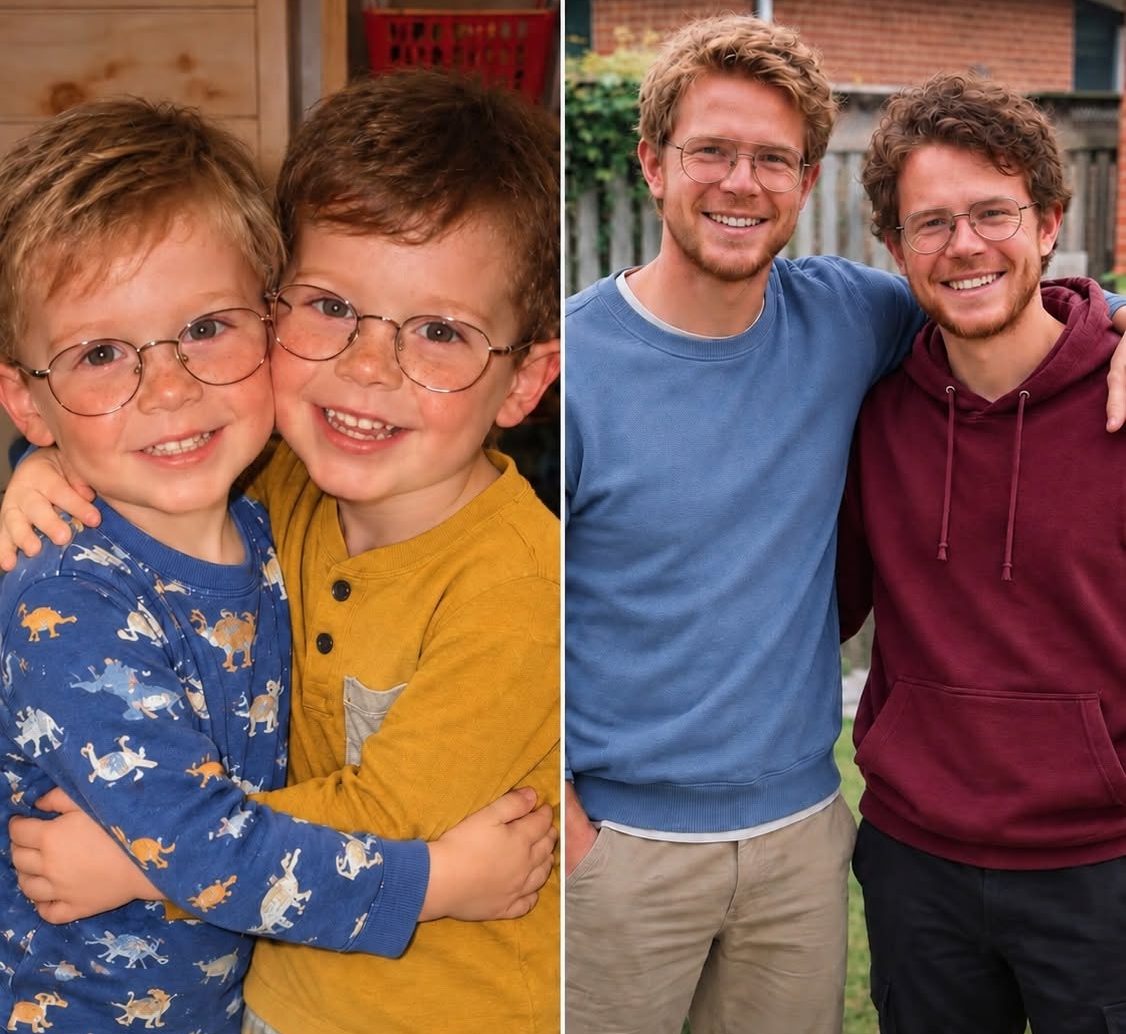
Part 2 – Adopted Brothers Discover The Shocking Secret Their Mother Hid For Twenty Years
I stood frozen in the narrow hallway with a bouquet of white lilies hanging from my hand, listening to the woman I had spent twenty years trying to impress laugh about the one thing I thought I could never lose: the truth of where I came from.
The flowers had been my idea.
That detail would stay with me later, the strange cruelty of it. I had spent the entire drive there thinking about something as simple as making her happy. I had stopped at the florist on the way because I remembered how she always said fresh flowers made a house feel cared for. I had chosen white lilies because she once told me they were her favorite, because I still remembered small things about her even after years of wondering whether she remembered small things about me.
That was the kind of person I had become around Beatrice.
Someone who collected details about a person who never seemed interested in collecting details about him.
The bouquet felt heavier now.
The kitchen light spilled across the polished floor, cutting a sharp line between where I stood and where Beatrice sat with Rose. I could see only a small part of them through the opening between the wall and the doorway, enough to catch Beatrice’s fingers wrapped around a coffee mug and the satisfied smile on her face. The lilies had begun to leave a faint, sweet scent on my skin, but suddenly it smelled like something left behind at a grave.
“They still don’t suspect anything, Mom,” Beatrice said, her voice carrying the same calm confidence she used whenever she believed she had control of a situation. “Twenty years, and they always believed everything I told them.”
My grip tightened around the bouquet until the stems bent slightly beneath my fingers.
I felt the rough edges of the stems press into my palm, a small physical pain that was easier to understand than the one spreading through my chest.
I wanted to move.
I wanted to step forward and demand answers.
I wanted to walk away before I heard anything else.
Instead, I stayed there.
Because there was something terrifying about hearing the truth when you had spent your entire life believing you already knew it.
Rose gave a quiet laugh from the kitchen table. Even at eighty-two, her voice still had the sharpness I remembered from childhood visits, the kind of voice that made a room feel smaller. She had always spoken like every sentence was a final decision. Like the world was a place where everyone else made mistakes and she was the only person capable of seeing clearly.
“I told you they would. Children believe what they are given. Especially children who are afraid of being sent away.”
A cold feeling moved through my chest.
The hallway suddenly felt too narrow.
The walls felt closer.
I wanted to believe I had misunderstood. I wanted the words to rearrange themselves into something harmless. Maybe they were talking about something else. Maybe there was some piece of this conversation that I wasn’t hearing.
But then Beatrice spoke again.
“Mason and Simon spent their whole lives thinking Elena walked away from them.”
The name hit me harder than anything else.
Elena.
I had heard it before.
Not from Beatrice.
Not from anyone who was supposed to know my past.
It was a name that had appeared once on a document I barely understood when I was a child, a name I asked about and was told belonged to a social worker who had helped with the adoption. I had accepted that answer because children learn quickly which questions make adults uncomfortable.
There are questions you stop asking because you realize the adults around you are not preparing to answer them.
They are preparing to stop you from asking again.
My mouth went dry.
Rose lowered her voice, but not enough.
“And now?” she asked.
“Now they have careers. Homes. Their own lives.” Beatrice sounded almost relieved. “Now they don’t need answers. They need stability.”
I stared at the kitchen doorway, unable to move.
For twenty years, I had carried a story inside me.
It was an ugly story, but it was simple.
My biological mother had left.
Beatrice and Kenneth had taken us in.
Kenneth had loved us.
Beatrice had tolerated us.
A painful story was still easier to live with than a missing one.
A painful truth could become a scar.
A missing truth was an open wound you could not stop touching.
But this wasn’t a missing piece.
This was someone hiding the entire puzzle.
I thought about all the times I had asked about Elena.
Not often.
Never directly after I became old enough to understand the tension in the room.
But when I was younger, I had asked.
I remembered standing in the living room with a school assignment about family trees. I remembered holding the paper in my hands, looking at the empty space where a name should have been written.
I remembered Beatrice taking the paper from me.
I remembered the pause before she answered.
That pause had seemed meaningless then.
Now it felt like a warning I had ignored.
“She left,” Beatrice had said back then.
Two words.
Enough to build a childhood around.
Enough to make a child decide that he had not been worth staying for.
I took one step backward, but my heel brushed against the edge of the small wooden table beside the hallway. The sound was barely louder than a whisper, yet my entire body reacted as if I had knocked over a glass.
The kitchen went silent.
Beatrice’s voice changed first.
“Mason?”
I remained still.
The front door was behind me.
I could leave.
I could place the flowers on the porch, walk back to my car, and pretend I had never heard any of this.
That was what the old version of me would have done.
The old version of me apologized before anyone accused him of anything.
The old version of me searched people’s faces for signs of disappointment and changed himself before anyone asked.
The old version of me spent twenty years trying to earn affection from someone who acted like love was a debt I had never finished paying.
But I was tired.
I stepped into the kitchen.
Beatrice looked up from her chair, and the expression on her face shifted so quickly I almost missed it. Surprise came first. Then fear. Then something colder, something that looked less like regret and more like calculation.
It was only a second.
A tiny movement.
A flicker.
But I had spent my life studying her reactions. I knew when she was pretending.
Rose’s hand stopped halfway to her coffee cup.
Neither of them spoke.
I looked at the table between us.
There were two coffee mugs, a plate with crumbs from some birthday pastry, and a small wrapped box that I had placed there earlier when I entered. The gift I had brought for Beatrice sat exactly where I had left it.
A present from a son who had just learned he might never have been one.
“I came to surprise you,” I said.
My voice sounded strange to my own ears.
Beatrice slowly stood.
“Mason, you shouldn’t have heard that conversation.”
The words were so wrong that for a second I almost laughed.
Not I’m sorry.
Not what did you hear?
Not are you okay?
You shouldn’t have heard it.
I looked at her.
“What conversation was I not supposed to hear?”
Beatrice’s lips parted, but nothing came out.
Rose shifted in her chair.
“You need to calm down.”
The anger that rose inside me was so immediate it surprised even me.
“I need to calm down?”
I turned toward her.
“The two of you were sitting here talking about how you lied to me for twenty years, and I need to calm down?”
Rose’s expression hardened.
“Watch your tone.”
There it was.
The same thing.
Even now, even after everything, she wasn’t afraid of hurting me.
She was offended that I had reacted.
Beatrice moved between us slightly.
“Mason, this is not what you think.”
I stared at her.
“Then tell me what it is.”
She looked away.
That single movement told me more than any answer could have.
“Tell me,” I repeated. “Who is Elena?”
Beatrice’s face tightened.
Rose closed her eyes briefly, as if she had been waiting for this moment and still hated that it arrived.
“She was your biological mother,” Beatrice finally said.
The room seemed to tilt.
I had imagined hearing those words before.
When I was younger, I imagined finding her.
I imagined asking why she left.
I imagined being angry.
I imagined being able to look into her eyes and finally understand what I had done wrong.
I never imagined hearing it from Beatrice in a kitchen where she had been laughing about the lie.
“Was?” I whispered.
Beatrice folded her arms.
“Mason—”
“No.”
My voice sharpened.
“Don’t do that.”
“Do what?”
“Say my name like that makes this easier.”
The silence that followed was uncomfortable because, for once, Beatrice had no immediate answer.
I set the lilies down on the table.
The flowers looked ridiculous there.
Beautiful and completely out of place.
“Did she abandon us?”
Beatrice looked at me.
For years, I had wanted her to look at me like I mattered. I had wanted some sign that she saw the little boy who used to wait at the window for her to come home.
Now she looked at me like I was a problem she needed to solve.
“Things were complicated,” she said.
I felt something break quietly inside me.
“That isn’t an answer.”
“It is the answer you need right now.”
I stared at her.
“The answer I need?”
Beatrice took a breath.
“You have built a life. Simon has built a life. Digging up everything from twenty years ago won’t change anything.”
“Maybe it changes whether I was hated.”
Her expression flickered.
Just for a second.
But I saw it.
That was the thing about designing.
People thought it was only about colors and shapes, but my work had taught me to notice small differences. A line slightly out of place. A shadow where there shouldn’t be one. A flaw hidden beneath a perfect surface.
Beatrice had a flaw.
She was afraid.
“Who told you that?” she asked quietly.
I almost smiled.
“Nobody had to.”
I looked around the kitchen I had sat in hundreds of times.
The same cabinets.
The same wooden table.
The same room where I had celebrated birthdays without ever feeling like the person being celebrated.
“You made sure I believed it.”
Beatrice looked down.
Rose spoke again.
“We protected you.”
I turned toward her.
“No. You protected yourselves.”
Rose’s eyes narrowed.
“You are young. You don’t understand what happens when adults have to make impossible choices.”
“Then explain the choice.”
Neither of them answered.
That silence was louder than anything they could have said.
I reached for my phone.
Beatrice noticed immediately.
“Who are you calling?”
“Simon.”
Her face changed.
“No.”
The word came out faster than I expected.
I looked at her.
“No?”
She softened her voice.
“Mason, think about what you’re doing.”
“I am.”
“You don’t know the full story.”
“Neither do I because you spent twenty years making sure I didn’t.”
Beatrice stepped closer.
“Mason, please.”
That word stopped me.
Not because it worked.
Because I couldn’t remember the last time she had said it like that.
There was fear in it.
Real fear.
And for a moment, a small part of me—the part that had spent years waiting for her approval—wanted to believe that fear meant she cared.
Then I remembered what I had heard.
Twenty years.
A secret.
A lie.
I pressed Simon’s name.
The phone rang.
Beatrice watched me.
Rose looked away.
The ringing seemed impossibly loud in the kitchen.
After the fourth ring, Simon answered.
“Mason?”
I closed my eyes briefly at the sound of his voice.
My brother.
The only person who had been standing beside me since we were small enough to share a bedroom.
“Where are you?”
There was a pause.
“I’m at home. Why?”
I looked at Beatrice.
“Come to Beatrice’s house.”
Another pause.
“Mason, what happened?”
I didn’t answer immediately.
Because saying it out loud would make it real.
“My biological mother didn’t abandon us.”
Silence.
Not the confused kind.
The kind that meant someone had just heard something they already knew.
I opened my eyes.
Beatrice noticed my expression.
“So you did know,” I said.
Simon’s breathing changed through the phone.
“Mason.”
“You knew something.”
“No.”
The answer came too quickly.
I felt my stomach tighten.
“Simon.”
Another pause.
“I found something.”
Beatrice moved forward.
“What did he find?”
I looked at her.
“You tell me.”
Simon spoke before she could.
“I’ll be there in ten minutes.”
The call ended.
The silence returned.
Beatrice sat down slowly.
Rose looked at her daughter.
“You should have told them years ago.”
Beatrice’s face hardened.
“And what would that have changed?”
Rose didn’t answer.
Beatrice looked at me.
“You think this makes me a monster.”
I didn’t respond.
She laughed once, but there was no humor in it.
“Of course you do.”
“I don’t know what to think.”
That seemed to hurt her more than anger would have.
Because anger meant I still understood the person she had been.
Confusion meant I didn’t know her at all.
“You were three years old,” she said quietly. “You don’t remember what happened before we took you in.”
“Then tell me.”
She looked toward the window.
Outside, the neighborhood was exactly the same as it had been every time I visited. Perfect lawns. Clean sidewalks. Houses with holiday decorations stored neatly in garages. A place where everyone knew everyone else’s name but not their secrets.
“There are things you don’t understand.”
“Then help me understand.”
She looked back at me.
“I can’t.”
The answer was so simple that it almost hurt more.
“You can’t,” I repeated.
Beatrice pressed her hands together.
“Not yet.”
I felt my anger rise again.
“Not yet?”
She didn’t respond.
I picked up the bouquet and held it awkwardly.
I had walked into this house wanting to give her flowers.
Now I wanted to know why I had spent half my life trying to grow in soil where someone had buried the truth.
When Simon arrived, I heard his car before I saw him. The engine stopped outside, followed by the quick sound of his footsteps on the porch.
The front door opened.
He stepped inside without knocking.
Simon always looked like he was halfway through solving a problem. Even when we were kids, he was the one who studied instructions before opening a toy box. He was the one who read every warning label. He was the one who noticed when something didn’t make sense.
Today, his face looked like someone had finally caught up to him.
He stopped when he saw all of us.
“Mason.”
I studied him.
“You knew.”
Simon looked at Beatrice, then Rose.
“I knew something was wrong.”
“That’s not what I asked.”
His jaw tightened.
“I found a letter.”
The room went still.
Beatrice whispered, “Simon.”
He ignored her.
“After Kenneth died.”
My chest tightened at the name.
Kenneth.
Even after all of this, hearing his name still felt different.
He was the one memory that hadn’t turned into a question yet.
“What letter?” I asked.
Simon looked at me.
“I was nineteen.”
His voice was quieter now.
“I was going through some of Kenneth’s old things. I wasn’t looking for anything. I was just trying to organize his files because Beatrice asked me to clean out the storage room.”
Beatrice looked away.
Simon continued.
“There was a folder hidden behind some old tax documents.”
“Why didn’t you tell me?”
The question came out before I could stop it.
Simon looked down.
“Because I was scared.”
That answer hurt more than I expected.
Not because I blamed him.
Because I understood it.
Simon had always been the one protecting me.
Even when we were children, he stood between me and every argument. He took the blame for things I did. He distracted Beatrice when she was angry.
He had been carrying something alone.
“What was in it?” I asked.
He reached into his jacket pocket.
For a moment, his fingers stayed there.
Like he was holding onto the last second before everything changed.
“Things about us.”
Beatrice stood.
“Simon, don’t.”
He looked at her.
“I should have done this years ago.”
The room became painfully quiet.
Rose’s voice lowered.
“You have no idea what you’re about to destroy.”
Simon looked at her.
“No.”
He shook his head.
“I think I finally understand what was already destroyed.”
He pulled out a folded piece of paper.
The edges were worn.
The paper had been handled many times.
My heart started beating faster.
I didn’t know why.
Maybe because some part of me recognized that whatever was written there had been waiting longer than I had.
Simon looked at the page.
Then he looked at me.
“Mason, Kenneth wrote this.”
I took a step closer.
“What does it say?”
Simon unfolded the letter carefully.
The handwriting was familiar.
I had seen it on birthday cards, grocery lists, notes he left on the refrigerator when we were kids.
Kenneth’s handwriting.
The handwriting of the man who told us we were his whole world.
Simon swallowed.
His eyes moved across the first lines.
Then his face changed.
Not shock.
Not confusion.
Something closer to grief.
“What?” I asked.
He looked up.
“Mason…”
His voice broke slightly.
“He said our adoption was never supposed to happen the way Beatrice told us.”
Part 3 – Kenneth’s Hidden File
“Where did you get that?”
Beatrice’s voice was quieter than before, but somehow that made it worse.
I had spent years learning the different versions of Beatrice.
I knew the sharp version of her. The one who could turn a simple question into an accusation. The one who could make a room feel smaller just by entering it with a certain look on her face.
I knew the tired version of her. The one who sighed while washing dishes and reminded us of everything she had done for us, every sacrifice she had made, every moment she wanted us to remember when we complained or asked for something she thought we did not deserve.
I knew the cold version too. The version that appeared whenever we got too close to a subject she did not want to discuss. A glance. A pause. A single word spoken with enough weight to tell us the conversation was over.
I had survived all of those versions.
I knew how to shrink myself around them.
I knew how to become quiet. How to apologize before I even understood what I had done wrong. How to step backward and let Beatrice have the space she always seemed to need.
But this was different.
This was not anger.
This was not annoyance.
This was fear.
And hearing fear in Beatrice’s voice felt like discovering a locked room inside a house I had lived in my entire life.
The worst part was realizing I had never even noticed the door.
Simon kept the letter open in his hands, but he did not look at Beatrice.
His eyes remained fixed on the page, following the handwriting as if the words themselves had become something physical. Something that could pull him under if he looked away.
The kitchen suddenly felt too small.
It was a room we had eaten in thousands of times. A room where birthdays had been celebrated, where homework had been finished, where arguments had started and ended. A room that should have felt ordinary.
But it no longer did.
It felt crowded.
Not with people.
With everything that had never been said.
The smell of Rose’s tea had gone stale. The steam that had once curled above the cup was gone, leaving only the faint scent of herbs and warmth that no longer belonged to the moment.
The lilies I had brought that morning sat on the counter beside the sink.
I looked at them for a second.
They seemed almost out of place.
A gift from the person I had been before walking through that door.
Before the letter.
Before five words had split my entire life into before and after.
“Answer him, Simon,” I said.
My voice surprised me.
It sounded calmer than I felt.
Inside, everything was moving too quickly.
Every thought collided with another. Every memory seemed to demand an explanation.
Simon finally looked up.
There was an apology in his eyes before he even spoke.
That hurt more than anger would have.
Anger would have meant he was defending himself.
An apology meant he already knew he had failed me somehow.
“I found it after Kenneth died,” he said.
The words landed slowly.
After Kenneth died.
Not before.
Not during.
After.
A piece of information that had apparently existed beside us for years while we continued living our lives as if nothing had been hidden.
“You found it when?” I asked.
Simon folded the letter slightly, careful not to crease the paper.
That small movement made something twist inside me.
Even now, even while everything was falling apart, he was protecting it.
Protecting Kenneth.
Protecting the last thing Kenneth had left behind.
Protecting all of us.
“When we cleaned out his office.”
I stared at him.
“You never told me?”
His jaw tightened.
For a moment, he looked younger.
Not physically.
Something in his expression reminded me of the boy he had been. The sixteen-year-old who had suddenly become older because life had demanded it.
“I didn’t know what to tell you.”
The answer felt impossible.
“How about the truth?”
The kitchen went silent.
The clock above the doorway continued ticking.
One second.
Then another.
Nobody moved.
Simon looked down.
“I was sixteen, Mason.”
He said my name the way he always did when he wanted me to remember something important.
Not like an argument.
Not like a challenge.
Like a plea.
“I had just lost Dad.”
His fingers tightened around the letter.
“You were barely sleeping. You stopped eating breakfast. You stopped answering when people talked to you unless they asked you something twice.”
I swallowed.
I remembered.
I remembered all of it.
The mornings when food sat untouched on my plate.
The nights when I stared at the ceiling because sleeping meant waking up and remembering again.
The way the house had felt after Kenneth was gone.
Like someone had removed the center of it and expected the walls to remain standing.
“You kept going into his room,” Simon continued. “You would sit there for hours.”
His voice softened.
“You thought if you stayed long enough, somehow he would walk through the door.”
My throat tightened.
Because I had thought that.
I had known it was impossible.
But some part of me had refused to accept that knowing something and believing it were the same thing.
Simon looked at the letter again.
“And then I found a file with our names on it.”
Beatrice moved toward him.
“Simon, you don’t understand what you found.”
He turned toward her for the first time.
“No, Beatrice.”
His voice was quiet.
Almost too quiet.
“I think that’s exactly the problem.”
Her expression hardened immediately.
“Careful.”
The word carried history.
It was the same warning she had used when we were children.
The same tone she used whenever she wanted us to remember that she was the adult and we were the children.
A reminder that there were things we were not supposed to question.
Things we were supposed to accept.
Things we were supposed to be grateful for.
But Simon was not ten years old anymore.
Neither of us was.
“I spent years being careful,” he said.
He looked at her.
“I think I was careful enough.”
Rose shifted in her chair.
Her hands, which had been resting calmly around her cup, were now gripping the porcelain so tightly her knuckles had turned pale.
“That file was private,” she said.
I looked at her.
“Private from who?”
She did not answer.
She didn’t need to.
That was the answer.
I walked toward Simon and held out my hand.
“Give me the letter.”
For a moment, he hesitated.
Not because he didn’t want me to see it.
Because he knew I would never be able to unsee it.
Once those words entered my mind, there would be no going back to the life I had walked into the house with.
Then he placed it in my palm.
The paper felt fragile.
Almost too fragile to carry something that had apparently waited years to be discovered.
Kenneth’s handwriting filled the page in neat lines.
I knew it immediately.
His letters had always leaned slightly to the right. Certain words were pressed harder than others, as though his hand had carried more emotion than he allowed his voice to show.
He wrote the way he spoke.
Carefully.
Patiently.
Like every word mattered.
I recognized the first line before I even finished reading it.
My boys,
I stopped breathing.
Not our names.
Not Mason and Simon.
My boys.
Kenneth had always called us that.
My boys.
The words had once made me feel chosen.
Loved.
Safe.
Now they felt like they were carrying something I had never been allowed to know.
My eyes moved lower.
If you are reading this, then I am no longer there to explain what I should have explained myself.
My vision blurred.
The room seemed to move away from me.
“I can’t,” I whispered.
Simon stepped closer.
“You can.”
I looked at him.
“You knew this was in there.”
“I knew something was in there.”
“You read it.”
Silence.
That was enough.
A strange mixture of betrayal and understanding passed through me.
Simon had carried this alone.
He had carried it because he thought he was protecting me.
But he had also taken away my choice.
“How much did you read?”
His face tightened.
“Enough.”
“That’s not an answer.”
He looked away.
“Enough to know our story wasn’t complete.”
I looked back down at the page.
The first paragraph was short.
Kenneth’s words were careful, almost hesitant, like he had spent years deciding what he was allowed to reveal.
Your mother did not abandon you.
The sentence erased everything else.
For a moment, I heard nothing.
Not Beatrice’s breathing.
Not Rose moving.
Not the clock.
Not even my own heartbeat.
Only those five words.
Your mother did not abandon you.
My fingers shook slightly.
“Mason.”
Simon said my name, but I did not look at him.
Because my entire childhood had been built around another sentence.
She left.
She didn’t come back.
She didn’t want you.
I had spent years trying to understand what kind of mother could walk away from two three-year-old children.
I had imagined her face a thousand times.
I imagined someone cold.
Someone careless.
Someone who looked at us and saw a burden.
Someone who could leave two children behind and never look back.
I had wondered what was wrong with us.
What made us so easy to leave.
But now Kenneth was telling me that perhaps the story I had lived with was never the truth.
I lowered the paper.
“Beatrice.”
She looked away.
That was worse than if she had shouted.
“Tell me he was wrong.”
She remained still.
“Tell me Kenneth was wrong.”
Her lips parted.
No words came.
Rose spoke instead.
“You don’t understand the circumstances.”
I turned toward her.
“I asked Beatrice.”
Rose’s expression changed slightly.
Not guilt.
Not yet.
Control.
She had spent her entire life arranging things so nothing ugly showed from the outside.
Keeping appearances.
Keeping order.
Keeping every broken piece hidden behind carefully chosen words.
“You boys were children,” Rose said. “You cannot judge decisions made by people who were trying to protect you.”
“Protect us?”
The laugh that escaped me was empty.
“From what? Knowing our mother existed?”
Beatrice closed her eyes.
“Mason.”
“No.”
I held up the letter.
“No, I spent twenty years believing a woman who gave birth to me didn’t want me.”
My voice shook.
“I spent twenty years thinking I should be grateful that someone else tolerated me.”
Nobody spoke.
“And now you’re standing there telling me this was protection?”
The silence that followed was heavier than any confession.
Simon gently took the letter back before my hands could damage it.
“We need to see the rest of the file.”
Beatrice immediately looked at him.
“No.”
The speed of her answer told me everything.
Simon noticed too.
He nodded slowly.
“Okay.”
The calmness in his voice made her nervous.
“Okay?” she repeated.
“Yeah.”
He placed the letter back into the envelope.
“That tells me there is a file.”
Beatrice’s face tightened.
“I said no.”
“And I heard you.”
Simon walked toward the hallway.
“But I also heard what you didn’t say.”
“Where are you going?”
“To find it.”
Her voice sharpened.
“You don’t have the right.”
Simon stopped.
For the first time all night, he looked genuinely angry.
“Neither did you.”
The words hung between them.
Beatrice looked like she had been struck.
I had spent years thinking Simon was the softer one.
The one who forgave too easily.
The one who avoided conflict because conflict made him uncomfortable.
I realized then that I had misunderstood him.
Simon wasn’t less angry.
He had simply carried his anger somewhere nobody could see.
The office door waited at the end of the hallway.
Kenneth’s office.
The room where he had spent hours after work.
The room where he kept documents, books, and things he considered important.
As children, we were not allowed inside without permission.
Beatrice always said it was because there were important papers there.
I wondered how many truths had been sitting behind that door.
Simon reached for the handle.
Beatrice followed.
“Don’t.”
He looked back.
“I need to know.”
“You don’t know what you’re asking for.”
“I’ve spent my whole life asking for something you refused to give me.”
His hand closed around the doorknob.
The lock clicked.
The sound was strangely ordinary.
A small sound.
A door opening.
And yet it felt like something much larger.
The office smelled exactly as I remembered.
Old paper.
Dust.
Cedar shelves.
The faint scent of Kenneth’s aftershave, the one he used every Sunday morning before church even though he stopped going regularly when we got older.
I stood in the doorway.
I was afraid to step inside.
It felt wrong.
Like entering a place where Kenneth was still waiting.
Like if I moved too quickly, I might disturb something sacred.
Simon went straight to the filing cabinet beside the desk.
He knew where to look.
That realization hit me immediately.
“You’ve been in this room.”
He did not turn around.
“Once.”
“When?”
“After I found the letter.”
I stared at him.
“And you still didn’t tell me.”
He stopped searching.
“I know.”
The answer was so simple it disarmed me.
No excuse.
No attempt to make himself innocent.
Just an admission.
“I was afraid.”
I looked at my brother.
“Of what?”
Simon ran his hand along the top drawer.
“That if I told you, you would lose the only good memories you had left.”
I didn’t speak.
Because I understood.
Kenneth was the center of our childhood.
He was the reason that house still felt like home.
He was the reason adoption had never felt like something we owed him for.
It had felt like love.
“If the truth meant Dad was part of some lie…” Simon said quietly, “I didn’t know if you could handle that.”
I walked farther into the room.
“And you could?”
He gave a small, bitter smile.
“No.”
The honesty hurt.
“But I thought I could carry it better.”
The filing cabinet was still locked.
Simon stared at it.
“I never found the key.”
“Then how do you know there’s something inside?”
He looked toward Kenneth’s desk.
“Because Dad wasn’t careless.”
He walked over and opened the bottom drawer.
Inside were old pens, receipts, instruction manuals, and a stack of envelopes.
He moved everything aside slowly.
Then he reached underneath the drawer.
A small brass key was taped to the bottom.
My heart sank.
Kenneth had hidden it.
Not lost it.
Hidden it.
Simon peeled the tape away carefully.
“He wanted someone to find this.”
Beatrice appeared behind us.
“Stop.”
Neither of us moved.
Her voice sounded different now.
Older.
Not the angry woman who told us to be grateful.
Not the woman who reminded us of every sacrifice.
Just someone watching a wall she built begin to collapse.
“Mason,” she said softly.
I turned.
“What?”
She looked at me.
For one second, I saw something that almost looked like regret.
Then it disappeared.
“You have to understand that everything I did was because I loved you.”
The sentence should have comforted me.
Instead, it made me colder.
“Love doesn’t explain everything.”
Her eyes filled slightly.
“You weren’t there.”
“No.”
I held her gaze.
“I wasn’t.”
The key turned.
The drawer opened.
Inside was a thick folder wrapped in faded blue cloth.
My name was written across the top.
Mason.
Underneath it was another name.
Simon.
Neither of us spoke.
The folder looked too small to contain twenty years of secrets.
Simon reached for it.
Then stopped.
He looked at me.
Not asking permission.
Giving me the choice.
I nodded.
Together, we unfolded the cloth.
The first thing inside was a photograph.
A woman holding two small children.
I stared at the image.
The children were us.
I knew immediately.
Even though we were only three years old.
Even though the picture was faded.
Even though I had no memory of the moment.
I knew.
The woman holding us was smiling.
Not the forced smile adults gave children for photographs.
A real smile.
The kind Kenneth used to have.
I picked up the photograph carefully.
“Who is she?”
Nobody answered.
But Beatrice’s face already had.
Simon turned the photograph over.
There was writing on the back.
Elena.
My chest tightened.
A name.
A name I had never heard.
A name that somehow felt like it belonged to me.
Simon opened the folder.
Inside were adoption papers, medical records, copies of documents I didn’t recognize, and several envelopes tied together with a rubber band that had long since cracked.
The top page was covered in official stamps and signatures.
I scanned the words.
Temporary guardianship.
Family crisis.
Biological parent.
The phrases seemed disconnected.
Pieces of a puzzle someone had intentionally thrown across the floor.
“Beatrice,” I said.
She stayed near the doorway.
“Who is Elena?”
Her face changed.
Not confusion.
Recognition.
And that was the moment I knew.
She knew this name.
“I think you should sit down,” she whispered.
“I don’t want to sit down.”
My voice was sharper than I intended.
“I’ve been sitting with a lie for twenty years.”
Rose stood slowly.
“Beatrice was young.”
I looked at her.
“She was forty.”
Rose’s mouth closed.
For once, she had nothing prepared.
Simon pulled out the first letter.
The envelope was addressed to Kenneth.
Not Beatrice.
Kenneth.
The handwriting was different.
Careful.
Rounded.
Almost hesitant.
He opened it.
I watched his eyes move across the page.
Then he handed it to me.
The letter began with a name.
Dear Kenneth,
I stared at the words.
A woman had written to him.
A woman who knew him.
A woman who knew us.
I read slowly.
The letter mentioned a difficult time.
A situation that had forced her to let someone else care for us temporarily.
It mentioned promises.
It mentioned trying to return.
It mentioned that she had never stopped loving us.
My vision blurred.
“She was looking for us?”
I looked at Beatrice.
Her silence answered.
Simon found another envelope.
Then another.
Photographs.
Notes.
Records.
A whole history of people and choices that had existed outside the story we were given.
Beatrice stepped into the room.
“I didn’t plan for it to happen this way.”
I looked at her.
“What way?”
Her eyes moved across the folder.
“The adoption.”
The word sounded strange coming from her.
Like even she knew it was no longer enough.
“I thought it would only be temporary at first.”
The room became still.
Simon stared at her.
“Temporary?”
Beatrice looked down.
“You were supposed to go back.”
The sentence cut deeper than I expected.
Not because she admitted it.
Because part of me had always feared I was never truly chosen.
Now I had to face something worse.
Maybe I had been chosen.
Just not by the person I thought.
“What happened?” Simon asked.
Beatrice sat down slowly.
Her hands trembled.
“Your mother was going through a crisis. Your grandmother and I knew the situation. We thought we could help.”
Rose interrupted.
“We were trying to keep the family together.”
Simon looked at her.
“Whose family?”
Rose didn’t answer.
Beatrice pressed her fingers together.
“Then months passed.”
She looked at us.
“And you were still with us.”
I waited.
I needed her to finish.
“Kenneth loved you.”
Her voice cracked.
“And I did too.”
“But?”
She swallowed.
“But I was afraid.”
The same answer.
Again.
Always fear.
“I was afraid that if Elena came back, I would lose you.”
The confession sat in the room.
Heavy.
Human.
And still impossible to ignore.
“You made her disappear,” Simon said.
Beatrice flinched.
“No.”
“Then what do you call it?”
She looked away.
“We made choices.”
The word was too gentle.
A blanket thrown over something sharp.
I opened another envelope.
Inside was a birthday card.
The date was from when we were eight.
My hands went cold.
There was no message written on the outside.
Only our names.
Mason and Simon.
I opened it.
A simple sentence was written inside.
Happy birthday. I think about you every day.
No signature.
But I knew.
I knew.
“Elena wrote this.”
Beatrice didn’t answer.
“Didn’t she?”
Her eyes filled.
“Yes.”
I closed the card.
Twenty years.
Twenty birthdays.
Twenty chances for someone to tell us.
Simon sat beside me.
The anger on his face was mixed with something else.
Grief.
Not only for what happened.
For everything that never happened.
For all the years we lost.
Then he found another envelope beneath the papers.
This one had Kenneth’s handwriting.
He opened it carefully.
A note.
Short.
Not meant for us.
A record.
A warning.
My heart began racing again.
Because Kenneth had known.
He had known enough to leave behind a trail.
Enough to hide the truth where someone could find it.
Simon read the first line.
Then he stopped.
“What?”
He looked at me.
His face had gone pale.
“What does it say?”
He turned the page around.
Kenneth’s handwriting stared back at us.
And beneath the old ink, beneath the years of silence and secrets, was the truth he had carried with him.
He had written that he knew Elena had never given up looking for us.
Part 4 – The Mother They Never Knew
The old answering machine sat on Kenneth’s workbench beneath a thick layer of dust, its plastic buttons faded from years of sunlight and neglect. A thin layer of gray covered the corners where no one had touched it since Kenneth’s hands had last rested there. The garage smelled like cedar shelves, old paper, and the faint metallic scent of tools that had been waiting for someone who would never return to use them. It was the smell of a place preserved by accident, a room that had been holding onto pieces of Kenneth long after the rest of the house had begun moving forward without him.
Simon stood beside the workbench, holding the small cassette tape between his fingers like it could break if he breathed too hard.
I watched him stare at the label.
Kenneth’s handwriting curved across the surface in the same careful way it had on birthday cards, school permission slips, and the small notes he left on the kitchen counter when he had to work late. Every letter looked familiar. Every line looked steady.
That was the hardest part.
The handwriting belonged to the man who had made us feel chosen.
The man who had taught us how to ride bicycles in the driveway until our knees were covered in scrapes. The man who had sat beside our beds when we were sick. The man who had told us, more than once, that being family was something people built, not something they were simply given.
For the first time in days, Simon looked less like someone searching for answers and more like someone afraid of finding them.
“Don’t play it yet.”
My voice came out quieter than I expected.
Simon looked up from the tape.
The garage light reflected off his glasses, hiding his eyes for a second, but I knew him too well to miss the hesitation.
“Why?”
Because if Kenneth knew.
Because if Kenneth knew and still let us live twenty years believing we were unwanted, then the one person I trusted most would become another person I had to mourn.
But I couldn’t say that.
“I don’t know what we’re going to hear.”
Simon placed the tape back on the workbench but didn’t let go of it. His thumb rested over Kenneth’s handwriting, almost like he was protecting the words.
“That’s exactly why we need to hear it.”
There was something different in his voice.
Simon had always been the one who calculated the next step. He measured everything. Every risk. Every possibility. Every consequence.
When we were children and Beatrice raised her voice, Simon was the one who quietly pulled me into another room before things got worse. When Kenneth died, Simon was the one who organized paperwork, sorted documents, and handled conversations with adults while I sat on my bedroom floor unable to touch anything that belonged to him.
He always had a plan.
But now there was no plan.
Only exhaustion.
“I spent years thinking you were the only one who believed me when I said something felt wrong,” I said.
Simon lowered his eyes.
“I wasn’t.”
The answer landed harder than I expected.
“What does that mean?”
He finally released the tape.
“It means I knew something was wrong before you did.”
The garage suddenly felt smaller. The shelves seemed closer. The old workbench where Kenneth used to repair bicycles and broken lamps looked less like a place filled with memories and more like a place where secrets had been waiting.
“How long?”
Simon ran a hand through his hair.
“Since I was seventeen.”
I stared at him.
“Seventeen?”
“I found one of Kenneth’s files when I was cleaning out the attic.”
“And you never told me?”
His jaw tightened.
“I found a letter. Just one. It wasn’t enough. I thought maybe I was misunderstanding it. I thought maybe there was some explanation that didn’t destroy everything.”
“You decided that for both of us.”
The words came out sharper than I intended.
Simon didn’t defend himself.
“Yes.”
That honesty made it worse.
I turned away and looked at the shelves.
A fishing rod.
A toolbox.
A stack of old magazines Kenneth had promised himself he would read.
Little pieces of a man who had made us feel safe sitting beside proof that he had known we weren’t living with the full truth.
“You had a letter from him for six years.”
“I had a letter that said Elena’s name.”
The way he said it stopped me.
“Elena.”
He nodded slowly.
“I didn’t know who she was at first. The letter was incomplete. Kenneth had written something about her trying to find us, but the page was torn. I thought maybe it was part of some legal thing. I thought maybe she was someone from before the adoption who wasn’t supposed to be involved anymore.”
“And you kept it?”
“I kept it because I was scared.”
I almost laughed.
Everyone was scared.
Beatrice was scared.
Rose was scared.
Simon was scared.
Kenneth had been scared.
Fear had become the excuse everyone used while our childhood disappeared.
“You don’t get to hide things from me because you’re afraid,” I said.
Simon looked at me, and for once he looked younger than twenty-three.
Not an engineer with a perfect apartment.
Not the person who always knew what to do.
Just my little brother standing in a garage, carrying a secret that had been too heavy for him.
“I know.”
The simplicity of it made my anger lose some of its shape.
Simon picked up the tape again.
“But I was wrong. I should have told you.”
The machine clicked when he pressed the button.
The tape began to spin.
For a few seconds, only static filled the room.
Then the recording played.
Kenneth’s voice.
Older than I remembered.
Tired.
But still him.
“We need to talk about the boys.”
My chest tightened.
The tape crackled.
“If someone finds this, it means I was not able to tell Mason and Simon myself. I hope that doesn’t happen, but if it does, I hope they understand that every decision I made came from wanting to protect them.”
Simon stopped the machine.
Neither of us spoke.
The silence between us filled with every possible thing Kenneth could say next.
“He recorded this for us,” Simon whispered.
I nodded.
“Keep going.”
Simon pressed play again.
Kenneth’s voice returned.
“I know Elena has been looking for them.”
The sentence was simple.
Almost impossible.
I grabbed the edge of the workbench.
“Elena.”
The name felt strange in my mouth.
Like something I had been missing without knowing it.
Kenneth continued.
“I know she never abandoned them. I know the story Beatrice told them is not the truth.”
The room seemed to tilt.
Simon closed his eyes.
“He knew.”
I didn’t answer.
Because knowing was different from suspecting.
Knowing meant the person who tucked us into bed, taught us to ride bicycles, and told us we were his whole world had stood beside a lie.
The tape clicked.
Then stopped.
The battery had died.
For several seconds, neither of us moved.
Finally, Simon removed the tape and looked at me.
“We need to find her.”
I looked toward the house.
“Elena.”
He nodded.
“Elena.”
The name no longer sounded like a stranger.
It sounded like a door.
—
We didn’t tell Beatrice where we were going.
Not because we wanted to punish her.
Because we didn’t know what she would do if she realized we were getting closer.
The next morning, Simon sat at my kitchen table surrounded by his laptop, printed documents, and a notebook filled with dates. He had always organized information like he was building a machine. Every fact had a place. Every possibility had a column.
I had never understood how he could make pain look like a project.
Now I understood.
It was the only way he knew how to survive it.
“I found the name through the adoption records,” Simon said. “There was a sealed section, but Kenneth kept copies.”
I stared at the photograph on the table.
It was old.
The edges were bent.
A woman stood in front of a small house, holding two toddlers.
Us.
I recognized myself only because of the familiar scar near my eyebrow.
Simon noticed me staring.
“I’ve looked at that picture a hundred times.”
“Before today?”
He nodded.
The answer hurt.
“Why didn’t you show me?”
“Because I didn’t know if I was giving you your mother or another person who left.”
I picked up the photograph.
The woman in it wasn’t smiling.
Not because she was unhappy.
Because she looked afraid.
Her hands were wrapped around us like she was trying to hold onto something the world was already taking away.
“She looks like she’s trying to protect us.”
Simon looked down.
“Maybe she was.”
For twenty years, I had carried one image of my biological mother.
A woman who left.
A woman who chose a life without us.
A woman who never looked back.
But that woman did not exist.
Someone else did.
Someone who had been searching.
Someone who had sent birthday cards we never received.
Someone who knew our names.
Someone who remembered the day we were born.
“We have to find her.”
Simon closed his laptop.
“I already started.”
I looked at him.
“What?”
“I searched the address from the old records.”
“And?”
He hesitated.
“What did you find?”
“An address.”
“Simon.”
He exhaled.
“She moved. More than once. But I found a current contact through a public record.”
My heart began pounding.
“You found her?”
“I found a way to reach her.”
The room became painfully quiet.
After everything we had learned, this felt like the most frightening moment.
Because lies were familiar.
The truth was not.
“What if she doesn’t want to see us?”
Simon looked genuinely surprised.
“Mason.”
“What?”
“You heard the same tape I did.”
I looked away.
“I heard she looked for us.”
“Exactly.”
“But people change.”
“Not someone who sends twenty birthday cards.”
The sentence stayed with me.
Twenty birthday cards.
Twenty years of someone trying to reach us.
While we were growing up believing nobody was trying.
—
We met Elena three days later.
The waiting was worse than the drive.
Every mile toward her house felt like moving closer to a memory I didn’t know I owned. I kept imagining impossible things. That I would recognize her immediately. That she would say my name in exactly the way a mother should say it. That something inside me would finally settle into place.
But another part of me expected nothing.
Maybe that was safer.
The neighborhood was quiet. Small houses lined the street. Lawns were trimmed. Children’s bicycles rested near driveways.
It looked ordinary.
That bothered me.
I had expected the place where my entire life changed to look different.
More dramatic.
More obvious.
Instead, Elena lived on a street where people watered plants and collected mail.
Simon parked across from the house.
Neither of us moved.
“Do you want me to go first?”
I looked at him.
“No.”
He nodded.
“Okay.”
We walked together.
The front door opened before we knocked.
A woman stood there.
She was older than the woman in the photograph but not unrecognizable. Her hair had turned silver around the edges. Her face carried years that came from more than age.
Her eyes moved from Simon to me.
Then back again.
The world seemed to stop.
She covered her mouth.
No words came out.
I had imagined this moment so many times.
I had imagined anger.
I had imagined tears.
I had imagined explanations.
I never imagined silence.
“Mason?”
My breath caught.
She said my name like she had been saying it for years when nobody else could hear.
Simon stepped closer.
“I’m Simon.”
Elena’s eyes filled immediately.
“I know.”
Her voice broke.
“I know who you are.”
I didn’t know what to do with that.
A stranger knowing my name felt impossible.
A mother knowing it felt even stranger.
“How?”
She looked down.
For a moment, she seemed unable to stand.
“I never stopped.”
The sentence was barely a whisper.
She opened the door wider.
“Please come inside.”
The house smelled like coffee and old books. There were framed photographs on the walls, but unlike Beatrice’s house, these photographs weren’t arranged to prove something.
They were memories.
Elena led us into the living room and sat across from us. Her hands trembled as she held a tissue she had folded and unfolded several times.
“I don’t know where to begin.”
“Start with the truth.”
I surprised myself by saying it.
Elena looked at me.
Not offended.
Not defensive.
Just heartbroken.
“The truth is that I lost you.”
Her voice shook.
“And I spent twenty years trying to bring you home.”
Simon leaned forward.
“What happened?”
Elena looked between us.
“I was young. Too young. Your father was gone before you were born, and after you were born, I had a family crisis. My mother became sick. I lost my job. I couldn’t afford the care you needed.”
She paused.
“I made a temporary arrangement.”
“With who?”
She looked down.
“Someone told me they could help.”
I felt my hands tighten.
“Beatrice.”
Elena closed her eyes.
“Yes.”
The name carried pain.
Not surprise.
“You knew her?”
“I knew of her. She was connected to people who helped families during difficult situations. She told me she could arrange temporary care while I got back on my feet.”
Simon’s expression hardened.
“But she adopted us.”
Elena nodded.
“She changed everything.”
The room went silent.
“How?”
Elena reached toward a cabinet and pulled out a box.
It was old.
Worn at the corners.
“I kept everything.”
Inside were cards.
Dozens of them.
Some had our names.
Some had dates.
Some had small drawings.
My hands shook as I picked one up.
The handwriting was unfamiliar.
But the words were not.
Happy birthday, Mason. I hope you are laughing today.
I closed my eyes.
Another card.
Happy birthday, Simon. I hope you know your mother loves you.
My throat tightened.
“Why didn’t we get these?”
Elena looked at me.
“Because Beatrice returned them.”
The words were quiet.
But they destroyed something inside me.
“She sent them back?”
“Not at first.”
Elena wiped her eyes.
“At first she told me the adoption was temporary. Then she stopped answering my calls. When I tried to visit, she told me you were adjusting and that seeing me would confuse you.”
Simon leaned back slowly.
“And you believed her?”
“I wanted to.”
Elena looked at the cards.
“I wanted to believe someone who said they were caring for my children.”
Her fingers touched the edge of the box.
“But then months became years.”
I couldn’t look away from the cards.
All those birthdays.
All those words.
All those moments that had never reached us.
“Why didn’t you go to court?”
Elena looked at me.
“I did.”
That answer surprised me.
“I fought.”
Her voice became stronger.
“I filed paperwork. I contacted agencies. I tried every way I could think of. But every time I got close, something happened. Records were missing. Messages were delayed. People told me the situation was complicated.”
“Rose.”
Elena’s silence answered before she did.
“Yes.”
Simon looked down.
“She helped Beatrice.”
“She helped keep the story alive.”
Elena looked at both of us.
“I don’t know exactly what she told people. I only know that every door I tried to open closed before I could reach you.”
The anger inside me had nowhere to go.
Beatrice had been cruel.
Rose had protected the lie.
But Elena had spent years standing outside a door that we thought nobody was trying to open.
“I thought you left us.”
The words escaped before I could stop them.
Elena’s face changed.
Not anger.
Pain.
“I know.”
She looked directly at me.
“That was the part I was most afraid of.”
Her voice became softer.
“That you would grow up thinking I didn’t love you.”
I looked away.
Because she was right.
That was exactly what I had believed.
For twenty years.
“I loved you every day.”
No one spoke.
The clock on the wall ticked loudly.
I stared at the floor, trying to understand how a person could miss someone they had never known.
—
When we left Elena’s house, the sky had already turned dark.
Simon drove without speaking.
The photograph sat between us in the center console.
I watched streetlights pass through the window.
“Do you hate her?”
Simon’s question came quietly.
I knew who he meant.
Beatrice.
“I don’t know.”
That was the truth.
I had spent years wanting her approval.
Even after everything.
Even after hearing her laugh about fooling us.
A part of me still remembered waiting by the window for her to come to a school event.
A part of me still wanted her to explain that there was some mistake.
Simon gripped the steering wheel.
“Kenneth knew.”
I looked at him.
“Yes.”
“Why didn’t he tell us?”
The question had followed me since the garage.
I had no answer.
But someone did.
When we returned home, Simon went straight to Kenneth’s hidden files.
He searched through the remaining documents while I sat at the table holding the old photograph.
After an hour, he found another envelope.
My stomach tightened.
Kenneth’s handwriting.
Again.
Simon opened it carefully.
Inside was a single page.
Not a letter.
A note.
At the top, Kenneth had written one sentence.
I need them to understand why I waited.
Simon read the first few lines silently.
Then he looked at me.
“Mason.”
Something in his voice made me stand.
“What?”
He handed me the page.
The words blurred for a moment.
Then I read them.
Kenneth had written that he had known Elena was still searching.
He had known Beatrice and Rose had hidden the truth.
But he had also written something else.
Something that changed the question I had been asking.
Not why he knew.
Not why he stayed silent.
But why he believed silence was the only way to protect us.
At the bottom of the page, beneath his explanation, was a final line.
A line that made my hands go cold.
Kenneth wrote that he had left a recording for us, and that before we judged his decision, we needed to hear what happened the night he chose to keep the truth hidden.
Part 5 – The Truth We Keep
The room was darker than I expected when Simon pressed play.
The old television in Kenneth’s study flickered before the recording appeared, filling the space with a grainy image of a man I had spent years trying not to miss. Dust floated through the beam of light from the lamp beside the desk, and I noticed how carefully Simon had arranged everything before I came in—the folders stacked by date, the photographs placed beside the recorder, the chair pulled out for me as though Kenneth himself had prepared a seat.
I stood behind the chair instead of sitting.
On the screen, Kenneth looked older than the man I remembered. Not old, exactly, but tired. His shoulders seemed heavier, and there were lines around his eyes that I had never noticed when I was a child. He looked directly into the camera for several seconds before speaking, and that silence hurt more than words would have.
“Hi, boys.”
My hand tightened around the edge of the chair.
It was such a simple thing.
Two words.
But hearing his voice again made the room feel smaller.
“I don’t know when you’re watching this,” Kenneth continued. “I don’t know how old you are, or what you think of me when you hear these words. I imagine you might be angry. I imagine you might feel betrayed.”
Simon lowered himself into the chair beside me, but he did not look away from the screen. His face had the same controlled expression he wore when he was solving a difficult engineering problem, except I knew him well enough to see the cracks beneath it.
“I need you to know something first,” Kenneth said. “Everything I did was because I loved you.”
I almost laughed.
Not because it was funny.
Because I had heard that sentence in so many different ways throughout my life. Beatrice had said love when she wanted obedience. Rose had said love when she wanted silence. Everyone seemed to have a version of love that required something from us.
Kenneth paused, as if he knew the thought might come.
“I know that sentence is not enough. I know love doesn’t erase the choices people make. It doesn’t erase the pain those choices cause.”
The room became completely still.
“I knew Elena was looking for you.”
The words landed exactly as hard as I expected them to.
Simon closed his eyes briefly.
Kenneth continued speaking, his voice steady but quiet.
“After the adoption became permanent, I found out that Beatrice and Rose had not told us the whole story. I found documents. Letters. Records that showed Elena never abandoned you. She believed she was giving you a safe place temporarily while she fixed the situation that forced her to leave.”
I looked at Simon.
He already knew.
Not everything, maybe. But enough.
“Why didn’t you tell us?” I whispered, even though Kenneth was not there to hear me.
Simon did not answer.
On the screen, Kenneth leaned forward.
“I asked myself that question every day.”
His eyes dropped for a moment.
“Every single day.”
He looked back at the camera.
“The first time I learned the truth, I wanted to tell you immediately. I wanted to take you both to Elena myself. I wanted to put the pieces back where they belonged.”
Kenneth swallowed.
“But you were children.”
The word echoed.
Children.
That was the part everyone seemed to forget.
Not the adoption papers.
Not the lies.
Not the adults making decisions.
The children.
“I had two boys who believed their world was stable. They believed they had a mother and father. They believed the house they lived in was home. I knew what Beatrice and Rose had done was wrong. I knew they had taken something from Elena. But I also knew that ripping you away from the only parents you had known could create another kind of wound.”
I stared at the screen.
A memory came back to me.
Kenneth sitting on the edge of my bed after a nightmare.
His hand resting on my shoulder.
“You are safe,” he had whispered.
At the time, I thought he was only talking about the nightmare.
Maybe he had been talking about everything.
“I spent years trying to convince Beatrice to tell you the truth,” Kenneth said. “I told her you deserved to know. I told her children grow into adults, and adults have the right to understand their own lives.”
His expression changed.
Sadness.
Disappointment.
“I failed to convince her.”
Simon leaned forward.
“Then why didn’t you?”
Kenneth’s recorded face remained silent for a moment.
“I should have.”
The honesty of those three words hurt more than an excuse would have.
“I should have told you. I should have trusted you with the truth. But every time I imagined losing you, I became afraid. I saw two little boys who had already lost their first family, and I couldn’t bring myself to become another person who took something away from them.”
I sat down.
The chair creaked beneath me.
Kenneth looked directly into the camera again.
“But I also knew a secret like this could not stay buried forever. So I made a decision.”
The screen shifted slightly as the recording continued.
“When you were old enough to choose for yourselves, you would find this. Not because I wanted to control what happened next. Because I wanted the choice to finally belong to you.”
I felt something inside me break.
Not loudly.
Not dramatically.
Just enough for everything I had believed to move.
“I left the file where Simon would eventually discover it. I knew he was the one who would search. I knew Mason would need someone beside him when the truth came.”
Simon looked down.
Kenneth knew us.
Even after death, he knew exactly how we would react.
“I am sorry for the years you spent believing something that wasn’t true,” Kenneth said. “I am sorry Elena lost those years with you. I am sorry Beatrice allowed fear to become something that hurt so many people.”
He took a breath.
“But I hope you understand one thing.”
The recording paused.
The man on the screen looked almost like he was gathering courage.
“I never thought of you as replacements. I never thought of you as children I took because someone else failed. You were my sons because every day you were my sons.”
My eyes burned.
Kenneth continued.
“If you choose to find Elena, go with an open heart. If you choose not to forgive Beatrice, I understand. If you choose something I cannot predict, that is okay too.”
A faint smile appeared on his face.
“Your lives belong to you.”
The recording ended.
The screen went black.
Neither Simon nor I moved.
For a long time, the only sound in the room was the soft clicking of the television cooling down.
“I hated him for a while,” Simon said.
His voice surprised me.
I looked over.
He was staring at the blank screen.
“I hated Kenneth.”
I said nothing.
“I found that letter years ago. The first one. I was cleaning out his office after he died. I was nineteen. I thought I was finding some paperwork from his job.”
Simon rubbed his hands together.
“I read it. Then I put it back.”
“You knew?”
“I knew something was wrong.”
His voice tightened.
“I didn’t know everything. I didn’t know where Elena was. I didn’t know how deep it went. But I knew Kenneth had been hiding something.”
I felt anger rise.
Not the sharp anger I had felt toward Beatrice.
Something different.
Something heavier.
“You knew and you didn’t tell me?”
Simon finally looked at me.
“I was scared.”
The answer was so simple that it disarmed me.
“I was scared you’d lose the only good memory you had left.”
I looked away.
Because I understood.
And I hated that I understood.
“I spent years trying to protect you,” Simon said. “Maybe I had no right to decide what you could handle.”
The room was quiet again.
Then I reached over and picked up the folder containing Elena’s letters.
“We find her.”
Simon nodded.
No hesitation.
“We find her.”
—
Finding Elena was not as difficult as I expected.
That was the part that made everything worse.
The truth had not been impossible to uncover.
It had simply been kept away from us.
Simon used the information from Kenneth’s files, old addresses, and documents he had collected over the years. He worked through the details with the same patience he used when designing complicated machines, connecting pieces until the answer appeared.
I watched him at the dining room table surrounded by papers.
For the first time, I understood why he became an engineer.
Simon had always needed things to make sense.
Even when our family did not.
Three days later, we stood outside a small blue house at the edge of town.
Neither of us knocked.
Not immediately.
The house looked ordinary.
That almost made it harder.
There was a flower garden near the porch. Wind chimes moved softly beside the front door. A child’s bicycle leaned against the fence, and for a second I wondered if Elena had built an entire life around the empty space we left behind.
Simon looked at me.
“You ready?”
“No.”
He nodded.
“Me neither.”
Then he knocked.
The woman who opened the door was not who I expected.
I don’t know what I expected.
Maybe someone who looked broken.
Someone who looked like a victim from a story.
Instead, Elena looked like someone who had survived.
Her hair was streaked with gray, but her eyes were clear. She held a dish towel in one hand, and when she saw us, the towel slipped slightly.
She looked at Simon.
Then me.
Then back again.
Her lips parted.
She didn’t speak.
She didn’t need to.
Some part of her already knew.
“Mason?” she whispered.
My chest tightened.
Nobody had ever said my name like that.
Like it was something precious they had been waiting years to hold.
I couldn’t answer.
Simon stepped forward.
“We found records.”
Elena’s hand covered her mouth.
“The adoption records?”
I nodded.
The expression on her face changed.
Not surprise.
Pain.
“I wondered if this day would ever come.”
She stepped aside.
“Please come in.”
Inside, the house smelled like coffee and old books.
There were photographs everywhere.
Not of us.
But of a life.
A life she had lived while we were gone.
She motioned toward the couch.
“I have something I want to show you.”
She disappeared down the hallway.
When she returned, she carried a wooden box.
Her hands shook as she placed it on the table.
“I kept these because I didn’t know what else to do.”
She opened it.
Inside were envelopes.
Dozens of them.
Some were yellowed with age.
Some had never been opened.
My breathing changed.
“What are they?”
Elena touched the top envelope gently.
“Birthday cards.”
I stared at them.
“Every year?”
She nodded.
“I sent them.”
My stomach twisted.
“To where?”
She looked down.
“To the addresses I was given.”
The silence answered before she did.
“They came back.”
She picked one up.
“This one was for your tenth birthday.”
Her fingers traced the envelope.
“This one was for your graduation.”
She looked at Simon.
“This one was when you became an engineer.”
Then she looked at me.
“And this one was when you started your design company.”
I couldn’t move.
She knew.
She had known.
“How?”
Her eyes filled.
“Because I tried.”
The words came out quietly.
“I called. I wrote. I hired someone to help me find you. Every time I got close, something changed. A phone number stopped working. An address wasn’t valid anymore. Someone always seemed to know before I did.”
Rose’s face appeared in my mind.
Beatrice’s voice.
The lie.
The years.
“I thought maybe you didn’t want me.”
Elena wiped her cheek.
“That was the hardest part. Not knowing.”
I looked at the cards.
All those birthdays.
All those moments when we thought nobody remembered.
Someone had.
Someone always had.
“I don’t know what to call you,” I admitted.
The confession surprised even me.
Elena looked at me carefully.
“Then don’t call me anything you aren’t ready to call me.”
Her answer made my throat tighten.
No demand.
No guilt.
No claim.
Just space.
“I missed twenty years,” she said. “I can’t ask you to pretend I didn’t.”
Simon sat beside me.
For once, neither of us had a solution.
There was no machine to repair.
No design flaw to correct.
No equation that could explain grief.
“We need to understand something,” Simon said. “Why did Kenneth stay silent?”
Elena looked down.
She knew.
“I asked him that too.”
I looked up.
“You knew Kenneth?”
She nodded slowly.
“At the beginning. Before everything changed.”
She folded her hands.
“Kenneth was the only person who tried to help me.”
The room became quiet.
“He told me he was fighting for you.”
Her voice softened.
“But he was afraid.”
I thought about the recording.
The fear.
The love.
The failure.
“He wanted to fix it,” Elena said. “But he believed he would destroy you if he moved too quickly.”
I closed my eyes.
A strange feeling moved through me.
Not forgiveness.
Not yet.
Something closer to understanding.
Before we left, Elena handed me one of the unopened birthday cards.
“This one was for your twenty-third birthday.”
I looked at the date.
My birthday.
Last year.
“You can read it whenever you’re ready.”
I held it carefully.
Like something fragile.
Like something that had waited twenty-three years for my hands.
—
We returned to Beatrice’s house the next morning.
Neither Simon nor I suggested it.
We both knew.
The truth was not complete until everyone involved faced it.
Beatrice opened the door before we knocked.
She must have been watching from the window.
Her face changed when she saw us.
Not anger.
Fear.
“Mason.”
Her voice carried the same uncertainty I had heard when I was a child waiting for her approval.
But this time, I was not waiting.
“We heard Kenneth’s recording.”
Her shoulders dropped.
“I see.”
Rose was sitting in the living room.
Eighty-two years old.
Still sitting upright.
Still carrying herself like she had spent her entire life defending a castle.
When she saw our faces, she knew the walls had fallen.
“You found her.”
It wasn’t a question.
I looked at her.
“You knew.”
Rose looked away.
For the first time, she looked small.
“I knew.”
Beatrice closed her eyes.
“Mom.”
“No,” Rose said quietly. “No more hiding.”
The woman who had protected the lie for twenty years suddenly looked exhausted by carrying it.
“We made mistakes.”
Simon gave a humorless laugh.
“Mistakes don’t last twenty years.”
Rose accepted the words.
“No. They don’t.”
Beatrice sat down slowly.
“I loved you.”
The sentence came quickly.
Almost desperately.
“I loved both of you.”
I felt the old instinct rise.
The child inside me wanted to accept those words.
Wanted to believe them.
But I was not that child anymore.
“You loved having us,” I said.
Beatrice flinched.
The truth hurt her.
Good.
But I also hated that it hurt.
“I was afraid,” she whispered.
She looked at her hands.
“When we adopted you, I thought I was saving you. Then you became mine.”
Mine.
The word hung between us.
“And when I found out Elena wanted you back, I couldn’t imagine losing you.”
Her eyes filled.
“I convinced myself that because I loved you, I had the right to keep you.”
Nobody spoke.
“That was wrong.”
The admission sounded like something she had fought against for years.
Rose nodded slowly.
“I helped her.”
Simon looked at her.
“Why?”
“Because I was afraid of shame.”
Rose’s voice was quiet.
“Our family had a reputation. People knew about the adoption. They knew about the tragedy. I thought losing you would make everyone see us as failures.”
She looked at the floor.
“So I protected the image of our family and destroyed the truth of it.”
For once, there was nothing left for them to hide behind.
No excuses.
No missing documents.
No locked doors.
Only four people standing inside the damage created by the past.
I looked at Beatrice.
“I don’t know what happens now.”
She nodded.
“I know.”
That answer surprised me.
“I spent years thinking if I admitted the truth, I would lose you.”
Her voice cracked.
“But I lost you anyway.”
I had imagined this moment so many times.
I imagined screaming.
I imagined walking away.
I imagined feeling nothing.
Instead, I felt tired.
“Kenneth loved us.”
Beatrice closed her eyes.
“Yes.”
“More than he knew how to fix things.”
A tear rolled down her face.
“Yes.”
I looked toward the window.
The sunlight touched the garden outside.
The same house.
The same place.
But not the same family.
“We’re going to need time.”
Beatrice nodded.
“I understand.”
And for the first time in my life, I believed she did.
—
Months later, Simon and I sat in Elena’s backyard watching the sunset.
The old birthday card she gave me was no longer unopened.
I kept it in my desk.
Not because it replaced the years we lost.
It couldn’t.
Nothing could.
But because it reminded me that somewhere, someone had been searching.
Simon leaned back in his chair.
“You know Kenneth would have hated seeing us like this.”
I smiled slightly.
“What, sitting outside?”
“No. Actually talking about feelings.”
I laughed.
It was the first easy laugh I had shared with him in a long time.
The world did not magically become simple.
Beatrice was still part of our story.
Some conversations with her were still difficult.
Some wounds were still there.
But wounds were different when they were exposed.
They could finally heal.
Elena walked out with three cups of coffee.
She still hesitated sometimes before calling us her sons.
We still hesitated sometimes before calling her Mom.
But we were learning.
Family was not the thing we had been handed.
It was the thing we chose.
Simon looked at me.
“Do you think Kenneth made the right choice?”
I watched the sky darken.
I thought about the man in the recording.
The man who loved us enough to protect us.
And who failed us because he was afraid.
“I think he made the choice he thought he could live with.”
Simon nodded.
“And you?”
I looked at the people beside me.
The people who knew the truth.
The people who stayed.
“I think we get to make our own.”
The past would always exist.
The lies.
The missing years.
The unanswered questions that had once controlled our lives.
But they were no longer secrets.
They belonged to yesterday.
And for the first time, tomorrow belonged to us.